
There is no amnesty for overstayers in the UK — and there are real routes out of irregular status: the 20-year private life rule, family life with British partners and children, the 7-year child rule, and the half-life provisions for young adults. Since February 2025 a separate bar shadows the endpoint: citizenship is normally refused to those who entered dangerously. This guide maps what regularisation actually looks like, route by route.
On This Page

Regularisation Without an Amnesty
Hundreds of thousands live in the UK without status, and the political conversation returns to them every cycle — sponsorship schemes, contribution requirements, headlines about routes to legality. The law meanwhile stands where the Immigration Act 1971 framework put it: no general forgiveness, but specific rules rewarding long residence, family life and childhood spent here. Regularisation in practice means qualifying under one of them, and the suitability rules in Part Suitability apply throughout.
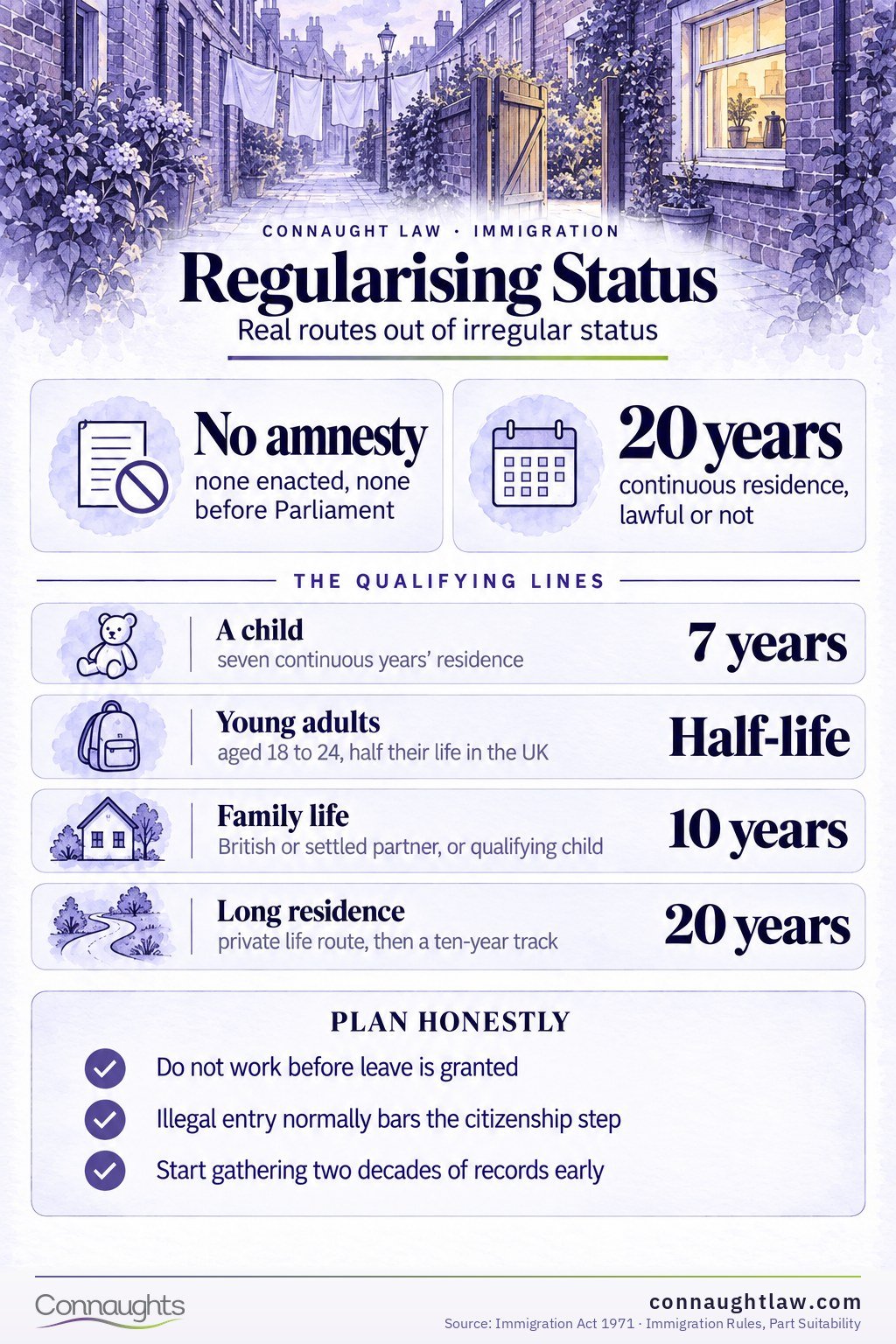
The Amnesty Question
Political announcements about routes and schemes are proposals until they appear in the Immigration Rules. Nothing resembling a general amnesty has been laid before Parliament, and every current regularisation path runs through rules that already exist.
No UK government has enacted a general amnesty, and none is before Parliament — policy announcements and consultation noise notwithstanding. Treat "amnesty 2026" content online as the traffic bait it is: the danger is not just disappointment but timing, because waiting for an amnesty that never comes costs years that the 20-year and family rules would have counted. The real question for any individual is which existing rule their life already satisfies.
A Bar at the Citizenship Step
Journeys That Bar Citizenship
Entry Method and Citizenship
Since 10 February 2025, the good character guidance has directed that citizenship applications from people who entered the UK illegally — particularly via dangerous journeys such as small boat crossings — will normally be refused, regardless of how much time has passed or what status was later granted. The bar operates at naturalisation, not before: leave and settlement remain reachable, but the final step to a British passport is barred by default, with discretion only at the margins. Anyone planning a regularisation strategy should plan around that ceiling honestly from the start.
The 20-Year Rule
Continuous Residence and Absences
Twenty years' continuous residence — lawful or not — qualifies an applicant for leave on the private life route, beginning a ten-year track to settlement. Continuity survives short absences but breaks on removal or lengthy departure, and the evidence burden is the route's real test: two decades of life documented through tenancies, medical records, work history and witnesses. Gaps in the paper trail, and how breaks in leave interact with the count, are the territory of our breaks in leave guide.
Family Routes
Partner and Parent Ten-Year Tracks
Overstayers with genuine relationships to British or settled partners, or parental relationships with qualifying children, regularise through the family ten-year tracks — EX.1's insurmountable obstacles and reasonableness tests carrying the cases the five-year route's status requirements exclude. Fee waivers under the principles in our fee waiver guide keep the route open to families the fees would otherwise bar, and discretionary leave — covered in our discretionary leave guide — catches compelling cases outside every rule.
Children's Routes
The Reasonableness Assessment
A child with seven continuous years' residence anchors the family's strongest regularisation case: where it would not be reasonable to expect the child to leave, the child qualifies — UK-born children directly for settlement — and parents follow on the parent route. The assessment weighs the child's schooling, integration and real-world alternatives, with the full framework in our 7-year child rule guide.
Young Adults
Applicants aged 18 to 24 who have spent at least half their life in the UK qualify under the half-life provisions — residence counted whether lawful or not — on a five-year track with early settlement discretion in strong cases, as our early ILR concession guide details. Between the children's rules, the half-life provisions and the 20-year rule, most long-irregular lives eventually cross a qualifying line; the craft is filing when the line is actually crossed, with the evidence assembled — the work of our settlement team and, where protection claims run alongside, our human rights and asylum team.
Frequently askedQuestions about regularisation
Is there an amnesty for overstayers in the UK in 2026?
No — no general amnesty exists or is before Parliament. Regularisation happens through specific rules: 20 years' residence, family life with British partners or children, the 7-year child rule, and the half-life provisions for young adults.
How can an illegal immigrant become legal in the UK?
By qualifying under an existing route: long residence (20 years), a genuine relationship with a British or settled partner, parentage of a qualifying child, seven years' residence as a child, or half a lifetime here as a young adult — each with its own evidence demands.
What is the February 2025 citizenship bar?
Guidance directing that naturalisation is normally refused for people who entered the UK illegally by dangerous journey, however long ago. It bars the citizenship step, not leave or settlement — plan any regularisation strategy with that ceiling in view.
Does unlawful residence count toward the 20-year rule?
Yes — the 20-year count includes unlawful residence, which is the rule's purpose. The challenge is proof: two decades evidenced through records most people never thought to keep. Start assembling them years before applying.
Can I work while regularising my status?
Not before leave is granted — working without permission remains an offence and a suitability risk that can damage the very application being built. Once leave is granted on a family or private life route, work is generally permitted.
Do fee waivers apply to regularisation applications?
Yes — human rights-based applications (family and private life) carry fee waiver eligibility where the fee is genuinely unaffordable, evidenced through full financial disclosure. Settlement applications themselves are excluded.
Tell us the timeline — arrival, family, children, work. We'll identify which qualifying line your life has already crossed and build the evidence for it.
Get Expert Advice