
Young adults who have spent half their lives in the UK hold one of the private life rules' most valuable and least-known positions: the half-life provisions, which cut the road to settlement from ten years to five. The cases turn on arithmetic and archives: proving the years, and showing the integrated life they built. This guide covers the framework, the half-life rule, evidence, and timing.
On This Page

Settlement for Lives Already Lived Here
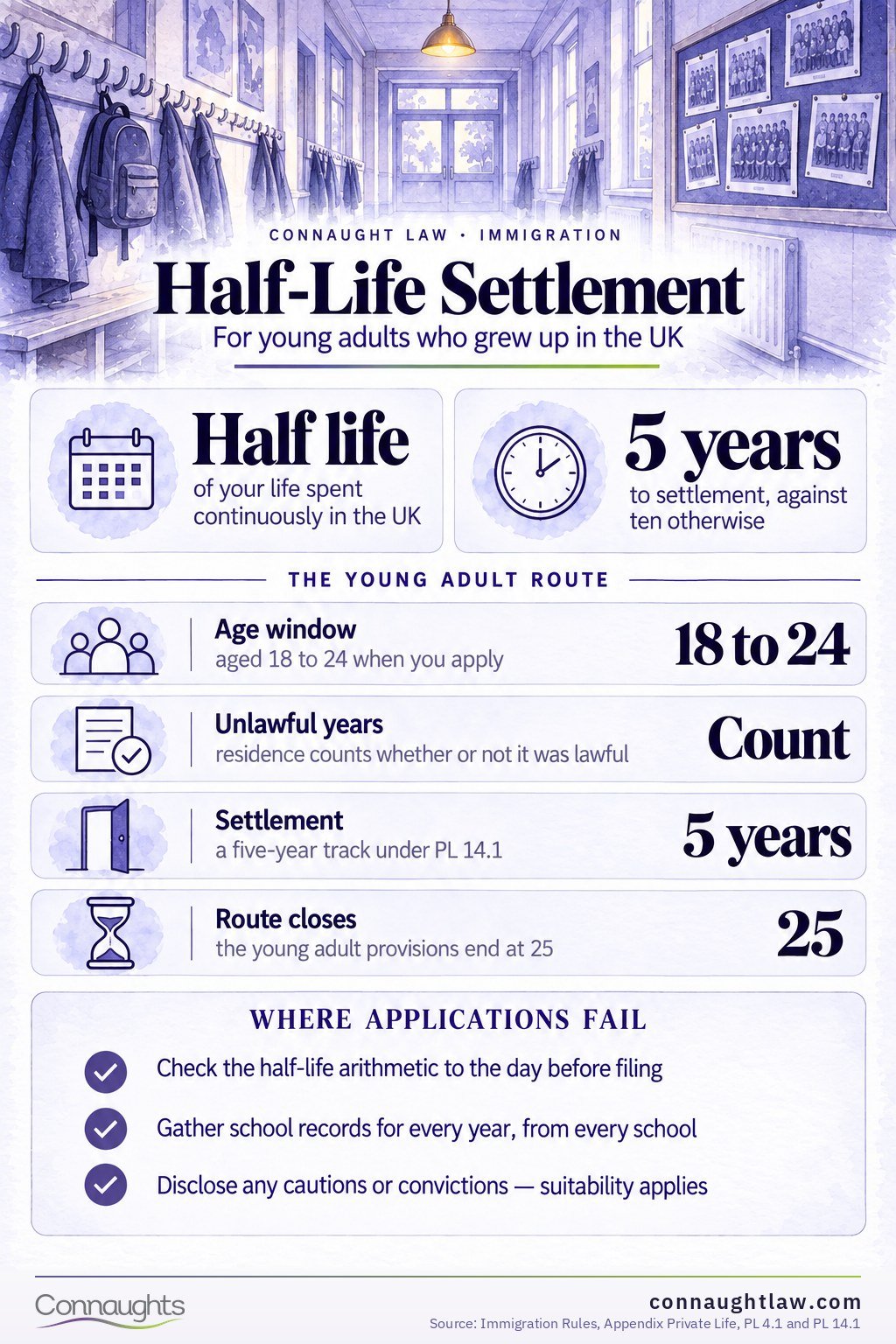
Young adults aged 18 to 24 who have spent more than half their lives continuously in the UK settle in five years under Appendix Private Life, against the ten an adult would otherwise serve. The fraction counts residence, not lawful residence, so childhoods spent here without status count in full. Everything then turns on whether the years can be evidenced — school records above all — and on filing once the arithmetic actually works.
Policy Framework
Appendix Private Life recognises what removal statistics long showed: young people who grew up in the UK are, in every sense but paperwork, from here. The framework gives 18-to-24-year-olds who have spent at least half their life in the UK a route to leave under PL 4.1 and a five-year track to settlement under PL 14.1, against the ten years an adult would otherwise serve under PL 14.2. The rules and the residence guidance frame it; the caseworking turns on the life evidenced.
The Half-Life Rule
The gateway is arithmetic: at the application date, more than half the applicant's life spent continuously in the UK — a 22-year-old needs eleven years and a day. The count is residence, not lawful residence, which is the provision's whole mercy: childhoods spent here without status count in full. Precision matters at the margins, and applications filed weeks before the fraction tips are the avoidable tragedy of this route.
Eligibility Criteria
Beyond the fraction: age 18 to 24 at application, continuous residence (short absences tolerated on ordinary principles), and suitability — the conduct grounds apply here as everywhere. Those who miss the age window or the fraction are not without options: the 7-year child rule serves the younger cohort, and the wider private life and regularisation routes the older.
Applying and Evidence
Documenting the Years
The evidence is a childhood reconstructed on paper: school enrolment and reports year by year, GP and NHS records, and the informal record — clubs, certificates, photographs with dates — filling institutional gaps. Education records are the backbone because they are contemporaneous, dated and independent; start gathering them from every school attended before the application needs them.
Processing and Decision-Making
Private life applications decide on human-rights-route timescales — months, without a short published standard — and recent caseworking has consolidated around the codified rules rather than the older concession-based discretion they replaced. The practical effect is predictability: meet the codified requirements with clean evidence and the grant follows; miss them and the fallback is PL 5.1(b)’s very significant obstacles test, which is far harder to evidence.
Why It Matters
Education and Career Effects
Status transforms the early twenties: home fee status and student finance for university, the right to work without restriction, and the end of the renewal cycle's cost and anxiety at exactly the age decisions compound. For many applicants the route's value is measured in the degree started on time.
Long-Term Outcomes
Settlement opens citizenship twelve months later, and the sequence — leave, ILR, naturalisation — resolves in the twenties what would otherwise shadow decades. Families should note the sibling effects too: one child's route often illuminates the whole household's options, which is where our settlement team starts.
Common Errors
Avoiding Application Mistakes
- Filing before the half-life fraction is actually crossed — check the arithmetic to the day.
- Evidence gaps in the school-age years that records requests could have closed.
- Ignoring suitability: undisclosed cautions or convictions surfacing in checks.
- Missing the age window by delaying past the 25th birthday.
- Treating fee waivers as automatic rather than evidencing unaffordability properly.
Financial and Maintenance Standards
The route carries no income threshold, but fee and surcharge costs are real, and fee waiver applications need genuine financial evidence — bank statements, household income, outgoings. A waiver refused for thin evidence delays the substantive application at the age when delay costs most.
Timing for Success
The window is 18 to 24 and the fraction improves with every year resident — but waiting also spends the window. The disciplined approach: compute the earliest qualifying date, assemble the records in the months before it, and file promptly once the arithmetic and the evidence agree; our immigration team runs that computation with the records requests in parallel.
Frequently askedQuestions about the young adult route
What is the half-life rule?
The requirement that an applicant aged 18 to 24 has spent at least half their life continuously resident in the UK — eleven years and a day for a 22-year-old. Residence counts whether or not it was lawful.
Can I get ILR early under this route?
Not earlier than five years. Appendix Private Life sets no discretion to shorten it. The concession is the five-year track itself under PL 14.1 — half the ten years an adult on the private life route serves under PL 14.2.
What if I am over 24?
The young adult provisions close at 25, but private life and long residence routes continue — 20 years' residence, or significant obstacles to integration elsewhere. The evidence you gathered for this route serves those too.
Does unlawful residence count toward the half-life fraction?
Yes — the fraction counts actual residence, which is the provision's point. Suitability still applies separately: conduct, not historic status, is what can complicate an otherwise qualifying application.
What evidence proves a childhood in the UK?
School records above all — enrolment, attendance, reports for every year — plus NHS registration and the dated informal record. Request school archives early; closures and record retention limits make old years the hardest to prove.
Is there a fee for young adult private life applications?
Standard application fees and the health surcharge apply, with fee waivers available where genuinely unaffordable — evidenced, not asserted. Settlement itself, when reached, carries the £3,226 fee and no surcharge.
Tell us your age, arrival and schools. We'll run the half-life arithmetic to the day, chase the records, and file when the numbers first work.
Get Expert Advice