
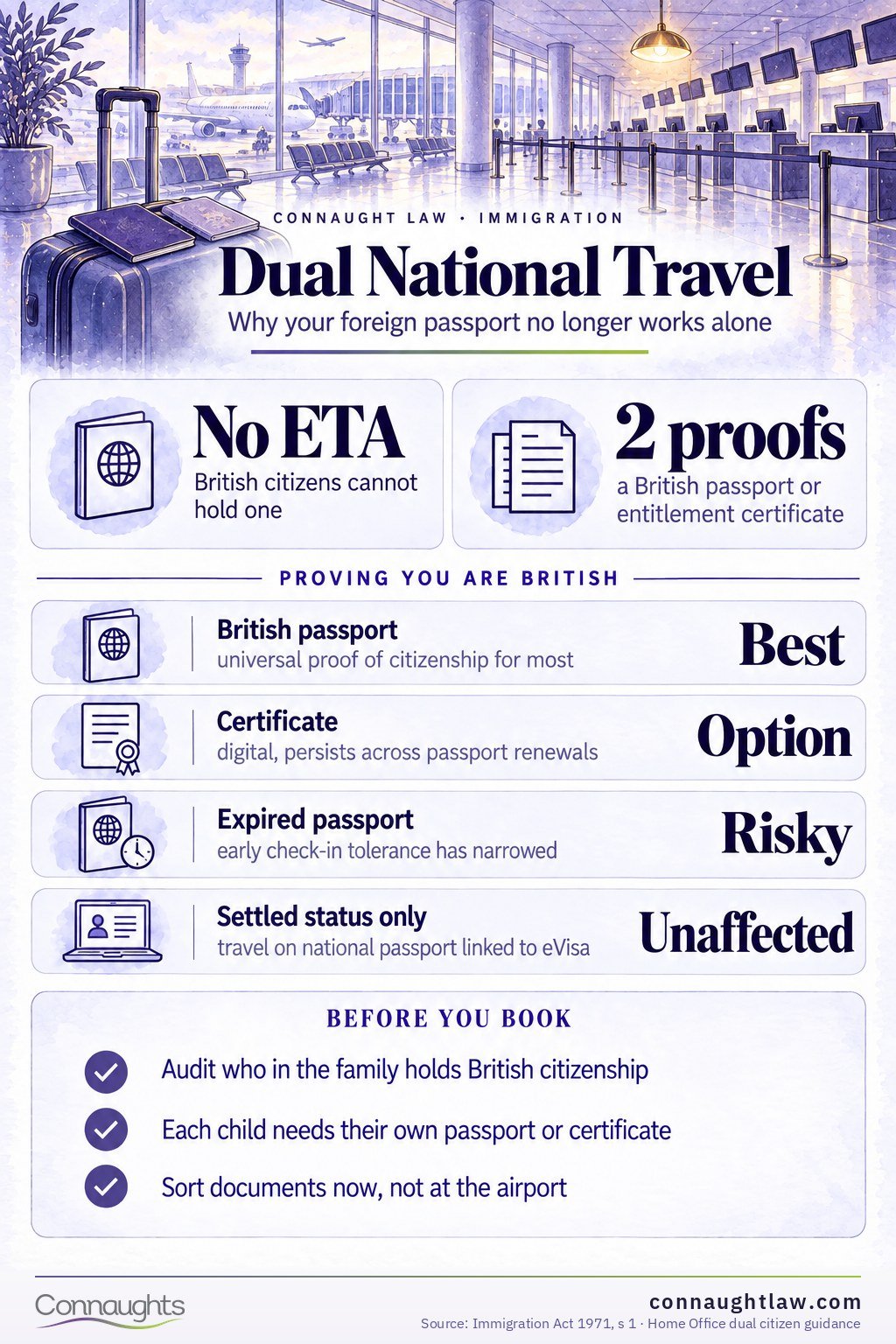
The ETA system quietly rewrote travel for British dual nationals: a British citizen cannot hold an ETA, so the foreign passport that used to board flights to the UK no longer works on its own. The choice is now a valid British passport or a £589 certificate of entitlement in the foreign one. This guide covers what changed, who is caught, the transitional concessions, the legal arguments, and the practical steps to take before your next booking.
On This Page

One Citizenship Too Many for the ETA
Under section 1 of the Immigration Act 1971, British citizens enter the UK as of right — they are outside immigration control and therefore outside the ETA scheme built for visitors. The system's logic is airtight and its consequence awkward: a dual national's foreign passport belongs to a person who cannot be granted an ETA, so carriers checking authorisation electronically find nothing to check. Proof of the British side — passport or certificate — became mandatory the day the scheme covered your other nationality.
What Changed
Before ETAs, dual nationals travelled on whichever passport was convenient — a German or American document boarded a London flight with no visa and no questions. The ETA rollout closed that informality nationality by nationality, and the Home Office's own guidance for dual citizens is blunt: British citizens must prove their right to travel with a British passport or a certificate of entitlement, because the ETA system will refuse them by design, not by error.
Who Is Affected
Groups Needing Immediate Action
- British-Europeans who have always travelled on the EU passport and let the British one lapse — or never held one.
- Naturalised citizens whose foreign passport remains their working document.
- British citizens by descent living abroad, whose citizenship exists on paper but has never been documented.
- Children of dual-national families holding only the foreign passport.
Passport or Certificate
Choosing Between the Two Proofs
A British passport costs less than the alternative and doubles as universal proof of citizenship — for most people, renewing or obtaining one is the answer. The £589 certificate of entitlement, now digital and persisting across passport renewals, suits the minority with real reasons to avoid a British passport: countries whose nationality law penalises its use, professional constraints, or personal circumstances. The wrong answer is neither — booking travel on an undocumented citizenship and hoping the airline improvises.
Transitional Rules
The rollout's early phases tolerated the gap: carriers were guided to accept evidence of British citizenship — including recently expired British passports — while dual nationals caught mid-transition made arrangements. That tolerance was a bridge, not a policy, and it has narrowed as the scheme matured; anyone still relying on an expired passport or a verbal explanation at check-in is trading on discretion that can be withdrawn between booking and boarding. Treat the concession era as over and document the citizenship properly.
Legal Challenges
Fairness and Legitimate Expectation
The strongest criticisms are administrative rather than constitutional: a change of this practical weight arrived through scheme design and carrier guidance rather than any measure debated as a rule for British citizens, and people who organised their lives around passport-choice freedom had little notice to adjust. Those arguments frame complaints and individual remedies; they have not stopped the scheme.
Discrimination Arguments
Commentators — including in the Commons Library's analyses of the ETA scheme — have noted the differential burden on dual nationals by national origin: the cost of proving Britishness falls only on those who hold it alongside something else. As a legal challenge the argument faces the usual immigration-context headwinds; as a policy critique it is why fee levels and the certificate's design remain under pressure.
Proportionality
The individual-level question — whether £589 or a passport application is a proportionate toll on exercising an existing right — matters most where it collides with urgent travel: family emergencies with no time for either process. Those cases are where challenge and complaint have traction, and where our judicial review team and appeal rights guide come into play.
What to Do Now
Audit the family's documents this month, not at the airport: identify who holds British citizenship, what proves it, and which documents are current. Renew or apply for British passports on normal timescales, or start the certificate process where that is the better fit. EU-national families should read this alongside their EU Settlement Scheme position — settled status and citizenship are different answers to the ETA problem, as our citizenship guide for EU nationals explains — and travel document holders have their own regime in our travel documents guide, with the wider status map in our settlement routes guide.
Frequently askedQuestions about the dual national rules
Can a British dual national get an ETA on their foreign passport?
No — British citizens are outside immigration control and cannot hold an ETA. The system refuses them by design, so the foreign passport alone no longer boards a UK-bound flight.
What are my options if my British passport has expired?
Renew it, or obtain a £589 digital certificate of entitlement in your foreign passport. Early-rollout tolerance for expired passports at check-in has narrowed — do not build travel plans on it.
Which is better — British passport or certificate of entitlement?
The passport, for most people: cheaper, universally recognised, and useful beyond UK travel. The certificate suits those whose other nationality or circumstances make carrying a British passport genuinely problematic.
Do children of dual-national families need their own proof?
Yes — every traveller documents their own status. A child holding only the foreign passport needs either a British passport or a certificate, and family bookings fail on the one child nobody documented.
I have EU settled status — does this affect me?
Not unless you are also British. Settled status holders travel on their national passport linked to their eVisa. The dual-national rules bite only once you naturalise — at which point your proof becomes the British passport or certificate.
Can the ETA rules for dual nationals be challenged?
Fairness, discrimination and proportionality arguments exist and have force as policy critique, but none has stopped the scheme. Individually, the practical remedy is documentation; challenge matters mainly in urgent-travel cases where the system's rigidity causes real harm.
Tell us who is travelling, what each passport says and when you fly. We'll pick the fastest compliant proof for each family member — before the airline picks for you.
Get Expert Advice