
Most UK visa refusals carry no right of appeal at all. Whether you have one turns on what you claimed rather than on what you applied for: refuse a human rights or protection claim and an appeal follows, refuse a visit, work or study application and it does not. Getting that distinction right on the day the refusal arrives decides whether the next fourteen days matter, or whether you should be doing something else entirely.
On This Page

Whether You Have an Appeal at All
Appeal rights were narrowed sharply by the Immigration Act 2014, and what remains is a short statutory list rather than a general right to challenge a refusal. Section 82 of the Nationality, Immigration and Asylum Act 2002 sets it out: the refusal of a protection claim, the refusal of a human rights claim, and the revocation of protection status. Everything else is challenged by another route, or not at all.
This matters more than it sounds, because the deadline runs from the decision and not from the day you work out what to do about it. Fourteen days inside the UK is not long to establish whether you have an appeal, an administrative review, or nothing.
Quick answer — which refusals carry an appeal
If your application was refused as a human rights claim — most family and private life applications — or as a protection claim, you have an appeal to the First-tier Tribunal. If it was a visit, student, work or most points-based refusals, you do not: the route is administrative review, and beyond that judicial review. EU Settlement Scheme refusals have their own appeal right.
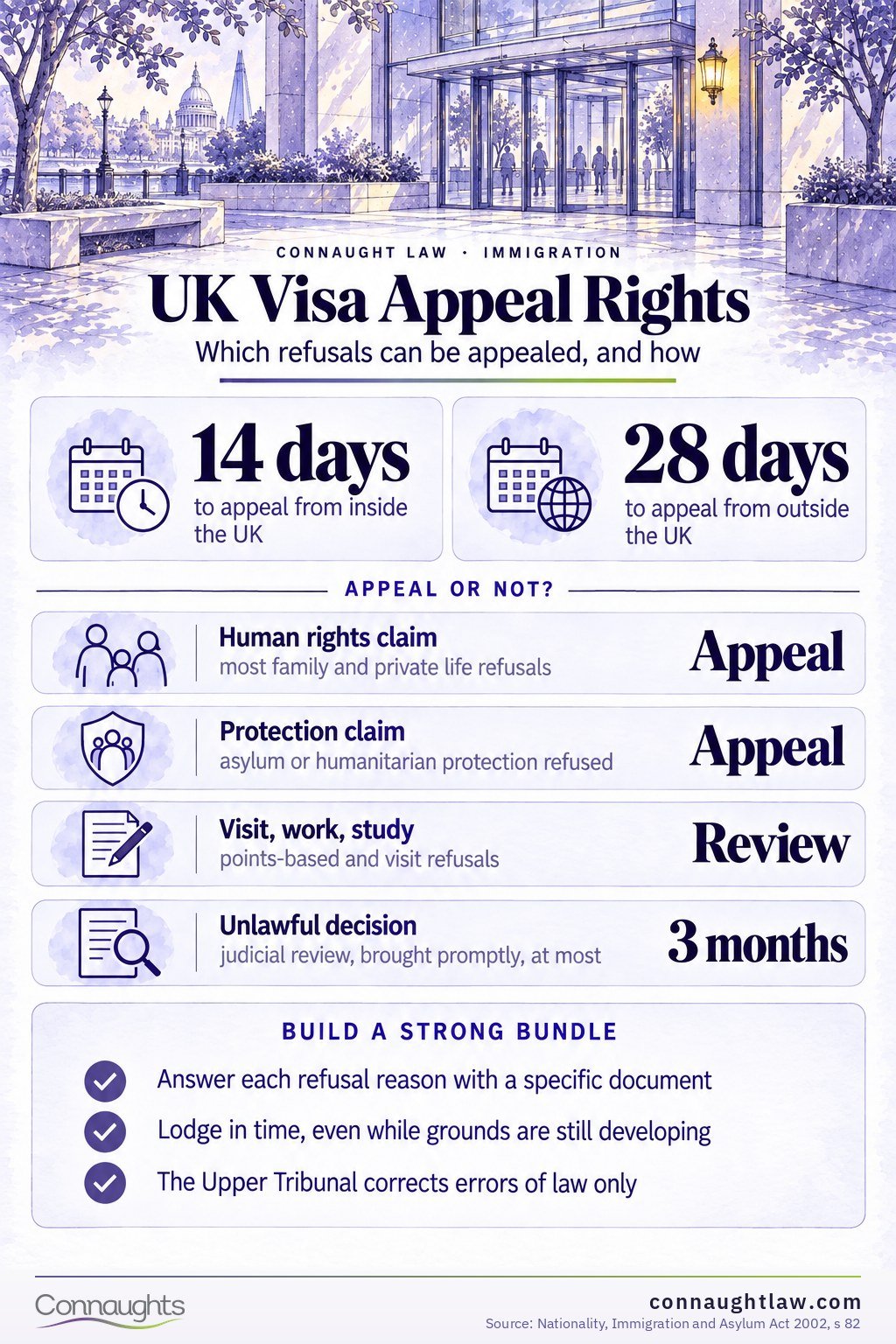
Decisions That Carry a Right of Appeal
The statutory list is short and worth reading literally. What triggers the right is the nature of the claim refused, not the label on the application form, so an application that raises Article 8 family life will usually attract an appeal even where the underlying route is not obviously a human rights route.
Human Rights and Protection Claims
Refusal of a protection claim — asylum or humanitarian protection — carries a right of appeal, as does refusal of a human rights claim and revocation of protection status. In practice this covers spouse and partner applications, parent and child applications, private life applications, and any refusal where the Home Office has considered and rejected an Article 8 case. Where the claim was made in the UK, the appeal is usually in-country and suspends removal.
Settled Status and Deprivation Decisions
EU Settlement Scheme decisions carry their own appeal right, created separately from section 82, and late applications are a common source of them — our guide to EU Settlement Scheme late applications covers the reasonable grounds test that usually decides them. Deprivation of citizenship decisions are also appealable, and certification of a claim as clearly unfounded removes the in-country appeal rather than the appeal itself, which is the subject of our note on section 94 certification.
When There Is No Appeal
The larger category is the one with no appeal. Recognising it quickly is the single most valuable thing you can do with a refusal letter, because the alternatives have their own short deadlines and pursuing the wrong one exhausts them.
Visit, Work and Study Refusals
Visit visa refusals, student refusals, skilled worker and other points-based refusals, and most entry clearance decisions carry no right of appeal. The refusal letter will say so, usually in a short paragraph near the end that is easy to miss. A refusal that engages no human rights claim leaves the tribunal with no jurisdiction, however unreasonable the decision looks.
What You Use Instead
Three routes cover almost everything else, and they are distinct processes with distinct tests rather than variations on one theme.
Deadlines — the dates that end a case
- Appeal to the First-tier Tribunal — 14 days from the decision if you are in the UK, 28 days if you are outside it.
- Administrative review — the route for caseworking errors in points-based and visit refusals, on a much shorter clock.
- Judicial review — for unlawfulness rather than error of fact, promptly and in any event within three months.
- Fresh claims — where new material has emerged since the last refusal was decided.
- Reapplying — often faster and cheaper than any of the above where the refusal turned on missing evidence.
Visit visa refusals sit in their own category and are worth reading about separately, because the practical answer is usually a better second application rather than a challenge: see our guide to challenging a visit visa refusal.
Lodging the Appeal in Time
The mechanics are straightforward and the deadlines are not forgiving. Rule 19 of the Tribunal Procedure (First-tier Tribunal) (Immigration and Asylum Chamber) Rules 2014 requires notice of appeal within 14 days of being sent the decision where the appellant is in the UK, and within 28 days where the appellant is outside it or has since left — see rule 19 itself.
Deadlines and How to File
An appeal lodged late is not automatically dead — the tribunal may extend time — but you must explain the delay, and the explanation has to be better than not having taken advice. Lodge within the deadline even if the grounds are still being developed; grounds can be amended, a missed deadline has to be excused.
The Online Appeal Service
Appeals are filed through the HM Courts and Tribunals Service online appeal service, with paper and email filing retained for cases the online route cannot take. The online route is faster and gives a clearer record of the filing date, which matters when the date itself may be in issue. Representatives use the MyHMCTS portal for the same process.
Building the Appeal Bundle
The bundle is where appeals are won. It should contain the decision under appeal and the original application, the grounds, a witness statement from the appellant and from any sponsor, and the documentary evidence answering each reason for refusal in turn. Country evidence belongs in protection appeals; financial and relationship evidence belongs in family appeals.
Bundle discipline — what persuades a judge
Take the refusal letter, list every reason given, and answer each one with a specific document and a paragraph of the witness statement that explains it. A judge reading a paginated, indexed bundle that tracks the refusal reasons is being led through the case; a judge reading an undated pile of documents is being asked to build it themselves. Evidence that post-dates the decision is generally admissible in human rights appeals, so gaps identified at refusal can still be filled.
How Often Appeals Succeed
Appealing is not a formality, but nor is it a long shot. The published figures are better than most people expect, and they are the right starting point for deciding whether to spend money on a challenge or on a fresh application.
What the Tribunal Statistics Show
In the Tribunal Statistics Quarterly for January to March 2026, the Immigration and Asylum Chamber received around 15,000 appeals and disposed of around 15,000. Of the 7,000 cases actually determined at a hearing or on the papers, 39% were allowed. That is a materially different picture from the one refusal letters imply.
Why Representation Changes the Odds
The statistics do not break outcomes down by whether the appellant was represented, so no honest figure can be given for the difference representation makes. What can be said is what the 39% figure conceals: appeals are allowed on the evidence before the tribunal, not on the evidence that was before the caseworker, and assembling that evidence is the work. An appeal that adds nothing to the refused application usually fails.
Waiting Times and the Open Caseload
The same release records an open caseload of about 152,000 cases and a mean time to clear an appeal of 61 weeks — eleven weeks longer than the same quarter a year earlier. Those two figures should shape the decision more than the success rate does.
61 weeks — plan around the wait
A year or more between lodging and hearing changes what a client should do in the meantime. Where an appeal is in-country and suspends removal, the wait is generally tolerable. Where it is out-of-country, or where a family is separated, a fresh and better-evidenced application can reach an answer long before a listed appeal does, and the two are not mutually exclusive.
Taking It to the Upper Tribunal
An unsuccessful appellant does not get a second hearing on the facts. The Upper Tribunal exists to correct errors of law, and an application that simply disagrees with the judge's findings will be refused permission.
Error of Law, Not a Second Go
Recognised errors of law include misapplying the Immigration Rules or the statutory tests, failing to give adequate reasons, making a finding no reasonable judge could have made on the evidence, taking irrelevant matters into account, or a procedural irregularity that produced unfairness. Fresh evidence that could have been produced at the hearing is not a ground.
Error of law — the Upper Tribunal test
Draft the grounds against the determination, paragraph by paragraph, identifying what the judge did rather than what you wish the outcome had been. A ground that begins "the judge failed to give any reasons for rejecting" is arguable; one that begins "the judge was wrong to prefer" is usually not. Where an error is found, the Upper Tribunal may remake the decision itself or send the case back.
Applying for Permission
Permission is sought first from the First-tier Tribunal, on a short clock that runs from when the decision was sent. If it refuses, the application can be renewed to the Upper Tribunal itself. Both stages are on the papers, and both turn on the quality of the grounds rather than on any further evidence, which is why the drafting is worth doing properly.
Fees, Costs and Timing
The direct cost of appealing is modest; the indirect cost is the wait. Both should be set against the cost of a fresh application, which for many refused applicants is the better answer.
Paying the Tribunal Fee
A fee is payable to lodge an appeal: £82 where a judge decides it on the papers and £144 where there is a hearing, both from 13 July 2026. Protection appeals and some other categories are exempt, and remission is available on means through Help with Fees — the current amounts and the eligibility criteria are on gov.uk. Check the fee before filing, because an unpaid fee can stop the appeal being treated as validly lodged.
What Representation Costs
Immigration appeals are not generally within the scope of legal aid, though protection cases and some others are. We do not publish hourly rates; our fees page explains how we cost this work, and our immigration appeals service sets out what representation covers. Where a refusal turned on a missing document, the honest advice is often that a fresh application costs less than an appeal and arrives sooner.
Planning Around the Delay
Assume a year or more from lodging to hearing, and plan the intervening period deliberately: keep evidence current, update witness statements as circumstances change, and tell the tribunal promptly about anything that alters the case. Where the delay itself causes hardship, that can sometimes be raised, but it is not a route to an earlier listing on its own.
If the refusal is one with no appeal, the alternatives are set out above; if it is a refusal of a work or study application, our visa refusal service and our judicial review service are the two starting points.
Frequently askedQuestions about UK visa appeals
How do I know whether I can appeal?
Read the last section of the refusal letter, which states whether a right of appeal exists and the deadline. If it says administrative review instead, there is no appeal. The test is whether a human rights or protection claim was refused, not which visa you applied for.
How long do I have to lodge?
Fourteen days from being sent the decision if you are in the UK, and twenty-eight days if you are outside it or have since left. The tribunal can extend time, but you must explain the delay and not having taken advice is rarely enough.
What proportion of appeals succeed?
In the January to March 2026 quarter, 39% of the 7,000 immigration and asylum cases determined at a hearing or on the papers were allowed. That is the published figure for all categories combined, not a prediction for any individual case.
How long will I wait for a hearing?
The mean time to clear an appeal was 61 weeks in the January to March 2026 quarter, eleven weeks longer than a year earlier, against an open caseload of around 152,000. Plan on a year or more rather than months.
Can I submit new evidence on appeal?
In human rights appeals the tribunal generally considers the position at the date of hearing, so evidence that post-dates the refusal is usually admissible. That is why an appeal bundle should answer the refusal reasons rather than simply repeat the original application.
Is appealing better than applying again?
Not always. Where the refusal turned on a document you can now supply, a fresh application is usually cheaper and much faster than waiting a year for a hearing. Where the Home Office has rejected your case on its merits, an appeal is the route.
Send us the refusal letter and the original application. We'll tell you whether there is an appeal, what the deadline is, and whether appealing or reapplying is the better use of your money.
Get Expert Advice