
A fresh claim is a narrow thing. Paragraph 353 of the Immigration Rules applies only where a human rights or protection claim has already been refused and every appeal is finished, and it asks one question: are the new submissions significantly different, and do they create a realistic prospect of success. It has nothing to do with work or study refusals, whatever else you may have read.
On This Page

What a Fresh Claim Really Is
When a protection or human rights claim has been refused and the appeals are over, the person is described as appeal rights exhausted. Further submissions can still be made. What paragraph 353 decides is whether those submissions are treated as a new claim — which would carry a fresh right of appeal if refused — or simply as representations, which would not.
Quick answer — who this applies to
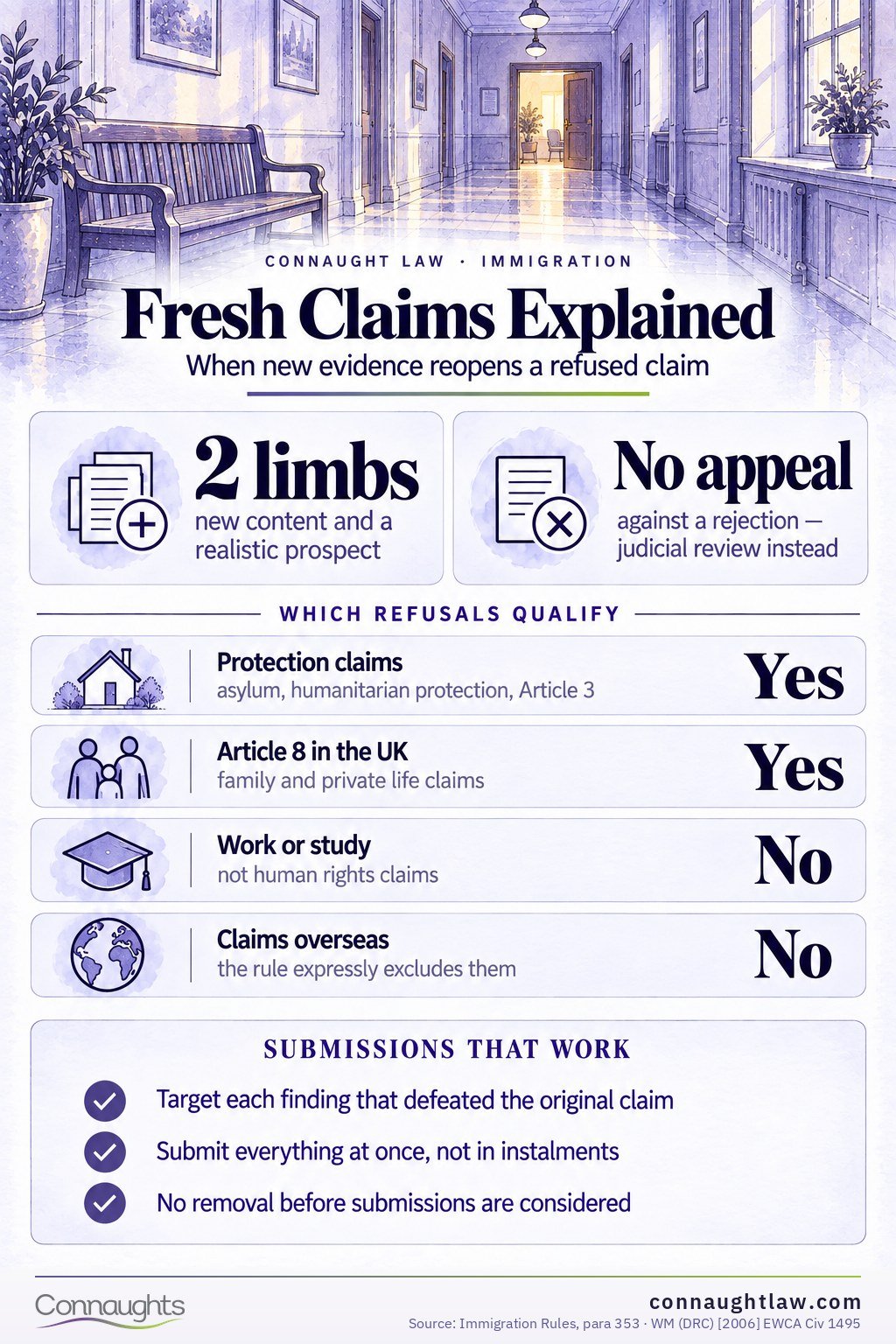
Only people whose human rights or protection claim has been refused, or withdrawn, with no appeal outstanding. It does not apply to claims made overseas, and it does not apply to refusals of work, study or visit applications — those are not human rights claims and there is no paragraph 353 route for them. If the submissions are rejected as not amounting to a fresh claim, there is no appeal; the remedy is judicial review.
Paragraph 353 in Full
Because so many people search for the rule itself rather than a paraphrase of it, here is the current text as it stands in Part 12 of the Immigration Rules.
Paragraph 353 — the rule as it reads
"When a human rights or protection claim has been refused or withdrawn or treated as withdrawn under paragraph 333C of these Rules and any appeal relating to that claim is no longer pending, the decision maker will consider any further submissions and, if rejected, will then determine whether they amount to a fresh claim.
The submissions will amount to a fresh claim if they are significantly different from the material that has previously been considered. The submissions will only be significantly different if the content: (i) had not already been considered; and (ii) taken together with the previously considered material, created a realistic prospect of success, notwithstanding its rejection. This paragraph does not apply to claims made overseas."
The Two-Part Test
The two limbs are cumulative and they do different work. Limb (i) asks whether the content has already been considered — a document the Home Office has seen before fails at this stage however strong it is. Limb (ii) asks whether the material, taken with everything that came before, creates a realistic prospect of success before a judge applying anxious scrutiny.
Two conditions — both must be met
- The content had not already been considered — genuinely new material, not a re-presentation of the old case.
- Taken with the earlier material, it creates a realistic prospect of success before a hypothetical judge applying anxious scrutiny.
- The threshold is not whether the claim would succeed. It is whether it might.
- The decision maker considers the submissions on their merits first, and only asks the paragraph 353 question if they are rejected.
The two questions come from WM (DRC) v SSHD [2006] EWCA Civ 1495, where Buxton LJ set out how the Secretary of State must approach the rule and how a court reviews it. A decision will be irrational if it is not taken on the basis of anxious scrutiny.
When the Rule Applies
Three conditions must be satisfied before paragraph 353 is engaged at all: the earlier claim was a human rights or protection claim, it has been refused or withdrawn, and no appeal relating to it is still pending. Submissions made while an appeal is outstanding are not further submissions — they belong in the appeal.
Which Refusals This Covers
This is where most of the confusion sits, and it is worth being blunt about it. Paragraph 353 is a protection and human rights provision. It is not a general second-chance mechanism for any refused visa application.
Protection and Human Rights Claims
Asylum, humanitarian protection and Article 3 claims are protection claims. Article 8 family and private life claims made in the UK are human rights claims. Both are within paragraph 353, and between them they account for essentially all genuine fresh claim work.
Work Routes Are Not Covered
A refused Skilled Worker, Innovator Founder or other sponsored application is not a human rights claim, so there is no fresh claim to make. The routes available are administrative review where the refusal offers it, judicial review where it does not, or — usually the best answer — a fresh application curing whatever the refusal identified. Our guide to administrative review sets out that route.
Family Applications and Article 8
Family applications are the one place the boundary genuinely blurs. A spouse or partner application refused inside the UK will usually have been considered as a human rights claim, in which case it carries an appeal — and once that appeal is exhausted, paragraph 353 applies to any further submissions. An entry clearance application refused abroad does not, because the rule expressly does not apply to claims made overseas. Our family visa team deals with both.
Study Routes and What to Do Instead
Student and Child Student refusals are outside paragraph 353 for the same reason work routes are. Administrative review is generally the offered remedy, and a corrected fresh application is usually faster than any challenge. Where the refusal engages private life built up over years in the UK, that is an Article 8 claim and the analysis changes — but it is the human rights element that brings it in, not the study route.
Evidence That Makes a Difference
Most rejected further submissions fail on limb (i): the material has been seen before, or is the same account told again. What succeeds is evidence that is genuinely additive and that goes to the reason the original claim failed.
Significantly Different, Not Merely New
A document created after the refusal is not automatically new content — a fresh letter restating what a previous letter said adds nothing. What counts is material addressing a finding that defeated the original claim: expert evidence on a country situation that has changed, medical evidence of a condition not previously diagnosed, documentary corroboration of an account the judge disbelieved for want of it, or evidence of a relationship or a child that did not exist before.
Credibility and Anxious Scrutiny
Where the original claim failed on credibility, the task is harder but not hopeless. In YH v SSHD [2010] EWCA Civ 116 Carnwath LJ described anxious scrutiny as "descriptive not of a legal principle but of a state of mind" — it requires reasoning that shows every factor in the applicant's favour was taken into account, but it "may work both ways" and does not require undue credulity towards a contrived account.
Evidence Types and Pitfalls
| Evidence | Why it can work | Common pitfall |
|---|---|---|
| Country expert report | Addresses a changed situation since the refusal | Generic report not tied to the individual's profile |
| Medical or psychiatric evidence | Diagnosis not previously before the decision maker | Repeats an earlier report without new findings |
| Relationship or child evidence | Facts that did not exist at the original decision | Asserted without documents or witness evidence |
| Documentary corroboration | Supplies what a judge found missing | Provenance unexplained, so weight is limited |
| New witness statement | Explains a point the tribunal misunderstood | Restates the account already disbelieved |
How to Lodge Further Submissions
The procedure changed materially in 2026, and this is the part most older guidance gets wrong. The requirement to attend in person is now written into the Rules themselves rather than sitting in policy.
The In-Person Appointment Rule
Protection further submissions must be made in person, by appointment, at a Service and Support Centre. Paragraph 353AA now carries that requirement, and paragraphs 353AB to 353AF.1 add validity conditions, grounds for rejecting submissions as invalid, rules on explicit and implicit withdrawal, and a duty to notify a change of address. The Further Submissions Unit is at Level 0, The Capital Building, Old Hall Street, Liverpool.
New since 2026 — the appointment requirement
Exceptions exist for unaccompanied children, people in detention, and those who cannot attend because of illness, childcare or a live judicial review. Human rights submissions are different again: they are made on the appropriate application form, such as FLR(FP) or FLR(O), rather than at an appointment. Check the current arrangements on gov.uk before travelling, because the list of centres has moved before.
What Happens Next
The decision maker considers the submissions on their merits. If they are accepted, permission follows. If they are rejected, the decision maker then asks the paragraph 353 question. Where the answer is yes, the refusal is a refusal of a fresh claim and carries a right of appeal. Where it is no, the submissions are rejected without an appeal. Under paragraph 353A a person who has made further submissions is not to be removed before the Secretary of State has considered them.
Outcomes and Recent Developments
Two things are worth knowing before deciding whether to make submissions: nobody can honestly tell you the odds, and the framework moved this year.
Why No Success Rate Is Published
The Home Office does not publish outcome statistics for further submissions, and no figure for the proportion accepted as fresh claims exists in any official release. Any percentage you find is an estimate. What determines the outcome is not a base rate but whether the material clears both limbs of the test, and that is assessable on the papers in front of you.
The Rules Changed in 2026
Part 12 was expanded rather than cut. Paragraph 353 itself survived the wider restructure of the Immigration Rules unchanged, but the new 353AA to 353AF.1 series added procedural requirements that did not previously exist in the Rules. Separately, paragraph 353B still requires the decision maker, once the fresh claim question is determined, to consider character, conduct and associations, compliance with conditions, and time spent in the UK for reasons beyond the person's control, in deciding whether there are exceptional circumstances making removal inappropriate.
Preparing Submissions That Work
Treat the exercise as answering a judgment rather than restating a case. Read the original refusal and the determination, list every finding that defeated the claim, and ask what evidence would now change each one. Material that does not go to one of those findings is unlikely to be significantly different however new it is.
Submit everything at once. Drip-feeding documents invites a decision on an incomplete picture, and each rejected set makes the next look like repetition. Explain in a covering submission why the material is new and which finding it addresses — the decision maker should not have to work that out.
If the Submissions Are Rejected
No appeal — judicial review instead
There is no right of appeal against a rejection of further submissions that do not meet the paragraph 353 test. The remedy is judicial review of that rejection, and the question for the court is whether the decision was reasonable and taken with anxious scrutiny. Our guide to immigration judicial review sets out the route, the three-month deadline and the costs risk.
Where the submissions do amount to a fresh claim and are refused, the position is different: that refusal attracts a right of appeal, covered in our guide to UK visa appeal rights, and our immigration appeals service explains how we run them.
Frequently askedQuestions about paragraph 353 and fresh claims
What is the test in paragraph 353?
Submissions amount to a fresh claim if they are significantly different from what has already been considered. They are only significantly different if the content had not already been considered and, taken with the earlier material, creates a realistic prospect of success.
Can I make a fresh claim after a work or student refusal?
No. Paragraph 353 applies only where a human rights or protection claim has been refused. For work and study refusals the routes are administrative review, judicial review, or a fresh application that cures the reason for refusal.
Do I have to attend in person?
For protection submissions, generally yes. Paragraph 353AA requires an in-person appointment at a Service and Support Centre. The limitation to protection grounds, and the exceptions for unaccompanied children, detention, illness and childcare, come from Home Office guidance rather than from the Rules themselves. Human rights submissions go on the relevant application form instead.
Can I appeal if my submissions are rejected?
Not against a rejection under paragraph 353 — there is no right of appeal. Judicial review is the remedy. If the submissions are accepted as a fresh claim and then refused, that refusal does carry a right of appeal.
Does old evidence count?
No. The first limb asks whether the content had already been considered. Material the Home Office or a tribunal has already seen fails at that point, however strong it seemed. It must be genuinely additional.
Can I be removed while submissions are pending?
Paragraph 353A provides that a person who has made further submissions is not to be removed before the Secretary of State has considered them. Take advice immediately if removal directions are set despite outstanding submissions.
Send us the refusal, the determination and what you now have. We'll tell you whether it clears both limbs of paragraph 353 and how it should be put.
Get Expert Advice