
Part 9 of the Immigration Rules no longer exists. Since 11 November 2025 the general grounds for refusal have sat in a new Part Suitability, numbered SUI, and for four family routes the change was more than cosmetic — they lost their own gentler suitability rules and now answer to the same code as everyone else. The substance of the criminality and deception grounds is largely unchanged; the numbering, the scope and the guidance are not.
On This Page

Part 9 Is Gone: What Replaced It
If you are working from a refusal letter, a precedent or a textbook that cites Part 9, it is out of date. The Part was deleted outright and a new Part Suitability inserted in its place, with paragraphs numbered SUI. Paragraph 39E went at the same time; the overstaying disregard it contained is now SUI 13.1.
Quick answer — the numbering changed, the substance mostly did not
The criminality thresholds, the deception grounds and the overstaying exception all carried over in materially the same terms. Two things did change: the family routes that previously had their own softer suitability rules now apply Part Suitability, and every cross-reference in the Rules and in caseworker guidance now points at SUI paragraphs. A refusal citing Part 9 on a decision made after 11 November 2025 is citing a rule that no longer exists.
Knowing the date matters for a practical reason. A decision made before it was governed by Part 9, and for the family routes brought newly inside Part Suitability the older and more generous rules are preserved for applications made earlier. So the first thing to establish about any suitability refusal is when the application was made, not simply when it was refused.
HC 1333 — the date and what it did
The restructure was made by statement of changes HC 1333, laid on 14 October 2025. Its change paragraphs read "9.1. Delete Part 9", "SUI.1. After the deleted Part 9, insert new 'Part Suitability'", "1.4 Delete paragraph 39E" and "1.5 Delete paragraph 39F". The Implementation section brings that group into force on 11 November 2025, with no transitional saving attached to it.
What Part Suitability Is
Part Suitability runs from SUI 1.1 to SUI 39.1 in five sections: application of the Part; grounds for refusing or cancelling entry clearance or permission; additional grounds on arrival in the UK; additional grounds relating to permission to stay; and further cancellation grounds. SUI 1.1 sets the scope, and it is worth reading literally because the exclusions matter.
SUI 1.1 provides that the Part "applies to all routes under these rules, except: (a) Appendix EU; and (b) Appendix EU (Family Permit); and (c) Part 11 (Asylum), except Part Suitability does apply to paragraphs 352ZH to 352ZS, and 352I to 352X; and (d) DELETED (e) Appendix Settlement Protection." EU Settlement Scheme applications therefore keep their own suitability code, and Appendix EU says separately that the overstaying exceptions in Part Suitability do not apply to it.
Routes That Newly Fall Inside It
This is the substantive change, and it is easy to miss in a document that looks like a renumbering exercise. Appendix FM, Appendix Private Life, Appendix Adult Dependent Relative and Appendix Settlement Family Life had their own suitability requirements, which the explanatory memorandum to HC 1333 describes as having "resulted in a more generous approach". Those bespoke rules were deleted and the routes now apply Part Suitability in full.
Unlike the deletion of Part 9 itself, this group does carry a transitional saving: applications made before 11 November 2025 are decided under the rules in force on 10 November. For anyone advising on a family application straddling that date, which version applies is the first question to settle.
Mandatory and Discretionary Grounds
The distinction runs through the whole Part. Where a ground is mandatory the decision maker has no discretion at all — the application must be refused. Where it is discretionary, the refusal is a judgement, and that judgement can be challenged on its reasoning in a way a mandatory refusal cannot.
Grounds That Require Refusal
SUI 2.1 requires refusal where the Secretary of State has personally directed exclusion, or the applicant is subject to an exclusion order or a deportation order. SUI 3.1 requires refusal where the applicant's presence "is not conducive to the public good because of their conduct, character, associations or other reasons (including convictions which do not fall within the criminality grounds)".
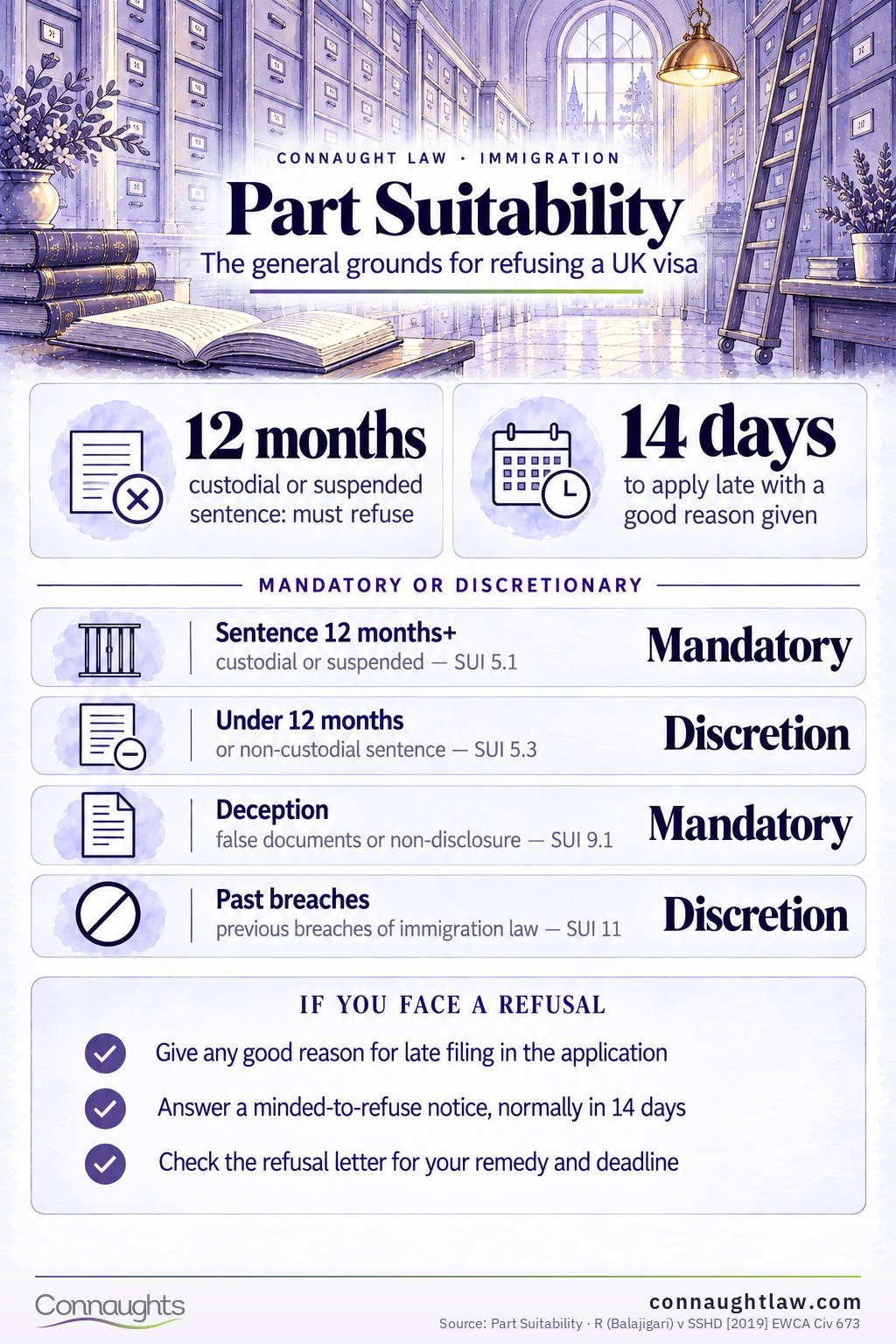
SUI 5.1 is the criminality ground, and it is the one that decides most cases. It requires refusal where the applicant "(a) has been convicted of a criminal offence in the UK or overseas for which they have received a custodial or suspended sentence of 12 months or more; or (b) is a persistent offender who shows a particular disregard for the law; or (c) has committed a criminal offence, or offences, which caused serious harm."
Twelve months — the line that decides most cases
- 12 months or more, custodial or suspended — mandatory refusal under SUI 5.1, mandatory cancellation under SUI 5.2.
- Under 12 months, or a non-custodial sentence or out-of-court disposal — discretionary under SUI 5.3 and SUI 5.5.
- Visitors and stays under six months — SUI 5.4 makes a sub-12-month sentence a mandatory refusal unless 12 months have passed since the sentence ended.
- A suspended sentence counts. This catches people who assume a sentence they never served is irrelevant.
- Persistent offending and serious harm are separate routes to a mandatory refusal with no sentence threshold at all.
Mandatory Refusal Grounds
| Ground | Paragraph | Trigger |
|---|---|---|
| Exclusion or deportation order | SUI 2.1 | Personal direction, exclusion order, or deportation order |
| Non-conducive conduct | SUI 3.1 | Conduct, character, associations or other reasons |
| Criminality | SUI 5.1 | 12 months or more, persistent offending, or serious harm |
| Criminality, short stays | SUI 5.4 | Sub-12-month sentence, visitors and stays under six months |
| Deception | SUI 9.1 | False representations, documents or information, or non-disclosure |
Where Refusal Is Discretionary
The discretionary grounds include sub-12-month criminality under SUI 5.3, false representations made "whether or not to the applicant's knowledge" under SUI 10.1, previous breaches of immigration law under SUI 11, failure to provide information, NHS debt, unpaid litigation costs and the medical grounds. Because these involve a judgement, the decision letter has to explain it — and a letter that recites the rule without engaging with the applicant's circumstances is vulnerable.
Deception Under SUI 9.1
SUI 9.1 requires refusal where the decision maker is satisfied that the applicant used deception "by: (a) making false representations or providing false documents or false information in relation to the application (whether or not relevant to the application); or (b) not disclosing relevant facts in relation to the application." The parenthesis matters: a false statement about something immaterial still engages the rule.
A deception finding does not end with the refusal. SUI 11.4(d) treats deception in a previous application as a breach of immigration laws, which triggers the mandatory refusal periods in SUI 12.1, and a finding of dishonesty is relevant to good character in any later citizenship application.
Balajigari and Minded to Refuse
The line between deception and error is the whole battleground, because SUI 9.1 requires the decision maker to be satisfied of deception — not merely of a discrepancy. An innocent mistake, a document completed badly, or a genuine misunderstanding is not deception, and the Home Office is expected to test that before deciding.
Minded to refuse — Balajigari in practice
The Part Suitability deception guidance published for caseworkers on 11 November 2025 quotes R (Balajigari) v SSHD [2019] EWCA Civ 673 and requires a "minded to refuse" notice where the implications of a deception finding are significant, or where the applicant may not know of the information relied on. The applicant is normally given 14 calendar days to respond. If you have been refused for deception without ever having been put on notice of the allegation, that is the first thing to look at.
Re-Entry Bans Under SUI 12.1
Where an applicant has previously breached immigration laws, SUI 11 identifies the breach and SUI 12.1 sets the period during which an application must be refused. The length turns on how the person left the UK and who paid for it — voluntary departure at your own expense attracts the shortest period, removal at public expense the longest, and deception its own period regardless of departure.
How Long the Ban Runs
The structure carried over from the old Part 9 unchanged, so periods calculated under the previous numbering still hold. What changed is the reference: a decision letter or a precedent citing paragraph 9.8.1 should now read SUI 12.1. Our guide to UK re-entry bans works through the periods and how they are counted.
Overstaying and SUI 13.1
Paragraph 39E was deleted by HC 1333 and its content re-enacted as SUI 13.1. The test is the same 14-day good-reason exception it always was, and periods that qualified under 39E qualify under SUI 13.1. Only the citation has moved.
SUI 13.1 — the exception in full
An applicant is not treated as an overstayer if their application was made within 14 days of their previous permission expiring and the decision maker considers there was a good reason beyond the control of the applicant or their representative, provided in or with the application, why it could not be made in time.
Alternatively, the exception applies where the application was made following the refusal or rejection of an in-time application and within 14 days of that refusal, the expiry of section 3C leave, the expiry of the time limit for an in-time administrative review or appeal, or the conclusion of such a review or appeal. Separate windows cover 24 January to 31 August 2020, the BN(O) window of 1 July 2020 to 31 January 2021, and 1 September 2020 to 28 February 2023 where covered by an exceptional assurance.
The 14-Day Exception in Full
A related but separate provision sits at SUI 11.5, which disregards a period of overstaying for the purposes of SUI 11.4(a) where the person left the UK voluntarily and not at public expense: 90 days or less where the overstaying began before 6 April 2017, 30 days or less where it began on or after that date, or any period to which SUI 13.1 applied. Our post on the former paragraph 39E traces how the provision developed and why the old number still appears everywhere.
Challenging a Suitability Refusal
What you can do depends entirely on what was refused, not on which suitability ground was used. The refusal letter states the remedy, and getting this wrong wastes the only deadline you have.
Which Remedy Applies
Where the refusal decided a human rights or protection claim, there is an appeal to the First-tier Tribunal. Where it refused a work, study or visit application, the route is usually administrative review — but note that administrative review only corrects caseworking error, so it is a poor fit for a disputed factual finding about deception. Where neither is available, judicial review challenges the lawfulness of the decision.
A discretionary refusal is generally more vulnerable than a mandatory one, because there is reasoning to attack. So is any deception refusal made without a minded-to-refuse process. If the refusal turned on an NHS debt, our guide to NHS debt and visa refusals covers that ground specifically, and our visa refusal service explains how we assess which route fits.
What the Guidance Says
Part Suitability is applied by caseworkers working from published instructions, and those instructions are more useful to an applicant than the rule text alone — they show how the discretion is actually exercised. A full set was published for Home Office staff on 11 November 2025, alongside the new Part, and they are on gov.uk with the Rules themselves.
Where Refusals Actually Come From
No statistics are published breaking visa refusals down by suitability ground, so nobody can tell you how often each is used and we are not going to estimate. What can be said from the rules themselves is where the risk concentrates: a suspended sentence the applicant did not think counted; an old conviction still inside a mandatory period; an inconsistency between an application and an earlier one being read as deception; and an overstay that would have been disregarded had the good reason been given in the application rather than afterwards.
That last point is worth emphasising because it is fixable. SUI 13.1 requires the good reason to be "provided in or with the application". An explanation offered after refusal is not what the rule asks for. Where a period of permission has been broken, our note on written notification of visa conditions covers when time actually starts running, and detention questions are dealt with in our guide to immigration bail.
Frequently askedQuestions about Part Suitability
What happened to Part 9 of the Immigration Rules?
It was deleted by statement of changes HC 1333 and replaced by a new Part Suitability, with paragraphs numbered SUI, in force from 11 November 2025. Paragraph 39E was deleted at the same time and its content is now SUI 13.1.
What is SUI 9.1?
The mandatory deception ground. An application must be refused where the decision maker is satisfied the applicant used deception by making false representations, providing false documents or information, or not disclosing relevant facts — whether or not the point was relevant to the application.
What is SUI 13.1?
The overstaying exception formerly at paragraph 39E. An applicant is not treated as an overstayer where the application was made within 14 days of permission expiring and a good reason beyond their control was given in or with the application, plus several dated windows.
Does a suspended sentence count?
Yes. SUI 5.1 refers to a custodial or suspended sentence of 12 months or more, so a suspended sentence at or above that length is a mandatory refusal. This surprises applicants who never served the sentence.
Do the family routes now use Part Suitability?
Yes. Appendix FM, Private Life, Adult Dependent Relative and Settlement Family Life lost their own suitability rules. Applications made before 11 November 2025 are decided under the previous, more generous provisions under a transitional saving.
Can I challenge a deception refusal?
Often yes, particularly where you were never given a minded-to-refuse notice. The guidance requires one where the implications are significant or you may not know of the information relied on, with normally 14 days to respond.
Send us the refusal letter and the application it decided. We'll tell you which SUI paragraph was actually used, whether it was mandatory or discretionary, and what remedy you have.
Get Expert Advice