
An unpaid NHS bill can cost you a visa, but not automatically and not at any amount. The rule is discretionary, the threshold depends on when the charge was incurred, and the case that catches most families is one the rule never mentions: a bill for a child born here. Under the charging regulations that debt belongs to the parent, and it lands on the parent's application.
On This Page

How NHS Debt Reaches an Immigration Decision
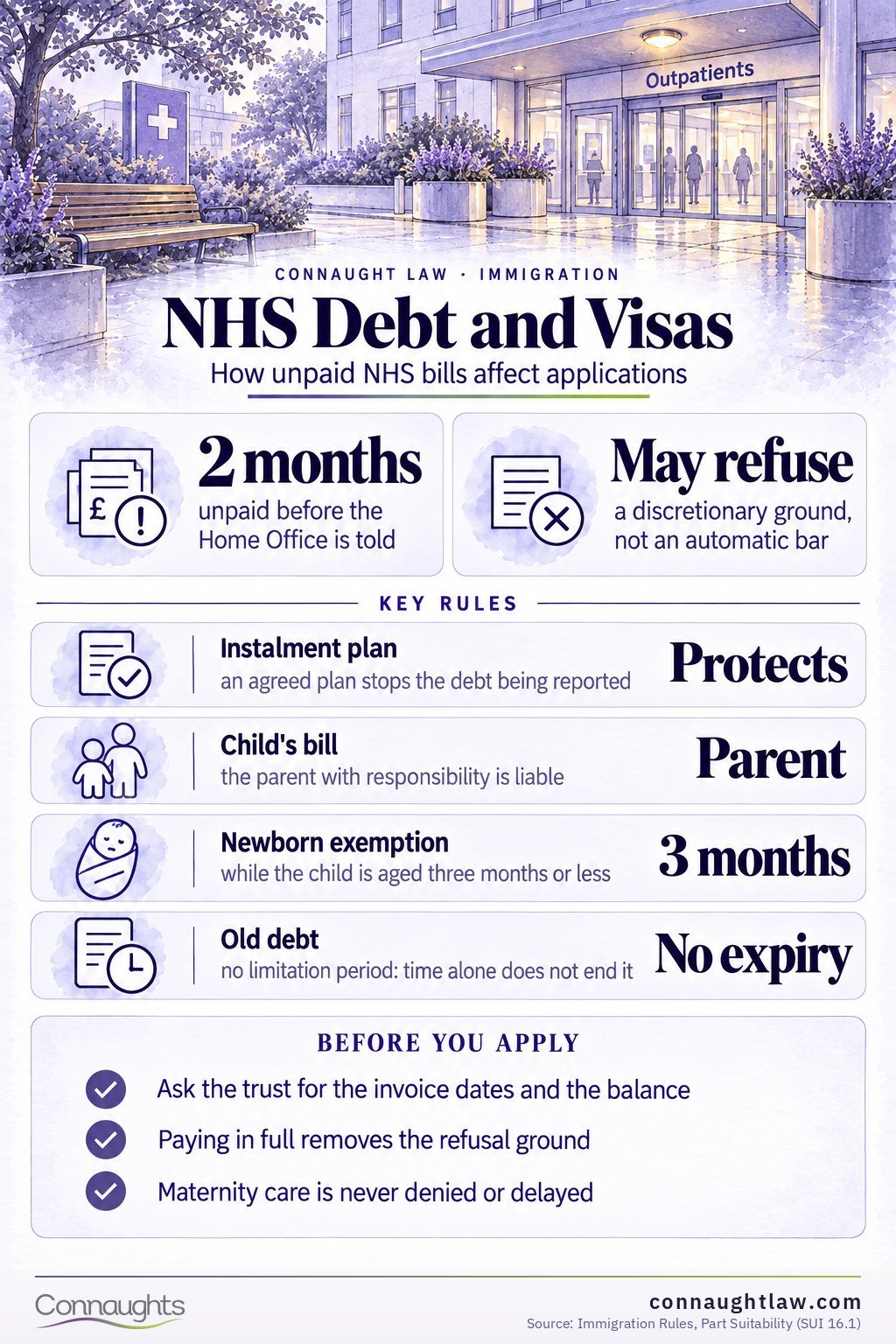
Hospitals do not report every unpaid bill. A relevant NHS body notifies the Home Office only once a qualifying debt has been outstanding for two months or more from the date of invoice, and where there is no agreement in place to pay by instalments. That two-month gap, and the instalment carve-out, are where most of the practical protection lies.
The debts that count come from secondary care — hospital treatment — under the charging regulations. A relevant NHS body means an NHS trust or foundation trust in England, a local health board or trust in Wales, a health board or the Common Services Agency in Scotland, or the Regional Board or an HSC trust in Northern Ireland. A GP surgery or a private clinic is not one.
Quick answer — a discretionary ground, not an automatic bar
SUI 16.1 says an application "may be refused". Home Office guidance instructs caseworkers not to refuse automatically and to consider the circumstances of the individual case. The Department of Health's own guidance puts it plainly: the Home Office is not compelled to refuse, and may find compelling or compassionate circumstances, or human rights considerations, that make refusal disproportionate.
What SUI 16.1 Says
The provision moved with everything else on 11 November 2025, when Part 9 was deleted and replaced by Part Suitability. It now reads: an application for entry clearance or permission may be refused where a relevant NHS body has notified the Secretary of State that the applicant has failed to pay charges under the relevant NHS regulations on charges to overseas visitors, and the outstanding charges have a total value of at least £500.
Three things follow from the wording. It bites on entry clearance and permission — the ground is about applications, not about your presence here. It requires notification by an NHS body, so a bill you know about but which has not been reported is not yet an immigration problem. And "may" means what it says.
Thresholds Are Not a Single Figure
The £500 in the rule is the floor, not the whole test. Caseworker guidance applies different thresholds depending on when the charge was incurred and which route the application is on, and an applicant with older debt can be well above £500 without reaching the applicable threshold.
Which Threshold Applies
| Charge incurred | Threshold | Applies to |
|---|---|---|
| On or after 1 November 2011 | £1,000 or more | Applications generally |
| On or after 6 April 2016 | £500 or more | Applications generally |
| On or after 24 November 2016 | £500 or more | Appendix FM, Private Life and Armed Forces |
| Since 1 July 2021 | £500 or more | EU, EEA and Swiss nationals |
Which figure applies — and the cumulative trap
- Debt is cumulative, not per invoice. Several small unpaid bills can cross a threshold together where none would alone.
- Pre-April 2016 debt under £1,000 cannot found a refusal on its own — but it can if further charges of at least £500 are incurred on or after 6 April 2016, or if later charges bring the total since November 2011 above £1,000.
- Only the outstanding balance counts. A part payment that brings the remaining sum below the applicable threshold takes the ground away.
- A debt repaid within six months before the application is treated by the guidance as recently discharged, which is relevant to how the case is considered.
A UK-Born Child, and Whose Debt It Is
This is the scenario families ask about most and the one most guides omit. A baby born in the United Kingdom to parents with limited leave does not automatically become British, and does not automatically become exempt from NHS charges. Under the charging regulations the child is an overseas visitor unless an exemption applies.
One exemption does apply, and it is narrow. Regulation 25(3) exempts a child born in the UK where a parent is exempt because they paid the immigration health surcharge (or under the pre-surcharge or Ukraine provisions), the child is aged three months or less, and the child has not left the UK since birth. All three conditions must hold. It is not an extension of the parents' surcharge; it is a separate, time-limited exemption.
Three months, then chargeable — the newborn window
Department of Health guidance is explicit that the three months exists to let parents regularise the child's status before charges begin, which may mean paying the surcharge on the child's behalf. If the status is not regularised, the parents become liable for the child's treatment once the child is over three months old, and payment can be required in advance.
Now the part that decides the immigration question. Regulation 4(4) provides that where an overseas visitor is a child, the person liable to pay is the person with parental responsibility. So a hospital bill for a UK-born child is not the child's debt in any practical sense — it is the parent's, and it is the parent's application it appears against.
Home Office guidance confirms the consequence and adds a safeguard. Where treatment was received by a child, the guidance records that parents or guardians may be liable, requires the case to be referred to a senior caseworker before any decision, and requires that the best interests of any affected child be treated as a primary consideration along with any human rights implications of refusal.
It also cuts the other way, and this is worth knowing before an application is made. The guidance directs caseworkers to consider whether the applicant's stated reason for coming to the UK at the time of an earlier application was genuine, or whether the intention was to access healthcare for the child. That turns an unpaid bill into a question about a previous application, which is a materially more serious allegation.
Maternity care is never withheld — but it is billed
Maternity services are chargeable to overseas visitors, and they must be treated as immediately necessary. No patient may have them denied or delayed because of charging, no charge should be made and no debt collection should take place until after delivery, and providers are told to reassure a patient who cannot pay that care will never be withheld. Free at the point of need is not the same as free.
Payment Plans and Partial Payment
An agreed instalment plan is the most useful thing available, because an NHS body will not notify the Home Office where there is an agreement in place to pay by instalments. It is for the NHS body or its debt collection agent to set the schedule, not for the applicant to propose one unilaterally and treat it as agreed.
Where a debt has already been reported, evidence that it has been paid or that an agreed schedule is being maintained is what the Home Office asks for. The wording matters: a plan that exists but is not being maintained is treated as no plan. And the guidance is blunt that an intention to pay in future carries no weight — caseworkers are told to consider the facts and not to give credence to promises to pay.
Paying in full removes the ground entirely: once the debt is paid there is no longer a basis to refuse under Part Suitability. There is one place where full payment is specifically required — settlement under Appendix Settlement Family Life or Appendix Private Life, where an applicant with a qualifying debt should be refused settlement but may be granted permission to stay, and becomes eligible to apply for settlement immediately once the debt is paid.
When a Debt Stops Counting
There is no limitation period. Nothing published sets a date after which an NHS debt ceases to be relevant to an immigration application, so an old debt does not expire simply through the passage of time.
What does end it is status. Guidance provides that an NHS debt record should be removed from Home Office systems, even where the debt remains unpaid, once a person has indefinite leave to remain, settled or pre-settled status under the EU Settlement Scheme, refugee status, or British citizenship. The debt itself survives as a civil matter; its immigration effect does not.
The ground also does not apply to several application types at all, including protection claims other than the specified family reunion and Calais leave paragraphs, Appendix EU and Appendix EU (Family Permit), Appendix S2 Healthcare Visitor, the Ukraine Scheme, and nationality applications.
Before You Apply
Find out what is actually recorded rather than assuming. Ask the trust for a statement of the account, the invoice dates and the outstanding balance, because the dates decide which threshold applies and the balance decides whether you are over it. An invoice dated before April 2016 is treated differently from one dated after.
Then deal with the debt before the application rather than alongside it. Pay it, bring it below the threshold, or agree a schedule with the trust and start maintaining it — and get written confirmation of whichever you have done, because that is the evidence the Home Office asks for. Where a refusal has already happened on this ground, our guide to visa refusals covers what follows.
Where the debt relates to a child, say so and evidence it. The senior caseworker referral and the best-interests consideration are built into the process, but they work on what is in front of the decision maker. A bare unpaid balance invites refusal; the same balance explained, with the child's position set out, invites the discretion the rule actually contains.
Frequently askedQuestions about NHS debt and visa applications
Will an NHS debt automatically refuse my visa?
No. SUI 16.1 says an application "may be refused", and guidance tells caseworkers not to refuse automatically but to consider the individual case. Compelling or compassionate circumstances and human rights considerations can make refusal disproportionate.
Is my baby born in the UK charged for NHS treatment?
Usually yes after three months. A child born here to a parent exempt through the health surcharge is exempt while aged three months or less and has not left the UK. After that, unless the child's status is regularised or another exemption applies, treatment is chargeable.
Is a bill for my child my debt or my child's?
Yours. Regulation 4(4) makes the person with parental responsibility liable for a child's charges. That is why such a debt affects the parent's own application, and why the guidance requires a senior caseworker referral and a best-interests assessment.
Can I be refused maternity care if I cannot pay?
No. Maternity services are chargeable but must be treated as immediately necessary, and cannot be denied or delayed because of charging. No charge should be made and no collection should take place until after delivery.
Does a payment plan stop the debt being reported?
Yes, if it is agreed. NHS bodies notify the Home Office only once a qualifying debt has been outstanding two months or more and there is no instalment agreement in place. A plan that is not being maintained is treated as no plan.
Does an old NHS debt ever expire?
Not by time. There is no published limitation period. The record is removed from Home Office systems, even if unpaid, once someone has indefinite leave, EU Settlement Scheme status, refugee status or British citizenship.
Send us the invoices with their dates and the refusal letter if you have one. We will tell you which threshold applies, whether the debt is yours in law, and what needs to be in place before you apply.
Get Expert Advice