A re-entry ban is a fixed period during which an application for entry clearance must be refused. Its length does not depend on what you did wrong. It depends almost entirely on how you left the United Kingdom and who paid, which is why two people with identical histories can face twelve months and ten years. The rules moved to Part Suitability in November 2025.
On This Page

What a Re-Entry Ban Actually Is
The rules call it a mandatory refusal period, and the formal name is the more accurate one. SUI 11.1 of Part Suitability requires that an application for entry clearance or permission to enter must be refused where the applicant has previously breached immigration laws and the application was made within the relevant period set by SUI 12.1.
Two things follow immediately. It is mandatory, so there is no discretion to grant inside the period. And it reaches entry clearance and permission to enter only — a re-entry ban does not, by itself, defeat an in-country application for permission to stay. Home Office guidance is explicit that permission to stay applications cannot be refused on the basis that someone is or was subject to a mandatory refusal period.
Quick answer — when a ban actually bites
Only when you apply from outside the United Kingdom, and only within the period. Outside the period, a refusal becomes discretionary and requires something more: SUI 11.2 applies where the applicant has also acted to frustrate immigration controls. Inside the country, different provisions apply, and different consequences follow.
The Periods, and What Each Turns On
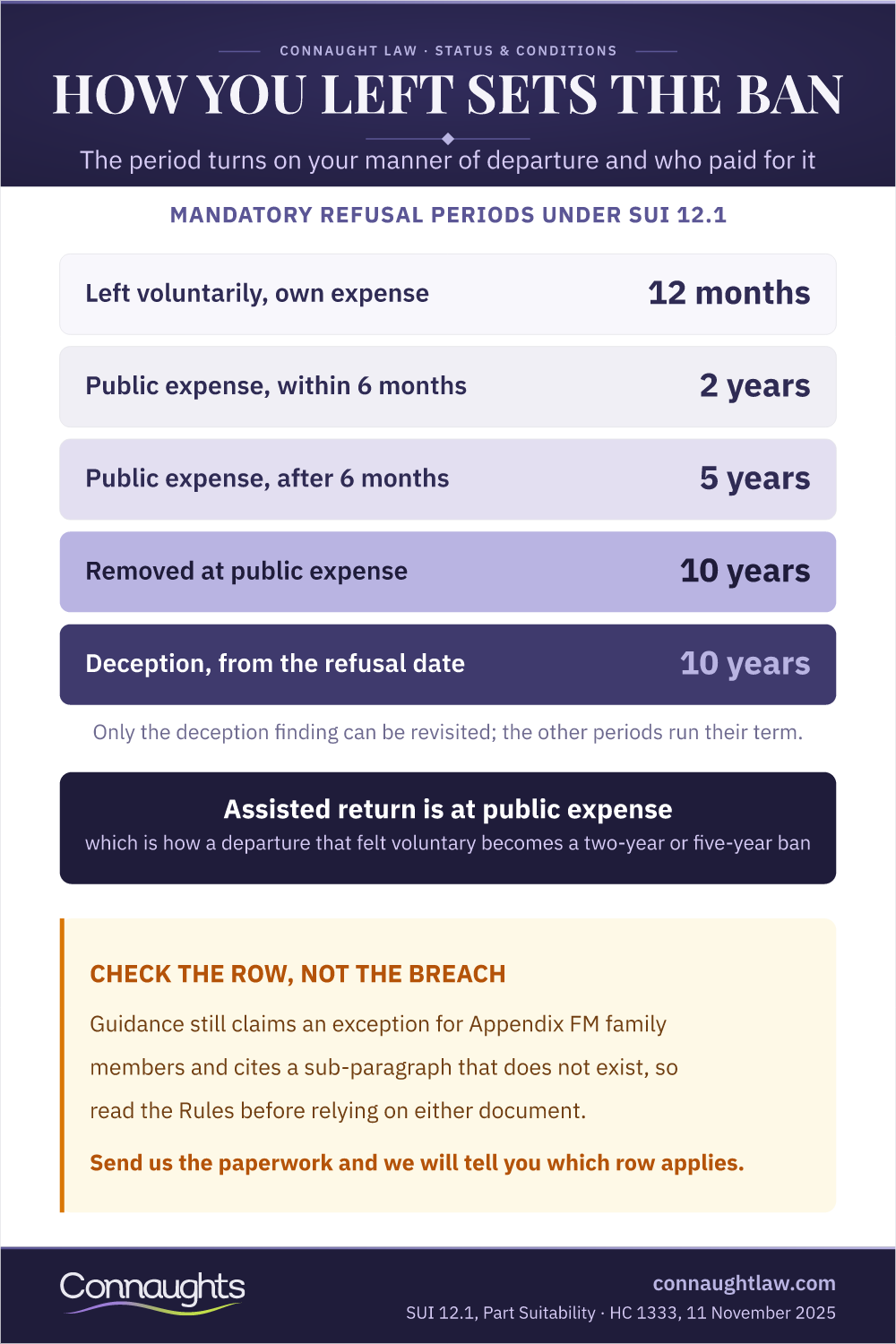
SUI 12.1 is a single paragraph carrying a table of six rows. The stem matters as much as the rows: where a person has breached more than one immigration law, only the breach leading to the longest period applies. For five of the six rows, time runs from the date the person left the United Kingdom, not from the breach and not from any decision.
How Long Each Ban Runs
| Period | Applies where the applicant | And left the UK |
|---|---|---|
| 12 months | Left voluntarily | At their own expense |
| 2 years | Left voluntarily | At public expense, within 6 months of being given notice of liability for removal, or of no longer having a pending appeal or administrative review, whichever is later |
| 5 years | Left voluntarily | At public expense, more than 6 months after that same point |
| 5 years | Left or was removed | As a condition of a caution under section 22 of the Criminal Justice Act 2003, provided any condition prohibiting return has itself expired |
| 10 years | Was removed | At public expense |
| 10 years | Used deception in an application — for visits, entry clearance applications only | Runs from the date of the refusal decision, not from departure |
Public expense is defined more widely than most people assume. Guidance treats the Home Office as having borne the cost where it paid travel or other expenses connected with leaving, expenses shortly after arrival in the new country, resettlement services, or the cost of a journey to assess the possibility of voluntary departure. Assisted voluntary return schemes fall inside it, which is how a departure that felt voluntary becomes a two-year or five-year ban.
The six-month window in the second row can also reset — where a removal decision is substituted after a fault is found, where an out-of-time appeal is admitted, or where further submissions are treated as a fresh claim or take more than a year to determine. If the timing is close, the sequence of events is worth reconstructing carefully.
Deportation is different — and no longer a ten-year ban
Guidance records that from 5 October 2023 a person subject to a deportation order is no longer subject to a ten-year mandatory refusal period, and should not be recorded as or refused on that basis. A deportation order operates under SUI 2.1 instead and lasts until it is revoked, which is a harsher position rather than a softer one. Our guide to deportation appeals covers revocation.
Where the Rule Lives Now
If you are searching for "general grounds for refusal" or for paragraph 320(7A), you are using names that have been retired twice. The old Part 9 was headed "General grounds for the refusal of entry clearance, leave to enter or variation of leave" and contained paragraphs 320 to 324. It was replaced at 9am on 1 December 2020, and paragraph 320 went with it — including 320(7A) on false representations and 320(7B) on previous breaches.
The replacement Part 9 was itself deleted on 11 November 2025 by Statement of Changes HC 1333, and its content moved into the new Part Suitability. So a provision people still search for by its 2012 number has now been renumbered twice in five years. The Home Office's own staff guidance collection is still titled "General grounds for refusal", which does not help.
The map is straightforward once stated. What was 320(7A) is now SUI 9.1 for deception, which is mandatory, and SUI 10.1 for false representations, which is discretionary. What was 320(7B) is now split: SUI 11.4 defines the breach, SUI 11.1 requires refusal, and SUI 12.1 sets the period. Nothing of substance was lost in either move, but every citation changed.
Overstaying and the Disregards
Overstaying is one of four routes into SUI 11.4. The others are breaching a condition attached to your permission, being an illegal entrant, and using deception in a previous application. All four require the person to have been aged 18 or over at the time — a breach committed as a child does not engage the ban at all.
Two provisions take overstaying back out again. SUI 11.5 disregards a period of overstaying where the person left voluntarily and not at the Secretary of State's expense, and either overstayed for 90 days or less where it began before 6 April 2017, or 30 days or less where it began on or after that date, or where SUI 13.1 — the provision that used to be paragraph 39E — applied to the period.
SUI 11.6 does something narrower and is easily missed. Where the overstaying arose from a refusal or cancellation that was later withdrawn, quashed, or reconsidered by direction of a court or tribunal, it is not counted — unless the legal challenge that led to the reconsideration was brought more than three months after the original decision. If a decision against you was overturned, that three-month point may decide whether the intervening period counts.
Working in breach of a condition deserves its own note, because it is one of the most searched scenarios and the answer is not what people expect. Working when your permission forbids it engages SUI 11.4(b) and makes you a person who has breached immigration laws. It does not carry a period of its own. The length still comes from how you leave, so the same breach can produce twelve months or ten years. Conditions are set out in the grant — our guide to visa conditions covers how they are notified.
Exemptions and Where the Ban Does Not Reach
Part Suitability does not apply to every route. SUI 1.1 excludes Appendix EU, Appendix EU (Family Permit), Appendix Settlement Protection, and most of Part 11 on asylum, though it does reach the family reunion paragraphs within it. SUI 1.3 excludes Appendix Electronic Travel Authorisation. Where the Part does not apply, neither does the ban.
Not everywhere — situations that do not create a ban
- Refused entry at the border as a visitor — guidance is clear that this does not make someone subject to a mandatory refusal period, and nor does cancellation of entry clearance at the border, electing to embark, or a carrier expense removal.
- Deception at the border as a visitor — the rules do not provide power to impose the ten-year period where deception is used in an application for permission to enter as a visitor at the border.
- Encountered before arrival — a person encountered or rescued before arriving in the UK is not treated as an illegal entrant, so no ban follows.
- Under 18 at the time — SUI 11.4 only applies to a person aged 18 or over when the breach occurred.
- Recognised victims of trafficking, and those in the UK illegally on or after 17 March 2008 who left voluntarily before 1 October 2008, should not normally be refused under these provisions.
None of that helps a person who does fall inside the rules, and it is worth being precise about which list you are reading. The exclusions above come from the Rules themselves. The guidance carries its own list, and on one point it is out of date.
The guidance is wrong here — go to the Rules
Home Office guidance still states there is an exception for family members applying under Appendix FM, and cites a "SUI 11.4(f)". No such sub-paragraph exists, and the blanket Appendix FM carve-out was in the old paragraph A320, which fell in December 2020. Appendix FM now says the applicant must not fall for refusal under Part Suitability. Do not rely on that passage.
Can a Ban Be Lifted?
The honest answer for most people is no. For the twelve-month, two-year, five-year and ten-year removal rows there is no published procedure to shorten or lift a running period — no application, no form, no fee, and no discretion clause in the Rules or in either guidance document. Those periods run their term. Any service offering to have one lifted is offering something that does not exist.
Two genuine routes exist and both are narrower than they sound. The first applies only to the deception row. Guidance allows an applicant to ask for the finding to be revisited in a later entry clearance application, explaining why there was no deception; the decision maker must consider whether the finding is still sustainable on the balance of probabilities, and whether mitigating or exceptional factors outweigh it. If satisfied there was no deception, there is no ban to apply.
The second is the Appendix FM human rights route. GEN.3.2 requires a decision maker, where an Appendix FM application fails the requirements or Part Suitability, to consider whether there are exceptional circumstances that would make refusal a breach of Article 8 through unjustifiably harsh consequences. Where that is made out the application is granted, and the mandatory refusal period is not among the suitability grounds preserved against such a finding. It is not automatic and it is not easy, but it is real.
Outside Appendix FM, Part Suitability contains no general human rights disapplication; it says only that route-specific rules set the approach. Where a ban has been applied on a factual basis you dispute — a departure recorded as being at public expense when it was not, for instance — the argument is about the facts rather than about discretion, and it belongs in the next application. Our visa refusal guide covers how to put one.
Returns Figures and What They Show
Because so much depends on how a person leaves, the published returns data is more useful here than any figure about bans, of which none is published. The current release is Immigration system statistics, year ending March 2026, published on 21 May 2026, recording around 39,000 returns from the United Kingdom.
Within that total, table Ret_D01 gives 9,723 enforced returns and 29,284 voluntary returns. The ratio is roughly three voluntary departures to every enforced one, and the difference between those two categories is, in ban terms, the difference between the first row of the table and the fifth: twelve months against ten years, if the voluntary departure is at the person's own expense.
That is the practical reading of the data, and it is why advice taken before departure is worth more than advice taken after it. Note the period attached to these figures; the series is quarterly and a later release may exist by the time you read this.
Frequently askedQuestions about re-entry bans and mandatory refusal periods
How long is a UK re-entry ban?
Twelve months, two years, five years or ten years, depending on how you left. Leaving voluntarily at your own expense is twelve months. Being removed at public expense is ten years. Deception in an application is ten years, running from the refusal decision.
Does a deportation order mean a ten-year ban?
No, not since 5 October 2023. A person subject to a deportation order is no longer given a ten-year mandatory refusal period. The order itself operates under a different provision and lasts until it is revoked, which is more restrictive rather than less.
Does a ban stop me extending my visa from inside the UK?
Not by itself. The mandatory refusal periods bite on entry clearance and permission to enter. Guidance states permission to stay applications cannot be refused on the basis of a mandatory refusal period, though other suitability provisions may still apply.
Can a re-entry ban be lifted early?
There is no published route to shorten or lift the twelve-month, two-year, five-year or ten-year removal periods. The exceptions are asking for a deception finding to be revisited in a later application, and the Appendix FM Article 8 route where refusal would have unjustifiably harsh consequences.
I was refused entry at the airport. Do I have a ban?
Generally no. Guidance states that refusal of permission to enter at the border as a visitor does not create a mandatory refusal period, and nor does cancellation of entry clearance at the border, electing to embark, or a carrier expense removal.
What if I worked on a visitor visa?
Working in breach of a condition makes you a person who has breached immigration laws under SUI 11.4(b). It carries no period of its own — the length still depends on how and when you leave, so the same breach can mean twelve months or ten years.
Send us the removal or refusal paperwork and the dates. We will tell you which row of SUI 12.1 applies, when the period actually started, and whether anything can be done about it.
Get Expert Advice