
Every grant of limited leave can carry conditions, and breaching one is a route to curtailment, refusal of the next application and a re-entry ban. Section 3(1)(c) of the Immigration Act 1971 sets out what may be imposed, and five new conditions were added to that list on 5 January 2026. But a condition binds only once it has been notified in writing — which is why the notice, not the breach, is often where these cases are actually decided.
On This Page

The Conditions on Your Permission
A condition is a restriction attached to limited leave: what you may do for work, whether you may study, whether you can claim public funds, where you must live, whether you must report. It is imposed under section 3(1)(c) of the Immigration Act 1971, and it can be added, varied or revoked later under section 3(3)(a) — so the conditions you were given at the start are not necessarily the conditions you are under now.
Two things follow that most people miss. First, if the limit on the duration of your leave is removed — that is, if you are granted settlement — section 3(3)(a) provides that any conditions attached to the leave cease to apply. Second, conditions carry across: under section 3(3)(b), the limitation and conditions on your leave apply also to any subsequent leave obtained after an absence within the original period, unless they are superseded.
What Conditions Can Be Imposed
The list is closed, and it grew this year. On 5 January 2026, section 46 of the Border Security, Asylum and Immigration Act 2025 inserted five new sub-paragraphs into section 3(1)(c), together with a new section 3(1A) restricting when they may be used and a new Schedule 1A governing electronic monitoring.
Conditions Under Section 3(1)(c)
| Condition | Provision | Note |
|---|---|---|
| Restricting work or occupation | 3(1)(c)(i) | The commonest condition of all |
| Restricting studies | 3(1)(c)(ia) | Inserted 2009 |
| No recourse to public funds | 3(1)(c)(ii) | Maintain and accommodate yourself and dependants |
| Register with the police | 3(1)(c)(iii) | The scheme was abolished in August 2022; the power remains |
| Report to an immigration officer or the Secretary of State | 3(1)(c)(iv) | Inserted 2008 |
| Residence | 3(1)(c)(v) | Inserted 2008 |
| Electronic monitoring | 3(1)(c)(vi), Schedule 1A | New on 5 January 2026. Cannot be imposed on anyone under 18 |
| Be at a particular place between particular times | 3(1)(c)(vii) | New on 5 January 2026 |
| Remain within a particular area | 3(1)(c)(viii) | New on 5 January 2026 |
| Not be in a particular area | 3(1)(c)(ix) | New on 5 January 2026 |
| Any other condition the Secretary of State thinks fit | 3(1)(c)(x) | New on 5 January 2026 |
The threshold in section 3(1A) is narrow and worth reading before assuming the new powers apply. They are available only where the Secretary of State considers that the person poses a threat to national security or to public safety, has committed an offence specified in Schedule 1 to the Serious Crime Act 2007, has committed a specified sexual offence, or has committed or is suspected of an equivalent offence abroad. They are not general-purpose conditions for ordinary applicants.
Schedule 1A fills in the electronic monitoring detail: co-operation with arrangements for recording location, presence or absence by electronic means, which may require wearing a device, and which must prohibit damaging or interfering with it. Paragraph 4 puts the age floor at 18. Enforcement policy has been moving in this direction for some time, and the 2025 white paper foreshadowed it.
Notice in Writing, and How It Is Served
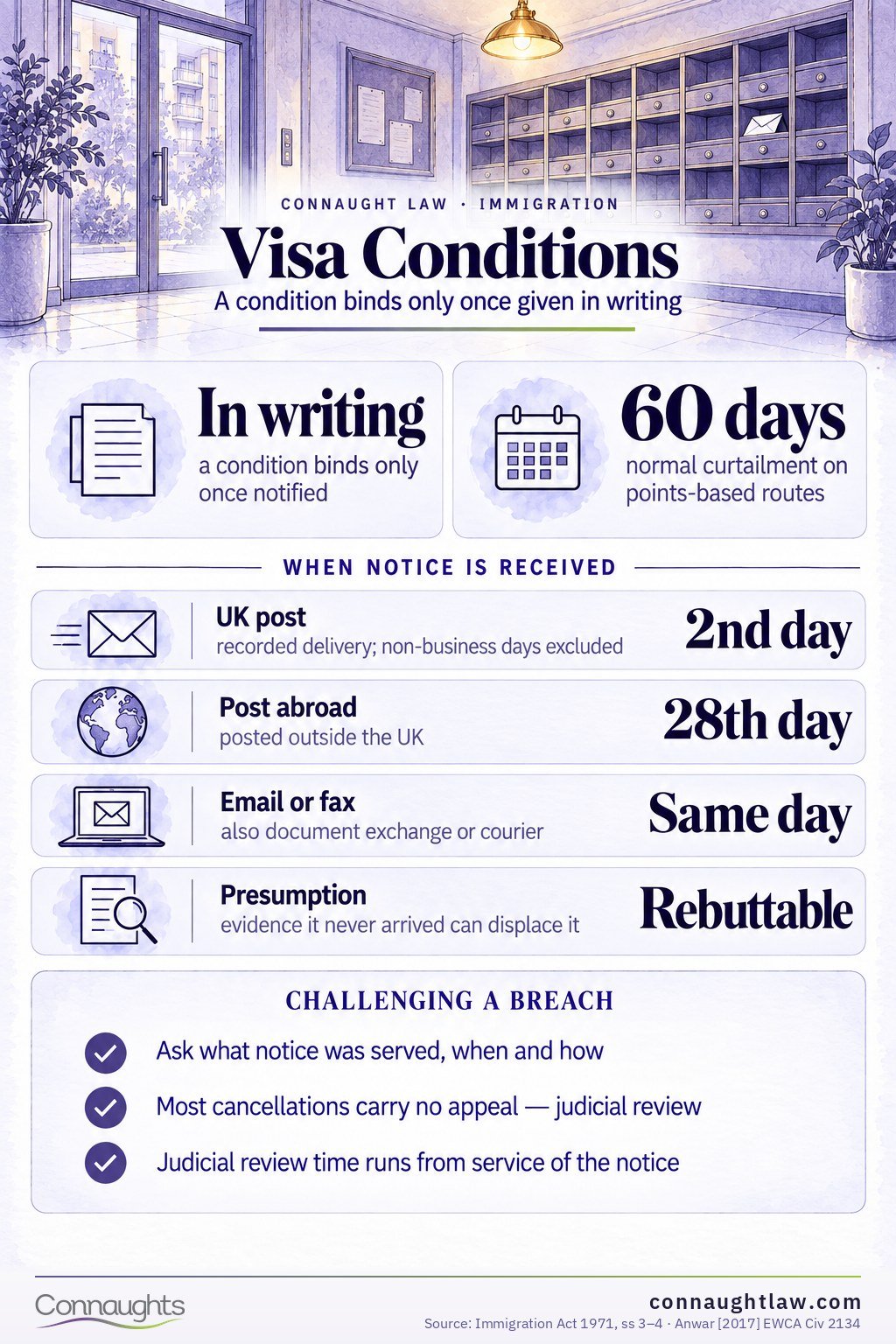
Section 4(1) of the Immigration Act 1971 requires that the powers to give leave, to vary it under section 3(3)(a) and to cancel it under section 3C(3A) “shall be exercised by notice in writing given to the person affected”. That is the whole basis of the argument set out below: a condition that was never notified in writing is not a condition you can be held to.
How the notice may be served depends on whether the decision carries a right of appeal. For non-appealable decisions, article 8ZA of the Immigration (Leave to Enter and Remain) Order 2000 permits service by hand, fax, post to an address given for correspondence, email to an address given for correspondence, document exchange or courier, with fallbacks where no address was provided and deemed service on file where attempts fail and the reasons are recorded.
For appealable decisions the Immigration (Notices) Regulations 2003 apply. Regulation 5 requires the notice to include or be accompanied by the reasons, the right of appeal and its statutory basis, whether it can be brought in country, the grounds, and information about how and when to appeal. Since 9 October 2023, regulation 7(1A) to (1C) treats a notice uploaded to the Home Office electronic portal as sent electronically, received when the person or their representative is notified of the upload.
- UK post. Deemed received on the second day after sending by recorded delivery, excluding non-business days.
- Post outside the UK. Deemed received on the twenty-eighth day after posting.
- Fax, email, document exchange or courier. Deemed received on the day it was sent.
- Every one of these applies “unless the contrary is proved” — article 8ZB is a presumption, not a rule, and evidence that the notice never arrived can displace it.
Anwar: No Notice, No Condition
Anwar v Secretary of State for the Home Department [2017] EWCA Civ 2134, decided on 15 December 2017, is the authority. The Court of Appeal held that where the Home Office relies on a condition, it must be able to show the condition was notified in writing under section 4(1). The judgment disapproved the Upper Tribunal’s decision in Bhimani [2014] UKUT 00516 (IAC) and the High Court’s in R (Afzaal) [2014] EWHC 2215 (Admin), directing that neither should be followed. It did not quash them; it removed their authority.
The principle was extended in R (Dhandapani) v SSHD [2025] EWCA Civ 1244, decided on 7 October 2025. The Court of Appeal confirmed that emailed service raises a rebuttable presumption which the appellant’s evidence was capable of displacing, and put the underlying point starkly: until notice of curtailment in writing is given, “there is simply no decision at all”. The practical consequence is that time for a judicial review runs from service of the notice, not from the date the Home Office made its decision internally.
eVisas and Where Conditions Now Appear
Almost all biometric residence permits expired on or before 31 December 2024, and the concession allowing travel on an expired card ended on 1 June 2025 without further extension. An expired permit can still be used to access a UKVI account for 24 months after the printed expiry date or until 31 December 2026, whichever comes first. Visa vignettes stopped being issued to new applicants on 1 July 2026.
The eVisa now displays the conditions of a person’s permission, and in practice it is what an employer or landlord will check. But it is worth being precise about its legal status: nothing in the move to digital changed section 4(1), article 8ZA or regulation 7. The eVisa is evidence of status and conditions. It is not the statutory notice, and no primary source says a UKVI account entry can stand in place of one.
Breach, Curtailment and the 60-Day Rule
The commonest breaches are working beyond a permitted limit, working when work is prohibited, claiming public funds under a no recourse condition, and failing to report. A student sponsored by a higher education provider with a compliant track record may work part-time during term time up to 20 hours a week on a full-time course at degree level or above — but only 10 hours a week on a full-time course below degree level, a distinction that catches people out.
Where a breach is established the Home Office cancels or curtails permission. The current cancellation and curtailment guidance, version 11.0 of 7 May 2026, requires the decision to be served in writing under section 4 and sets 60 days as the normal curtailment period where someone on a points-based route has failed to start or has ceased work or study, unless immediate cancellation is appropriate. The notice must state the ground, the reasons in detail, the exercise of discretion where the ground is discretionary, and the date permission expires as a result.
There is no right of appeal against a cancellation decision made on or after 6 April 2015, except under Appendix EU and Appendix EU (Family Permit). Overstaying that follows a curtailment can attract a re-entry ban, and a breach recorded against you is a suitability problem on every later application.
Challenging an Allegation of Breach
Start with the notice. Ask what was served, when, to which address, and by which method — and whether the Home Office can produce it. Under Anwar the condition has to have been notified in writing, and under Dhandapani the presumption of receipt can be rebutted by evidence. If the file shows service to an address you had already told the Home Office was out of date, or deemed service on file where a live address existed, that is the strongest point available.
Then check the substance. Was the condition actually breached on its terms, or on the Home Office’s reading of them? Was the correct hours limit applied for the level of the course? Was discretion exercised where the ground is discretionary, and does the decision letter say so? Where there is a right of appeal it goes to the tribunal; where there is not, the route is judicial review, and time runs from service. Our appeals team can tell you which of the two you are in.
Frequently askedQuestions about visa conditions and written notice
Where do I find the conditions on my visa?
On your eVisa in your UKVI account, and in the written decision you were given when permission was granted. If the two differ, the written notice under section 4(1) is the legally operative document — the eVisa is evidence of your status, not the statutory notice.
What happens if I breach a visa condition?
The Home Office can cancel or curtail your permission. On points-based routes the normal curtailment period is 60 days where you have failed to start or have ceased work or study, though immediate cancellation is possible. A recorded breach then counts against suitability on every later application.
Can the Home Office change my conditions after granting leave?
Yes. Section 3(3)(a) allows conditions to be added, varied or revoked. The variation has to be notified in writing in the same way as the original grant. If the limit on the duration of your leave is removed, the conditions cease to apply.
What if I was never told about the condition?
That is the Anwar point. A condition must be notified in writing under section 4(1), and the Home Office has to be able to show it was. Service by email or post raises only a rebuttable presumption of receipt, which evidence can displace.
How many hours can a student work?
Up to 20 hours a week during term time on a full-time course at degree level or above with a compliant sponsor, and up to 10 hours a week on a full-time course below degree level. Full-time work is permitted during vacations. Self-employment and professional sport are prohibited.
What are the new 2026 conditions?
Electronic monitoring, a curfew-style condition, remaining within an area, staying out of an area, and any other condition the Secretary of State thinks fit. They came into force on 5 January 2026 and are available only where the section 3(1A) national security or serious offending threshold is met.
Is there a right of appeal against curtailment?
Not for cancellation decisions made on or after 6 April 2015, other than under Appendix EU and Appendix EU (Family Permit). The remedy is judicial review, and the three-month period runs from service of the written notice rather than the date of the decision.
Tell us what the Home Office says you breached and what you were sent when your leave was granted. We will tell you whether the condition was properly notified in writing.
Get Expert Advice