
Divorce changes immigration status for one group only: partners whose visa depends on the marriage. ILR survives divorce untouched, but a spouse visa holder must tell the Home Office, expects curtailment to around 60 days, and needs a new basis to stay — a British child, domestic abuse provisions, private life, work, or a new relationship. This guide covers the notification rules, the 60-day window, and each surviving route with its costs.
On This Page

Divorce Ends the Visa, Not the Options
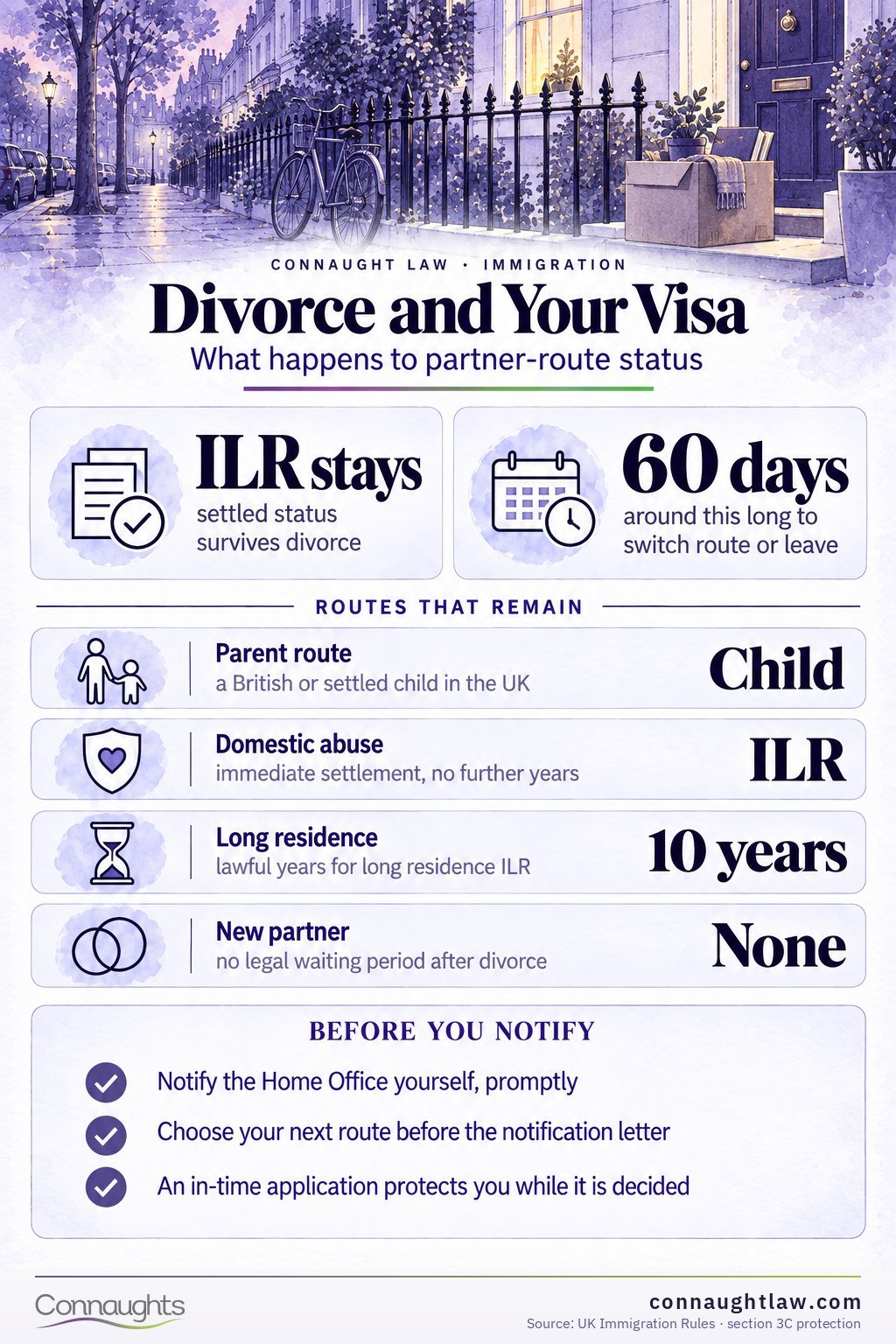
Only one group is affected: partners whose leave depends on the marriage. Indefinite leave, once granted, is personal and survives the relationship, short of a marriage shown to have been a sham. A partner visa holder must notify the Home Office, and curtailment to around 60 days follows — a deadline to switch routes, not a removal. What decides the outcome is whether another basis exists.
What Happens First
Telling the Home Office
A partner-route visa exists for the relationship, so when the relationship permanently ends, the rules require notification — from you, whatever your ex-spouse or their family threaten to report first. Notifying promptly and on your own terms matters: it opens the controlled 60-day window, keeps your credibility intact for the next application, and prevents the version of events reaching the Home Office being someone else's.
The 60-Day Curtailment Window
The standard response is curtailment of leave to around 60 days (or the visa's own end date if sooner) — not removal, and not a ban, but a deadline: switch to another route, or leave. Sixty days is enough for a prepared application and brutal for an unprepared one, which is why the route-selection thinking belongs before the notification letter, not after the curtailment notice.
ILR and Divorce
Settled Status Is Divorce-Proof
Indefinite leave granted through the partner route is yours, not the marriage's: divorce after ILR changes nothing, cannot trigger revocation, and needs no notification beyond ordinary record-keeping. The rare exceptions involve deception — an ILR obtained through a marriage shown to have been a sham from the start can be revisited — but genuine relationships that later failed present no risk, however soon after settlement the split comes.
Routes That Remain
A British or settled child grounds the parent route. Domestic abuse grounds immediate settlement. Ten lawful years grounds long residence, with private life and work routes alongside. And a new genuine relationship can found a fresh partner application with no waiting period — only closer scrutiny.
The Parent Route
A divorced parent with a British or settled child in the UK usually holds the strongest card: the parent route requires genuine parental involvement — direct access or shared care evidenced through the arrangements our child arrangements guide covers — and leads to settlement in its own right. Courts and caseworkers alike centre the child's welfare; so should the application.
Immediate ILR After Domestic Abuse
Where the relationship ended because of domestic abuse, the rules provide immediate settlement: no further qualifying years, fee relief for the destitute, and evidence standards that accept police, medical, refuge and court records in place of convictions. It is the one route where the relationship's end accelerates status rather than threatening it — covered fully in our domestic violence immigration guide, with the bereavement parallel in our bereaved partner guide.
Private Life and Long Residence
Long UK residence keeps its own doors open: ten lawful years for long residence ILR, private life routes for those with deep roots, and the wider options — including for those whose status has already slipped — mapped in our regularisation guide. Work routes complete the picture: a divorcing spouse with a sponsorable job can switch to a Skilled Worker visa on the employer's certificate.
New Partners
There is no legal waiting period after divorce — a new, genuine relationship can found a fresh partner application as soon as the decree absolute lands. What changes is scrutiny: caseworkers examine rapid transitions carefully, and the second application must evidence the new relationship's genuineness on its own merits, with the timeline honestly presented. Sponsors similarly face no bar on sponsoring again, though repeat sponsorship patterns attract attention.
Fees and Timelines
What the Next Application Costs
In-country applications on the parent, partner or private life routes run £1,407 plus the health surcharge at £1,035 a year; the domestic abuse settlement route costs £3,226 with fee exemption for destitute applicants; and decision standards range from eight weeks for straightforward extensions to a year for some human rights routes. The 60-day window therefore shapes strategy: file the strongest available application within it, and let processing time run on section 3C protection. Route selection under that clock is exactly what our family visa team does.
Frequently askedQuestions about divorce and immigration status
Do I have to tell the Home Office about my divorce?
Yes, if your visa is based on the relationship — the notification duty is yours and prompt disclosure protects your credibility. ILR holders face no such requirement; settled status is unaffected by divorce.
Can ILR be revoked if I divorce?
No — indefinite leave is personal and survives divorce entirely, however recently it was granted. The only exposure is deception: a marriage shown to have been sham from the outset can reopen the grant, but a genuine marriage that failed cannot.
How long do I have after separation to sort my status?
Typically around 60 days from curtailment of your partner visa. That window accommodates a prepared switch — parent route, work, private life, domestic abuse settlement — and an in-time application extends your protection while it is decided.
Will I be deported after divorce?
Not summarily — curtailment gives a deadline, not a removal. Overstaying past it is what creates enforcement risk. Most divorcing visa holders with children, jobs or long residence have a viable route; the task is choosing and filing it in time.
Can I stay if my ex and I share children?
Usually — genuine parental involvement with a British or settled child grounds the parent route, with settlement of its own. Evidence the child's status, your role and the care arrangements; the child's welfare is the application's centre.
Is there a waiting period before sponsoring a new spouse?
No legal one — a fresh, genuine relationship can be sponsored once the divorce is final. Expect closer scrutiny of quick transitions, and build the new application's evidence accordingly.
Tell us your status, your children's position and your work situation — before you notify anyone. We'll pick the strongest route and file it inside the window.
Get Expert Advice