Does Divorce End Financial Obligations? UK Clean Break Orders 2026

Divorce financial obligations UK law separates cleanly into two facts most people conflate: the final divorce order ends your marriage, and does absolutely nothing to end your financial relationship. Spousal claims survive until a court dismisses them; child maintenance runs regardless; joint debts bind both names whatever any private deal says. This guide maps what you owe and can claim after divorce - maintenance, capital, pensions, debts - how consent orders and clean breaks convert agreements into finality, the risks of leaving claims open, and how the Law Commission’s December 2024 review may reshape the whole framework.

Understanding Divorce Financial Obligations UK in 2026

Financial obligations after divorce fall into three streams. Obligations to children - child maintenance and, where ordered, school fees and housing provision - are non-negotiable and survive everything. Obligations between spouses - maintenance, capital division, pension sharing - are what the financial order settles. And obligations to third parties - mortgages, joint loans, guarantees - bind whoever signed them, indifferent to the divorce.

Confusing the streams causes most post-divorce grief: an ex-spouse who “agreed to take the loan” but defaults still damages your credit; a clean break between adults never touches child maintenance; and a divorce concluded years ago leaves spousal claims alive if no order dismissed them.

The official overview of money and property when a relationship ends on gov.uk covers the procedural basics; what it cannot do is tell you which obligations in your particular divorce are live, closable or already closed - the audit this page is designed to prompt.

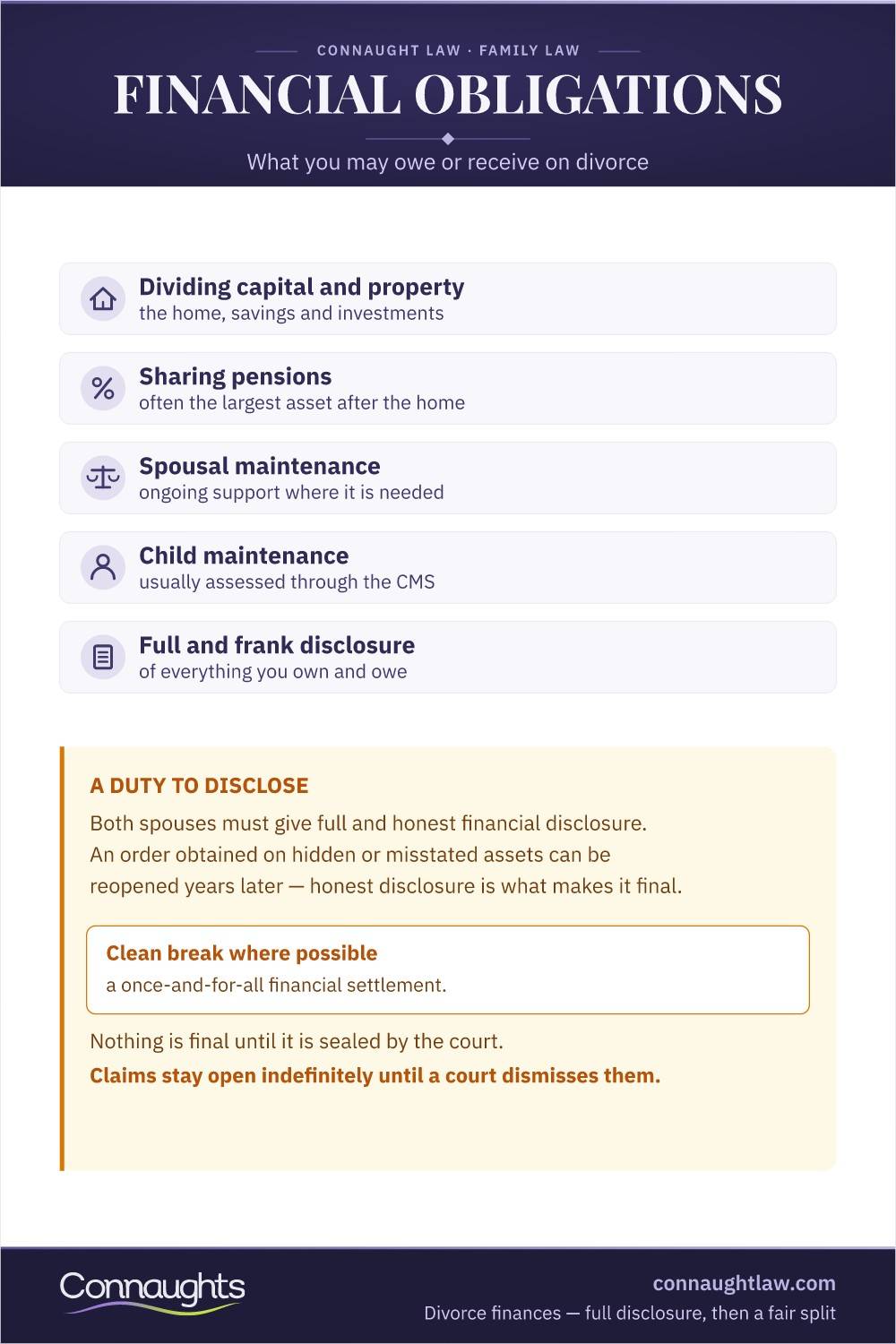
Divorce Financial Obligations Uk Infographic — Dividing Property, Sharing Pensions, Spousal And Child Maintenance, And The Duty Of Full Financial Disclosure

Why Divorce Alone Does Not End Financial Ties

The final order dissolves the marriage; the claims machinery of the Matrimonial Causes Act stands entirely apart from it. Either former spouse can issue financial remedy proceedings after - sometimes long after - the divorce, unless and until those claims are dismissed by court order. Wyatt v Vince remains the emblem: claims pursued nearly two decades post-separation, against wealth built entirely afterwards.

Ongoing obligations can also be created rather than merely left open: spousal maintenance orders continue until their term ends, the recipient remarries, or a court varies them; undertakings in orders - to pay the mortgage, maintain insurance - bind like orders; and secured provisions survive even death in some forms.

Spousal maintenance deserves its own clarity because myths surround it: it is not automatic, not for life by default, and not a reward or punishment. Courts order it where one spouse cannot meet needs from their own resources - commonly after long marriages with career sacrifices - and modern practice favours terms that fund transition to independence over indefinite dependence.

Divorce Financial Obligations UK: What Continues Automatically

Child maintenance continues by force of statute through the CMS or agreement - the framework in our guide to child maintenance - until children finish secondary education or turn 20 in approved education. Joint mortgages and debts continue by contract. Everything else continues only as claims - real, but closable.

Insurance-linked obligations round out the automatic list: orders commonly require maintaining life cover securing maintenance, keeping children on health policies, or preserving death-in-service nominations pending pension implementation. Letting such policies quietly lapse breaches the order as surely as missing a payment.

Understanding Clean Break Orders

The clean break is the law’s off-switch: a financial order that divides assets and dismisses future claims both ways - capital, maintenance, pensions and Inheritance Act claims against each other’s estates. Courts must consider it in every case under section 25A, and it is the default destination where both parties can stand financially alone.

Where immediate independence is unrealistic, deferred structures bridge: term maintenance with a bar on extension, stepping down to dismissal. The complete anatomy - what gets dismissed, drafting pitfalls, costs - is in our dedicated guide to clean break orders.

Agreement is not enough; approval is what binds. A consent order - the agreed division drafted into an order, lodged with a D81 summary of means, approved by a judge from the conditional order stage - costs £62 from 13 July 2026 and converts goodwill into law. Judges check fairness before sealing; genuinely lopsided deals attract questions.

Timing the consent order well saves double handling: negotiate during the divorce’s 20-week reflection period, lodge at the conditional order stage, and take the final order once the financial order is sealed. Couples who leave the money “until after the divorce goes through” surrender the process’s built-in scaffolding and often lose momentum entirely.

The order’s foundation is disclosure: proportionate, honest exchange of the financial picture, because an order built on concealment can be set aside - the Supreme Court did exactly that in Sharland and Gohil. What disclosure involves, and what happens without it, is covered in our guide to financial disclosure and Form E.

Post-Divorce Financial Claims: The Risks of Open Claims

Open claims mature silently. Future inheritances, business growth, property appreciation and even windfalls remain exposed; the prospering ex-spouse becomes the defendant regardless of who “left whom”. Delay complicates but rarely extinguishes - courts weigh intervening years, but no limitation period closes the door by itself.

The remarriage trap adds asymmetry: remarrying before applying for financial orders bars most of your own claims while leaving you exposed to your ex’s. And death converts open claims into estate litigation - a former spouse who never remarried can claim against an estate under the 1975 Act unless a clean break dismissed it. Each risk has the same one-page cure.

Enforcement is the mirror-image risk where obligations exist and are ignored: maintenance arrears can be collected through attachment of earnings, charging orders and judgment summonses; capital orders through execution against property. Enforcement applications are procedural rather than re-arguments - courts enforce what was ordered, and interest runs on unpaid lump sums.

Variation is the legitimate route when circumstances genuinely change: redundancy, illness or retirement can justify reducing maintenance; promotion or cohabitation can justify increasing or ending it. What never works is unilateral self-help - stopping payments because contact is difficult, or because the recipient has a new partner, converts a grievance into arrears and enforcement.

The Rule of Thumb: If your divorce is done but no financial order was ever sealed, your financial relationship is still open - whatever was said, promised or informally honoured since. A consent order with clean break provisions can still be obtained now, and almost always should be.

No-Fault Divorce and Financial Implications

No-fault divorce changed the atmosphere, not the arithmetic: conduct was almost never relevant to money before April 2022 and remains almost never relevant. What the reform did change is sequencing - the 20-week reflection period is now the natural window for disclosure and negotiation, so the consent order is ready when the conditional order arrives, as mapped in our no-fault divorce guide.

The final order’s timing carries the familiar cautions: taken before the financial order, it can extinguish pension survivor rights and home rights protection. The divorce fee is £628 from 13 July 2026; the financial machinery prices separately (£62 consent, £321 contested Form A).

Tax timing rides alongside: transfers between separating spouses are CGT-neutral for three tax years from the separation year - and indefinitely under a court order - while transfers outside those windows can generate real bills. Sequencing the order and the transfers together is basic hygiene in property-heavy settlements.

International and Complex Financial Situations

Cross-border lives multiply the obligations map: maintenance is enforceable abroad through the 2007 Hague Convention network; English capital orders may need registering or suing on where assets sit; and a foreign divorce does not necessarily end English claims - Part III of the 1984 Act can open them where the foreign outcome fell short, as the Potanina litigation has redefined.

Currency and jurisdiction clauses in orders prevent expensive ambiguity: which country’s courts vary maintenance, in what currency payments run, and who bears transfer costs. International families should also mirror-check that an English order’s key terms are enforceable where the paying party and the assets actually live.

Complex assets demand their own disciplines: businesses need valuation and extraction planning, trusts need realistic analysis of benefit, and pensions - routinely the second-largest asset - need the sharing, offsetting and timing craft set out in our guide to pensions and divorce.

The 2024 Law Commission Review and What May Change

The Law Commission’s December 2024 scoping report concluded that financial remedies law lacks certainty and accessibility, offering four reform models from codification to a default matrimonial property regime - with binding nuptial agreements and maintenance term limits inside the debate. The government has yet to choose a direction.

For divorcing couples the practical meaning is limited but real: the law on this page governs today, orders made now remain valid whatever reform brings, and the review is one more reason to close claims formally rather than leave them to a framework that may shift. Watch this space; do not wait for it.

The audit to leave this page with takes ten minutes: Is there a sealed financial order? Does it contain clean break dismissals, including estate claims? Are all joint products closed or refinanced? Are maintenance and insurance obligations being honoured and documented? Any “no” is a task with a known fix - and every fix is cheaper this year than next.

Frequently Asked Questions

Do I have financial obligations to my ex after divorce?

Only those created by order, agreement or statute: spousal maintenance if ordered, child maintenance under the CMS scheme, joint debts by contract. But absent a clean break order, your ex retains claims against you - which is an exposure, not yet an obligation.

How long after divorce can my ex claim money from me?

Indefinitely, until a court dismisses the claims - Wyatt v Vince allowed claims nearly 20 years after separation. Delay weakens claims but does not bar them. A consent order with clean break provisions is the only reliable close.

Does my ex-wife or ex-husband get half of everything?

Not automatically. Needs - especially children’s housing - come first; equal sharing applies to matrimonial property in bigger-money cases, with non-matrimonial wealth (per Standish) more protected. Outcomes are case-specific, which is why agreed orders beat litigation.

Who pays joint debts after divorce?

Both signatories, as far as the lender is concerned - whatever the order says between you. Orders allocate responsibility and can require refinancing, but only closing or transferring the account actually ends joint liability and credit-file association.

Does remarriage end financial obligations?

It ends spousal maintenance to the remarrying recipient automatically, and it bars most claims by a spouse who remarries before applying. It does not touch child maintenance, joint debts, or existing capital orders. Cohabitation is murkier - it can justify variation but nothing automatic.

Can spousal maintenance be changed after the order?

Yes - maintenance orders are variable on changed circumstances: up, down, suspended or capitalised into a lump sum for a final break. Term extensions depend on the drafting; a section 28(1A) bar makes the end date absolute.

We divorced years ago with no financial order. What now?

Your claims - and your ex’s - are still open. A consent order can still be made, dismissing claims both ways; if agreement fails, either can litigate, with the court weighing everything that has happened since. Taking advice before your circumstances improve further is the smart sequencing.

Will the Law Commission review change my divorce settlement?

No - orders made under current law stand. The review may eventually reshape maintenance, sharing rules and nuptial agreements for future cases, but the government has not yet chosen a model. Settle under the law that exists; do not plan around reform that may not come.

Expert Legal Support
Obligations Mapped

A clear statement of what you owe, what you can claim, and what is still open.

Finality Delivered

Consent orders and clean breaks that close claims permanently, both ways.

Complex Cases

Pensions, businesses and cross-border enforcement handled with specialist input.

To understand - and close - your financial position after divorce, contact the family law team at Connaught Law for a confidential consultation.

Contact Our Family Team

Disclaimer:

The information in this blog is for general information purposes only and does not purport to be comprehensive or to provide legal advice. Whilst every effort is made to ensure the information and law is current as of the date of publication it should be stressed that, due to the passage of time, this does not necessarily reflect the present legal position. Connaught Law and authors accept no responsibility for loss that may arise from accessing or reliance on information contained in this blog. For formal advice on the current law please don't hesitate to contact Connaught Law. Legal advice is only provided pursuant to a written agreement, identified as such, and signed by the client and by or on behalf of Connaught Law.