
Financial disclosure in a UK divorce rests on one duty: full and frank disclosure of your finances, owed to your spouse and to the court, for as long as proceedings run. Form E is the sworn statement that delivers it — property, pensions, income, businesses, debts and needs — and it is where cases are won, lost and occasionally blown up. This guide covers what must be disclosed, the documents required, and what happens to spouses who hide things.
On This Page

One duty, twenty-eight sworn pages
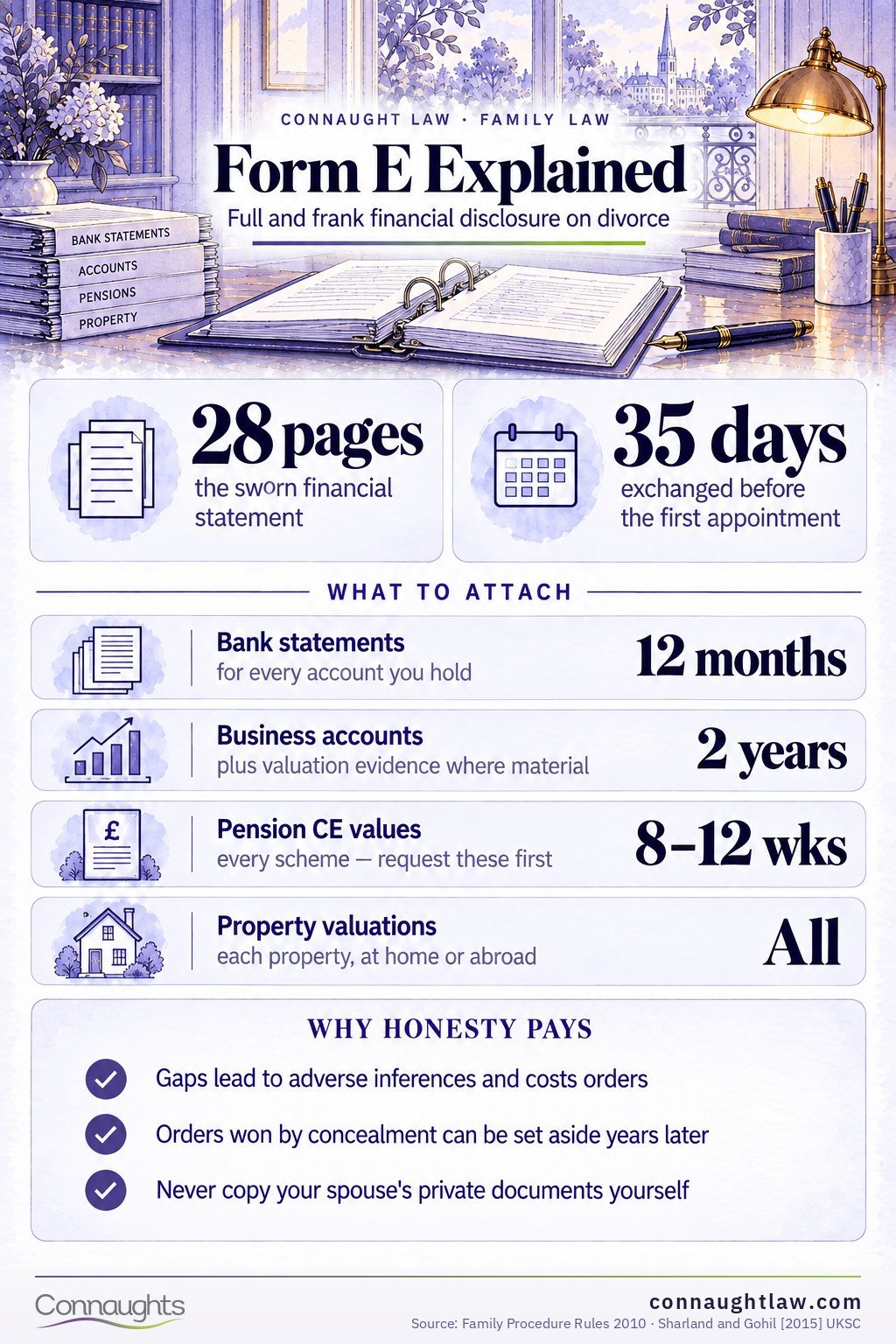
Form E is the sworn 28-page financial statement used in divorce financial proceedings: every asset, debt, pension and income source, backed by documents, signed under a statement of truth. It is the divorce financial settlement form people search for — and lying on it can unravel a settlement years later.
Disclosure is not an obstacle to settlement; it is the raw material of one. No figure can be negotiated, mediated or approved until both sides know what exists — which is why the quality of the first exchange predicts the speed of everything after it.
- Complete disclosure first time means few questionnaires, early negotiation and a consent order approved within the divorce itself.
- Gaps breed questionnaires; questionnaires breed hearings; hearings breed costs.
- Pension CE values are the slowest item — schemes can take eight to twelve weeks, so request them before anything else.
- Evasive disclosure converts a paper exercise into contested proceedings with a court timetable.
When Financial Disclosure Is Required in Divorce
In contested financial proceedings, disclosure is compulsory on the court's timetable: Form E exchanged 35 days before the first appointment. In negotiation or mediation, couples exchange voluntarily — often using Form E as the template because it asks every question a court would. Even a fully agreed deal discloses: the court approves a consent order only with a D81 financial summary, and agreements built on guesswork are the ones reopened later.
What Assets Must Be Disclosed in Divorce
Everything, everywhere: property at home and abroad, bank and savings accounts, investments, business interests, pensions, insurance and policies, significant chattels, and all debts. The duty reaches beneficial interests held behind nominees, trust interests, and assets acquired since separation. Whether an asset ends up shared is a separate argument — disclosure comes first, and concealment forfeits the credibility that argument needs.
Business Interests: The Hardest Section Done Properly
Business owners disclose the last two years' accounts and a realistic view of value — and the commonest error is conflating salary with what the business is actually worth or throws off. Where the business is material, a single joint expert values it; a spouse who disputes that figure has the Daniels v Walker route, not self-help.
Crypto, Cash and the New Frontiers
Digital assets fall squarely within the duty: exchange accounts, wallets and stablecoins are disclosable, and courts now expect wallet addresses and statements for material holdings. Cash businesses and lifestyles that outrun declared income attract forensic scrutiny — the mismatch itself is evidence, and judges are comfortable drawing conclusions from it.
Form E: The Sworn Financial Statement Explained
The form walks through personal details, the family home and other property, capital and debts, pensions with cash-equivalent values, business interests, income from every source — and then the sections that decide cases: income needs and capital needs, where you set out what the future actually costs. It closes with a statement of truth. The official form and guidance notes are on GOV.UK.
Common Form E Failures
- Guessed valuations where documents exist — the questionnaire that follows costs more than the valuation would have.
- A needs section written as an afterthought, though it frames the entire award.
- Missing bank statements that suggest editing rather than oversight.
- Business income understated against a lifestyle the other side can evidence.
- Late disclosure of the inconvenient asset — timing reads as concealment.
Documentation Requirements: The Evidence Behind the Form
The Document Checklist
| Document | Coverage Required |
|---|---|
| Bank statements | Twelve months, for every account held |
| Payslips and P60 — or tax returns | Employment income; self-employment via returns |
| Business accounts | The last two years, plus valuation evidence where material |
| Pension CE values | Every scheme — request first; they arrive slowest |
| Property valuations and mortgage statements | Each property held, at home or abroad |
| Policy surrender values | Life and investment policies |
Where a property valuation is likely to be contested, agree the method early; where pensions dominate, the CE request is the first letter to send, not the last.
Voluntary vs Court-Ordered Disclosure
Voluntary disclosure suits couples who will actually cooperate: proportionate, fast, and it keeps total legal spend a fraction of the contested route. Its weakness is teeth — nothing compels the reluctant discloser. Court-ordered disclosure trades cost for a fixed timetable and penal consequences. The graduated approach works: start voluntary, escalate to proceedings the moment disclosure turns evasive, and let the escalation itself do some persuading.
Consequences of Non-Disclosure in Divorce
Judges confronted with gaps draw adverse inferences — assuming hidden resources and awarding accordingly — and back them with costs orders and, for sworn falsehoods, contempt exposure. The deeper danger is durability: in Sharland and Gohil the Supreme Court confirmed that orders obtained by fraudulent non-disclosure can be set aside years after they were made. A settlement built on concealment is never actually final.
Court Powers to Investigate Hidden Assets
Suspicion has machinery: specific disclosure orders, focused questionnaires, orders joining third parties, forensic accountancy, and freezing injunctions where dissipation threatens. Section 37 of the Matrimonial Causes Act can reverse transfers made to defeat claims. What the suspicious spouse must not do is self-help — the Imerman rules forbid taking or copying the other party's private documents, and evidence gathered that way rebounds on the gatherer. Suspect, then instruct; do not raid the study.
Frequently askedQuestions about Form E, documents and hidden assets
Is Form E compulsory in every divorce?
It is compulsory in contested financial proceedings, exchanged on the court's timetable. Couples settling voluntarily can disclose by agreement — often using Form E anyway, because it asks the right questions — and even a consent order needs the D81 financial summary for approval.
What happens if my spouse lies on Form E?
Form E is sworn: lies risk adverse inferences, costs orders, contempt proceedings and, per Sharland and Gohil, the set-aside of a final order obtained by fraud — years later if necessary. Concealment also destroys the liar's credibility on every other issue in the case.
Do I have to disclose assets I owned before the marriage?
Yes. Disclosure covers everything you hold, whenever acquired. Whether pre-marital assets are shared is a separate classification argument — and one you argue more persuasively having disclosed them properly than having been caught omitting them.
Are pensions really part of financial disclosure?
Completely — cash-equivalent values must be disclosed for every scheme, including final-salary pensions whose paper figures often understate the promise. Request CE values immediately: schemes can take eight to twelve weeks, and they are the item that delays exchanges most.
Can I check my spouse is telling the truth?
Through the proper channels, yes: questionnaires, specific disclosure orders, third-party disclosure and forensic accountants. What you cannot do is take their documents yourself — the Imerman rules prohibit self-help, and improperly obtained evidence damages your own position.
Do we need disclosure if we already agree on everything?
A proportionate exchange, yes. The court will not approve a consent order blind — the D81 summarises both positions — and an agreement made on guesswork is exactly the kind that gets reopened. Knowing what exists is what makes the agreement safe to sign.
What about assets my spouse holds abroad or in crypto?
Fully disclosable — the duty has no borders and no format exceptions. Wallet addresses, exchange statements and foreign accounts all fall within it. Enforcement abroad adds complexity, but adverse inferences fill evidential gaps where the international picture does not add up.
How long does financial disclosure take?
Voluntary exchange typically runs a few months end to end, paced by pension values and business accounts. On the court track, Form E is exchanged 35 days before the first appointment, with questionnaires following. Either way, the pension CE request should go out first.
Tell us the date, what documents you already hold and what is missing. We will tell you what full and frank requires in your case — and how to meet the deadline without handing away credibility.
Get Expert Advice