
If the family home is in your spouse's sole name, a matrimonial home rights notice is the free protection that stops it being sold or remortgaged over your head while the marriage ends. Registration uses Form HR1 at the Land Registry, costs nothing, and does not need your spouse's consent — though they will be notified. This guide covers completing and sending the form, unregistered property, how long protection lasts and how it is removed.
On This Page

Free protection most non-owning spouses never register
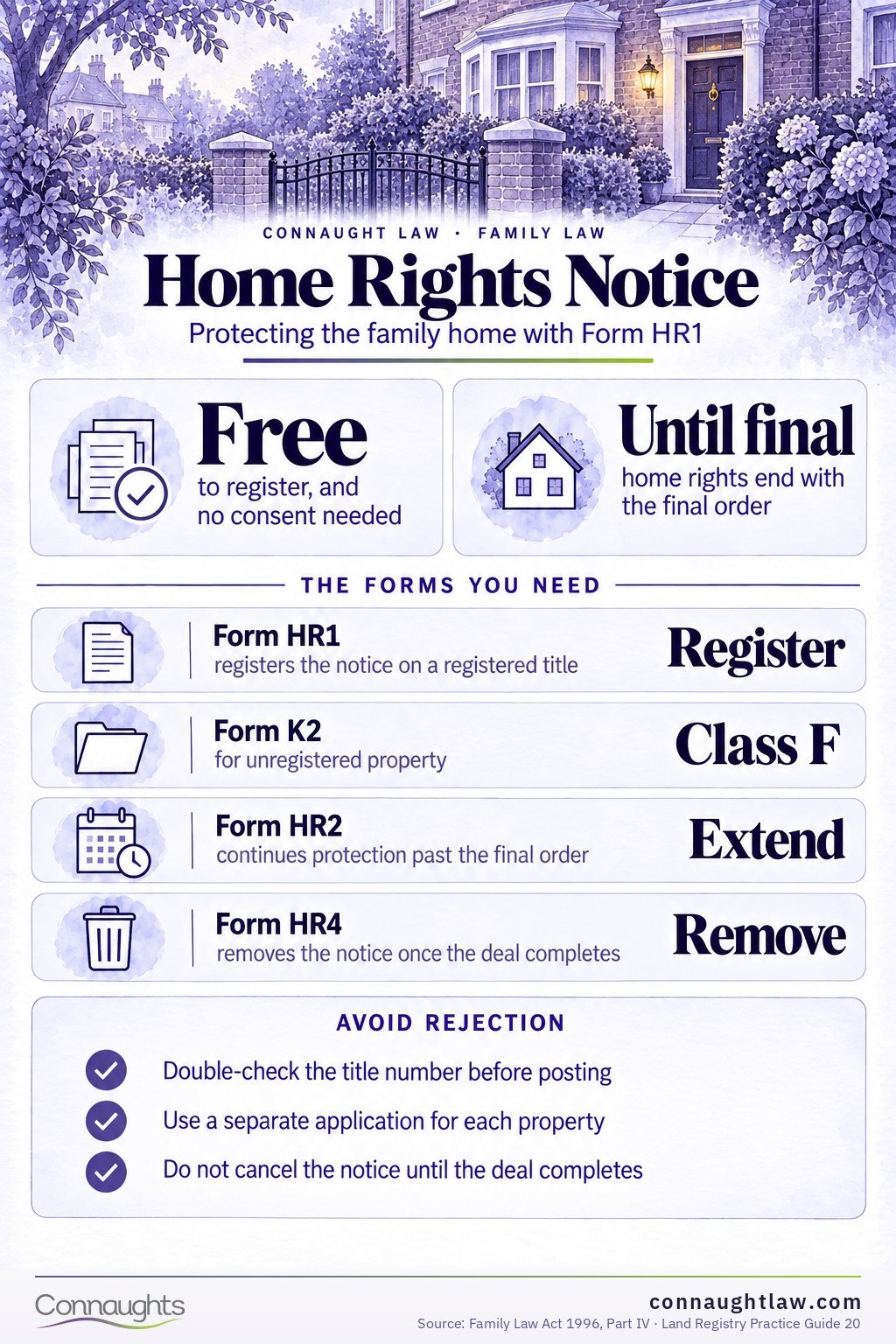
A spouse or civil partner who does not own the family home has statutory home rights under the Family Law Act 1996. Registering them with Form HR1 — free, no consent needed — puts a notice on the title that stops a sale or remortgage completing behind your back. Post the form to the Land Registry; protection runs from the application.
The protection exists for a blunt reason: a non-owning spouse's rights bind third parties only once they are on the register. Until then, the home can change hands or carry new borrowing without your signature ever being required — and timing, not paperwork, is what separates the protected from the unlucky.
- Unregistered home rights bind nobody outside the marriage — a buyer or lender takes free of them.
- Registration is the work of a form and a stamp; undoing a completed sale is litigation.
- Your spouse is notified after you register — not asked before.
- Register first, negotiate second: the notice is leverage as well as protection.
What Are Matrimonial Home Rights?
Under Part IV of the Family Law Act 1996, a spouse or civil partner who is not on the title of the matrimonial home has the right to occupy it and not to be evicted or excluded without a court order. The rights exist automatically on marriage; what does not happen automatically is anyone else knowing about them — which is the entire point of registration. They are occupation rights, not ownership: any claim to a share of the property's value runs separately through the financial settlement.
Key Protections
- A sale completing without your knowledge — buyers' solicitors will not complete over a home rights notice.
- A remortgage or further charge draining the equity mid-divorce.
- Eviction or exclusion from the home without a court order.
- A transfer to a third party designed to defeat your settlement claims.
How to Complete and Submit Form HR1
The form itself is short, and most people complete it in well under an hour. You will need the property's title number — free to find via the Land Registry's search service, with a full title register download costing £7 if you want it — and your marriage or civil partnership details. The official form and notes are on GOV.UK; Land Registry Practice Guide 20 is the technical authority.
The Submission Process
| Step | What to Do |
|---|---|
| 1. Download Form HR1 | The official form from GOV.UK — no solicitor required |
| 2. Find the title number | Search the register on GOV.UK; note it exactly as shown |
| 3. Complete the form | Your details, the property, the marriage or civil partnership — every section, legibly |
| 4. Post it | HM Land Registry Citizen Centre, PO Box 74, Gloucester GL14 9BB — no fee to include |
| 5. Await confirmation | The Registry processes the notice and notifies both you and the owner |
Processing takes several weeks, but protection is not waiting on it: the notice takes priority from the application, so the safeguard is effectively in place once the form is validly submitted.
K2 Form for Unregistered Property: The Class F Land Charge
A minority of properties — typically those not sold since before 1990 — remain unregistered, and Form HR1 cannot attach to a title that does not exist. The equivalent protection is a Class F land charge, registered on Form K2 with the Land Charges Department. Same effect, same free registration, different machinery; if a title search returns nothing for the property, K2 is your route, and cancellation later uses Form K13.
What Registering Home Rights Costs
Nothing. HR1 registration is free, K2 registration is free, and later cancellation on HR4 or K13 is free. The only money that might change hands is £7 for an online copy of the title register if you want to see the notice on the title — and the modest cost of advice if you pair registration with settlement strategy, which is usually where a solicitor earns their place in this story.
How Long Does a Home Rights Notice Last?
Home rights are creatures of the marriage: they continue until the final divorce or dissolution order, at which point they end automatically — notice and all. That cliff-edge is why the financial order comes before the final order in well-run divorces. Where protection must outlast the marriage — a deferred sale, an unresolved settlement — the court can order continuation, registered on Form HR2. No periodic renewal is needed in the meantime; once registered, the notice simply stands.
Removing a Home Rights Notice: The HR4 Form
When the settlement completes — the house transferred, sold or bought out — the notice comes off with Form HR4, again free of charge. Removal is usually a term of the consent order, timed against the transfer itself rather than promised in advance. Do not cancel as a goodwill gesture mid-negotiation: the notice is doing its work precisely up to the moment the deal completes.
The Property Alert Service
The Land Registry's free Property Alert service emails you when activity touches a monitored title — up to ten properties per account. It is surveillance, not protection: an alert tells you something is happening; only the registered notice stops it completing. Run both — the alert as the tripwire, the notice as the lock.
Common Mistakes That Get Applications Rejected
- A wrong or mistyped title number — the commonest rejection of all.
- Missing signatures or incomplete applicant details.
- Illegible handwriting on a posted form.
- One form covering several properties — home rights protect the matrimonial home, one application per property.
Occupation Orders: When Rights Need Enforcing
The notice protects against transactions; it does not regulate who lives in the house. Where occupation itself is the battleground — exclusion, lock-outs, domestic abuse — occupation orders under the same Part IV of the Family Law Act let the court declare, restrict or suspend occupation, including excluding an abusive owner from their own property. Registration and an occupation order solve different problems and often run together.
What Happens After Registration
The notice appears on the title register, visible to anyone who searches it — every conveyancer, every lender. In practice that freezes disposals: a buyer's solicitor will not complete, and a lender will not advance funds, until the notice is dealt with. Expect your spouse to receive the Registry's notification and to raise it; that conversation, with the protection already in place, is exactly the negotiating position the registration was for. On divorce, the endgame is a settlement that deals with the home and lifts the notice at completion — with any argument about the property's classification running alongside.
Frequently askedQuestions about registering, renewing and removing home rights
How do I register matrimonial home rights with the Land Registry?
Download Form HR1 from GOV.UK, complete it with the property's title number and your marriage details, and post it to the Land Registry — no fee, no solicitor required. For the rare unregistered property, register a Class F land charge on Form K2 instead.
Where do I send the HR1 form?
To HM Land Registry Citizen Centre, PO Box 74, Gloucester GL14 9BB. Include no payment — registration is free. Keep a copy of the completed form and note the date of posting, since protection runs from the application.
How long does it take to register home rights?
Processing takes several weeks, but the notice takes priority from the application itself — the protection is effectively in place once a valid form is submitted. Errors restart the clock, so check the title number carefully before posting.
Can I register home rights without my spouse knowing?
You do not need their consent, and they cannot block the registration — but the Land Registry notifies the owner once a valid application is received. Plan for that conversation: the notice is usually the moment the property issue surfaces openly.
What is an HR1 form?
The Land Registry form that registers a matrimonial home rights notice — the Family Law Act 1996 protection for a spouse or civil partner who does not own the family home. It records your occupation rights on the title so a sale or remortgage cannot complete over them.
What happens if I don't register home rights?
The rights still exist between you and your spouse, but they bind nobody else: the property can be sold or remortgaged and a buyer or lender takes free of them. You would be left chasing the proceeds through the financial settlement instead of holding the house in place.
Tell us the property address and where the marriage stands. We will confirm whether HR1 or K2 applies, check the title, and have the protection registered before the next conversation happens.
Get Expert Advice