
Who gets the house in a divorce rarely turns on whose name is on the deeds. Between spouses the family home is matrimonial property almost regardless of ownership: courts can transfer it, order its sale, or preserve it for the children until they grow up. Outcomes turn on needs — the children's housing first — then on fair sharing of what the marriage built. Here is how the decision actually gets made.
On This Page

Needs decide it, not the deeds
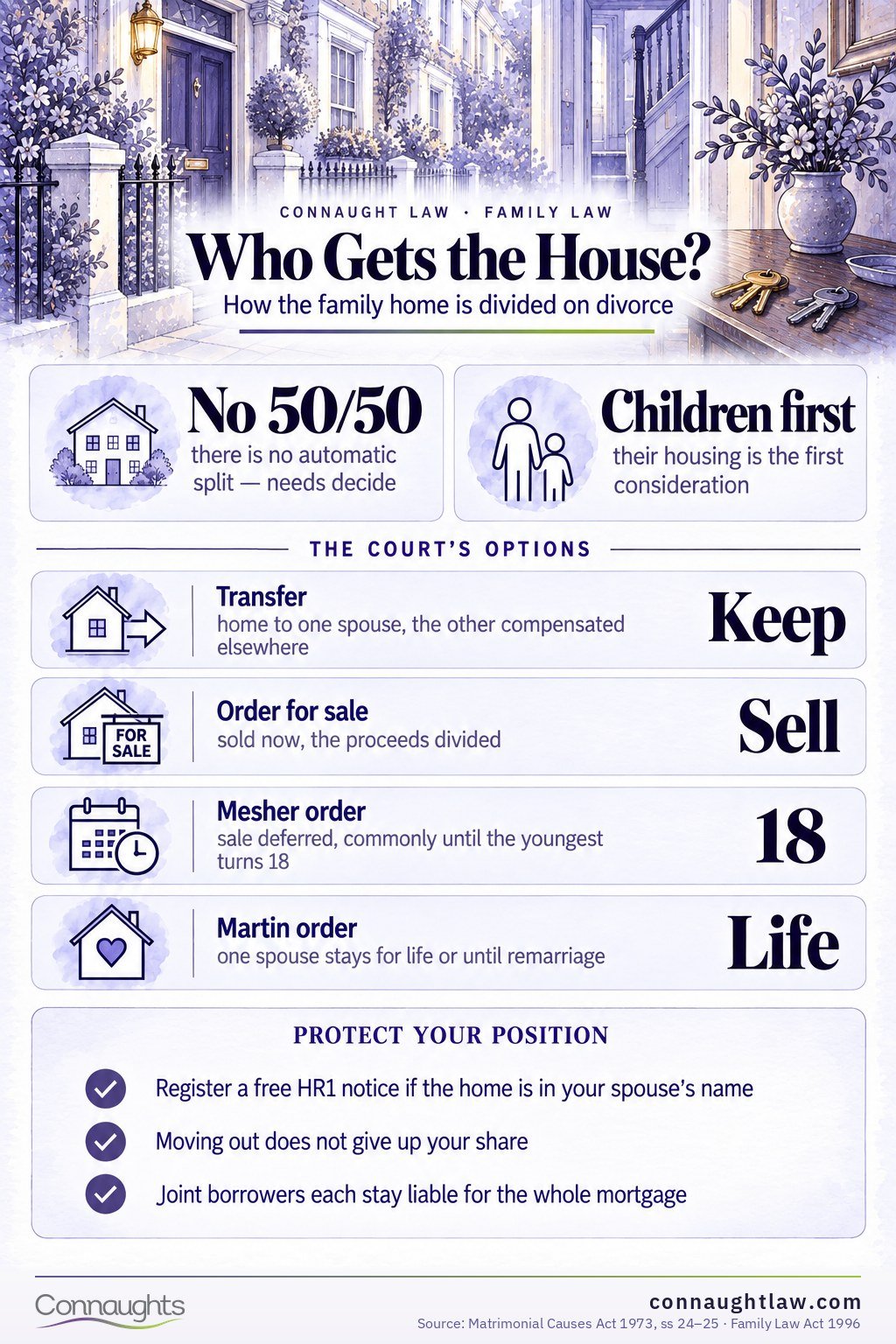
There is no automatic 50/50 and no rule that the owner keeps the house. The court's first consideration is the welfare of minor children, then the needs and resources of both spouses. Whose name is on the title barely matters between spouses — the home can be transferred, sold or preserved whatever the deeds say.
That answer surprises people in both directions. The spouse who bought the house before the marriage discovers sole ownership carries little protective weight; the spouse who never appeared on the deeds discovers they may keep the home outright. Both results flow from the same source: the family home is the asset the law treats most communally, because it is where the family's needs are concentrated.
The Legal Framework for Dividing the Home
The court's powers come from sections 24 and 25 of the Matrimonial Causes Act 1973: property adjustment orders, guided by a fairness test measured first by needs. The section 25 checklist weighs needs, resources, contributions, the length of the marriage, ages, earning capacity and the standard of living — and gives first consideration to the welfare of minor children. The organising principles are needs, sharing and, rarely, compensation. Since Standish v Standish [2025] UKSC 26 the sharing principle formally reaches only matrimonial property — but the family home sits at the heart of that category in almost every case.
How Courts Value the Home
Division starts from a reliable figure. Couples can agree a value from estate agent appraisals; where they cannot, the court expects a single joint expert's RICS valuation, and challenging it has its own rules. Our guide to house valuation for divorce covers the routes, the costs and who pays — the short version is that the figure is evidence, not a negotiating position.
When Only One Name Is on the Deeds
Between spouses, sole legal ownership carries little weight. The court can transfer a house owned entirely by one spouse to the other if fairness and needs require it — ownership matters at the margins, in short marriages, or where the property is genuinely non-matrimonial and needs are met elsewhere. The position is entirely different for unmarried couples, where title is close to everything: our guide to unmarried couples' rights on separation explains that harsher world.
Who Gets the House When There Are Children
Where children live is the gravitational centre of the outcome. The parent with primary care usually needs the home — or a home — and courts build settlements around that: a transfer to the caring parent with the other compensated from different assets, or a deferred sale that keeps the children housed until adulthood. The child arrangements and the housing therefore move together; deciding one while ignoring the other is how settlements unravel.
Home Rights and the HR1 Notice
A spouse who does not own the home has statutory home rights under the Family Law Act 1996 — the right to occupy and not to be excluded without a court order. Those rights bind third parties only if protected: registering an HR1 notice at the Land Registry, free of charge, stops the owning spouse selling or remortgaging over your head while the divorce runs. Home rights end with the final divorce order (the old decree absolute) unless extended — one more reason not to end the marriage before the finances are resolved.
- Home rights die with the final divorce order — protection lapses if you end the marriage first.
- Remarriage before applying for financial remedy can extinguish your own claim.
- Pension survivor benefits and some CGT positions also turn on the order of events.
- Resolve the financial order, then apply for the final order — not the other way round.
Court Orders for the Family Home
Where agreement fails, the court chooses from a short menu — and the menu is worth knowing even if you settle, because negotiated deals are drafted in its shadow and made binding through a consent order (£62 to lodge from 13 July 2026, against £321 to issue contested proceedings). Our guide to financial orders on divorce covers the wider framework.
Orders Over the Home
| Order | What It Does | Typical Use |
|---|---|---|
| Transfer of property | Home to one spouse, with or without a balancing payment or charge-back | Caring parent keeps the children housed |
| Order for sale | Immediate sale, proceeds divided in set shares | Neither can afford the home alone; clean break |
| Mesher order | Sale deferred to a trigger — commonly the youngest child turning 18 — then divided | Children housed now, capital released later |
| Martin order | One spouse occupies for life or until remarriage | Longer marriages without dependent children |
Whichever order fits, the tax consequences of moving the property should be checked before the deal is struck, not after.
Since April 2023, transfers between separating spouses are on a no-gain, no-loss basis for capital gains tax for up to three tax years after separation — and without time limit when made under a court order or formal agreement. The family home itself is usually protected by private residence relief; second homes and rentals need the order structured with tax advice. Our CGT on divorce guide works the rules through — the same outcome sequenced differently can cost five figures.
Joint Ownership, Sole Ownership and Severance
How you hold the home matters most at the edges. Joint tenants own the whole together, and on death the survivor takes everything automatically — which is rarely what a divorcing spouse intends, so severing the joint tenancy to become tenants in common in defined shares is a standard early step in many divorces. Tenants in common already hold distinct shares, which the eventual order can adjust. None of this changes the court's powers; it changes what happens if one of you dies before the order is made.
Where There Are No Children
Without children, the gravitational pull weakens and the sums come forward: sharing what the marriage built, meeting both spouses' housing needs, and the length of the marriage all carry more weight. Short marriage, house brought in by one spouse, needs met both ways — the owner has a real argument for keeping it. Long marriage and one home between you — expect the equity to be shared whatever the title says.
Mortgage Responsibility During and After Divorce
The lender is not a party to your divorce. Joint borrowers each remain liable for the whole mortgage whatever any agreement or order says between you — missed payments damage both credit files, and persistent default shrinks the very equity you are dividing. Agree the interim payments early, in writing, and treat them as part of the settlement arithmetic.
Transferring the home usually means transferring the mortgage: the receiving spouse must pass the lender's affordability tests to take it over alone, or remortgage elsewhere. Where affordability fails, orders get creative — guarantees, charge-backs, delayed transfers — but no court can force a lender to release a borrower. Get the lender conversation started before the settlement is designed around an assumption it will not survive.
Does Moving Out Affect Your Rights?
Moving out does not surrender ownership or your claim to the equity — that myth persists and is wrong. Home rights and beneficial interests survive relocation. What changes is practical: re-entering an established status quo is harder, occupation of the home pending sale affects leverage, and running two households drains the budget that must eventually fund the settlement. Where safety is the issue, an occupation order can exclude an abusive spouse instead — leaving is not the only protective option.
Frequently askedQuestions about keeping, selling or transferring the home
Who gets the house in a divorce in the UK?
There is no automatic rule. The court prioritises the housing needs of minor children, then both spouses' needs and resources under section 25, then fair sharing. The commonest outcomes: transfer to the caring parent with offsetting elsewhere, sale and division, or a deferred sale.
Is my spouse entitled to half the house if it is in my name?
Potentially — and sometimes more. Between spouses the family home is matrimonial property whoever owns it, and the court can transfer it outright if needs require. Sole title matters mainly in short marriages where both parties' needs are met without touching it.
Can my spouse force me to sell the house?
Not unilaterally. A sale needs your agreement or a court order, and a registered HR1 notice stops the owning spouse selling or remortgaging behind your back while the divorce runs. Courts order sale where neither spouse can sustain the home or a clean break demands it.
What happens to the house if we have children?
The children's housing comes first. Typical outcomes: the parent with primary care keeps the home with the other compensated from different assets, or a Mesher order defers the sale — commonly until the youngest turns 18 — so the children stay housed while both retain shares.
Should I move out of the house during divorce?
Leaving does not forfeit ownership or your financial claims — that is a myth. It can, though, shift practical leverage and doubles the household bills mid-negotiation. Take advice before going; where safety is the concern, an occupation order may protect you better than leaving.
Who pays the mortgage during a divorce?
Both joint borrowers stay fully liable to the lender regardless of who lives there or what you agree between yourselves. Missed payments damage both credit files. Agree the interim arrangement early and fold it into the settlement arithmetic rather than leaving it to drift.
Do we pay capital gains tax when transferring the house in divorce?
Usually not for the family home, thanks to private residence relief. Since April 2023, transfers between separating spouses are no-gain, no-loss for three tax years after separation — without time limit under a court order. Second homes and rentals need the order structured with tax advice.
What is a Mesher order and when is it used?
A deferred-sale order: the home is held until a trigger event — typically the youngest child turning 18 — then sold and divided in set shares. It keeps children housed when the assets cannot fund two homes, at the cost of locking up the other spouse's capital until the trigger.
Tell us who owns it, who lives there, the mortgage position and the children's ages. We will tell you the realistic outcomes and the steps that protect your position now.
Get Expert Advice