
Spouses can transfer assets between them free of capital gains tax while they are living together. Separation used to end that treatment at the close of the tax year; since April 2023 it continues for the three tax years after the year of separation — and without limit where the transfer is made under a court order or formal agreement. This guide explains the windows, the reliefs, and the sequencing that keeps a settlement tax-free.
On This Page

The tax that arrives after the deal is done
Capital gains tax on transfer of property on divorce is usually avoidable: transfers between separating spouses are on a no-gain, no-loss basis for three tax years after the year of separation, and indefinitely where made under a court order or formal agreement. Miss both routes and the transfer is taxed at market value.
The trap is sequencing, not rates. The same settlement executed in a different order — final order first, transfer later, no consent order — can move a couple from zero tax to a five-figure bill. The rules below decide which side of that line you land on, and the worked examples at the end show the arithmetic in practice.
What Changed on 6 April 2023
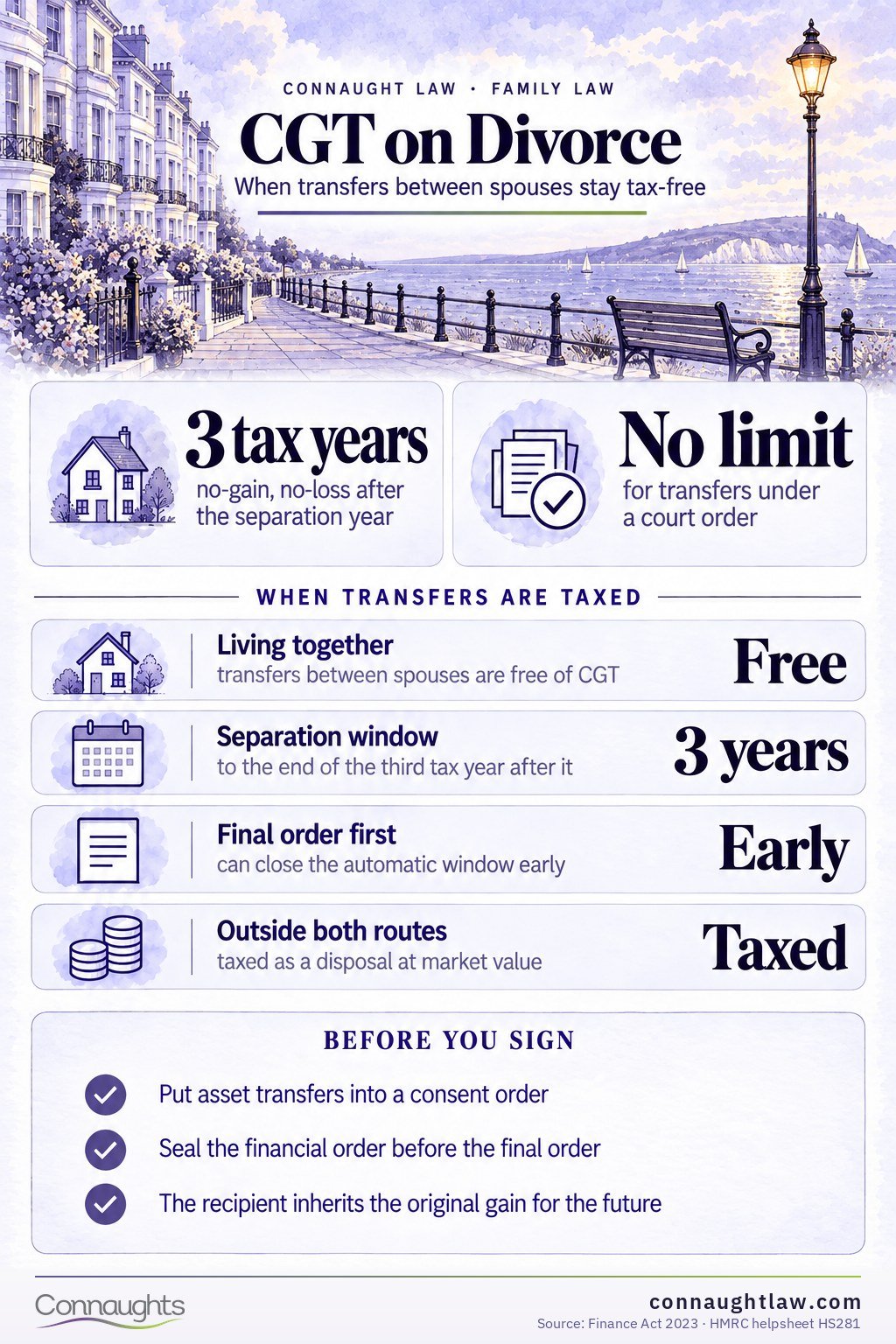
Before April 2023, no-gain, no-loss treatment ended with the tax year of separation — a couple separating in March had weeks to reorganise their entire financial life tax-free. The Finance Act 2023 reforms replaced that cliff with the current regime: three full tax years after the year of separation for transfers generally, and no limit at all for transfers made under a formal divorce agreement or court order. Separating couples now plan around a timetable rather than a trapdoor.
A technical guidance update issued by HMRC in April 2025, affecting divorce CGT treatment, was reversed in May 2025 — current rules continue exactly as described here. The episode is worth remembering for one reason: tax guidance moves, sometimes briefly, and settlement documents should be checked against the rules in force on the day they are signed.
The Three-Tax-Year Transfer Window
The automatic window runs to the end of the third tax year after the tax year in which you separated. Separate any time between 6 April 2024 and 5 April 2025, and no-gain, no-loss transfers run until 5 April 2028. The recipient inherits the original acquisition cost, so no tax arises on the transfer itself — the gain is deferred until they eventually dispose of the asset.
Calculating Your Transfer Deadline
- Fix the date of permanent separation — the tax year it falls in starts the clock.
- Count three complete tax years from the end of that year: separation in 2024–25 means protection to 5 April 2028.
- The final divorce order can close the window earlier — check both dates, not one.
- Transfers under a court order or formal agreement ignore the window entirely — no deadline applies.
Why the Final Order Can Close the Window Early
The automatic protection ends at the final divorce order (the old decree absolute) where that comes before the three-year deadline — a trap for couples who complete the divorce quickly and leave the asset shuffling for later. The cure is simple and standard: put the transfers into a consent order. Orders and formal agreements carry unlimited no-gain, no-loss treatment, which is one more reason the financial order should come before the final order, not after.
Property Transfers in Divorce Settlements
Transferring the Family Home
The family home is usually the easy case: private residence relief exempts the gain for periods you lived there plus the final nine months of ownership, so a transfer between spouses — or a sale — rarely produces tax for the occupying spouse. The 2023 reforms also protect the spouse who moved out: where they transfer their interest to the remaining spouse, or retain a percentage of eventual sale proceeds under a Mesher-style arrangement, relief can apply to their share as if the home had remained their main residence.
Investment Property and Buy-to-Let Transfers
Second homes and rentals have no residence relief, which makes them the assets the windows exist for. Inside the window — or under an order — they move between spouses tax-free, with the gain deferred. Outside both, each transfer is a market-value disposal: residential property gains are taxed at 18% within the basic rate band and 24% above it, and with buy-to-let gains often measured in six figures, the sequencing decision is worth real money. A reliable valuation anchors all of it.
CGT Exemptions for Divorcing Couples
No Gain, No Loss Treatment
No-gain, no-loss does not erase a gain — it moves it. The receiving spouse takes the asset at the transferor's original base cost and inherits the whole gain for the future. In negotiation that matters: £200,000 of shares carrying a large deferred gain is worth less after tax than £200,000 of cash, and settlements that ignore latent tax overpay the receiving party's true position.
Private Residence Relief
Full exemption covers your main residence for the periods you occupied it, plus the final nine months of ownership regardless of occupation. Married couples share one main residence between them; on separation each can eventually establish their own. Elections and timing around second properties reward advice — the relief is generous but mechanical, and it follows the facts of occupation, not the intentions.
Using Both Annual Exempt Amounts
The annual exempt amount is £3,000 per person for 2026–27. Where taxable disposals are unavoidable, spreading them across tax years and across both spouses uses multiple exemptions instead of one — modest money against the sums above, but free for the cost of a diary. The current rates and allowances are on GOV.UK, and HMRC's helpsheet HS281 covers separation specifically.
Worked Examples: Three Common Scenarios
Scenario 1: Recent Separation, Family Home Transfer
James and Sarah separated on 15 September 2024. They jointly own the family home — bought in 2015 for £280,000, now worth £520,000 — and Sarah wants to buy James out, with the divorce finishing in 2026. Separation fell in 2024–25, so no-gain, no-loss protection runs to 5 April 2028: the transfer to Sarah triggers no CGT, and she inherits James's £140,000 share of the original base cost. Because the house was always their main residence, private residence relief would have sheltered the gain in any event — this is the doubly protected case.
Scenario 2: Old Separation, Expired Window
David and Emma separated in March 2019 and never formalised the divorce. Their three jointly owned buy-to-lets are worth £900,000 against £450,000 of cost, and they now want to split them. The window for a 2019 separation closed in April 2023 — so transfers now are market-value disposals unless made under a formal agreement or order. Without one, each faces CGT on £225,000 of gain: after the £3,000 exemption, £222,000 at 24% is £53,280 each. With a consent order, the same transfers are no-gain, no-loss. The order is the difference.
Scenario 3: Deferred Sale, Percentage Entitlement
Michael moved out of the family home in June 2023; Lisa remains there with the children, and their 2024 consent order gives Michael 40% of the sale proceeds when the property sells around 2030. Under the deferred-sale rules, Michael's share keeps the CGT treatment he would have had at the time of the order: the home remained the family's main residence throughout, private residence relief covers both shares, and his 40% arrives tax-free. Moving out did not cost him the relief — the 2023 reforms exist for exactly this pattern.
Frequently askedQuestions about CGT on transfers, deadlines and reliefs
How long do I have to transfer assets to my ex-spouse without paying CGT?
Until the end of the third tax year after the tax year you permanently separated, or the final divorce order if that comes first. Transfers made under a court order or formal divorce agreement have no deadline at all — which is why the consent order matters.
What is the CGT rate on divorce property transfers?
Inside the no-gain, no-loss windows: nothing — the gain defers. Outside them, residential property gains are taxed at 18% within the basic rate band and 24% above it, after the £3,000 annual exempt amount (2026–27 figures, per GOV.UK).
Do I need a court order to avoid CGT on divorce transfers?
Not within the three-tax-year window — protection there is automatic. A consent order or formal agreement adds unlimited time protection, which matters where the window has expired, the divorce completed early, or a deferred sale runs for years. For most settlements it is cheap insurance.
What happens if I transfer property after the deadline without a formal agreement?
The transfer is treated as a disposal at market value and CGT falls due on the full gain since acquisition — on a £300,000 gain, £297,000 taxed at 24% is £71,280. The same transfer inside a consent order would have been no-gain, no-loss.
Does Private Residence Relief protect the family home transfer?
Usually, yes: the relief exempts gains for your periods of occupation plus the final nine months of ownership. Since April 2023 a departing spouse who transfers their interest, or takes a share of eventual sale proceeds, can keep relief on their share despite having moved out.
How did the 2025 HMRC guidance change affect divorce settlements?
It didn't, in the end — the April 2025 technical update was reversed in May 2025 and the rules continue as described here. Its real lesson is procedural: have the tax position checked against current guidance immediately before signing, not months earlier.
Can we save tax by spreading transfers across tax years?
Where disposals are taxable, yes: sequencing across years and across both spouses uses multiple £3,000 annual exemptions and can keep gains within basic-rate bands. Inside the no-gain, no-loss windows the point is moot — nothing is taxable to spread.
What CGT issues affect international couples divorcing in the UK?
Residence and treaty position drive everything: a spouse taxable abroad may face foreign tax where the UK sees none, and UK property disposals by non-residents have their own reporting regime. Cross-border settlements need the tax advice coordinated in both jurisdictions before the order is drafted.
Tell us when you separated, what is being transferred and whether a consent order exists. We will tell you which window you are in and what the sequencing saves.
Get Expert Advice