
When a marriage ends, the family home is usually the largest asset to divide — and the first disagreement is often about what it is worth. This guide explains how a house is valued for divorce in England and Wales: the routes to a reliable figure, what each costs and who pays, when the court requires an independent expert, and what you can do when your former partner does not accept the number.
On This Page

How Assets Are Valued When You Divorce
A financial settlement starts from an accurate picture of what there is to divide. Under section 25 of the Matrimonial Causes Act 1973, the court weighs each party's needs, contributions and resources — and it can only do that against genuine market values, not guesswork. An informal estimate that suits one side rarely survives scrutiny: it invites challenge, delays proceedings, and can cost far more to correct than a proper valuation would have cost to obtain.
Each asset has its own kind of valuer. Property is valued by RICS-registered surveyors, businesses by chartered accountants, pensions by actuaries, and vehicles, artwork or jewellery by specialist valuers. What matters in every case is the same: a report the court can rely on, with a clear methodology, comparable evidence, and the expert's duty owed to the court rather than to the person paying the bill.
Financial disclosure in divorce proceedings is given on Form E, exchanged no later than 35 days before the first appointment. It must state a current market value for the family home and any other property, and list personal belongings individually worth more than £500. Deliberate under-valuation or concealment is treated as fraud on the court: in Sharland v Sharland [2015] UKSC 60 the Supreme Court confirmed that fraudulent non-disclosure can reopen a financial order even after it has been approved.
How to Get Your House Valued for a Divorce
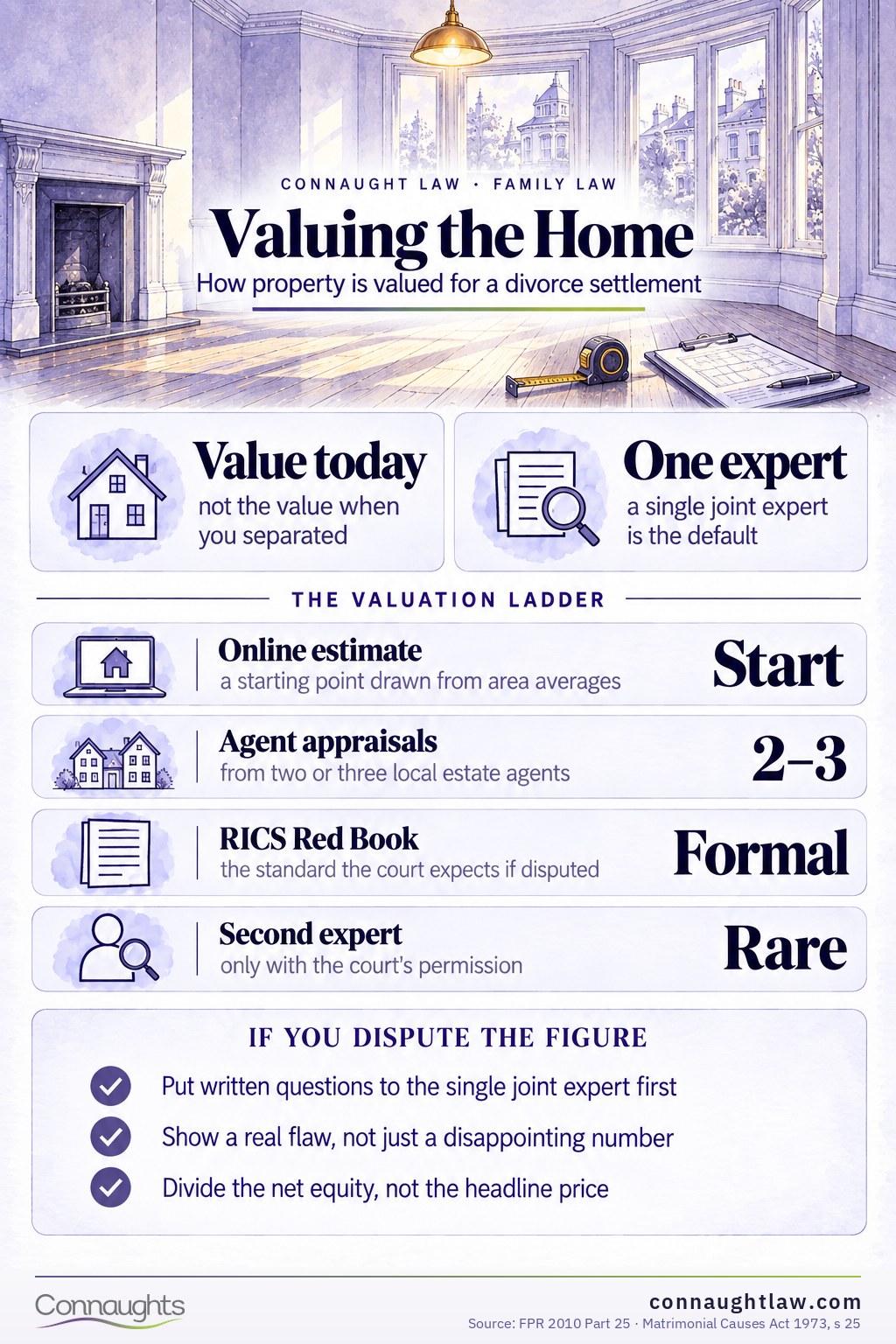
Most couples reach a house valuation in one of three ways, and the right route depends on how much you disagree. Start simple: the cheapest figure both of you accept is the best one. The court only expects formal expert evidence where the number is genuinely in dispute — and the further up the ladder you go, the more it costs and the longer it takes.
Online Estimates and Estate Agent Appraisals
Online estimates from portals such as Zoopla or Rightmove are a starting point, nothing more — they are drawn from area averages and cannot see the condition of your home. Free market appraisals from two or three local estate agents are the usual next step. Where a divorce is amicable and both of you accept the average of those figures, that is often enough for a negotiated settlement or consent order, at no cost at all.
When You Need a RICS Red Book Valuation
Where the figure is contested, or a substantial settlement will be built on it, a formal valuation from a RICS-registered surveyor is the standard the court expects. A Red Book report sets out methodology, comparable sales and adjustments, and is admissible in financial remedy proceedings. Expect £400–£800 for a standard home, more for high-value or unusual property. In contested proceedings the surveyor is normally appointed as a single joint expert — one valuer, instructed by both of you, with the fee split equally.
What a House Valuation Costs
- Standard home (£200k–£500k): RICS Red Book valuation £400–£600, report in 2–3 weeks
- High-value property (£500k–£2m): £800–£1,200, 3–4 weeks, with detailed comparable analysis
- Complex estate or portfolio: £1,500–£3,000+, 4–8 weeks — multiple buildings, land or development potential
- Buy-to-let: £500–£1,000, 2–4 weeks, including rental yield analysis
- Overseas property: £800–£2,500 depending on jurisdiction, 4–12 weeks, common in international divorce cases
Who Pays and Which Date Counts
Estate agent appraisals are free. A privately instructed surveyor is paid by whoever instructs them, and a single joint expert's fee is split equally unless the court orders otherwise. On timing: the court works from current values, not the value when you separated or when you bought the house. A valuation more than a few months old will usually need updating before a final hearing, and in a moving market that can shift the settlement — so obtain figures as close to the negotiation or hearing as is practical.
It is the net equity that gets divided, not the headline price. From the agreed value come the mortgage redemption figure (including any early repayment charge), sale costs where a sale is planned — typically 1–3% agent's commission plus conveyancing — and any capital gains tax on divorce that applies to property other than the main home. Those deductions can change the arithmetic of a settlement significantly, which is why they belong in the financial orders negotiation from the start.
When the Court Requires an Independent Expert
Expert valuation evidence in financial proceedings is governed by Part 25 of the Family Procedure Rules 2010. The court's permission is needed before expert evidence can be relied on, and the default is a single joint expert (SJE): one valuer, jointly instructed, owing their duty to the court rather than to either party. Each side can put written questions to the expert about the report, and instructing a second expert is allowed only with the court's permission — granted sparingly, where there is real reason to doubt the first report.
The qualification must match the asset: RICS-registered surveyors for property, chartered accountants or corporate finance specialists for a business, qualified actuaries for pensions. The report itself must comply with Part 25's requirements — the expert's qualifications, the instructions received, the methodology and its limitations, and a declaration that the duty to the court overrides any obligation to the instructing party. A report that falls short risks rejection, with the cost and delay of re-instruction.
Single Joint Expert vs Separate Expert Instructions
| Instruction Type | Cost Structure | Timeline Impact | Court Preference |
|---|---|---|---|
| Single Joint Expert (SJE) | Split 50/50 between parties, typically £400-£15,000 total depending on asset | 4-8 weeks from instruction to report delivery | Strongly preferred, default approach unless exceptional circumstances |
| Separate Expert Instructions | Each party pays own expert, doubling total costs to £800-£30,000 | 8-16 weeks including report exchange and reconciliation meetings | Disfavoured, requires court permission demonstrating necessity |
| Party-Instructed Shadow Expert | Each party's private cost, £300-£10,000 for advisory opinion only | Parallel to SJE process, no tribunal delay | Permitted for advice but report inadmissible without court permission |
Pension Valuation in Financial Proceedings
A pension is often the largest asset in the case after the family home, and it cannot be valued by asking the provider for a cash equivalent alone. Where the fund is substantial, or where the scheme is a defined benefit one, the court will usually want a report from a pensions actuary before any division is agreed. We set out how that instruction works, and how pension sharing differs from offsetting, in our guide to pensions and divorce.
Challenging a Valuation You Think Is Wrong
The first route is written questions to the single joint expert under Part 25 — asking the expert to justify the comparables, explain an assumption, or address something the report overlooked. It is quick and cheap relative to the alternatives, and it often resolves the issue: the expert either defends the figure convincingly or adjusts it. Questions must stay within the scope of the original instruction; anything more is likely to need a further fee or the court's involvement.
If the report is more fundamentally flawed, the next step is asking the court for permission to instruct a second expert. Permission is the exception, not the rule: you need to show a substantial problem — wrong comparables, a methodology error, a factual premise that is untrue — not merely that you hoped for a bigger number. Where two reports do end up in play, the experts are usually directed to meet and produce a joint statement narrowing what remains in dispute.
Grounds for Challenging a Valuation
- Inappropriate comparables: sales from the wrong area, the wrong property type, or too old to reflect the market
- Methodology errors: the wrong basis of value, missed adjustments, or non-compliance with Red Book standards
- False factual premises: the report assumes a condition, tenancy or planning position that is wrong
- Qualification concerns: the expert lacks the accreditation or experience the asset requires
- Bias or advocacy: the report argues for one side instead of assisting the court
- Stale figures: the valuation is too old for a moving market and needs updating
Resolving a Valuation Dispute
Most valuation disputes settle without a judge. Where the gap between figures is modest — within roughly 10–15% — the pragmatic answer is usually to negotiate or split the difference, because the cost of fighting quickly exceeds the amount at stake. Family mediation gives that negotiation structure: a neutral mediator works through why the figures differ and what evidence would close the gap, and anything agreed is recorded ready to be turned into a consent order.
If mediation fails, the court's own process pushes hard towards settlement. At the Financial Dispute Resolution hearing, a judge who will not decide the final case reviews both positions and gives a frank indication of the likely outcome — often enough to bring an unrealistic valuation position back to earth. Only a small minority of cases go beyond the FDR to a final hearing, where the judge hears the experts and decides the figure.
Dispute Resolution Routes and Costs
| Resolution Method | Cost Range | Timeline | Outcome Type |
|---|---|---|---|
| Direct Negotiation | Solicitor time only, charged at an hourly rate | 2-4 weeks for straightforward disagreements | Consensual agreement requiring both parties' acceptance |
| Family Mediation | £150-£300 per hour mediator fees, typically 3-5 sessions | 6-12 weeks including preparation and follow-up | Voluntary settlement recorded in Memorandum of Understanding |
| Private FDR | £3,000-£8,000 including retired judge or KC fees and legal costs | 8-16 weeks from agreement to hearing | Judicially-facilitated settlement with preliminary indication |
| Court FDR Hearing | £5,000-£15,000 legal costs including preparation and attendance | 20-35 weeks within court financial remedy timetable | Judge's preliminary view encouraging settlement |
| Final Contested Hearing | £15,000-£50,000+ including expert evidence and trial costs | 12-18 months from application to final order | Binding judicial determination with costs consequences |
Before contesting any figure, weigh the dispute against its price. A £10,000 disagreement over the house is rarely worth £30,000 of contested proceedings, and judges penalise disproportionate litigation in costs. The right question is never whether the valuation can be attacked — most can be — but whether the net result after fees leaves you better off. We advise on exactly that calculation before any challenge is launched.
Frequently askedQuestions about getting a house valued for divorce
How much does a house valuation for divorce cost?
Estate agent appraisals are free. A RICS Red Book valuation costs £400–£800 for a standard home, rising to £1,500–£3,000 for complex or very high-value property. Where the surveyor is appointed as a single joint expert, the fee is split equally between you. Reports typically arrive two to four weeks after instruction.
Can we use an estate agent's appraisal instead of a surveyor?
Yes, if you both accept the figure. Many amicable divorces average two or three free agent appraisals and settle on that basis. But an appraisal is a marketing opinion, not expert evidence — if the value is disputed, or the court is involved, expect to need a RICS valuation from a single joint expert.
What happens if my ex does not accept the valuation?
The usual sequence is written questions to the expert, then negotiation or mediation, then — only with the court's permission — a second expert. Permission requires showing a real flaw in the report, not just disappointment with the number. Most disputes settle once a judge gives an indication at the FDR hearing.
Do we both have to use the same valuer?
In court proceedings, usually yes: the single joint expert is the default, instructed and paid for jointly, and a separate expert needs the court's permission. You can take advice privately from your own "shadow" valuer at your own cost, but that report cannot be used in evidence without permission.
Tell us who instructed the valuer, what figure came back and what you think it has missed. We will tell you whether that is a point worth taking and how it is usually raised.
Get Expert Advice