
After the family home, pensions are usually the largest asset in a marriage — and the one most often under-valued or traded away badly. Courts can share them by percentage, offset them against other assets or, rarely now, attach future income. Getting it right means understanding cash-equivalent values and their blind spots, the public sector rules after McCloud, what happens to state pensions, and the timing traps around the final order.
On This Page

The biggest asset nobody values properly
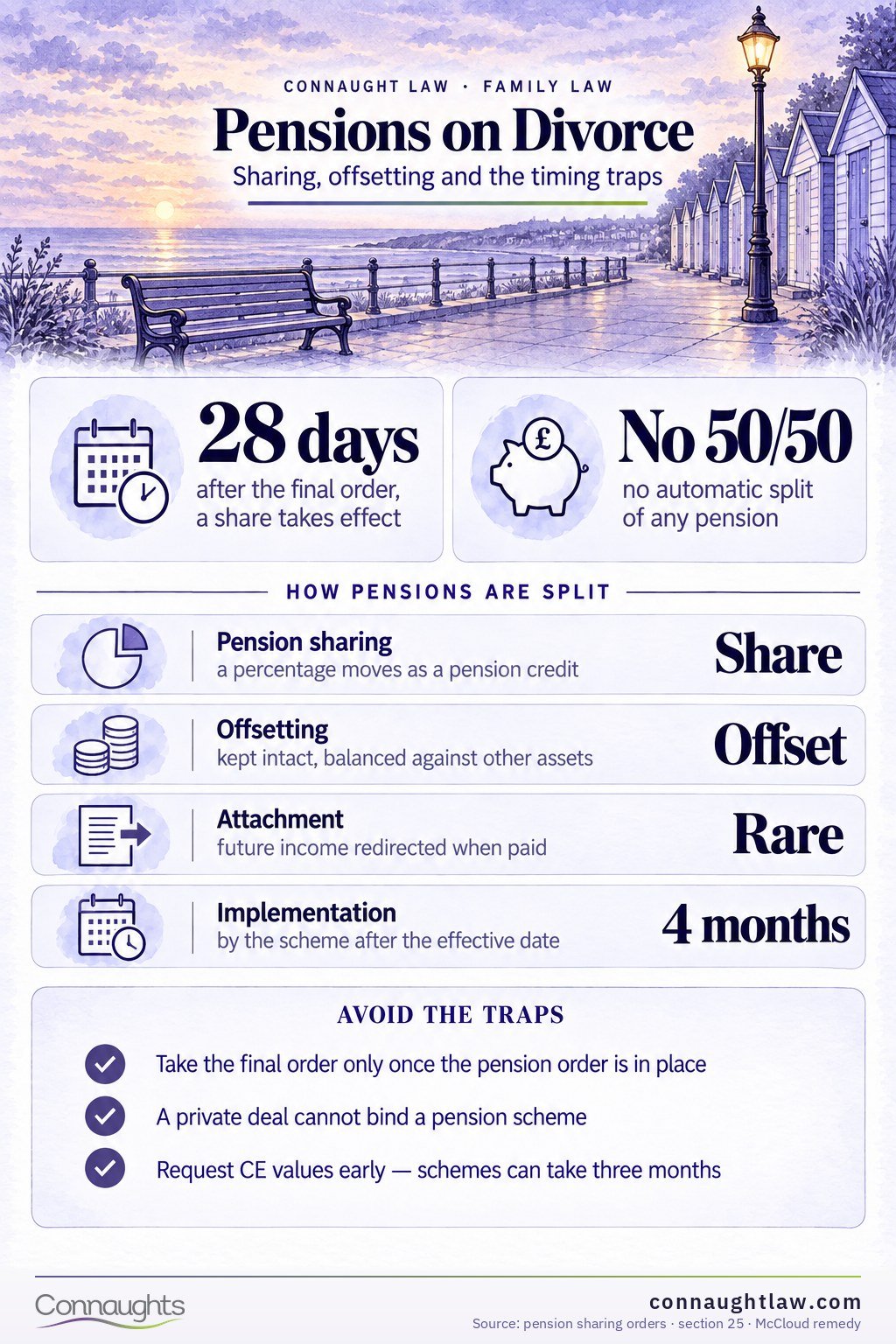
Pensions built during the marriage are matrimonial assets: courts share them by percentage through a pension sharing order, offset them against other assets, or — rarely now — attach future income. Nothing transfers automatically, private deals cannot bind a scheme, and a sharing order only takes effect once the final divorce order is made and 28 days have passed.
The reason pensions are traded away cheaply is that their headline number misleads. A cash-equivalent value is a scheme's estimate, not a market price — and for defined-benefit schemes it frequently understates what the promised income would cost to buy. Everything in this guide flows from that one problem: value the pension properly, and the rest of the settlement arithmetic becomes honest.
Pension Entitlement on Divorce
There is no automatic 50% split. Pensions are weighed within the section 25 exercise alongside everything else — though in longer marriages courts commonly aim at equality of retirement income, which can mean more or less than half of any given pot. Accrual during the marriage is squarely shareable as matrimonial property; pre-marital accrual can be argued out, subject always to needs. Disclosure starts with the cash-equivalent value of every pension in Form E — schemes must provide one free CE per year and can take up to three months, so request them early.
What Is a Pension Sharing Order?
A pension sharing order transfers a stated percentage of one spouse's pension to the other as a pension credit — an independent pension in the recipient's own name, immune to the ex-spouse's later choices, deaths and remarriages. The tax wrapper survives the transfer: the credit grows tax-advantaged and becomes accessible from normal minimum pension age (57 from April 2028), with the recipient's own lump-sum entitlement under the post-2024 allowance rules.
How Pension Sharing Orders Work in Practice
The sequence runs: CE valuations, a negotiated percentage — often built on an expert's report where the schemes are complex — the order made within the financial remedy order, and implementation by the scheme within four months of the effective date. The effective date itself is where couples trip: the order takes effect only when the final divorce order is made and 28 days have passed.
- A pension share dies with the member if they die before implementation — do not delay the final order sequence casually.
- Apply for the final divorce order only once the pension order is in place, not before.
- Remarriage before financial claims are made can extinguish them entirely.
- Diarise the scheme's four-month implementation window and chase it.
The Three Methods of Pension Division
Methods Compared
| Method | What Happens | Watch For |
|---|---|---|
| Pension sharing | A percentage transfers as a pension credit — clean break, independent funds | Effective 28 days after the final order; death before implementation can defeat it |
| Offsetting | Pensions kept intact, balanced against other assets such as the house | £1 of pension is not £1 of equity — discount for tax and accessibility |
| Attachment | Future income or lump sums redirected when eventually paid | Now rare: no clean break, waits on the member's choices, largely dies with them |
Sharing suits genuine retirement equality, especially after long marriages. Offsetting suits couples with enough non-pension wealth to balance the books — commonly one keeping the house, the other the pension — but only with honest discounting. Attachment survives mainly in legacy orders.
Protecting Your Pension in Divorce
Protection is built from evidence, not concealment. For the member: dated statements proving pre-marital accrual, and an argument confining sharing to the marital portion — needs permitting. For the non-member: refuse offsetting priced at raw CE parity, and understand what happens to survivor benefits and death-in-service cover before the final order, not after. Both sides protect themselves the same way — by valuing properly before negotiating.
Age Gaps, Ill Health and Retirement Horizons
Personal circumstances move pension outcomes more than any other asset class. A large age gap changes when each party can access their share; ill health changes the life expectancy behind every actuarial figure and can justify departing from standard approaches entirely. Standard percentages suit standard lives — where yours is not, the expert report earns its fee twice over.
Public Sector Pension Sharing: NHS, Teachers, Police, Civil Service
Public sector schemes promise income rather than capital, and their CE values frequently understate the real cost of the benefits — a police or NHS pension's guaranteed, index-linked income would cost far more to buy than its paper figure suggests. Shares are implemented through internal membership rather than transfers out. The McCloud remedy, resolving the age-discrimination litigation, adds a current complication: affected members' remedy choices change their benefits and their CE figures, so valuations produced mid-remedy may need re-running before they are relied on.
State Pension and Divorce Rights
The new state pension — for those reaching pension age from April 2016 — cannot be shared on divorce, with one exception: a protected payment above the full rate can be. Older, pre-2016 entitlements carry legacy substitution rules that can boost a divorced person's basic pension using an ex-spouse's record. Get a state pension forecast during the divorce, identify National Insurance gaps, and price voluntary contributions into the settlement — small money now, meaningful income later. MoneyHelper's guidance covers the mechanics.
Professional Support: Where Valuation Earns Its Fee
Instruct a pensions-on-divorce expert (PODE) whenever the case involves defined-benefit or public sector schemes, a large age gap, ill health, multiple pensions or a proposed offset. The report typically costs a small fraction of the value it protects, and courts increasingly expect one where the pensions are substantial. Legal strategy and regulated financial advice then divide the labour: the financial order fixes the split; an adviser helps the recipient invest what arrives.
Frequently askedQuestions about sharing, offsetting and valuing pensions
Is my spouse entitled to my pension in divorce?
Potentially, whatever the account name says: pensions are matrimonial assets weighed in the overall settlement, and accrual during the marriage is squarely shareable. Nothing transfers automatically, though — a court order is the only mechanism that moves pension rights.
How much of my pension will my ex get?
There is no fixed fraction. Courts aim at fairness — often equality of retirement income after a long marriage, which can mean more or less than 50% of any particular pot once ages, other assets and pre-marital accrual are weighed.
What is the difference between pension sharing and offsetting?
Sharing transfers a percentage of the pension itself, giving each spouse independent retirement funds. Offsetting leaves pensions intact and balances them against other assets — workable only when the trade is discounted honestly, because £1 of pension is not worth £1 of accessible equity.
Can my state pension be split in divorce?
The new state pension cannot be shared, except any protected payment above the full rate. Pre-2016 entitlements carry legacy substitution rules that can improve a divorced person's position. Get a forecast during the divorce and factor National Insurance gaps into the settlement.
What happens to my pension share if my ex dies?
After implementation, a pension credit is entirely yours — your ex's death does not affect it. The danger sits before implementation: death between the orders can defeat a share, which is why the sequence and the scheme's four-month window deserve active management.
Are NHS, police and teacher pensions treated differently?
They are shared through internal membership rather than transfers out, and their CE values often understate the promise — guaranteed index-linked income is expensive to replicate. The McCloud remedy is currently changing many members' figures, so check valuations are post-remedy before relying on them.
Do we need a pension sharing order if we agree privately?
Yes. Only a court order can transfer pension rights — a private deal to sort the pensions later is unenforceable against the scheme, dies with the payer, and leaves financial claims open. Agreeing the split amicably is fine; embody it in a consent order.
Can I protect the pension I built up before we married?
Often, partially: evidence the pre-marital accrual with dated statements and argue for sharing confined to the marital portion. Courts accept the logic in principle — but needs can still override it where the other assets cannot support both households in retirement.
Tell us what schemes exist, roughly what they are worth on paper and how long the marriage ran. We will tell you whether sharing or offsetting fits — and what the paper figures are hiding.
Get Expert Advice