
A broken jaw disrupts eating, speech and work for weeks, and compensation follows those consequences. Under the Judicial College Guidelines (18th edition, April 2026), awards run from £8,530 for a simple fracture with full recovery to £60,160 for multiple fractures with permanent disability — while the six-figure "jaw brackets" repeated online are fabricated. This guide explains what surgery with plates means for your award, gives an honest answer on average settlements, and sets out the two routes after an assault: a civil claim where an insured defendant exists, and the CICA scheme where the attacker cannot pay.
On This Page
Understanding Broken Jaw Compensation UK 2026
A fractured mandible interferes with the most routine acts: eating, speaking, yawning, sleeping on one side. Treatment — fixation with plates or weeks of wiring — brings liquid diets, weight loss and time away from work, and the aftermath can include numbness in the lip and chin from inferior alveolar nerve damage, clicking temporomandibular joints, bite misalignment and dental damage. Compensation is valued on exactly these consequences: a general damages bracket set by severity, plus every financial loss the injury causes.
Jaws break where lives collide: assaults above all, road collisions involving cyclists and motorcyclists, sports impacts, falls onto hard edges and workplace incidents. The legal route follows the mechanism. A civil personal injury claim runs against a defendant who exists and can pay; the state scheme steps in where an assailant is unidentified or has nothing. Route selection is the first strategic decision in every jaw claim.
Fracture patterns matter medically and legally. Condylar fractures near the joint threaten long-term movement and bite; angle fractures track through wisdom-tooth territory and its nerves; breaks at the chin often pair with a second fracture elsewhere in the jaw. Bilateral and comminuted patterns anchor the top bracket, and the radiology report is where a claim's tier first becomes legible.
Broken Jaw Compensation Amounts
The jaw ladder in the Judicial College Guidelines, 18th edition (April 2026), has three published rungs.
Jaw Fracture Brackets
| Fracture Category | JCG 18th Edition Bracket |
|---|---|
| Simple fracture — treatment, complete recovery | £8,530 – £11,540 |
| Serious fracture — permanent consequences such as difficulty eating or paraesthesia | £23,730 – £40,280 |
| Very serious — multiple fractures, prolonged treatment, permanent disability | £40,280 – £60,160 |
Position within a bracket follows the residuals: nerve symptoms and their distribution, eating restrictions, joint dysfunction, bite alignment and any facial asymmetry. Associated injuries are valued alongside under their own chapters — loss of or serious damage to several front teeth at £11,540 to £15,080, facial scarring from £2,260 at its most trivial to £39,750 for significant scarring and beyond, and moderate psychiatric injury at £7,740 to £25,190, which assault cases routinely engage.
- Figures such as £100,040 to £120,048 appear in no edition of the Judicial College Guidelines.
- Their false precision is the tell; the Guidelines publish rounded brackets, not invented decimals.
- The top published jaw bracket is £40,280 to £60,160 under the 18th edition.
- Larger totals are built from associated injuries and financial losses, not from brackets that do not exist.
What Is the Average Settlement for a Broken Jaw?
No official average exists — courts and the Judicial College publish brackets, not settlement statistics, so any single "average" figure online is marketing. What can honestly be said: most broken jaw claims involve a simple fracture that heals fully, producing general damages of £8,530 to £11,540 plus financial losses, so typical settlements sit in the low five figures. Serious fractures with permanent consequences settle from £23,730 upward before losses, and earnings and dental costs often multiply the final total well beyond the bracket itself.
Surgery with Plates: What It Means for Compensation
A jaw fracture fixed with plates (ORIF) that heals fully typically attracts £8,530 to £11,540 under the 18th edition Judicial College Guidelines. Where surgery leaves permanent numbness, difficulty eating or restricted opening, awards rise to £23,730 – £40,280, and to £40,280 – £60,160 for multiple fractures with lasting disability. Financial losses are added on top of these figures.
Open reduction and internal fixation — ORIF — is the standard operation for displaced jaw fractures: small titanium plates and screws hold the bone while it unites, usually placed through incisions inside the mouth so no external scar results. Some fractures are managed instead with wiring or elastics that immobilise the jaws for weeks. Needing an operation at all is itself a severity marker, because surgeons plate fractures that are displaced, unstable or multiple.
There is no separate "plates bracket" in the Guidelines: the operation is evidence, and the outcome decides the award. A single plated fracture with full recovery within months sits in the simple bracket, usually toward its top given the surgery and its recovery burden. Plating followed by permanent paraesthesia, eating difficulty or restricted mouth opening moves the claim into the serious bracket. Multiple plated fractures with prolonged treatment and lasting disability anchor the very serious bracket.
The recovery period is claimable in its own right. Weeks of liquid or soft diet, weight loss, disturbed speech, dental hygiene difficulties and time off work all belong in the schedule of loss, supported by weight records, food diaries and employer evidence. For public-facing or physical work, the fixation weeks are usually a complete absence.
Plates are normally left in place permanently, but infection, irritation or cold sensitivity leads to removal surgery in a minority of cases — a further operation whose costs and recovery weeks must be priced into the claim before settlement, not discovered after it. For assault victims, the CICA tariff set out below also pays specifically more where the fracture required an operation and disability continues.
Assault Claims and the CICA Route
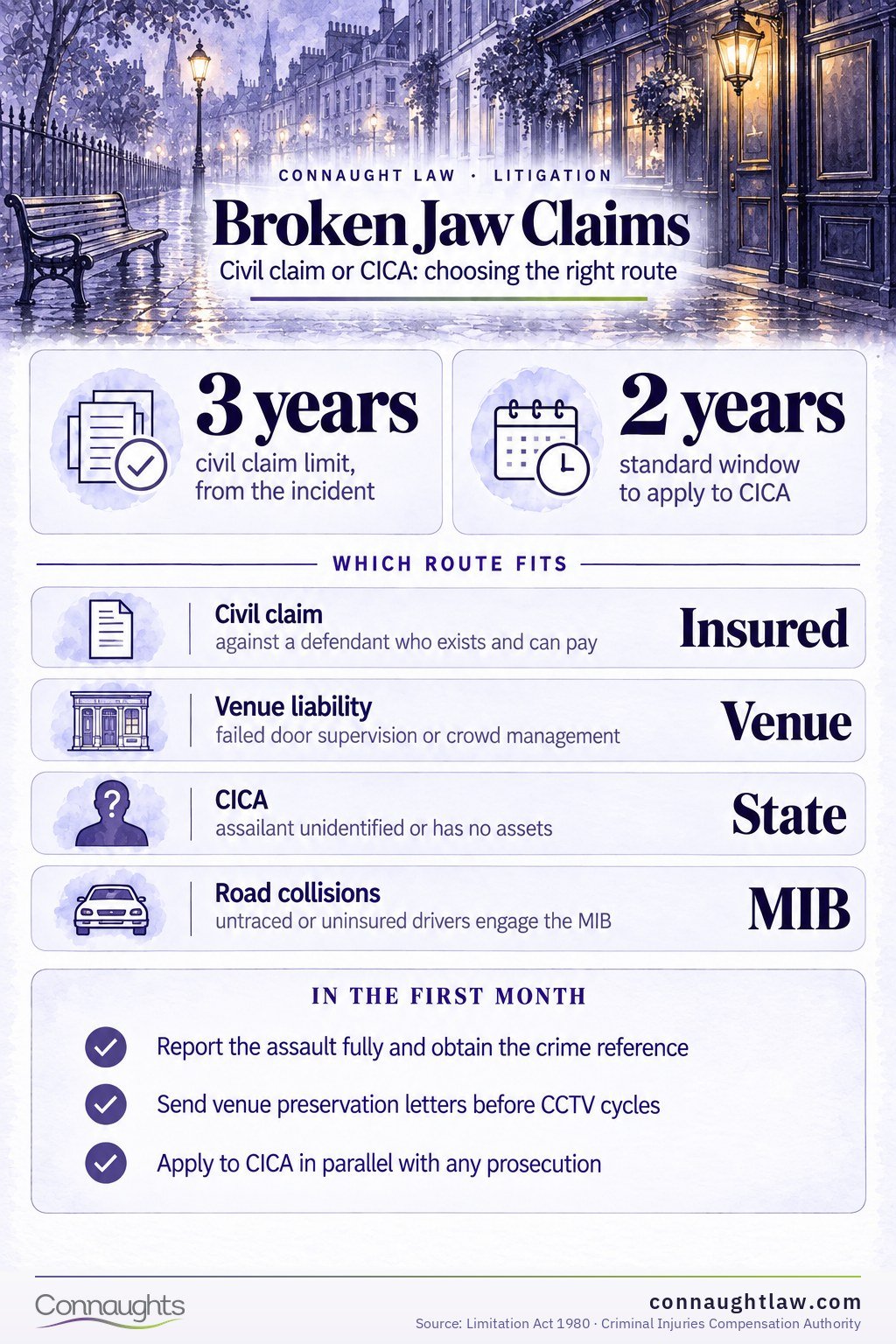
Assault is the jaw fracture's signature cause, and it forks the claim. Where a civil defendant exists and can pay — occasionally the attacker, more realistically a venue whose security or crowd management failed — civil damages under the brackets above are the better route. Where the assailant is unidentified, unconvictable or has no assets, the Criminal Injuries Compensation Authority pays on its own statutory tariff.
The uninsured assailant is the hard reality of assault claims. A judgment against an individual with no insurance, home or income is usually worthless, and criminal courts' compensation orders are modest and credited against any later award. That is why CICA exists: it compensates blameless victims of violent crime from state funds, on fixed tariff amounts that sit well below civil levels.
CICA has its own rules: apply within two years of the incident as standard, report the crime and cooperate with the police and the scheme throughout, and expect awards to be reduced or refused where the applicant has unspent convictions or where their own conduct contributed to the incident. The scheme pays nothing for injuries valued below its £1,000 minimum. The current tariff values jaw fractures as follows.
CICA Jaw Tariff
| CICA Tariff — Fractured Jaw | Award |
|---|---|
| No operation, substantial recovery | £1,500 |
| Operation, substantial recovery | £1,800 |
| No operation, continuing significant disability | £3,500 |
| Operation, continuing significant disability | £6,200 |
Where several injuries are claimed together — a fractured jaw with dental damage and psychological injury, say — CICA pays 100% of the highest tariff value, 30% of the second and 15% of the third. Loss of earnings and special expenses are recoverable only in defined circumstances, another reason the civil route pays more whenever it genuinely exists. Refused or under-assessed applications can be reviewed and appealed within the scheme's own deadlines.
Venue and Door Staff Liability
Venue liability deserves emphasis because it is so often missed. Licensed premises owe duties around door supervision, glassware policies, ejection practice and crowd management, and a breach converts an anonymous assault into an insured civil claim paying full compensation. The same logic reaches event organisers, transport hubs and employers in violence-exposed sectors such as care, retail and late-night transport. CCTV and incident logs decide these cases, so preservation letters must go out within days.
Psychological consequences track assault jaws closely: hypervigilance in crowds, avoidance of the venue, disturbed sleep and, in a proportion of victims, diagnosable post-traumatic symptoms. Civil claims value these under the psychiatric brackets; CICA recognises them within its tariff. A GP record made in the difficult weeks is what makes either route real.
Families reasonably wait for the criminal case and quietly lose the two-year application window doing it. Report, apply or diarise within months of the assault and let the routes run in parallel; nothing about a pending trial prevents protective steps.
Proving a Broken Jaw Claim
Liability follows the setting. An assault needs the incident evidenced and the right defendant selected. A road claim — cyclists over handlebars and motorcyclists above all — runs on ordinary negligence, with the whiplash tariff irrelevant to fractures, as our car accident compensation guide explains; untraced or uninsured drivers engage the MIB. Occupier and employer claims turn on systems: lighting, flooring, guarding, violence risk assessment and crowd control.
Medical proof is orthodox: maxillofacial records and imaging, operation notes, and in contested or serious cases a consultant oral and maxillofacial surgeon addressing causation, treatment and the permanence of nerve, joint and bite consequences. NHS patient guidance on jaw fractures frames the standard pathway, and departures from it can add a clinical negligence claim to the original injury.
Missed Jaw Fractures in A&E
Missed fractures are a real pattern: mandible X-rays misread, patients discharged with "facial bruising" who cannot bite a week later, condylar breaks found only on later CT. The claim then divides between the original wrongdoer and the hospital whose delay extended pain, complicated fixation or entrenched malocclusion, with causation apportioned on expert evidence.
Complications That Raise the Award
Complications escalate value because they escalate consequence. Permanent inferior alveolar or mental nerve paraesthesia — numbness of lip, chin or gum — is expressly within the serious bracket's language, and paraesthesia still present at around eighteen months is usually permanent. Infection requiring plate removal, non-union needing revision surgery and malocclusion needing orthodontics each add treatment, cost and award.
Temporomandibular joint dysfunction is the complication that outstays its welcome: clicking, locking and restricted opening that turn dentistry, apples and long conversations into planning exercises. Specialist TMJ opinion, physiotherapy and splint therapy belong in both treatment and schedule, and permanence here is a serious-bracket feature, not a footnote.
Dental rehabilitation is its own budget line: teeth devitalised by the fracture declaring themselves months later, root treatments, implants with lifetime maintenance and orthodontics where the bite shifted. Private costing is the norm in schedules, because NHS dental pathways rarely match the timetable a claim — or a mouth — actually needs.
Facial injuries also travel in company. Lacerations or surgical access can leave marks valued separately on the ladder in our scar compensation guide; the same impact can fracture the cheekbone or orbit, covered in our eye injury guide; and a blow hard enough to break the jaw can concuss, engaging the brackets in our head injury compensation guide. The multi-injury face is valued as one face, led by its gravest element.
The Claims Process and Timeline
Process runs on two calendars. The legal one is standard: three years under the Limitation Act 1980 for civil claims — for children, three years from the eighteenth birthday — and two years as standard for CICA. The medical one governs settlement: union confirmed, hardware settled or removed, nerve recovery plateaued, and bite and joint consequences declared. Valuing before the second calendar finishes hands the uncertainty discount to the defendant.
Children's jaw fractures — playgrounds, cycling, sport — carry the standard protections: litigation friends, court approval of settlements and growth-aware maxillofacial evidence, since fractures near growth centres can influence development and deserve follow-up before final valuation. Interim payments fund treatment meanwhile in civil claims once liability is clear.
Financial losses complete the schedule: earnings through fixation and recovery, softened-diet and supplement costs, dental and orthodontic treatment priced privately, travel, and care during the weeks when eating needed help. Where work is public-facing, speech and presentation consequences belong in the earnings evidence. Civil claims typically run on conditional fee agreements with costs recovery framed by the solicitors' guideline hourly rates; CICA applications are commonly handled for agreed fees given the scheme's cost rules.
Evidence habits for the first month, condensed: photograph swelling and wounds as they evolve; keep the discharge summary and fixation instructions; log the liquid-diet weeks and weight; report assaults fully and obtain the crime reference; and send venue preservation letters before CCTV cycles. Jaw claims forgive almost any delay except the evidential one.
Frequently askedQuestions about broken jaw compensation claims
How much compensation do you get for a broken jaw in the UK?
Under the 18th edition Judicial College Guidelines: £8,530 to £11,540 for a simple fracture with full recovery, £23,730 to £40,280 for serious fractures with permanent effects, and £40,280 to £60,160 for very serious multiple fractures — plus dental, scarring, psychiatric and financial losses where they apply.
How much compensation for broken jaw surgery with plates?
Plating itself has no separate bracket — outcome decides. A plated fracture healing fully typically attracts £8,530 to £11,540; permanent numbness, eating difficulty or restricted opening lifts awards to £23,730 to £40,280 or above. CICA pays £1,800 to £6,200 for operated fractures, depending on recovery.
What is the average settlement for a broken jaw?
No official average is published. Most claims involve simple fractures that heal fully, settling in the low five figures once financial losses are added; serious fractures with permanent consequences start from £23,730 in general damages before losses.
I was assaulted and the attacker was never caught — can I still claim?
Yes, through the CICA scheme: report promptly, cooperate with police, and apply within the two-year standard window. Jaw fracture tariffs run from £1,500 to £6,200, and awards can be reduced for conduct or unspent convictions.
Can I claim against a pub or club where I was attacked?
Where security, crowd management or licensing compliance failed, yes — and venue claims pay full civil-level damages with insurance behind them. CCTV and incident logs decide these cases, so preservation requests must go in within days.
Are the £100,000-plus jaw figures online real?
No. Figures like £100,040 to £120,048 exist in no edition of the Judicial College Guidelines. The top published jaw bracket is £40,280 to £60,160; claims exceed it only through associated injuries and financial losses.
Is permanent numbness after a jaw fracture claimable?
Yes. Inferior alveolar and mental nerve paraesthesia is a recognised permanent consequence placed expressly within the serious bracket's language, and its extent — lip, chin, gum — affects position within that bracket.
What are the time limits for a broken jaw claim?
Three years from the incident for civil claims — from age 18 for children — and two years as standard for CICA applications. The practical evidence window for CCTV, door logs and witnesses is measured in days and weeks.
Tell us where it happened, whether anyone else was responsible and what surgery you have had. We’ll tell you which route fits — a civil claim or the CICA scheme — and protect whichever deadline is running.
Get Expert Advice