
Scar compensation in the UK is assessed under the Judicial College Guidelines 18th Edition, published in April 2026, which sets facial scarring awards from £2,260 for trivial marks to £128,590 for very severe disfigurement. The value of any claim turns on location, visibility, permanence, and psychological impact — a permanent facial scar commands substantially more than a concealed body mark. This guide explains the current brackets, the separate CICA tariff for assault scarring, and the evidence that determines where an award falls.
On This Page

Understanding Scar Compensation Claims
Scarring claims arise wherever another party's negligence — or a criminal act — leaves lasting marks: road traffic collisions causing facial lacerations, workplace burns and chemical exposure, dog attacks, and wounds that heal poorly after surgery. The route determines how the award is calculated. A civil personal injury claim against a negligent driver, employer, or occupier is valued under the Judicial College Guidelines, while assault victims usually apply to the Criminal Injuries Compensation Authority under a fixed statutory tariff. Where inadequate treatment caused or worsened the scarring, a medical negligence claim may run alongside or instead.
Valuation turns on location, size, and visibility; the character of the scar — flat and fine-lined, raised keloid or hypertrophic tissue, or depressed atrophic marks; the claimant's age; the strength of any psychological reaction; and above all whether the scarring is permanent. The NHS classifies keloid and hypertrophic scars as abnormal healing responses that are notoriously difficult to treat, which is why plastic surgeon evidence, rather than an online calculator, determines where a claim genuinely sits.
Judicial College Guidelines Scar Compensation Brackets
The Judicial College Guidelines 18th Edition, published on 9 April 2026, is the current authority for scarring awards in England and Wales. It replaced the 17th Edition (April 2024) with an uplift of roughly 8.26% reflecting Retail Price Index inflation to August 2025. The brackets are starting points used by courts, insurers, and negotiators — individual awards move within and occasionally beyond them on the strength of medical and psychological evidence.
Under the 18th Edition, facial scarring awards run from £2,260 for trivial marks to £128,590 for very severe disfigurement, and body scarring from £3,130 to £30,030. Assault scarring claimed through CICA follows a lower fixed tariff of £1,000 to £11,000.
General damages for the scar itself are only part of the claim. Special damages add the actual and future costs of revision surgery, laser treatment, skin camouflage, silicone therapy and pressure garments, counselling, and any earnings lost during treatment or through reduced career prospects — significant in client-facing and appearance-dependent roles. Recoverable legal costs are assessed against the courts' guideline hourly rates. Every head of loss needs documentary support, so retain invoices, prescriptions, and employer correspondence from the outset.
Facial Scarring and Disfigurement Compensation
Facial scarring occupies the highest scarring brackets because the face cannot be concealed by clothing and carries the greatest social and psychological weight. The 18th Edition divides facial disfigurement into five bands, with placement driven by the severity of the disfigurement and the strength of the psychological reaction. The current ranges are set out below.
Facial Scarring Bands
| Facial Scarring Band | 18th Edition Range | What It Covers |
|---|---|---|
| Very severe | £39,340 – £128,590 | Very disfiguring scarring with a severe psychological reaction, typically in younger claimants |
| Less severe | £23,730 – £63,970 | Substantial disfigurement and a significant psychological reaction |
| Significant | £12,040 – £39,750 | Worst effects reduced by plastic surgery; some cosmetic disability remains |
| Less significant | £5,220 – £18,150 | One scar which can be camouflaged, or several small scars, marring but not markedly affecting appearance |
| Trivial | £2,260 – £4,670 | Minor cosmetic effect only |
The ordering contains a quirk worth understanding: the less severe bracket (£23,730–£63,970) sits above the significant bracket (£12,040–£39,750). Significant scarring covers cases where plastic surgery has reduced the worst effects, leaving some cosmetic disability and a psychological reaction that is no more than considerable. Less severe scarring, by contrast, involves substantial disfigurement that surgery cannot substantially repair, together with a significant psychological reaction — the label describes its position below the very severe band, not a modest injury.
A direct answer on facial scar compensation, then: a permanent but camouflageable facial scar typically falls within £5,220–£18,150; substantial permanent facial disfigurement with a marked psychological reaction commands £23,730–£63,970; and very severe disfigurement in a younger claimant with severe psychological consequences can reach £128,590. Where a psychiatric condition such as depression or post-traumatic stress disorder is separately diagnosed, moderate psychiatric harm is valued at £7,740–£25,190 in its own right, though courts guard against compensating the same distress twice.
Earlier editions of the Guidelines published separate bracket figures for male and female claimants. That distinction has been removed: modern editions apply unified facial scarring brackets, and courts assess the individual claimant's circumstances — age, employment, lifestyle, and psychological evidence — rather than making assumptions based on gender.
Facial scarring claims commonly follow dog attacks — see our dog bite compensation guide for the strict liability rules that often apply — and disproportionately involve children, whose scars are assessed with a lifetime of visibility ahead; our child injury compensation guide covers the court approval process child settlements require. Scarring to the eyelid or brow that affects the eye itself engages separate, often higher, brackets discussed in our eye injury compensation guide.
Factors Elevating Facial Scarring Awards
- Age at injury: younger claimants face decades of visibility, pushing awards toward bracket ceilings
- Scar character: keloid, hypertrophic, or contracted scarring resists treatment and reads as more disfiguring
- Multiple procedures: repeated revision surgery, grafting, or laser courses evidence severity and add special damages
- Psychiatric diagnosis: depression, social anxiety, PTSD, or body dysmorphic disorder formally documented by a psychologist
- Vocational impact: appearance-dependent or client-facing careers where scarring measurably limits prospects
Permanent Scars: How Permanence Drives the Award
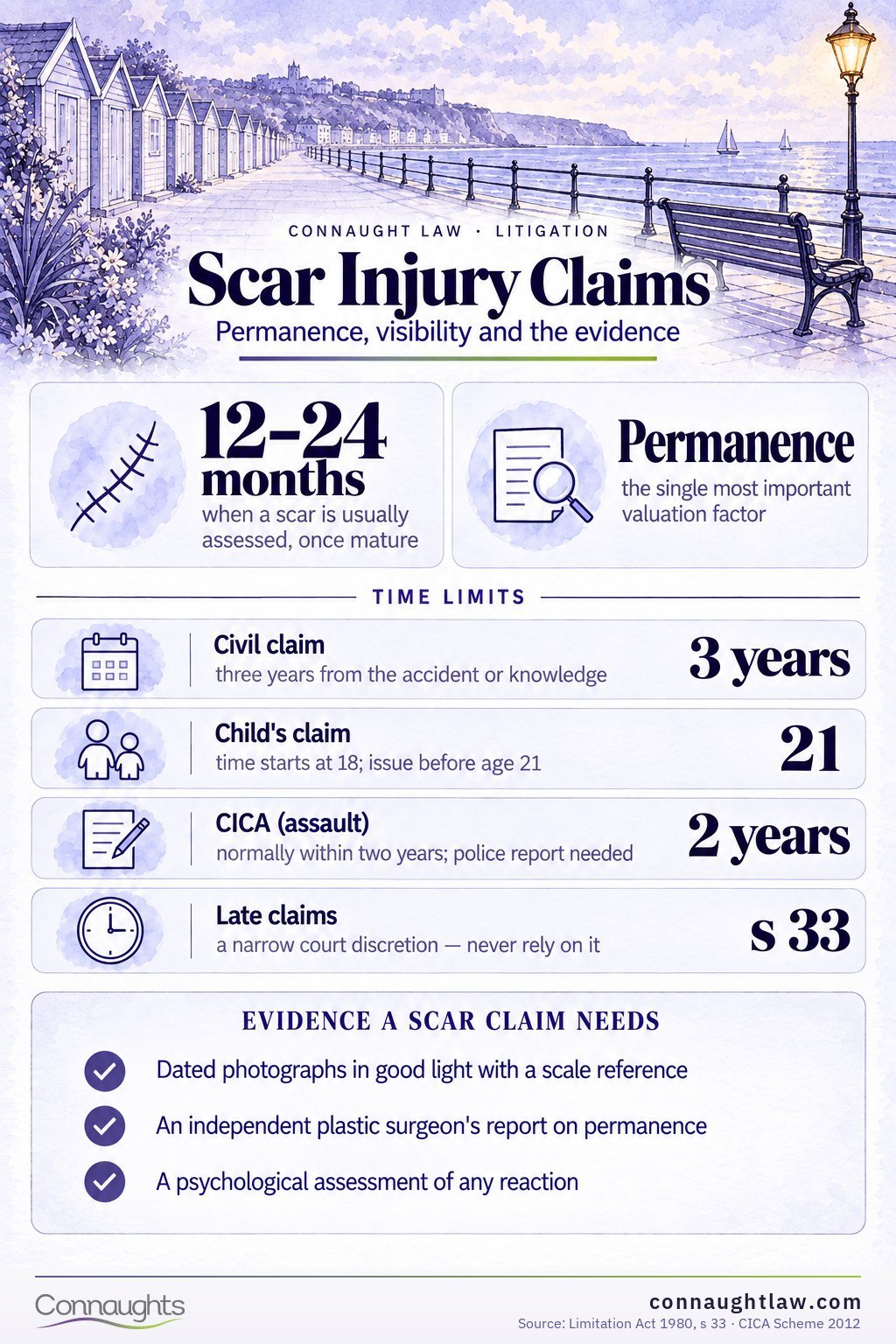
Permanence is the single most important valuation factor in any scarring claim. A scar that fades to near-invisibility within eighteen months supports only a modest award; a permanent scar — one that has matured and will not materially improve — anchors the claim in the brackets above and justifies compensation for lifelong cosmetic, social, and psychological consequences. Scars are generally assessed once mature, typically twelve to twenty-four months after injury, when a plastic surgeon can state with confidence what the claimant will live with.
Permanent scar compensation is not extinguished by treatment. Revision surgery and laser therapy may improve appearance, but where a permanent mark remains once treatment concludes, the award reflects the residual disfigurement plus everything endured to achieve it. Conversely, settling before a scar has matured risks error in both directions — insurers pay less for scarring that might fade, and claimants cannot reopen a concluded settlement if keloid tissue later develops. Timing the valuation correctly is central to these claims.
Body Scarring Compensation: Arms, Legs, and Torso
Body scarring is valued under two 18th Edition brackets, both materially lower than the facial ranges because clothing conceals most body scars for most of the day. Multiple noticeable laceration scars, or a single disfiguring scar, to the legs, arms, hands, back, or chest fall within £10,350–£30,030. A single noticeable scar, or several superficial scars, with some minor cosmetic deficit attract £3,130–£10,350.
Scars on the arm are among the most common body scarring claims because forearms are visible in everyday short-sleeve wear — a factor that pushes awards up within the bracket. They typically arise from lacerations in road or workplace accidents, dog bites, and surgical fixation: open reduction of a fracture leaves permanent operative scarring that forms part of the overall injury valuation, as our broken arm compensation guide explains. A visible, permanent forearm scar with genuine cosmetic impact will generally sit in the middle of the lower bracket or above.
Leg and torso scarring most often follows orthopaedic surgery, degloving injuries, and road rash in motorcycle accidents. Where scarring accompanies a fracture or internal injury, courts value the whole picture together rather than mechanically adding separate awards — the scar may lift the underlying injury award, or be assessed within the body scarring bracket, whichever fairly reflects the combined effect. Medical evidence should address both dimensions explicitly.
Location matters on the body just as it does on the face: scarring to the hands and forearms, or to areas exposed when swimming or during intimacy, carries more weight than marks the claimant alone ever sees. Photographs taken in ordinary clothing help establish real-world visibility.
Burn Scarring and Contracture Compensation
Burn injuries occupy their own territory. The Guidelines recognise that burns are typically more painful than lacerations, carry higher risks of hypertrophic scarring and infection, and often require grafting — so awards for burn scarring generally exceed those for equivalent-sized scars from other mechanisms, and significant burns covering a large body surface area are valued well above the standard scarring brackets. Exact figures depend on surface area, depth, grafting, and residual disability, which makes early specialist evidence essential.
Contracture scarring adds a functional dimension: tightened skin across a joint restricts movement, limits work capacity, and may require release surgery and prolonged physiotherapy. These cases are valued for disability as well as disfigurement, with special damages covering treatment, therapy, and adapted equipment. Where scarring or contracture resulted from inadequate wound care, delayed treatment, or surgical error, the claim may proceed as a medical negligence claim instead — the compensation principles are the same, but breach of duty must be proved through independent expert evidence.
Criminal Injuries Compensation for Assault Scarring
Victims of violent crime — assaults, glassings, and attacks with weapons — claim through the Criminal Injuries Compensation Authority where no insured defendant exists. The CICA scheme pays fixed statutory tariff amounts, not Judicial College brackets. The incident must be reported to the police, and applications must normally be made within two years of the incident, and as soon as reasonably practicable. Where an incident was reported before an applicant's 18th birthday, the deadline extends to their 20th birthday.
Eligibility carries conditions the civil courts do not impose. Applicants must cooperate with the police and prosecution so far as reasonably practicable, and an award can be withheld or reduced where the applicant has unspent criminal convictions or where their own conduct contributed to the incident. These provisions catch out many applicants, so conduct and cooperation issues should be addressed openly in the application rather than left for the Authority to discover.
The scheme's tariff bands scarring by location and by whether the disfigurement is significant or serious. The current amounts under the Criminal Injuries Compensation Scheme 2012 are set out below.
CICA Scarring Tariff
| Scarring Location | Significant Disfigurement | Serious Disfigurement |
|---|---|---|
| Face | £2,400 | £11,000 |
| Head (scalp) | £1,500 | £3,500 |
| Neck | £1,500 | £4,600 |
| Torso or limbs | £1,000 | £3,500 |
Burns are tariffed separately and higher — severe facial burns attract £27,000. Where an assault causes multiple injuries, the scheme pays 100% of the highest tariff, 30% of the second, and 15% of the third; the minimum award is £1,000. These figures sit far below civil equivalents: serious facial disfigurement worth £11,000 from CICA could exceed £60,000 in a civil claim, so where a traceable, insured defendant exists, civil proceedings are almost always the better route.
Medical Evidence Requirements
Scarring is one of the few injuries a court can see, which makes the quality of visual and expert evidence decisive. A consistent photographic series — taken in good light, at set intervals, with a scale reference — documents the scar from injury through maturity. A plastic surgeon's independent report then classifies the scarring, assesses permanence and treatment prospects, and anchors the claim within the Judicial College brackets.
Psychological evidence carries equal weight in facial cases. A formal assessment documenting depression, social anxiety, or avoidance behaviour — supported by therapy records and, where relevant, workplace evidence — is what separates a mid-bracket award from a ceiling award, because the brackets themselves are defined partly by the psychological reaction.
- Photographic series: consistent lighting, angles, and scale reference from injury through scar maturity
- Plastic surgeon report: scar classification, permanence assessment, and realistic treatment prospects
- Psychological assessment: diagnosis, severity, and prognosis for any psychiatric reaction
- Treatment records: surgery, laser sessions, dressings, therapy attendance, and prescriptions
- Impact evidence: witness statements and employer correspondence showing real-world consequences
Limitation Periods and Claim Deadlines
Civil scarring claims must be issued within three years of the accident under the Limitation Act 1980, or within three years of the date of knowledge where the significance of the scarring emerged later — relevant to keloid and hypertrophic scars, which can develop months after a wound apparently healed. A child's time does not begin until their 18th birthday, so a claim can be issued at any point before they turn 21. Courts hold a narrow discretion under section 33 to allow late claims, but it should never be relied upon.
The practical tension is that scars should be valued at maturity, yet limitation runs from injury. The answer is to take advice early — proceedings can be issued protectively while medical evidence matures, and interim payments can fund treatment before settlement. CICA's two-year window is shorter and stricter, so assault victims in particular should act promptly.
Frequently askedQuestions about scar compensation claims
How much compensation for a facial scar in the UK?
Under the Judicial College Guidelines 18th Edition, facial scarring awards range from £2,260 for trivial marks, through £5,220–£18,150 for less significant scarring, to £39,340–£128,590 for very severe disfigurement with a severe psychological reaction, most commonly in younger claimants.
How much is permanent scar compensation?
Permanence anchors every bracket. A permanent but concealable facial scar typically attracts £5,220–£18,150; permanent substantial facial disfigurement £23,730–£63,970 or more; and permanent body scarring £3,130–£30,030 depending on visibility, the number of scars, and overall cosmetic impact.
Can I claim compensation for a scar on my arm?
Yes. Arm scarring from lacerations, dog bites, or surgical fracture fixation falls under the body scarring brackets — £3,130–£10,350 for a single noticeable scar and £10,350–£30,030 for multiple or disfiguring scarring — with visible forearm scars valued toward the upper end.
What does CICA pay for facial scarring after an assault?
The CICA tariff pays £2,400 for significant facial disfigurement and £11,000 for serious facial disfigurement, with lower amounts for head, neck, and body scarring. Applications require a police report and must normally be made within two years of the incident.
Does keloid scarring increase compensation?
Generally, yes. Keloid tissue expands beyond the original wound, resists treatment, and frequently recurs after excision, so it reads as more disfiguring and more permanent than flat scarring — pushing awards higher within the relevant bracket and increasing special damages for repeated treatment.
Does age affect scar compensation amounts?
Significantly. The very severe facial bracket expressly contemplates younger claimants, who face decades of visibility, heightened social consciousness during formative years, and longer psychological exposure. Comparable scarring will generally be valued higher for an 18-year-old than for a 70-year-old.
Do men and women receive different facial scarring awards?
No. Earlier editions of the Judicial College Guidelines drew gender distinctions in facial disfigurement awards, but modern editions apply unified brackets. Courts now focus on the individual's psychological reaction, age, employment, and lifestyle rather than gender-based assumptions.
Can I claim for a scar that may fade?
Yes, but the award will be modest unless permanence is established. Most claims are valued once the scar has matured — usually twelve to twenty-four months after injury — when a plastic surgeon can confirm whether the mark is permanent and whether treatment would improve it.
How long does a scar compensation claim take?
Typically eighteen months to three years. Scars should be valued once mature — usually twelve to twenty-four months after injury — so straightforward claims settle shortly after that point, while burn, contracture, and psychiatric-overlap cases take longer to evidence fully.
Tell us how it happened, where the scar is and what treatment has been offered. We’ll tell you which band it falls in, whether the CICA route applies, and why photographs from now matter later.
Get Expert Advice