The COVID-19 pandemic triggered the fastest change to UK law in modern peacetime. Emergency legislation, courts moving online almost overnight, and landmark litigation reshaped how the legal system works — and much of that change outlasted the emergency itself. This chronicle traces the legal response from the emergency measures of 2020 to the lasting legacy that still shapes practice today, across the areas the pandemic affected most.
The pandemic produced emergency legislation in the Coronavirus Act 2020, moved the courts to remote hearings, and generated landmark litigation — most notably the FCA business interruption insurance test case. The acute emergency ended when most temporary provisions lapsed in 2022, but remote justice, flexible working and key legal precedents endured.
The Emergency Response Phase (2020)
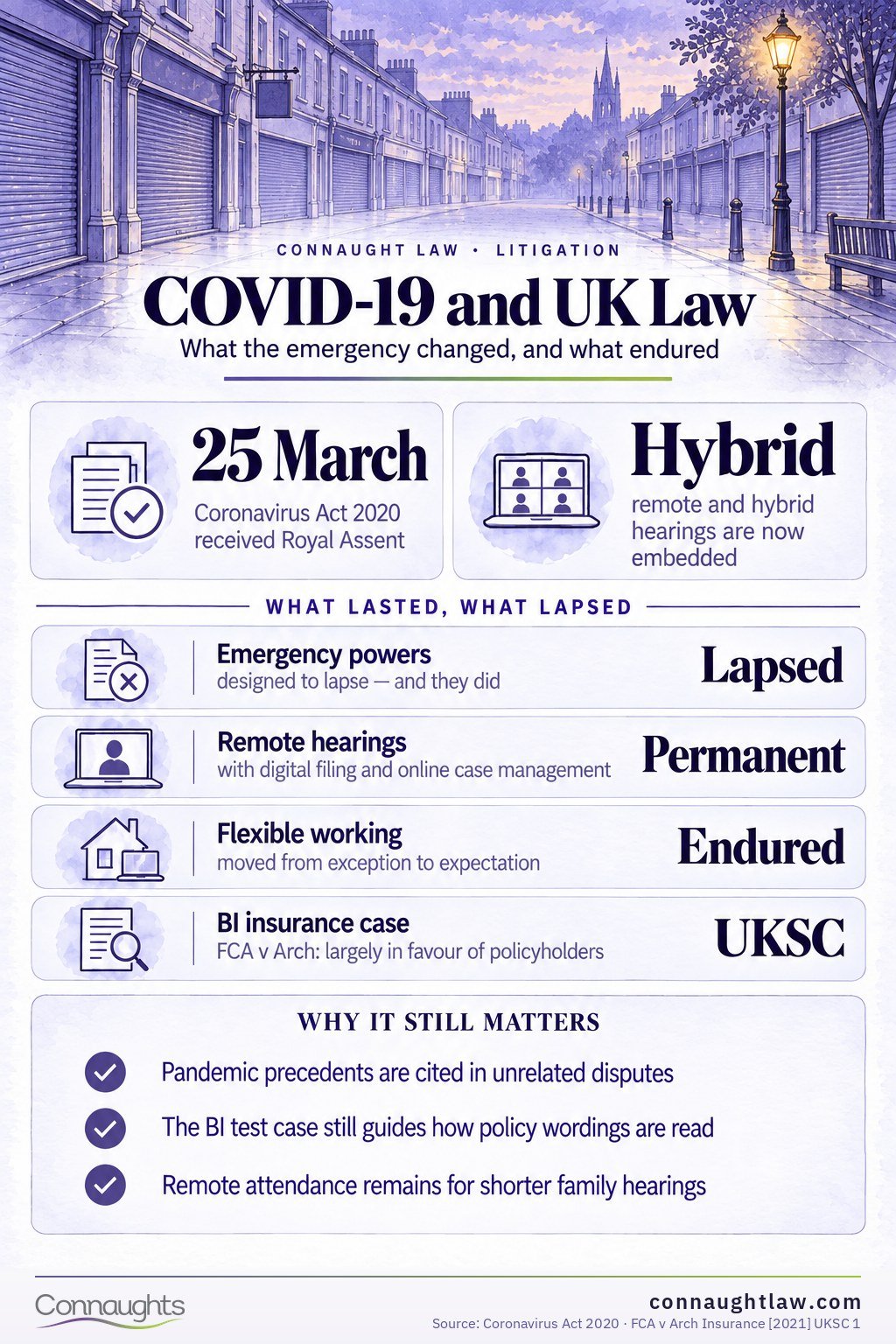
The legal response began in earnest in March 2020 with the Coronavirus Act 2020, which received Royal Assent on 25 March 2020 and gave the Government sweeping temporary powers. Alongside it, public health regulations imposed the national lockdown, restricting movement and closing businesses, and the Coronavirus Job Retention Scheme — furlough — was introduced to support wages. A temporary ban on residential evictions protected tenants during the crisis.
This was emergency law-making at unprecedented speed, and much of it was deliberately time-limited. The framework was designed to be temporary, with sunset provisions, and most of it has since expired. But the volume and reach of the measures set the tone for everything that followed.
Immigration Law Measures (2020–2021)
Immigration law adapted quickly to closed borders and disrupted travel. The Home Office introduced concessions for those unable to return home or attend appointments, extended visas that would otherwise have expired, and made temporary adjustments to right-to-work and right-to-rent checks so they could be carried out remotely. Biometric and application processing timescales were significantly disrupted.
Most of these measures were transitional and have since ended, with the adjusted checking arrangements eventually replaced by permanent digital verification. The episode showed how quickly immigration administration could be reshaped when necessary, and some of the digital methods trialled then have carried through into current practice.
Employment Law Transformation (2020–2022)
Employment law was tested more than most areas. The furlough scheme, which ran until September 2021, kept millions in work and generated novel questions about pay, holiday and redundancy. Remote working moved from a minority arrangement to the default for large parts of the workforce, and employers' health and safety duties came under new scrutiny, including workers' rights to refuse unsafe work.
The most durable change was cultural and practical: flexible and hybrid working became a mainstream expectation rather than a concession. That shift has since fed into wider reform of flexible working rights, and the pandemic is now seen as the point at which the traditional model of full-time office attendance permanently loosened.
Business Interruption Insurance Litigation
The most significant single piece of litigation was the Financial Conduct Authority's business interruption insurance test case, Financial Conduct Authority v Arch Insurance (UK) Ltd [2021] UKSC 1. The Supreme Court ruled largely in favour of policyholders on 15 January 2021, holding that qualifying disease and denial-of-access clauses could respond to pandemic losses and rejecting insurers' narrow causation arguments. It unlocked claims for many thousands of businesses.
The litigation continued to develop afterwards, most notably in London International Exhibition Centre plc v Allianz Insurance plc [2024] EWCA Civ 1026, which extended cover to "at the premises" disease wordings. These principles now shape how policy wordings are construed well beyond the pandemic — a point explored in our guides to what business interruption insurance covers and how to claim on it.
The Digital Justice Revolution
Perhaps the most lasting change was to the courts themselves. Faced with the impossibility of in-person hearings, the courts moved to remote and hybrid hearings almost overnight, using video platforms that had previously been treated as experimental. The Coronavirus Act 2020 expanded the use of video and audio technology in proceedings, and the existing HMCTS reform programme was dramatically accelerated.
What began as a necessity became permanent infrastructure. Remote and hybrid hearings, digital filing and online case management are now normal features of civil justice, not emergency measures. This acceleration is a chapter in the longer story told in our history of civil litigation reform.
Family Law Adaptation (2020–2022)
Family law faced acute pressures. Remote hearings were adopted for many family matters, raising questions about fairness and participation in sensitive cases. Child arrangements became contested where lockdown restrictions and health concerns collided with contact orders, and the courts issued guidance on how existing orders should operate during the restrictions.
The strain also worsened existing backlogs in the family courts, a pressure that persisted after restrictions lifted. As in other areas, some adaptations — particularly remote attendance for shorter or procedural hearings — have remained part of family practice.
Permanent Legal Precedents
Several changes have proved permanent. Remote and hybrid hearings are now embedded in the courts. The construction principles from the business interruption test case continue to guide how policy and contract wordings are interpreted. Flexible working has moved from exception to expectation. And the experience of rapid, technology-enabled administration has influenced how public bodies operate.
The distinction that matters is between the temporary and the durable. The emergency powers were designed to lapse, and they did; what remained were the structural adaptations that proved useful in their own right, independent of the pandemic that prompted them.
Historical Analysis: What the Period Means
Looking back, the COVID-19 legal response is best understood as an acceleration rather than a rupture. Trends that were already under way — digital justice, flexible working, the modernisation of court administration — were compressed into a few years by necessity. The temporary emergency law has almost entirely expired, with the Coronavirus Act 2020 largely lapsing in 2022, but the adaptations that worked outlived it.
For anyone dealing with the law today, the relevance is practical. Pandemic-era precedents, particularly on insurance and contract construction, are cited in disputes that have nothing to do with the pandemic, and the procedural changes it forced are simply how the system now operates. The period is a case study in how quickly the law can change — and in which of those changes endure.
Frequently Asked Questions
What was the Coronavirus Act 2020?
It was the principal emergency legislation of the pandemic, receiving Royal Assent on 25 March 2020 and granting temporary powers across public health, the economy and the justice system. It was designed to be time-limited, and most of its provisions had lapsed by 2022.
How did COVID-19 change the court system?
The courts moved to remote and hybrid hearings almost overnight, using video technology and accelerating the existing digital reform programme. These changes became permanent, so remote hearings, digital filing and online case management are now standard features of civil justice.
What was the FCA business interruption test case?
It was the Supreme Court case FCA v Arch Insurance (UK) Ltd [2021] UKSC 1, decided on 15 January 2021, which found largely for policyholders on whether business interruption policies covered pandemic losses. Its principles on construing policy wordings continue to be applied well beyond the pandemic.
Did COVID change employment law permanently?
The temporary furlough scheme ended in 2021, but the shift to flexible and hybrid working proved durable and has influenced wider reform of flexible working rights. The pandemic is widely seen as the point at which full-time office attendance permanently loosened as the default.
Are the pandemic emergency laws still in force?
Almost all of the temporary emergency measures, including most of the Coronavirus Act 2020, have expired. What remains are the structural changes — remote justice, digital administration and key legal precedents — that proved useful independently of the emergency.
How did the pandemic affect family law?
Family courts adopted remote hearings and issued guidance on how child arrangements should operate under restrictions, while backlogs worsened. Some adaptations, such as remote attendance at shorter hearings, have remained part of family practice.
What happened to immigration rules during COVID?
The Home Office introduced temporary concessions, visa extensions and adjusted remote checks for those affected by travel and appointment disruption. Most were transitional and have ended, though some digital verification methods trialled then have carried into current practice.
Why does the COVID legal response still matter?
Because much of it endured. Remote hearings, flexible working and pandemic-era precedents on insurance and contract construction are part of everyday legal practice now, so understanding the period explains why the current system works the way it does.
Expert Legal Support
Insurance Disputes
We apply the business interruption test-case principles to insurance and coverage disputes, pandemic-related or not.
Employment Advice
We advise on flexible working, workplace rights and the employment issues the pandemic reshaped.
Modern Litigation
We navigate the remote and digital court procedures that are now a permanent part of the justice system.
The legal legacy of the pandemic still shapes disputes today — whatever your issue, the team at Connaught Law can apply the current law and precedents to protect your position.
The information in this blog is for general information purposes only and does not purport to be comprehensive or to provide legal advice. Whilst every effort is made to ensure the information and law is current as of the date of publication it should be stressed that, due to the passage of time, this does not necessarily reflect the present legal position. Connaught Law and authors accept no responsibility for loss that may arise from accessing or reliance on information contained in this blog. For formal advice on the current law please don't hesitate to contact Connaught Law. Legal advice is only provided pursuant to a written agreement, identified as such, and signed by the client and by or on behalf of Connaught Law.
UK COVID-19 Legal Response Timeline 2020-2026: Complete Historical Chronicle
The COVID-19 pandemic triggered the fastest change to UK law in modern peacetime. Emergency legislation, courts moving online almost overnight, and landmark litigation reshaped how the legal system works — and much of that change outlasted the emergency itself. This chronicle traces the legal response from the emergency measures of 2020 to the lasting legacy that still shapes practice today, across the areas the pandemic affected most.
Understanding the UK COVID-19 Legal Response
The pandemic produced emergency legislation in the Coronavirus Act 2020, moved the courts to remote hearings, and generated landmark litigation — most notably the FCA business interruption insurance test case. The acute emergency ended when most temporary provisions lapsed in 2022, but remote justice, flexible working and key legal precedents endured.
The Emergency Response Phase (2020)
The legal response began in earnest in March 2020 with the Coronavirus Act 2020, which received Royal Assent on 25 March 2020 and gave the Government sweeping temporary powers. Alongside it, public health regulations imposed the national lockdown, restricting movement and closing businesses, and the Coronavirus Job Retention Scheme — furlough — was introduced to support wages. A temporary ban on residential evictions protected tenants during the crisis.
This was emergency law-making at unprecedented speed, and much of it was deliberately time-limited. The framework was designed to be temporary, with sunset provisions, and most of it has since expired. But the volume and reach of the measures set the tone for everything that followed.
Immigration Law Measures (2020–2021)
Immigration law adapted quickly to closed borders and disrupted travel. The Home Office introduced concessions for those unable to return home or attend appointments, extended visas that would otherwise have expired, and made temporary adjustments to right-to-work and right-to-rent checks so they could be carried out remotely. Biometric and application processing timescales were significantly disrupted.
Most of these measures were transitional and have since ended, with the adjusted checking arrangements eventually replaced by permanent digital verification. The episode showed how quickly immigration administration could be reshaped when necessary, and some of the digital methods trialled then have carried through into current practice.
Employment Law Transformation (2020–2022)
Employment law was tested more than most areas. The furlough scheme, which ran until September 2021, kept millions in work and generated novel questions about pay, holiday and redundancy. Remote working moved from a minority arrangement to the default for large parts of the workforce, and employers' health and safety duties came under new scrutiny, including workers' rights to refuse unsafe work.
The most durable change was cultural and practical: flexible and hybrid working became a mainstream expectation rather than a concession. That shift has since fed into wider reform of flexible working rights, and the pandemic is now seen as the point at which the traditional model of full-time office attendance permanently loosened.
Business Interruption Insurance Litigation
The most significant single piece of litigation was the Financial Conduct Authority's business interruption insurance test case, Financial Conduct Authority v Arch Insurance (UK) Ltd [2021] UKSC 1. The Supreme Court ruled largely in favour of policyholders on 15 January 2021, holding that qualifying disease and denial-of-access clauses could respond to pandemic losses and rejecting insurers' narrow causation arguments. It unlocked claims for many thousands of businesses.
The litigation continued to develop afterwards, most notably in London International Exhibition Centre plc v Allianz Insurance plc [2024] EWCA Civ 1026, which extended cover to "at the premises" disease wordings. These principles now shape how policy wordings are construed well beyond the pandemic — a point explored in our guides to what business interruption insurance covers and how to claim on it.
The Digital Justice Revolution
Perhaps the most lasting change was to the courts themselves. Faced with the impossibility of in-person hearings, the courts moved to remote and hybrid hearings almost overnight, using video platforms that had previously been treated as experimental. The Coronavirus Act 2020 expanded the use of video and audio technology in proceedings, and the existing HMCTS reform programme was dramatically accelerated.
What began as a necessity became permanent infrastructure. Remote and hybrid hearings, digital filing and online case management are now normal features of civil justice, not emergency measures. This acceleration is a chapter in the longer story told in our history of civil litigation reform.
Family Law Adaptation (2020–2022)
Family law faced acute pressures. Remote hearings were adopted for many family matters, raising questions about fairness and participation in sensitive cases. Child arrangements became contested where lockdown restrictions and health concerns collided with contact orders, and the courts issued guidance on how existing orders should operate during the restrictions.
The strain also worsened existing backlogs in the family courts, a pressure that persisted after restrictions lifted. As in other areas, some adaptations — particularly remote attendance for shorter or procedural hearings — have remained part of family practice.
Permanent Legal Precedents
Several changes have proved permanent. Remote and hybrid hearings are now embedded in the courts. The construction principles from the business interruption test case continue to guide how policy and contract wordings are interpreted. Flexible working has moved from exception to expectation. And the experience of rapid, technology-enabled administration has influenced how public bodies operate.
The distinction that matters is between the temporary and the durable. The emergency powers were designed to lapse, and they did; what remained were the structural adaptations that proved useful in their own right, independent of the pandemic that prompted them.
Historical Analysis: What the Period Means
Looking back, the COVID-19 legal response is best understood as an acceleration rather than a rupture. Trends that were already under way — digital justice, flexible working, the modernisation of court administration — were compressed into a few years by necessity. The temporary emergency law has almost entirely expired, with the Coronavirus Act 2020 largely lapsing in 2022, but the adaptations that worked outlived it.
For anyone dealing with the law today, the relevance is practical. Pandemic-era precedents, particularly on insurance and contract construction, are cited in disputes that have nothing to do with the pandemic, and the procedural changes it forced are simply how the system now operates. The period is a case study in how quickly the law can change — and in which of those changes endure.
Frequently Asked Questions
What was the Coronavirus Act 2020?
It was the principal emergency legislation of the pandemic, receiving Royal Assent on 25 March 2020 and granting temporary powers across public health, the economy and the justice system. It was designed to be time-limited, and most of its provisions had lapsed by 2022.
How did COVID-19 change the court system?
The courts moved to remote and hybrid hearings almost overnight, using video technology and accelerating the existing digital reform programme. These changes became permanent, so remote hearings, digital filing and online case management are now standard features of civil justice.
What was the FCA business interruption test case?
It was the Supreme Court case FCA v Arch Insurance (UK) Ltd [2021] UKSC 1, decided on 15 January 2021, which found largely for policyholders on whether business interruption policies covered pandemic losses. Its principles on construing policy wordings continue to be applied well beyond the pandemic.
Did COVID change employment law permanently?
The temporary furlough scheme ended in 2021, but the shift to flexible and hybrid working proved durable and has influenced wider reform of flexible working rights. The pandemic is widely seen as the point at which full-time office attendance permanently loosened as the default.
Are the pandemic emergency laws still in force?
Almost all of the temporary emergency measures, including most of the Coronavirus Act 2020, have expired. What remains are the structural changes — remote justice, digital administration and key legal precedents — that proved useful independently of the emergency.
How did the pandemic affect family law?
Family courts adopted remote hearings and issued guidance on how child arrangements should operate under restrictions, while backlogs worsened. Some adaptations, such as remote attendance at shorter hearings, have remained part of family practice.
What happened to immigration rules during COVID?
The Home Office introduced temporary concessions, visa extensions and adjusted remote checks for those affected by travel and appointment disruption. Most were transitional and have ended, though some digital verification methods trialled then have carried into current practice.
Why does the COVID legal response still matter?
Because much of it endured. Remote hearings, flexible working and pandemic-era precedents on insurance and contract construction are part of everyday legal practice now, so understanding the period explains why the current system works the way it does.
We apply the business interruption test-case principles to insurance and coverage disputes, pandemic-related or not.
We advise on flexible working, workplace rights and the employment issues the pandemic reshaped.
We navigate the remote and digital court procedures that are now a permanent part of the justice system.
The legal legacy of the pandemic still shapes disputes today — whatever your issue, the team at Connaught Law can apply the current law and precedents to protect your position.
Speak to UsDisclaimer:
The information in this blog is for general information purposes only and does not purport to be comprehensive or to provide legal advice. Whilst every effort is made to ensure the information and law is current as of the date of publication it should be stressed that, due to the passage of time, this does not necessarily reflect the present legal position. Connaught Law and authors accept no responsibility for loss that may arise from accessing or reliance on information contained in this blog. For formal advice on the current law please don't hesitate to contact Connaught Law. Legal advice is only provided pursuant to a written agreement, identified as such, and signed by the client and by or on behalf of Connaught Law.