
Whether you can claim on a business interruption policy depends on three things: what triggered the interruption, what your policy wording actually covers, and whether you can evidence the loss. Many valid claims are declined at first, and the COVID-19 test cases showed that a refusal is often the start of the argument, not the end. This guide explains who can claim, how the process works, how much you can recover, and what to do when an insurer says no.
On This Page
Can I Claim on Business Interruption Insurance in the UK?
You can usually claim if an event your policy insures against has interrupted your trade and caused a measurable loss of income. In most policies that means physical damage to your property, but disease and denial-of-access extensions can also respond. Whether a claim succeeds turns on the exact wording, the evidence of loss, and notifying the insurer promptly — and a declined claim can often be challenged.
Can I Claim? Eligibility in Short
Eligibility starts with the policy, not the loss. You need business interruption cover in force at the time of the event, an interruption caused by a peril the policy insures against, and a resulting financial loss that falls within the indemnity period. If all three are present, you have the basis of a claim; if any is missing, the claim is likely to fail however genuine the loss.
The most common trigger is physical damage to your premises — fire, flood, storm or similar — because standard business interruption cover attaches to the property (material damage) section through the material damage proviso. Some policies go wider, with extensions for damage at a supplier's or customer's premises, failure of public utilities, denial or prevention of access, and notifiable disease. Reading which triggers your policy actually contains is the first step in deciding whether you can claim.
Essential Eligibility Criteria
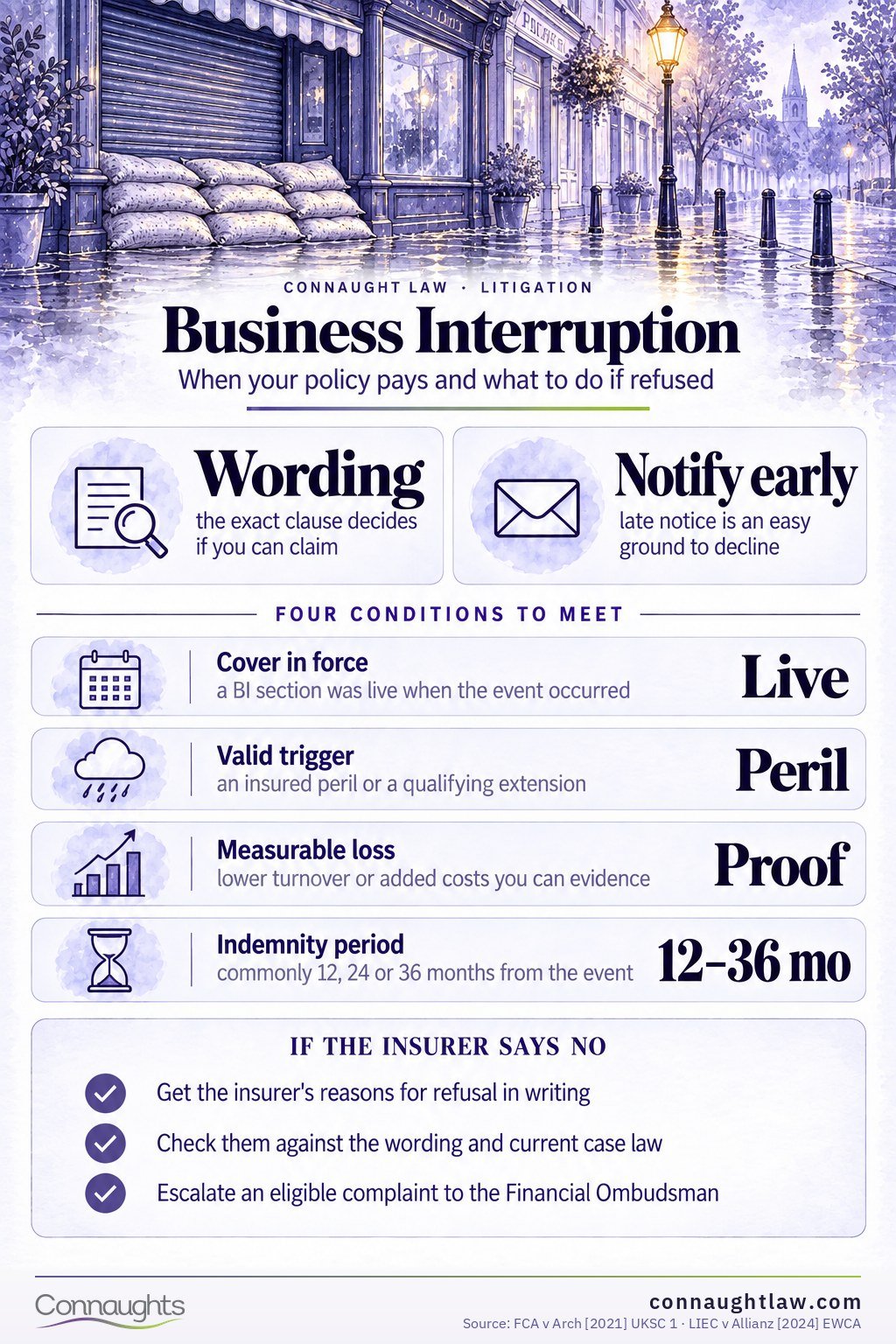
- Cover in force: a business interruption section was live when the event occurred.
- A valid trigger: the interruption was caused by an insured peril or a qualifying extension.
- A measurable loss: reduced turnover or added costs you can evidence from your accounts.
- Within the indemnity period: the loss falls inside the time limit set in the policy.
Reading Your Policy Wording
Business interruption claims are won and lost on wording. Two policies covering the same business can respond very differently to the same event, so the specific clauses — not the general label on the policy — decide whether you can claim. The key is to identify which trigger your loss relies on and then read that clause closely against what actually happened.
Damage-based cover responds to physical damage and depends on the material damage proviso being satisfied. Non-damage extensions work differently: a disease clause responds to an outbreak of a notifiable disease, usually within a stated radius or "at the premises", while a denial or prevention-of-access clause responds when action by an authority or nearby danger stops customers reaching you. Each has its own conditions, limits and excesses, and each must be read on its own terms.
Key Clause Types That Decide a Claim
In practice, three clause types decide most claims: the damage trigger and its proviso; disease clauses, including the "at the premises" wording tested in the courts; and denial or prevention-of-access clauses. If you are unsure which of these your loss engages, our guide to what business interruption insurance covers sets out each trigger and the exclusions that sit alongside it.
What the COVID-19 Test Cases Mean for Claims
The pandemic produced the leading case law on non-damage business interruption claims, and it reshaped what policyholders can argue. In the FCA's test case, Financial Conduct Authority v Arch Insurance (UK) Ltd [2021] UKSC 1, the Supreme Court ruled largely in favour of policyholders on 15 January 2021. It held that qualifying disease and denial-of-access clauses could respond to pandemic losses, and it rejected insurers' argument that a claim failed unless the business could show the loss would not have happened "but for" the local outbreak. That decision remains the starting point for reading non-damage clauses.
The law then developed for "at the premises" disease wordings, which the FCA test case had not decided. In London International Exhibition Centre plc v Allianz Insurance plc [2024] EWCA Civ 1026, the Court of Appeal held on 6 September 2024 that such clauses could also respond to COVID-19 losses. The Supreme Court refused the insurers permission to appeal in December 2024, so that ruling now stands and a quantum trial to assess the sums due was listed for early 2026.
Why the Test Cases Still Matter
Most pandemic claims are now settled, so the practical value of these cases is the principle they establish: business interruption disputes are decided on careful construction of the wording, and an initial refusal is frequently overturned when the clause is read correctly. That lesson applies well beyond COVID-19 to any claim an insurer declines on the basis of policy interpretation.
How to Make a Claim: Process and Evidence
A business interruption claim follows a recognisable path, and how you handle the early stages often decides how smoothly it runs. Notify the insurer as soon as you are aware of the event — late notification is one of the easiest grounds for an insurer to decline. Then identify the trigger you are relying on, and begin gathering the financial evidence that proves the loss.
Proving the loss is the heart of the claim. Insurers expect to see accounts, management figures and turnover history that show what the business would have earned but for the interruption, set against what it actually earned. You are also expected to mitigate — to take reasonable steps to reduce the loss — and to keep records of the mitigation spend, because the increased cost of working is itself claimable. Where cash flow is under pressure, interim payments can often be requested while the claim is quantified.
Evidence and Documentation
- Financial records: annual accounts, management accounts and turnover history before and after the event.
- The policy and schedule: the full wording, so the correct trigger and sums insured are identified.
- Proof of the event: evidence of the damage, closure or access restriction that caused the interruption.
- Mitigation records: receipts and notes for the extra spend incurred to keep trading.
Policies require prompt notification of a potential claim. Delay gives the insurer a straightforward reason to decline, so tell your insurer or broker as soon as an event that might interrupt trading occurs, even before the loss is quantified.
How Much Can I Claim?
What you can recover is set by the policy's sums insured and the indemnity period, not by the size of the loss alone. The claim is built on lost gross profit — turnover you would have earned less specified variable costs, on the policy's basis — plus the increased cost of working spent to limit the loss, and often the professional fees of preparing the claim. If the sum insured is lower than the true value at risk, an average clause can reduce the payout in proportion, so underinsurance directly limits what you can claim.
The indemnity period caps how long the loss is paid for, running from the date of the event — commonly 12, 24 or 36 months. If trading is still depressed when that period ends, the later loss falls outside the cover. Because of this, matching the sum insured and indemnity period to a realistic recovery is what determines whether a claim makes the business whole or leaves a shortfall.
If the Insurer Underpays
Where an insurer accepts the claim but offers less than the loss, the dispute is usually about quantum — the gross profit basis, the trends clause adjustment, or the length of the indemnity period. An eligible small business that cannot resolve the figure can escalate the complaint to the Financial Ombudsman Service, whose maximum award is £455,000 for complaints about acts or omissions on or after 1 April 2019, rising each April in line with inflation.
Declined Claims and Disputes
A declined claim is not the end of the road. The test-case litigation showed that insurers' first interpretation of a clause is not always correct, and many refusals are reversed once the wording is properly argued. If your claim has been declined or underpaid, the first step is to get the insurer's reasons in writing and check them against the actual policy wording and the current case law.
From there, an eligible business can complain to the insurer, escalate to the Financial Ombudsman Service, or take legal advice on the policy. Smaller businesses — broadly those with an annual turnover under £6.5 million, a balance sheet under £5 million and fewer than 50 employees — can use the Ombudsman, while a micro-enterprise (fewer than 10 staff and turnover or balance sheet not above €2 million) also qualifies. For contested claims and larger disputes, our insurance dispute solicitors and financial services disputes lawyers can review the wording and take the argument forward.
Frequently askedQuestions about business interruption claims
Can I claim if my policy has an "at the premises" disease clause?
Potentially yes. In London International Exhibition Centre plc v Allianz Insurance plc [2024] EWCA Civ 1026, the Court of Appeal held that "at the premises" disease clauses could respond to COVID-19 losses, and the Supreme Court refused the insurers permission to appeal. Whether your policy responds still depends on its exact wording and the evidence of loss.
What policy wording provides cover for a claim?
Cover usually comes from a damage trigger tied to the material damage proviso, or from a non-damage extension such as a disease clause or a denial or prevention-of-access clause. Each has its own conditions and limits, so the specific clause you rely on decides whether you can claim.
How much can I claim under my business interruption policy?
You can claim your lost gross profit over the indemnity period plus the increased cost of working, subject to the sums insured. Underinsurance can reduce the payout through an average clause. If the Financial Ombudsman deals with the complaint, its maximum award is £455,000 for acts or omissions on or after 1 April 2019.
What evidence do I need to prove a claim?
You need financial records showing turnover before and after the event, the full policy and schedule, proof of the damage or restriction that caused the interruption, and records of any mitigation spend. Clear accounting evidence is what turns a valid claim into a paid one.
Can I resubmit a previously declined claim?
Often yes. Many claims are declined on a first reading of the wording that later proves too narrow. Ask for the insurer's reasons in writing, check them against the policy and current case law, and challenge the decision or escalate it to the Financial Ombudsman if it does not hold up.
How long do I have to make a claim?
Policies require prompt notification of a potential claim, so you should tell your insurer as soon as an event occurs rather than waiting until the loss is quantified. Separate contractual and legal time limits can also apply, so early advice on a disputed claim is sensible.
What should I do if my insurer refuses to pay?
Get the refusal reasons in writing and test them against the wording and the COVID-19 test-case principles. You can complain to the insurer, refer an eligible complaint to the Financial Ombudsman Service, or take legal advice. A refusal is frequently the beginning of a dispute rather than its conclusion.
How did the court decisions change what I can claim?
FCA v Arch [2021] UKSC 1 confirmed that qualifying disease and denial-of-access clauses could respond to pandemic losses and rejected insurers' narrow "but for" causation defence. The 2024 Court of Appeal ruling extended this to "at the premises" disease clauses, widening the wordings under which businesses can claim.
Tell us what interrupted the business, what the wording says and the reason given for the refusal. We’ll tell you whether the decline is arguable and what evidence would move it.
Get Expert Advice