
In London Trocadero v Picturehouse Cinemas [2025] EWHC 1247 (Ch), the High Court held that a landlord's insurance commissions were not recoverable from the tenant as insurance rent, implied a term that premiums be charged at market rate, and ordered repayment of roughly £700,000 collected over nearly a decade. For commercial tenants it opens a recovery route through years of service and insurance charges; for landlords it makes commission arrangements a live legal exposure. This note covers the judgment, the scheme it unpicked, and what each side should do now.
On This Page

The Trocadero Judgment: Commissions Are Not Insurance Rent
Most commercial leases make the tenant pay "insurance rent" — the cost of the landlord insuring the building. The question in Trocadero was what happens when a large slice of that cost is not premium at all but commission flowing back to the landlord's own group. Mr Justice Richards's answer, handed down on 23 May 2025, reset the market's assumptions: the tenant pays for insurance, not for the landlord's participation in it.
First, on construction: the commissions did not fall within the lease's definition of insurance rent, so they were never recoverable from the tenant. Second, by implication: a term was implied that premiums recharged to the tenant be at market rate. The result — repayment of approximately £700,000 of overcharged insurance rent spanning 2015-16 to 2022-23. The full judgment repays reading for any leaseholder or landlord with commission arrangements in place.
Inside the Case: How the Scheme Worked
Structure and Scale
How the Commission Worked
The evidence described a circular arrangement: insurers wrote the cover at premiums that funded generous broker commissions; commission — at rates reaching around 60% — flowed to the landlord's side; and the full inflated premium was recharged to the tenants as insurance rent. From 2022-23 an additional 35% "placement, administration and work transfer fee" joined the structure. The tenants funded everything; the landlord's group profited from the insurance it was contractually obliged to arrange on their behalf.
Why Tenants Rarely See It
Commission sits inside the premium, and the premium arrives as a single line in a service charge or insurance rent demand. Nothing on the face of the demand distinguishes risk price from distribution profit — which is why the judgment's practical power lies less in its numbers than in the audit it legitimises: tenants may now ask what the premium actually contained, with authority behind the question.
The Regulatory Backdrop
Residential Ban Proposals
The regulatory tide was already running against opaque commissions before the judgment — though mostly in the residential leasehold world. Government has consulted on banning insurance commissions for residential landlords and managing agents, replacing them with transparent handling fees; that reform sits in the wider leasehold programme rather than in commercial leasing. Trocadero matters precisely because it reaches where the regulations do not: it is common law, and it applies to commercial leases now.
FCA Rules and the Direction of Travel
The FCA's multi-occupancy buildings insurance rules already require commission disclosure and fair-value assessment in the residential leasehold market, having found broker remuneration rising far faster than the service justified. Commercial insurance distribution remains lighter-touch — but a landlord defending a 60% commission before a judge who has read Trocadero should not expect the regulatory context to help them.
Market Effects
Pricing and Practice
What It Does to Value
Insurance rent that quietly carried commission was, economically, extra rent — and extra rent that now has to be repaid changes underwriting on both sides. Buyers of tenanted buildings should diligence historic insurance arrangements as a contingent liability; tenants valuing lease commitments can treat the insurance line as challengeable rather than fixed. Well-run landlords are moving to commission-free procurement with transparent fees, because the alternative is carrying a Trocadero exposure on the balance sheet.
Cleaner Procurement
The practical fix is unglamorous: competitive broking, commission disclosure in the placing documents, and management fees charged openly where a landlord genuinely does insurance work. Everything the judgment punished was avoidable with ordinary transparency.
What to Do Now
Landlords: Audit Your Own Arrangements
- Map every commission, fee or benefit your side receives from the buildings insurance you recharge.
- Read each lease's insurance rent definition against Trocadero — does it actually cover what you collect?
- Quantify the look-back exposure across the portfolio; limitation runs, but slowly.
- Move procurement to market-rate, disclosed arrangements before a tenant's letter arrives.
Tenants: The Recovery Route
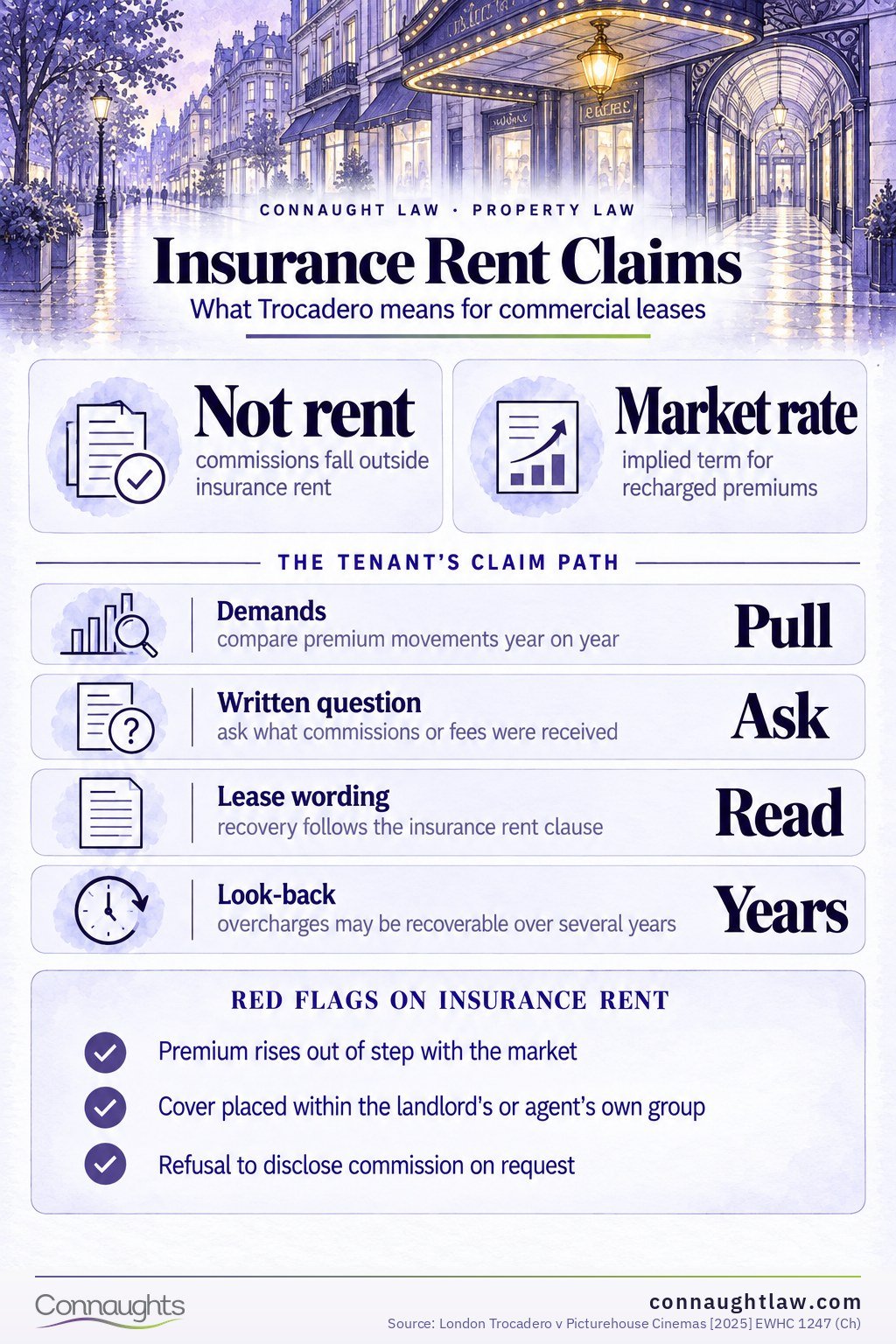
- Pull the demands and compare year-on-year premium movements against the market.
- Ask the landlord in writing what commissions or fees were received on the placement — the judgment makes silence itself informative.
- Check the lease's insurance rent clause: recovery follows the drafting, and Trocadero shows how narrowly courts will read it.
- Historic overcharges may be recoverable across multiple years — the Trocadero repayment covered nearly a decade.
What Comes Next
Appeal Status and the Precedent
The landlord side has signalled an intention to appeal, so the principles may yet be refined above. But the judgment's two pillars — construction of the insurance rent clause and the implied market-rate term — rest on orthodox reasoning, and advisers across the market are already treating them as the operating assumption. Multi-tenant buildings with common arrangements are natural territory for coordinated claims.
Evidence Wins These Cases
Trocadero was won on documents: placing records, commission statements, premium histories. Tenants contemplating a claim should preserve demands and correspondence now; landlords defending should assemble the same file for the opposite reason. Neither side improves its position by waiting.
The Standards Shift
The wider lesson tracks the direction of every recent reform in this sector, residential and commercial alike: charges that pass through a landlord must be what they claim to be. Insurance rent means insurance; management fees mean management; and profit taken silently between the two is now a repayment claim waiting for a letterhead. The firms and landlords who thrive under that standard are the ones who never needed the opacity.
Frequently askedQuestions about insurance commission claims
What did the Trocadero case decide?
That the landlord's insurance commissions were not recoverable from the tenant as insurance rent, that premiums recharged must be at market rate under an implied term, and that roughly £700,000 collected over nearly a decade had to be repaid. The citation is [2025] EWHC 1247 (Ch).
Can commercial tenants claim back insurance overcharges?
Where the lease's insurance rent clause does not cover commissions and premiums exceeded market rate, yes — Trocadero's repayment spanned multiple years. The starting point is your demands, your lease wording and a written question to the landlord about commissions received.
Does the judgment apply to residential leaseholders?
Residential leaseholders have their own, stronger track: FCA multi-occupancy insurance rules on disclosure and fair value, and government proposals to ban commissions outright. Trocadero's common-law reasoning reinforces the same principle from the commercial side.
What should landlords do about existing commission arrangements?
Audit them against each lease's insurance rent definition, quantify the historic exposure, and move to disclosed, market-rate procurement. An arrangement that only works unexamined is now a liability, because examination is exactly what the judgment invites.
Is the decision final?
An appeal has been signalled, so the appellate courts may refine the principles. The market is not waiting: the reasoning is orthodox, advisers are treating it as the operating assumption, and the evidence-gathering that decides these claims is unaffected by the appeal timetable.
What are the red flags on my insurance rent?
Premium rises out of step with the market, a landlord or agent placing cover within its own group, refusal to disclose commission on request, and round-figure "administration" fees layered onto the premium. Any two together justify a proper audit.
Tell us what the lease says about insurance rent, what you have been charged and whether the landlord has disclosed any commission. We will tell you whether the charge is recoverable and what to ask for first.
Get Expert Advice