
Property law has changed more in two years than in the previous twenty, and the changes land on different people differently: viral claims about DWP home ownership rules that need separating from what actually changed, leasehold reform arriving in stages, tighter building safety liability, reshaped stamp duty thresholds and a mortgage rulebook under review. This guide takes each change in turn — what is in force, what is rumour, and who needs to act.
On This Page

UK Property Law Changes: What Is Actually In Force in 2026
Some of what follows is commenced law with dates and penalties; some is review and consultation; and one headline — the "DWP home ownership rules" filling social feeds — is largely neither. Sorting the three categories is most of the value a lawyer can add this year, because the cost of acting on rumour runs in both directions: pensioners frightened out of legitimate claims, and landlords surprised by obligations that were real all along.
In force: the April 2025 stamp duty thresholds, the Renters' Rights Act's central reforms (1 May 2026), the Building Safety Act's 30-year liability, and the first provisions of the Leasehold and Freehold Reform Act 2024. In progress: the FCA's mortgage rule review, the Law Commission's work on business tenancies, the Planning and Infrastructure Bill, and the Building Safety Levy (delayed to autumn 2026). Rumour dressed as news: any claim that your main home now counts against Pension Credit.
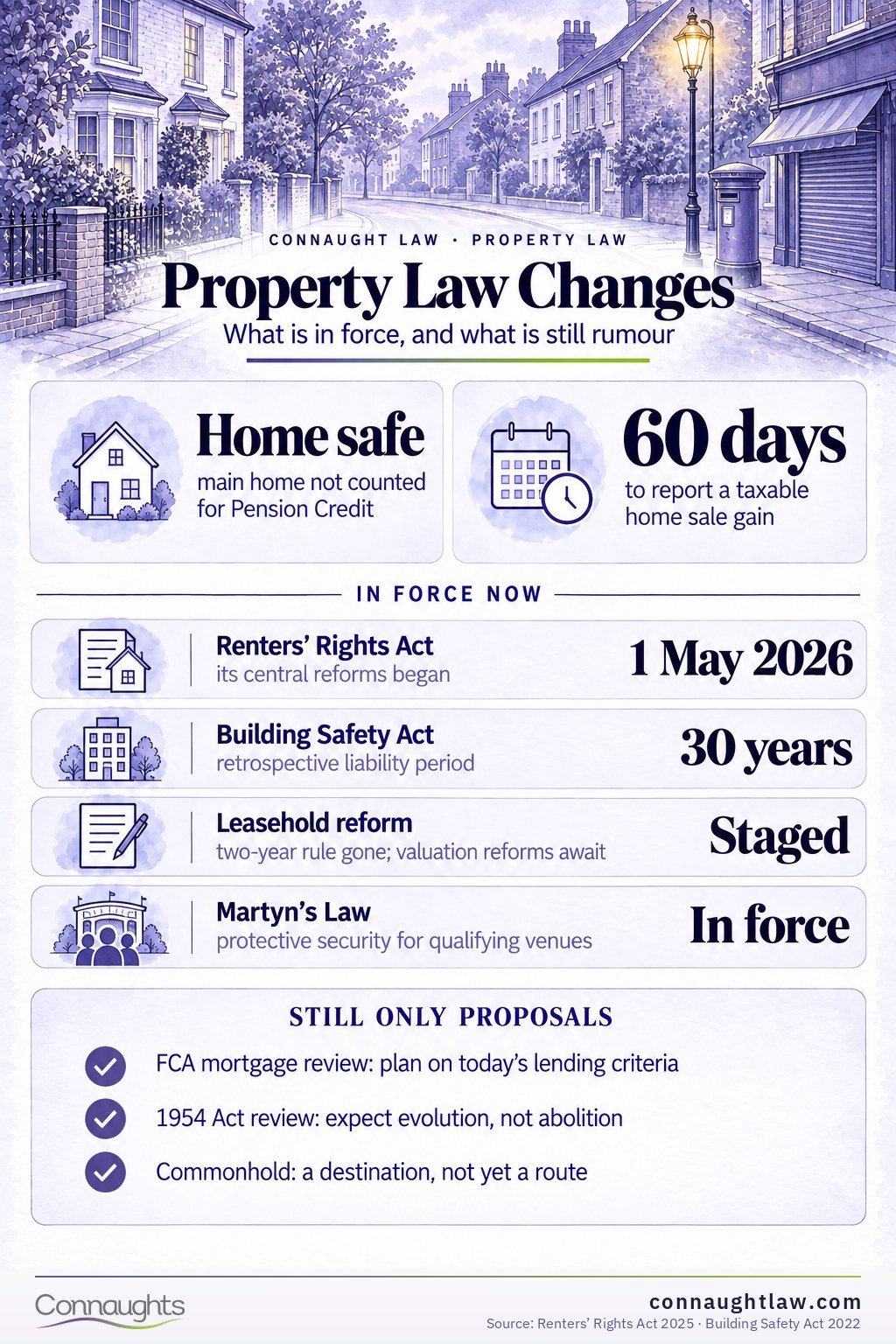
DWP and Your Home: What Changed and What Did Not
Start with the claim spreading online: that the DWP has introduced "home ownership rules" under which pensioners' houses count against their benefits. It has not. The home you live in remains disregarded in the Pension Credit means test, as it always has been — capital rules bite on savings and on property you do not occupy, where an assumed income applies above £10,000. No commenced legislation makes your main residence assessable, and the articles claiming otherwise trace back to content farms, not to any DWP announcement.
What has genuinely changed is verification. The Public Authorities (Fraud, Error and Recovery) Act 2025 gives the DWP new powers, phasing in from 2026, to require banks to flag accounts that appear to breach benefit eligibility limits, alongside wider inter-agency data sharing. That is enforcement of the existing rules, not new rules about your home — the practical consequence is that undeclared capital and undeclared second properties will surface faster, while the position of a pensioner living in their own home is untouched.
The Rules, Benefit by Benefit
The table below sets out where your home actually stands in each means test — and what the 2025–26 changes really altered in each case.
How Benefits Are Assessed
| Benefit | The Rule on Your Home | What Actually Changed |
|---|---|---|
| Pension Credit | Main residence disregarded; savings and non-resident property count above £10,000 | Nothing in the rule — verification powers phasing in from 2026 |
| Housing Benefit (pension age) | The home you live in is disregarded; other properties count as capital | Tighter data-sharing exposes undeclared second properties |
| Social care means test | Home disregarded while you or a partner live in it; 12-week disregard on entering care | Unchanged — deferred payment agreements remain available |
| Council tax support | Local schemes, generally mirroring the main-residence disregard | Verification alignment with DWP data |
Why the Rumour Bites Hardest in High-Value Areas
The scare stories land differently in a £750,000 semi than a £150,000 terrace, which is precisely why they circulate: property-rich, income-poor pensioners are the audience most frightened by the idea of their home being means-tested — and the audience most harmed if fear stops them claiming Pension Credit they are entitled to. Around £1.5 billion of Pension Credit goes unclaimed each year; the rumour's real cost is measured there, not in any rule change.
Private Residence Relief: The Rules That Catch People
Selling your main home remains CGT-free under private residence relief — the traps live at the edges. The final-period exemption covers only the last 9 months of ownership (36 months for those moving into care or with a disability). Letting relief survives only where you shared occupation with your tenant, capped at £40,000. And any taxable residential gain must be reported and paid within 60 days of completion — the deadline that still catches executors, divorcing couples and accidental landlords every month.
Where the Relief Narrows
- Final period: 9 months' automatic relief after moving out — plan sale timing around it, especially in divorce
- Letting relief: shared-occupation cases only, £40,000 cap — the old buy-to-let letting relief is long gone
- 60-day reporting: taxable residential gains reported and paid within 60 days of completion
- Mixed use and gardens: business use, plots over half a hectare and development sales all fragment the relief
The FCA's Mortgage Review: Access Over Caution
The FCA's ongoing mortgage rule review is rebalancing a rulebook written after 2008 for a market that now excludes too many creditworthy borrowers. The direction of travel: simplified affordability testing, easier remortgaging and term reductions, more room for first-time buyers, the self-employed and later-life borrowers.
What Is Proposed, and What It Means
For buyers, the practical near-term change is already visible in lender behaviour: stress rates applied more proportionately and faster switching. For advisers, the caution is equally practical — proposals are not rules, and a purchase planned around a consultation is a purchase planned on sand. Track what the FCA finalises, not what it floats.
Commercial Property: Tenure Under Review, Security Rules In Force
Two currents run through commercial property. The Law Commission is reviewing the Landlord and Tenant Act 1954's security of tenure framework — evolution, on current signals, rather than abolition. Meanwhile obligations already in force are the ones to act on: the Terrorism (Protection of Premises) Act 2025 — Martyn's Law — brings qualifying venues into a protective-security regime, and the Building Safety Act's extended liability reaches commercial owners of residential blocks, as our URS v BDW analysis sets out.
Security of Tenure: What to Watch
For landlords and tenants negotiating renewals now, the sensible assumption is continuity: contract on the law as it stands, keep break options flexible, and treat the Law Commission's eventual recommendations as a lease-drafting event for the next cycle rather than this one.
Leasehold to Commonhold: The Long Transition
The Leasehold and Freehold Reform Act 2024's staged commencement — the two-year rule gone, valuation reforms awaiting — is covered in full in our LAFRA guide. The strategic layer above it is commonhold: the government's declared destination for flat ownership, carried by the draft Commonhold and Leasehold Reform Bill confirmed in the May 2026 King's Speech.
Why Commonhold Has Been Here Before
Commonhold has existed since 2002 and produced fewer than 20 developments — lenders would not lend, developers would not build, and nobody converts what nobody funds. The new Bill's test is whether it solves those three problems rather than restates the aspiration. Leaseholders planning extensions or collective enfranchisement today should transact on today's law; commonhold is a destination, not yet a route.
Planning: The Infrastructure Push
The Planning and Infrastructure Bill carries the government's growth agenda into the consent system — streamlined nationally significant infrastructure decisions, reformed committees and environmental delivery plans. For individual owners the near-term effect is indirect but real: where plan-making accelerates, land designations and development potential move, and with them the assumptions behind valuations and options.
Stamp Duty and the Tax Lines That Moved
Since 1 April 2025 the SDLT nil-rate band has been £125,000, with first-time buyer relief at £300,000 on purchases up to £500,000 — thresholds that pulled far more transactions into charge and made apportionment questions live again, as our chattels and fixtures guide covers. Alongside: the Building Safety Levy on new residential development, delayed to autumn 2026, and an increased £600,000 capital goods scheme limit for land and buildings easing VAT administration on mid-size projects.
One Compliance View, Not Six
The changes above arrive from six regulators with six timetables, but they land on the same assets. A pensioner's estate plan now touches DWP verification, PRR deadlines and the IHT business relief cap at once; a landlord's portfolio touches the Renters' Rights Act, building safety and SDLT together. The planning that works starts from the asset and maps every regime against it — the alternative is six separate advisers each solving a sixth of the problem.
- Pensioners: ignore the home-ownership scare stories; check Pension Credit entitlement, declare what the rules already require
- Sellers and separating couples: diarise the 60-day CGT deadline before completion, not after
- Landlords: Renters' Rights compliance first, levy and database timelines second
- Leaseholders: run the extend-now-or-wait arithmetic; do not price on uncommenced valuation reforms
- Commercial owners: Martyn's Law applicability check, then the 1954 Act watch-list
Questions about this year's property law changes
Has the DWP really changed home ownership rules for pensioners?
No. The home you live in remains disregarded for Pension Credit and pension-age Housing Benefit. What changed is verification: the Fraud, Error and Recovery Act 2025 lets the DWP require banks to flag accounts breaching eligibility limits, phasing in from 2026. Enforcement of existing rules — not new rules about your house.
Will claiming Pension Credit put my home at risk?
Claiming Pension Credit has no effect on ownership of your home, and your main residence is not counted in the means test. Around £1.5 billion of Pension Credit goes unclaimed each year, much of it by property-rich, income-poor pensioners frightened by exactly these rumours. Check entitlement; the home is safe either way.
What are the current stamp duty thresholds?
Since 1 April 2025: nil to £125,000, with first-time buyer relief giving nil to £300,000 on purchases up to £500,000, and the higher-rate surcharge on additional dwellings on top. The lower thresholds pull far more purchases into charge — and make fixtures-and-fittings apportionment worth doing properly.
When does the Building Safety Levy start?
Implementation has been delayed to autumn 2026. It will charge new residential development in England to fund remediation, on top of the Building Safety Act liability regime that already applies — including the 30-year retrospective limitation confirmed in URS v BDW.
What is the 60-day CGT rule when selling property?
Any taxable gain on UK residential property must be reported to HMRC and the tax paid on account within 60 days of completion. Fully relieved main-home sales are outside it, but second homes, lettings and many divorce transfers are squarely in — and the penalty clock starts at day 61.
Are the FCA mortgage changes in force?
The review is live and some simplifications are landing, but much remains proposal rather than rule. Lender behaviour is already loosening at the margins; plan a purchase on today's criteria and treat further relaxation as upside, not as the plan.
When will commonhold replace leasehold?
Not soon. The draft Commonhold and Leasehold Reform Bill was confirmed in the May 2026 King's Speech, but commonhold has existed since 2002 and produced fewer than 20 developments. Until lenders and developers commit, transact on leasehold law as it stands.
Tell us what you own, what you let and what you are planning to buy or sell this year. We will map the changes that actually apply and the deadlines attached to them.
Get Expert Advice