
You do not pay stamp duty on genuine chattels — the carpets, curtains and free-standing furniture that come with a house. You do pay it on fixtures, however the contract labels them. The line between the two is drawn by case law, policed by HMRC, and worth real money either side of an SDLT threshold — and more still where a property is uninhabitable at the point of purchase. This guide explains the test, what HMRC accepts, the evidence an apportionment needs, and where claims go wrong.
On This Page

Stamp Duty on Fixtures and Fittings: How the Line Is Drawn
Stamp Duty Land Tax is charged on what you pay for the land — and in law, the land includes every fixture attached to it. Chattels are different: they are personal property, and money fairly attributed to them sits outside the SDLT calculation entirely. That is why paragraph 4 of Schedule 4 to the Finance Act 2003 requires the price to be apportioned between the two on a "just and reasonable" basis, and why the label in the contract decides nothing by itself.
The distinction earns its keep at the thresholds. A few thousand pounds of genuine chattels can bring the chargeable price under an SDLT band — a legitimate saving. The same few thousand pounds attributed to items that are in law fixtures is an inaccurate return, with interest and penalties to follow. Everything in this guide flows from that single difference.
Since April 2025 the nil-rate band has been £125,000 (£300,000 for first-time buyers), down from £250,000 and £425,000. Lower thresholds mean more purchases sit within reach of a band edge — and the additional property surcharge raises the stakes again for second homes and buy-to-let — which is exactly where a just and reasonable apportionment between the property and its contents changes the bill.
Fixtures: Part of the Land, Part of the Price
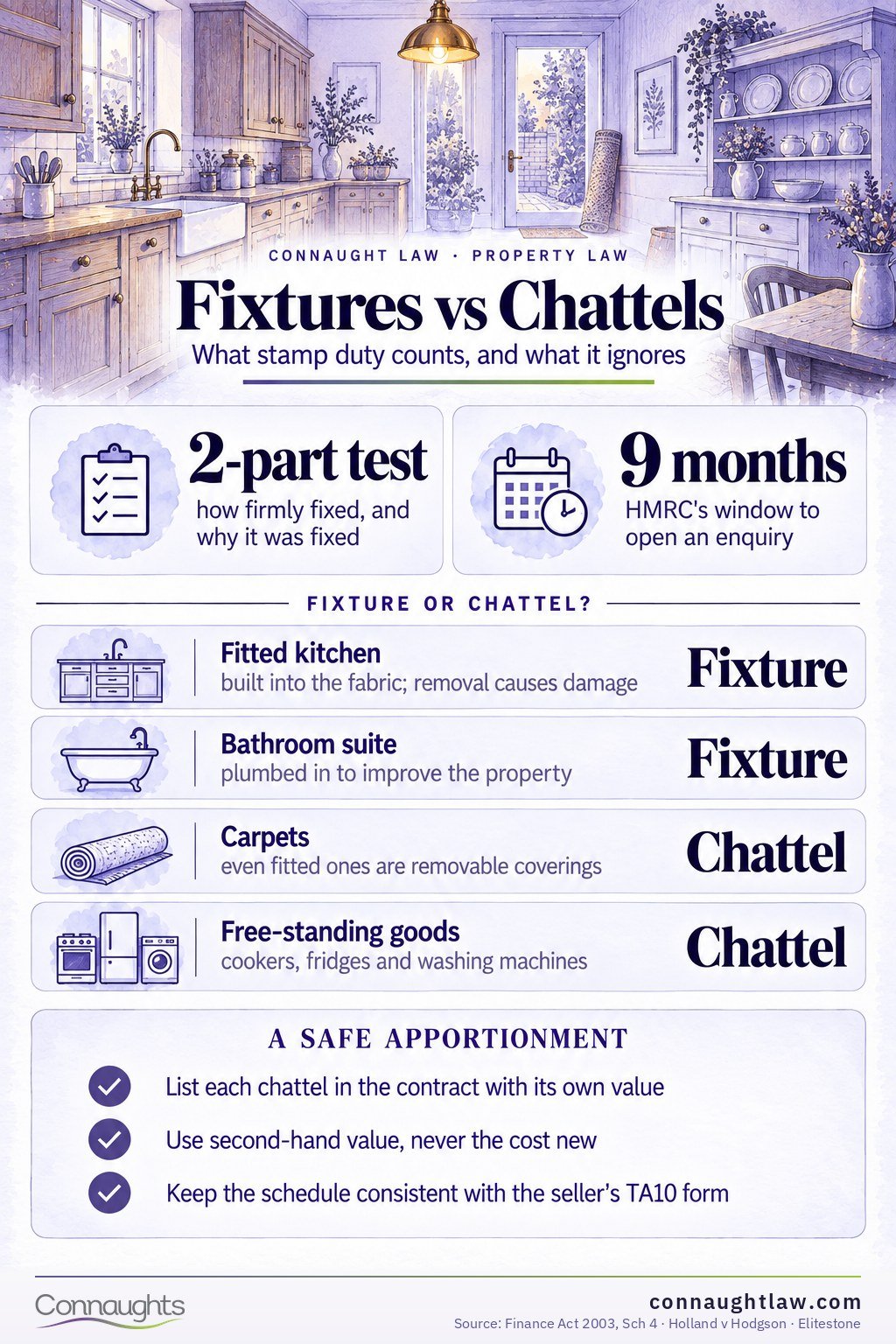
The courts decide what is a fixture with a two-part test set in Holland v Hodgson (1872): the degree of annexation — how firmly the item is attached — and the purpose of annexation — whether it was attached to improve the land permanently or merely to enjoy the item itself. Purpose has become the dominant limb. In Elitestone Ltd v Morris [1997], the House of Lords held that a bungalow resting on concrete pillars, attached by nothing but gravity, was part and parcel of the land because it could not be removed except by demolition.
In Botham v TSB Bank (1996), the Court of Appeal worked through an entire flat, item by item — the closest thing English law has to a homeowner's checklist. Bathroom fittings and kitchen units: fixtures. Carpets, curtains, light fittings and white goods: chattels. The pattern is consistent: the more the item is built into the fabric, and the less it can be removed without damage, the more likely it has stopped being anyone's personal property.
Items HMRC Treats as Fixtures
| Item | Why It Is a Fixture |
|---|---|
| Fitted kitchen units and worktops | Built into the fabric; removal causes damage |
| Bathroom suites and sanitary ware | Plumbed in and annexed for the improvement of the property |
| Central heating systems and boilers | Integrated into the building's services |
| Fitted wardrobes and built-in cupboards | Constructed to fit the space; not free-standing |
| Alarm systems and hard-wired installations | Wired into the structure for the benefit of the property |
HMRC's position follows the case law and is set out in its SDLT manual at SDLTM04010. Money attributed to any of these items is chargeable consideration, whatever the contract calls them.
Chattels: The Items SDLT Ignores
A chattel keeps its character as personal property: it rests on the land rather than forming part of it, and it leaves with the seller unless the contract says otherwise. Payment fairly attributed to chattels is not chargeable consideration, which is the entire basis of legitimate fixtures-and-fittings planning.
HMRC's Recognised Chattels List
- Carpets and rugs: fitted or otherwise, treated as removable coverings
- Curtains and blinds: curtains are chattels; fitted blinds are closer to the line and turn on attachment
- Free-standing furniture: wardrobes, dressers, tables — anything not built in
- Kitchen white goods: free-standing cookers, fridges and washing machines (integrated units are fixtures)
- Light shades and fittings: shades and free-hanging fittings, as distinct from hard-wired installations
- Garden ornaments and potted plants: resting on the land by their own weight
The recurring theme is attachment. The same item can fall either side of the line depending on how it is installed — a free-standing dishwasher is a chattel, an integrated one is not — which is why a per-item list agreed between the parties, at realistic second-hand values, is worth more than any general rule.
How Fixtures and Fittings Affect Your Stamp Duty Bill
The mechanics are simple. The SDLT return is made on the chargeable consideration — the price minus whatever is justly and reasonably attributed to chattels. Where a purchase sits near a band edge, that attribution is decisive: on a £255,000 purchase that genuinely includes £5,000 of chattels, SDLT is calculated on £250,000, saving £250 at the 5% marginal rate that applies above that point. Away from a threshold, the saving is the marginal rate applied to the chattel value — real, but modest, and never worth inflating.
Where the Rate Change Bites
| Threshold | To 31 March 2025 | From 1 April 2025 | Effect |
|---|---|---|---|
| Nil-rate band | £250,000 | £125,000 | Far more purchases now straddle a band edge |
| First-time buyer relief | £425,000 | £300,000 | FTB purchases in the £300k–£425k range lost relief entirely |
| 2% band | Did not apply | £125,001–£250,000 | Chattel apportionment affects more transactions at the margin |
The current bands are on the gov.uk SDLT rates page, and our stamp duty calculator shows what your purchase attracts before any apportionment. The arithmetic above is the honest ceiling of this planning: nobody legitimately saves thousands on an ordinary house purchase through fixtures and fittings, and anyone promising otherwise is describing a scheme, not the law.
Apportioning the Price: Doing It Properly
A defensible apportionment is built at the contract stage, not reverse-engineered afterwards. The items pass through the seller's TA10 fittings and contents form, into an itemised schedule in the contract, at values the parties can justify. The standard is second-hand value — what the items would fetch as used goods — never what they cost new. A three-year-old fitted-look sofa and a used washing machine are worth a fraction of their receipts, and HMRC knows it.
The Evidence an Apportionment Needs
- Itemised schedule: each chattel listed in the contract with its own value — never one round number
- Second-hand valuations: realistic used values, with the basis recorded
- The TA10 form: consistent with the schedule — contradictions between the two invite enquiry
- Photographs: showing items are free-standing rather than built in
- Both parties' agreement: an apportionment imposed by one side is worth little
Keep the file with your completion papers. If HMRC asks, the question will come months after completion, when memories of what was in the house have faded — the schedule and photographs answer it in minutes.
HMRC can open an enquiry into an SDLT return for nine months after filing, and can go back further where a return is careless or deliberate. Penalties scale with culpability on top of the extra duty and interest — a round-number apportionment with no supporting schedule is precisely the profile that gets tested.
Where Fixtures and Fittings Claims Go Wrong
The failures are predictable. Values pitched at replacement cost rather than second-hand value. A single unexplained round number — "£5,000 for fixtures and fittings" — with no schedule behind it. And items claimed as chattels that the law says are part of the building: in Orsman v HMRC [2012], part of an £8,000 "fixtures and fittings" payment related to built-in units, which the tribunal held were part of the land — tipping the chargeable price over a threshold and triggering the extra duty.
A newer hazard sits at the other end of the transaction: cold-call outfits offering to "reclaim overpaid stamp duty" on fixtures and fittings months after completion, for a cut of the refund. Some claims are legitimate; many are aggressive reconstructions that HMRC unwinds later, leaving the buyer holding the repayment, the interest and the penalty long after the agent's fee is gone. Have the apportionment done properly at purchase — with your conveyancing solicitor, inside the transaction — rather than retrofitted by a commission-led stranger. Buyers early in the process will find the sequence in our first-time buyer conveyancing guide.
Frequently askedQuestions about stamp duty on fixtures and fittings
Do you pay stamp duty on fixtures and fittings?
You pay SDLT on fixtures — items attached to the building, like fitted kitchens and bathroom suites — because in law they are part of the land. You do not pay it on genuine chattels such as carpets, curtains and free-standing furniture, provided the price attributed to them is just and reasonable.
How much can chattels save on stamp duty?
The marginal rate applied to the genuine chattel value — and no more. £5,000 of chattels at a 5% band edge saves £250; the same items away from a threshold save less. Anyone promising four-figure savings on an ordinary purchase is describing an inflated valuation, not legitimate planning.
Are blinds and carpets fixtures or chattels?
Carpets are chattels, even fitted ones — they are treated as removable coverings. Blinds sit closer to the line: curtains are chattels, but fitted blinds integrated with the window recess lean towards fixtures. Attachment decides it, which is why the same item can fall either side in different homes.
What evidence does HMRC expect for a chattels valuation?
An itemised schedule in the contract, values at second-hand rather than replacement cost, consistency with the seller's TA10 form, and agreement between both parties. A single round number with nothing behind it is the profile most likely to draw an enquiry within HMRC's nine-month window.
What are the penalties for overvaluing chattels?
The extra duty comes first, with interest. Penalties then scale with culpability — from none where reasonable care was taken, through percentages of the underpaid tax for careless errors, to substantially more where an inaccuracy was deliberate. The contract label carries no protection; the law looks at what the items actually were.
Can I claim a stamp duty refund on fixtures and fittings after completion?
Sometimes — if fixtures and fittings were genuinely ignored in the original return, an amendment within twelve months can correct it. Be wary of refund agents cold-calling with reconstructed valuations: HMRC can claw back refunds it later finds unjustified, with interest and penalties, long after the agent has taken their cut.
Tell us the price, what is included in the sale and where the nearest SDLT threshold sits. We will tell you what a just and reasonable apportionment looks like and what evidence to keep.
Get Expert Advice