
Renting in London is still a competition — but since 1 May 2026 it is a refereed one. Section 21 evictions are gone, every private tenancy is now periodic, landlords cannot accept bids above the advertised rent, and rent in advance is capped at one month. This guide covers your rights at each stage: applying, paying a deposit, living in the property, and challenging a rent increase.
On This Page

Renting in London: The Rules Changed on 1 May 2026
For years, advice to London tenants was tactics — move fast, offer over asking, accept the fixed term you were given. The Renters' Rights Act 2025 rewrote the ground those tactics stood on. Since 1 May 2026, assured shorthold tenancies no longer exist: every private tenancy is a periodic assured tenancy, there is no fixed term to be locked into, and a landlord can end it only on statutory grounds — section 21 no-fault notices are gone.
The competitive pressure has not vanished; good flats still draw multiple applicants within days. What has changed is what the competition is allowed to cost you — and a tenant who knows the new rules negotiates from a different position than one still playing by the old ones.
All private tenancies became periodic on 1 May 2026, existing ones included. Section 21 was abolished the same day — only section 21 notices served before then can still be enforced, and the last court deadlines for those fall in mid-2026. Rental bidding is banned, rent in advance is capped, and rent rises now follow one statutory route a tenant can challenge.
The Market Is Still Competitive; the Law Now Referees It
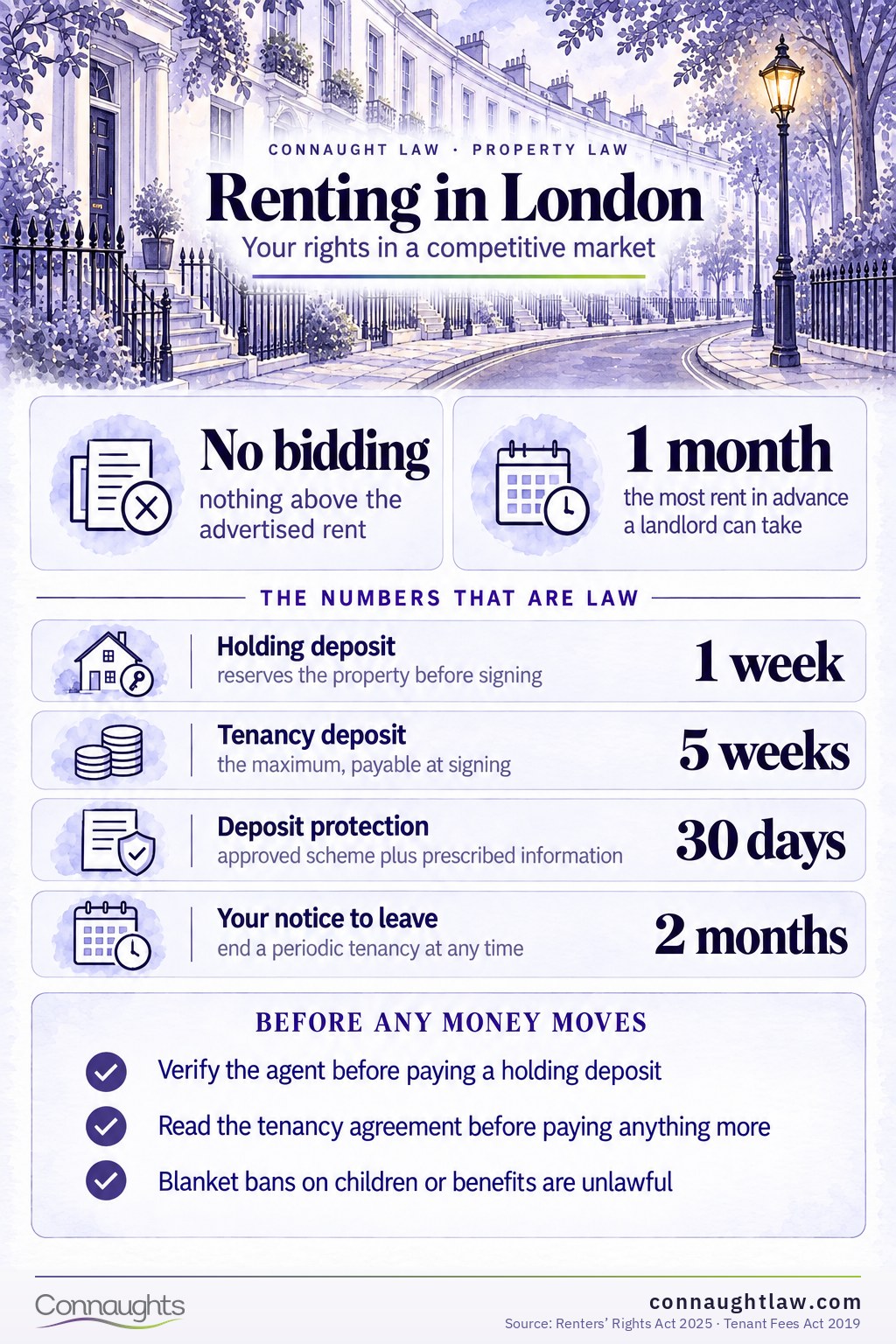
Expect speed: popular listings go to viewing lists within hours and to referencing within days. What you should no longer expect is an auction. Landlords and agents must advertise a rent and cannot invite, encourage or accept offers above it — the bidding wars that defined the last decade of London renting are unlawful. Nor can requirements be loaded upfront: a holding deposit is capped at one week's rent under the Tenant Fees Act 2019, and rent in advance is now capped at one month once the tenancy is agreed.
The practical consequence: preparation beats money. The applicant who wins is now the one whose paperwork is ready, not the one who offered three months upfront — because offering three months upfront is no longer something a landlord may take.
What London Actually Costs: Rent Is Only the Start
Borough-level rent tables age badly and we will not invent one; check current listings for the areas you are weighing. The durable point is structural: the gap between inner and outer London rents remains wide enough that where you sit on the map is the biggest financial decision of the tenancy — but rent is only one line of it.
Inner vs Outer London: The Real Trade-Off
Inner boroughs price proximity; outer boroughs price space. The honest comparison is total monthly cost — rent, travel, council tax band — against the hours of your life the commute takes. That sum lands differently for a hybrid worker on two office days than for someone commuting ten times a week, which is why nobody else's borough advice fits you exactly.
What Varies by Borough
| Cost Line | Inner London | Outer London |
|---|---|---|
| Rent per room or unit | Highest in the market | Materially lower, more space per pound |
| Travel | Lower zones, cheaper caps, walkable options | Higher zone caps or rail season tickets |
| Council tax | Varies sharply by borough, not by distance | Often — not always — higher bands for houses |
| Competition | Fastest-moving listings | More stock, slower decisions possible |
Where Demand Is Shifting
The Elizabeth Line moved the map: places with fast direct runs into the City and Canary Wharf now compete with inner boroughs for the same tenants, and their rents have been closing the gap. The corridor effect is real in both directions — better transport raises rents where it lands, which is why the value moves one stop further out every few years.
Rent plus Travel: The Sum That Actually Matters
Do the Whole Sum
Compare tenancies on rent plus travel, never rent alone. A cheaper flat two zones further out can lose its entire advantage to a travelcard, and TfL's own fare finder gives you the exact monthly figure in minutes. Run it before a viewing, not after you have fallen for the kitchen.
Routes That Keep the Cost Down
The pattern that keeps working: Overground and Elizabeth Line corridors where zone caps stay reasonable, and National Rail towns just outside the zones where a season ticket plus lower rent beats Zone 2 arithmetic. The detail changes with every fares revision — the method of checking it does not.
- Monthly rent: the advertised figure — which is now also the maximum a landlord may accept
- Travel: the actual monthly cap or season ticket for your real commute, from TfL or the rail operator
- Council tax: the band for the specific property, from the borough's site
- Bills and service charges: ask what is included before you apply, not at signing
- Time: a saved £150 that costs ten hours a month has a price too
Outer London and the Borders
The Eastern Value Corridor
East London's Elizabeth Line towns remain the clearest value story: direct, fast runs to the City from areas whose rents still sit well below inner-borough levels. That is exactly why they are competitive — the value is no longer a secret.
Zone 6 and Just Beyond
On the borders, the calculation flips to National Rail: lower rents against a season ticket and a longer door-to-door. For hybrid workers the border towns often win outright; for daily commuters the travel line eats the saving. Do the sum for your week, not the average tenant's.
Applications: What Landlords May Ask — and What They May Not
Standing Out Lawfully
Speed still wins applications, so build the pack before the search: photo ID, three months' bank statements, employment reference or contract, previous landlord reference, and a guarantor briefed in advance if your income multiple is borderline. What no longer wins applications is money a landlord may not take — over-advertised-rent offers and stacks of rent upfront are both off the table.
Right to Rent, Referencing and the Banned Questions
Every adult occupier faces a right to rent check — passport, immigration status share code, or Home Office check — before a tenancy can lawfully start. Referencing and affordability checks are lawful; discrimination is not: blanket bans on tenants who receive benefits or have children are unlawful under the Renters' Rights Act, and a pet request must now be considered and not unreasonably refused. If an agent's requirements feel like a filter for who they would rather not house, the law is on your side and the paper trail matters.
- Identity and right to rent: passport or share code for every adult moving in
- Income evidence: contract, payslips or accounts; agents commonly look for roughly 30× monthly rent in annual income
- References: employer and previous landlord, warned they will be contacted
- Guarantor: identified and documented in advance if you may need one
- Deposit funds ready: five weeks' rent, payable at signing — not before
Deposits: The Cap, the Clock and Getting It Back
Five Weeks, Protected Within 30 Days
For annual rents under £50,000, the tenancy deposit is capped at five weeks' rent, and the holding deposit that reserves the property at one week. Once paid, the deposit must go into a government-approved protection scheme within 30 days, with the prescribed information served on you. A landlord who misses either step faces a penalty of one to three times the deposit — and in London's turnover market, unprotected deposits remain the most common tenant claim we see.
Five weeks' deposit maximum. One week's holding deposit. Thirty days to protect it and serve the prescribed information. One month's rent in advance, no more. Anything an agent asks for beyond these is either a banned fee under the Tenant Fees Act 2019 or a number worth questioning in writing.
Standards, Repairs and Disputes
Disrepair obligations sit with the landlord — structure, heating, water, safety — and reporting in writing starts the clock. Deposit deductions are contested free through the scheme's dispute service, where the landlord carries the burden of proving the deduction; photographic check-in evidence wins those cases. The Act's new landlord database and ombudsman are being phased in alongside — our Renters' Rights Act guide tracks the detail, and where a landlord seeks possession, the grounds now have to be proved, a shift covered by our evictions team from both sides.
Budgeting for a London Tenancy
What Affordability Checks Look For
Agents typically test for annual income around thirty times the monthly rent, with a guarantor bridging any gap. Budget past the referencing test, though: the tenancy that passes affordability on paper still has to survive travel, council tax and bills — the whole-sum arithmetic above — with something left over.
Paying Less Without Moving to Zone 9
Rent falls to negotiation more often in winter, on stock that has sat for weeks, and where you can offer a clean file and flexible start date. Since tenancies are now periodic by law, you are not trading a longer fixed term for a discount — the lever is being the applicant who can complete referencing this week.
Trading Rent for Travel
| Move | What You Gain | What It Costs |
|---|---|---|
| One zone out on the same line | Lower rent, often more space | A higher travel cap and minutes each way |
| Tube corridor to Elizabeth Line / Overground | Newer stock, faster trains | Rising rents where the corridor is popular |
| Zones to National Rail border towns | The biggest rent reduction available | Season ticket plus a commute that tests hybrid patterns |
Viewings, Offers and the Bidding Ban
Moving Fast Without Signing Blind
Speed pressure is where tenants get hurt: money transferred before anything is verified, agreements signed unread. Hold two lines however hot the market feels — pay a holding deposit only to an agent you have verified is real and money-protected, and read the tenancy agreement before any money beyond the holding deposit moves. A day's delay costs you a flat occasionally; a fake listing costs five weeks' rent every time.
What You Can Still Negotiate
The rent itself — downward, on slow stock. The start date. Works, furnishing and decoration before move-in. What you no longer negotiate is security: the periodic tenancy and the statutory notice you give (two months, any time) are fixed by law, and a rent increase comes once a year by statutory notice, challengeable at the First-tier Tribunal (Property Chamber) before it takes effect — a challenge that no longer risks eviction, because there is no section 21 to answer back with.
Frequently askedQuestions about renting in London under the new rules
Can a landlord accept more than the advertised rent?
No. Since the Renters' Rights Act took effect, landlords and agents must advertise a rent and cannot invite, encourage or accept bids above it. If you are told a higher offer will secure the flat, that is an invitation to break the law — and worth reporting to the borough as much as refusing.
How much deposit can a London landlord take?
Five weeks' rent where the annual rent is under £50,000, plus a holding deposit capped at one week. The deposit must be protected in an approved scheme within 30 days with the prescribed information served on you — failure carries a penalty of one to three times the deposit.
Can I still be evicted without a reason?
Not for tenancies going forward: section 21 was abolished on 1 May 2026 and possession now needs a statutory ground the landlord can prove. Only section 21 notices served before that date can still be enforced, and the court deadlines for those expire in mid-2026.
How much rent in advance can be required?
One month, once the tenancy agreement is entered into. The era of outbidding other applicants with six months upfront is over — a landlord may not invite or accept it, which levels the field for tenants whose strength is a clean file rather than a lump sum.
Can landlords refuse tenants with children or on benefits?
Blanket bans are unlawful under the Renters' Rights Act. A landlord can still apply genuine affordability and referencing checks to everyone equally, but "no DSS", "professionals only" filtering and automatic refusals of families are precisely what the Act prohibits. Keep the correspondence — it is evidence.
How do I challenge a rent increase?
A rent rise now comes by statutory notice, once a year, with two months' warning. If it is above market level, apply to the First-tier Tribunal before the increase date — the tribunal sets a market rent, the challenge itself cannot trigger an eviction, and until it is decided the old rent generally continues.
Tell us what was demanded — rent above the advertised figure, months in advance, an unprotected deposit — and when. We will tell you what the Act says, what it is worth and how to enforce it.
Get Expert Advice