
The Renters' Rights Act 2025 is now law in force, not a proposal to track. Since 1 May 2026 every private tenancy in England is periodic, section 21 is gone, and possession runs entirely through section 8 grounds a landlord must prove. This guide covers what changed on commencement day, the timeline for what is still coming, the new rent rules, and what a landlord has to do differently to stay on the right side of penalties that reach £40,000.
On This Page

The Renters' Rights Act 2025: What Changed on 1 May 2026
The Renters' Rights Act 2025 received Royal Assent on 27 October 2025, and its central reforms took effect on 1 May 2026 — for existing tenancies as well as new ones. There was no grandfathering: on commencement day, every assured shorthold tenancy in England converted to a periodic assured tenancy, fixed terms ceased to exist, and the section 21 notice — the instrument on which most possession practice was built — was abolished.
For landlords this is the biggest change to the private rented sector since the Housing Act 1988, and the practical consequence is simple to state: possession now has to be earned through evidence. Every route to recovering a property runs through section 8 grounds that must be proved to a judge, and every management habit built around "we can always serve a 21" needs replacing with records that would survive a hearing.
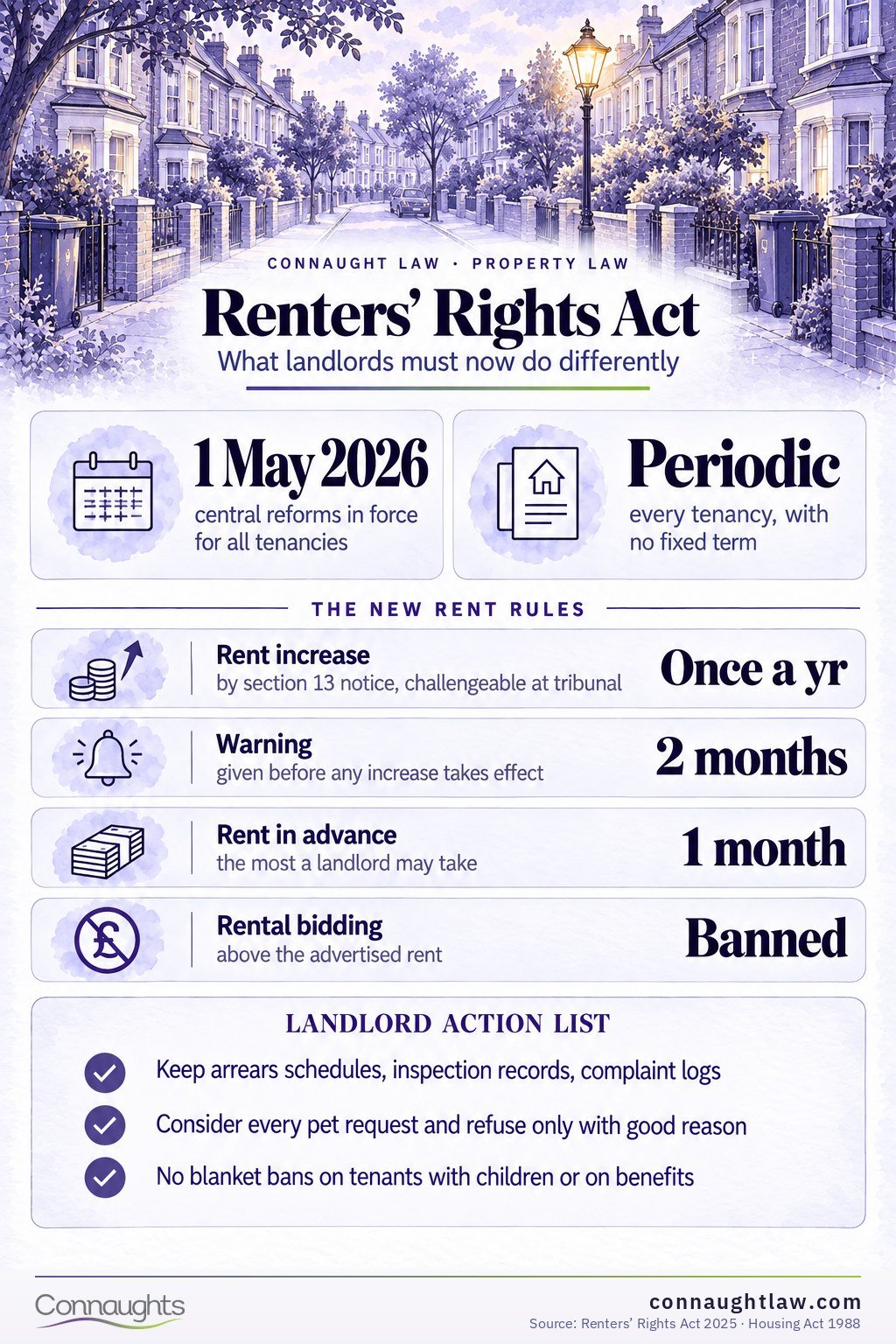
In force since 1 May 2026: periodic tenancies for all, section 21 abolished, the new section 8 grounds, the rental bidding ban, the one-month cap on rent in advance, pet request rights and the discrimination bans. Still being phased in: the Private Rented Sector Database (registration opening from late 2026) and the landlord ombudsman (launching 2028), per the government's implementation roadmap.
Timeline: What Took Effect and What Is Still Coming
Commencement, Stage by Stage
The Act commenced in stages, and the stages matter because landlord obligations arrive with each one. The dates below are the government's published roadmap; the database and ombudsman dates are targets rather than commenced law, and prudent landlords will treat each as "prepare now, comply on the day".
Commencement Dates
| Date | What Happened | What It Means |
|---|---|---|
| 27 October 2025 | Royal Assent | The Bill became the Renters' Rights Act 2025 |
| 13 November 2025 | Implementation roadmap published | Government confirmed the staged commencement plan |
| 27 December 2025 | Council enforcement powers | Local authorities gained new investigatory powers and civil penalty tools |
| 1 May 2026 | Central reforms in force | Periodic tenancies, section 21 abolition, new grounds, rent rules — all tenancies |
| Late 2026 (target) | PRS Database opens | Landlord registration begins — see our PRS database guide |
| 2028 (target) | Landlord ombudsman launches | Mandatory redress scheme for tenant complaints |
Section 21 Is Gone and Every Tenancy Is Periodic
Section 21 notices can no longer be served — only notices served before 1 May 2026 retain any effect, and the transitional window for enforcing those closes through mid-2026. From commencement, tenancies have no fixed term and no end date: they roll monthly until the tenant gives two months' notice or the landlord proves a ground. Our evictions team now runs every possession case through that grounds framework, and the difference from the section 21 era is that the paperwork has to be right at the start, not fixed at the hearing.
What Periodic-Only Means in Practice
Fixed terms protected landlords less than folklore suggested, but their disappearance still changes the economics: a tenant can leave on two months' notice at any point, including week one. Void risk shifts onto pricing and retention rather than contractual lock-in. What landlords gain in exchange is a cleaner statutory framework — no more renewal paperwork, no more debates about periodic conversion, one set of rules for every tenancy in the portfolio.
Possession Now Runs Through Section 8
The reformed grounds do cover the legitimate reasons landlords need their properties back: moving in, selling, redevelopment, serious arrears, antisocial behaviour and breach. But the mandatory grounds for moving in or selling cannot be used in the first twelve months of a tenancy and carry four months' notice — the Act's answer to disguised no-fault eviction — and every ground must be evidenced. A judge, not a form, now decides whether possession follows.
Getting the Grounds Right First Time
The cases that fail are failing on preparation: the wrong ground pleaded, notice periods miscounted, arrears schedules that do not reconcile, or a "selling" ground with nothing behind it — and using the moving-in or selling grounds without genuine intent is itself a penalty offence. The working rule is to build the evidence file before serving anything: our guide to the section 8 grounds for possession covers the ground-by-ground detail.
- Moving in (Ground 1): landlord or close family occupying — not available in the first 12 months, four months' notice
- Selling (Ground 1A): genuine intention to sell — same 12-month and four-month limits, penalties for misuse
- Serious arrears (Ground 8): the threshold is now three months' arrears, with four weeks' notice
- Antisocial behaviour: notice can be immediate — but the evidence standard is unforgiving
- Breach and damage: discretionary grounds where the judge weighs proportionality — records decide these
Rent: One Route Up, Two New Bans
Rent increases now follow a single statutory route: one increase a year by section 13 notice, with two months' warning, challengeable by the tenant at the First-tier Tribunal before it takes effect. Rent review clauses in old agreements are dead letters. The tribunal route has no eviction to fear behind it any more, so landlords should expect above-market increases to be tested — and should price them to survive testing.
The Bidding Ban and the Advance Cap
Two marketing-stage practices are now unlawful: inviting or accepting bids above the advertised rent, and taking more than one month's rent in advance once the tenancy is agreed. Both were standard competitive-market behaviour in high-demand areas a year ago; both now carry civil penalties. Advertise the rent you mean, and build referencing strength rather than upfront cash into how you select tenants.
New Duties: Standards, Database and Ombudsman
Around the headline reforms sits a compliance layer arriving in stages. The Decent Homes Standard is being extended to the private sector with Awaab's law hazard timescales to follow; the PRS Database will make registration a precondition of lawful letting as it rolls out from late 2026; and from 2028 every landlord joins a mandatory ombudsman scheme. Pet requests must already be considered and not unreasonably refused, and blanket bans on tenants with children or on benefits are unlawful now — per the government's guide to the Act.
- Audit the paperwork: gas, electrical, EPC, deposit protection — the documents that once gated section 21 now gate credibility on any ground
- Build the evidence habit: arrears schedules, inspection records, complaint logs — every possession route now needs proof
- Reprice honestly: advertised rent is the ceiling; annual section 13 increases should survive a tribunal look
- Prepare for registration: the database will expose portfolio compliance in one search — fix it before it is public
- Take advice before serving anything: a defective notice now costs months, not a re-service
Questions landlords are asking about the Act
When did the Renters' Rights Act 2025 come into force?
Royal Assent came on 27 October 2025 and the central reforms took effect on 1 May 2026 — periodic tenancies, section 21 abolition, the new grounds and the rent rules, applying to existing tenancies as well as new ones. The database and ombudsman follow in later phases.
Does the Act apply to tenancies that already existed?
Yes. On 1 May 2026 every existing assured shorthold tenancy converted automatically to a periodic assured tenancy. There is no grandfathering: fixed terms in signed agreements ceased to have effect, and the new possession and rent rules apply to every tenancy from that date.
Can landlords still use section 21 notices?
No new section 21 notice can be served. Only notices served before 1 May 2026 retain effect, and the transitional deadlines for acting on those expire during mid-2026. Every new possession case proceeds on section 8 grounds that must be proved.
How can a landlord get their property back now?
Through the reformed section 8 grounds: moving in or selling (after the first year, on four months' notice, with genuine intent), serious arrears at the three-month threshold, antisocial behaviour, and breach. Each needs evidence that stands up in court — the ground is an argument now, not a form.
How often can rent be increased?
Once a year, by section 13 notice with two months' warning. The tenant can refer the increase to the First-tier Tribunal before it takes effect, and challenging no longer carries any eviction risk — so increases pitched above market should expect scrutiny.
What is the Private Rented Sector Database?
A national register of landlords and properties, opening for registration from late 2026 and becoming a precondition of lawful letting as it rolls out. It will surface compliance history in one search — our separate PRS database guide covers registration step by step.
Do landlords have to allow pets?
Tenants now have a statutory right to request a pet, and consent cannot be unreasonably refused. Blanket no-pets policies are finished; refusals need property-specific reasons, given in writing, within the required timeframe.
What penalties apply for getting it wrong?
Councils can impose civil penalties of up to £7,000 for less serious breaches and up to £40,000 for serious or repeat ones, alongside rent repayment orders and, for some conduct, prosecution. The enforcement powers commenced in December 2025 — councils were armed before the main rules even landed.
Tell us how many properties you let, what your current agreements say and whether any possession action is in progress. We will tell you what needs fixing first and how to run possession under the new grounds.
Get Expert Advice