
Replacement of domestic items relief lets a landlord deduct the full cost of replacing furniture, appliances and furnishings in a let property — and it remains one of the most under-claimed deductions in the private rented sector. The rules are precise: replacements only, never initial purchases; like-for-like value, not upgrades; movable items, never fixtures. This guide covers the four statutory conditions, the calculation with worked figures, the boiler question everyone asks, and the Making Tax Digital records the relief will soon depend on.
On This Page
Replacing What Tenants Wear Out: The Relief That Pays For It
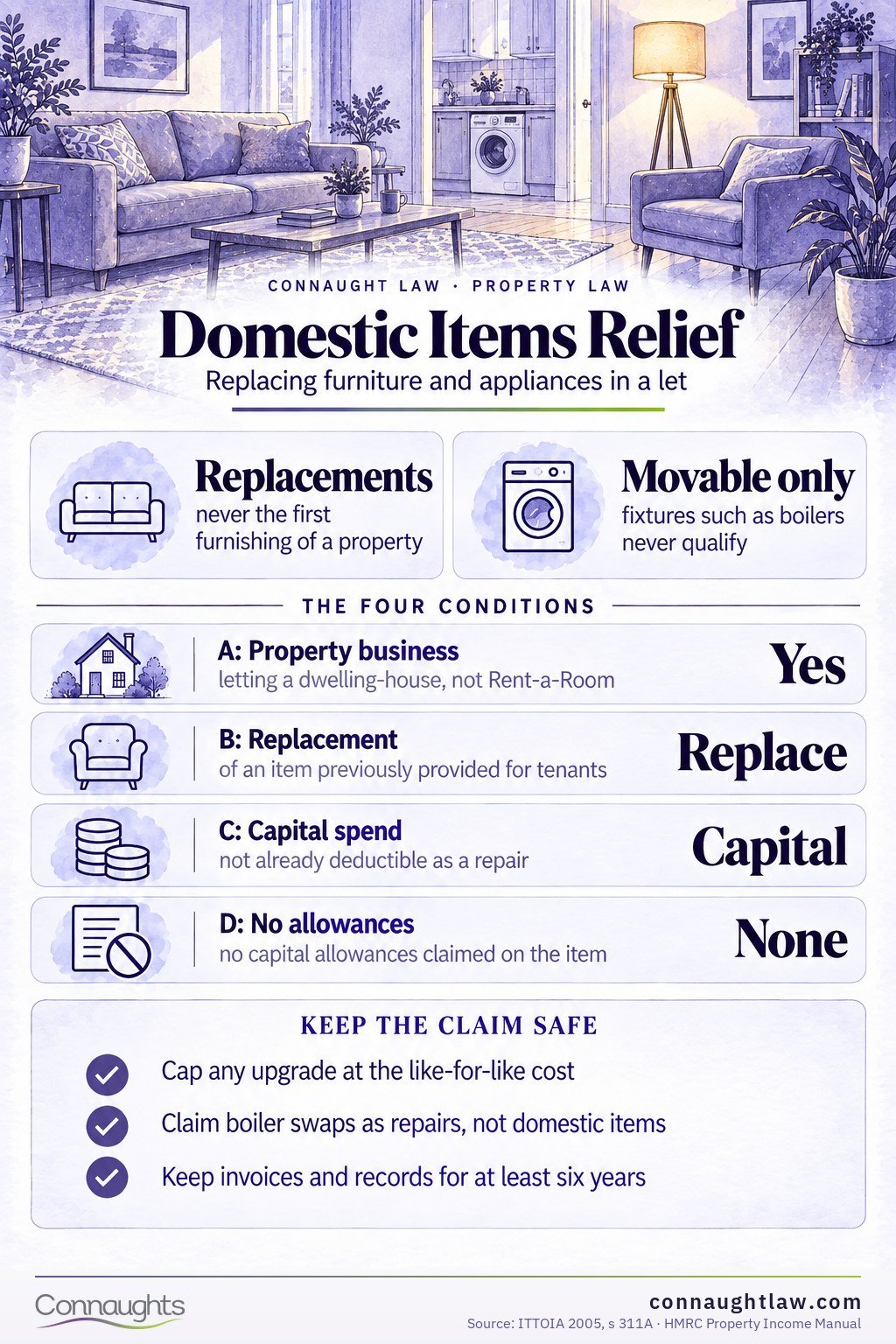
Replace a domestic item you previously provided for tenants — a washing machine, a sofa, the carpets — and the cost is deductible in full against rental profits, under section 311A ITTOIA 2005. No election, no percentage, no claim form: it goes through the property pages of the return, supported by the receipts.
What the Relief Is — and What It Replaced
From Wear and Tear to Replacement Relief
Until April 2016 the wear and tear allowance handed furnished-property landlords 10% of net rents regardless of spending; the replacement relief that succeeded it pays only for money actually spent. Two recent changes matter: the furnished holiday lettings regime was abolished in April 2025, pushing former FHL landlords onto this relief instead of capital allowances, and HMRC's Property Income Manual guidance at PIM3210 was updated on 4 December 2025, confirming the relief's scope for residential lettings — with Rent-a-Room properties excluded.
Which Items Qualify
Qualifying Domestic Items
- Movable furniture: beds, sofas, wardrobes, tables and chairs.
- Furnishings: carpets, curtains, blinds, rugs, bedding.
- Appliances: fridges, freezers, washing machines, dishwashers, televisions.
- Kitchenware: crockery, cutlery, pots and pans.
Fixtures Do Not Qualify — Including the Boiler
The Fixture Side of the Line
Items vs Fixtures
| Room | Qualifies | Does Not Qualify |
|---|---|---|
| Kitchen | Free-standing cooker or fridge | Built-in oven, integrated appliances, the units themselves |
| Bathroom | Free-standing accessories | Bath, basin, toilet, shower unit |
| Heating | Portable heaters | Boilers, radiators, central heating systems |
| Bedroom | Free-standing wardrobe | Fitted wardrobes and built-in furniture |
The question HMRC's manuals get searched for most: a boiler is a fixture, so this relief never touches it — but that is not bad news. A like-for-like boiler replacement is normally deductible in full as a repair to the building under ordinary revenue principles; only a genuine upgrade or an installation that improves the property beyond what was there becomes capital. Same logic for radiators and bathroom suites: fixture repairs claim as repairs, not as domestic items.
The Four Statutory Conditions
Condition A: A Property Business
You must carry on a property business including the letting of a dwelling-house — ordinary buy-to-let landlords qualify automatically; Rent-a-Room cases do not.
Condition B: A Genuine Replacement
A new item must replace an old one previously provided for tenant use in that property, with the old item no longer available to tenants. Furnishing a property for the first time — including the first furnishing of a newly bought rental — is outside the relief entirely.
Condition C: Capital Spending
The relief exists precisely because item replacement is capital expenditure that ordinary deduction rules would refuse. If the spend already deducts as a repair, it takes that route instead — no double dipping.
Condition D: No Capital Allowances
Where capital allowances have been claimed on an item — common in former FHL businesses — this relief cannot apply to its replacement. Post-abolition, former holiday-let landlords need to check which regime each item's history sits in before claiming.
Calculating the Deduction
Like-for-Like
The deduction is the new item's cost, plus incidental costs of buying and disposing, minus anything received for the old item. Simple where the replacement matches the original in kind and quality.
The Upgrade Cap
Replace with something substantially better and the deduction is capped at what a like-for-like replacement would have cost — the upgrade element is capital and unrelieved. A functional change of the same modern standard (the current equivalent model) is not an improvement; a leap in specification is.
Worked Figures
Deduction Examples
| Scenario | Spend | Claimable |
|---|---|---|
| Washing machine, like-for-like | £350 | £350 |
| Washing machine, premium upgrade | £800 | £350 — the like-for-like equivalent |
| Sofa plus £50 delivery | £650 | £650 |
| Fridge with £100 trade-in received | £500 | £400 |
Incidentals and Disposal
Delivery, installation and disposal fees join the claim; trade-in values and sale proceeds for the old item come off it. The receipts for all of these are the claim — which is where the next section takes over.
Making Tax Digital: The Records Side
The MTD Timeline for Landlords
- April 2026: landlords with qualifying income over £50,000 move to MTD-compatible software, with quarterly updates.
- April 2027: the threshold drops to £30,000.
- April 2028: down again to £20,000.
- The final declaration replaces the traditional return, due 31 January after the tax year.
Digital Records for This Relief
Each claim needs the invoice for the new item, evidence of what it replaced, incidental cost receipts and any disposal proceeds — retained at least six years, and flowing through MTD software once you are in the regime. HMRC can open an enquiry within twelve months of filing; the claims that survive are the ones where the record was made at purchase, not reconstructed at enquiry.
Common Mistakes
Claiming the First Furnishing
The commonest error by far: initial purchases never qualify, however furnished the letting. The relief starts with the second sofa, not the first.
Overclaiming on Upgrades
Claiming the full £800 premium machine against a £350 baseline is the error HMRC's compliance activity is built to catch — the like-for-like cap needs applying and evidencing, ideally with a screenshot of the equivalent model's price at the time.
Thin Documentation
No invoice, no evidence of the old item, no note of disposal — a real replacement becomes an unallowable claim purely for lack of paper.
Misclassifying Fixtures
Built-in appliances, bathroom suites and boilers claimed as domestic items fail — though many belong in the repairs column instead, which is the better answer anyway.
Claiming Within Exclusions
Rent-a-Room lettings sit outside the relief, and items with capital-allowance history are barred by Condition D — both worth checking before the claim, not after the enquiry.
Frequently askedQuestions about domestic items relief
What is replacement of domestic items relief?
A deduction under section 311A ITTOIA 2005 for the cost of replacing movable items provided for tenants — furniture, appliances, furnishings, kitchenware — claimed in full against rental profits, capped at like-for-like value where you upgrade.
Can I claim for furnishing a property for the first time?
No. Initial purchases never qualify — the relief pays only for genuine replacements of items previously provided in that property. The distinction is absolute, and it is the most policed line in the relief.
Does a boiler replacement qualify?
Not under this relief — a boiler is a fixture. But a like-for-like boiler swap normally deducts in full as a repair under ordinary rules, so the tax answer is usually just as good, claimed in a different box. Upgrades beyond like-for-like drift into capital.
What happened to the wear and tear allowance?
Abolished from April 2016. The 10%-of-rent deduction was replaced by this relief, which pays for actual spending only — worse for landlords who never replaced anything, better for those who genuinely maintain their lets.
How does the relief work for former holiday lets?
Since the FHL regime ended in April 2025, holiday-let landlords use this relief like everyone else — but items that already received capital allowances are barred by Condition D, so each item's history needs checking before its replacement is claimed.
What records do I need to keep?
The new item's invoice, evidence of what it replaced, incidental cost receipts and any disposal proceeds — for at least six years, and digitally once Making Tax Digital applies to you from April 2026 onwards by income band.
Tell us what you replaced, what it replaced and what happened to the old item. We will tell you how much is deductible, which box it belongs in, and what records HMRC will expect you to hold.
Get Expert Advice