
Every private landlord in England will have to register themselves and every property they let on the new PRS database, with rollout starting in late 2026. The duty comes from the Renters' Rights Act 2025; the timetable comes from the government's implementation roadmap; and the price of ignoring it is a civil penalty ladder rising to £40,000, a ban on marketing the property, and a block on possession orders. Here is what is confirmed, what is still unconfirmed, and what to have ready before the portal opens.
On This Page

The National Landlord Database: What It Is and Why It Exists
England has never had a national register of private landlords — licensing has been local, partial and inconsistent. The Renters' Rights Act 2025 changes that with the Private Rented Sector Database: one national record of who lets what, visible to tenants checking a landlord before signing and to councils enforcing standards. For landlords it doubles as the government's compliance channel, surfacing legal obligations in one place rather than across scattered guidance.
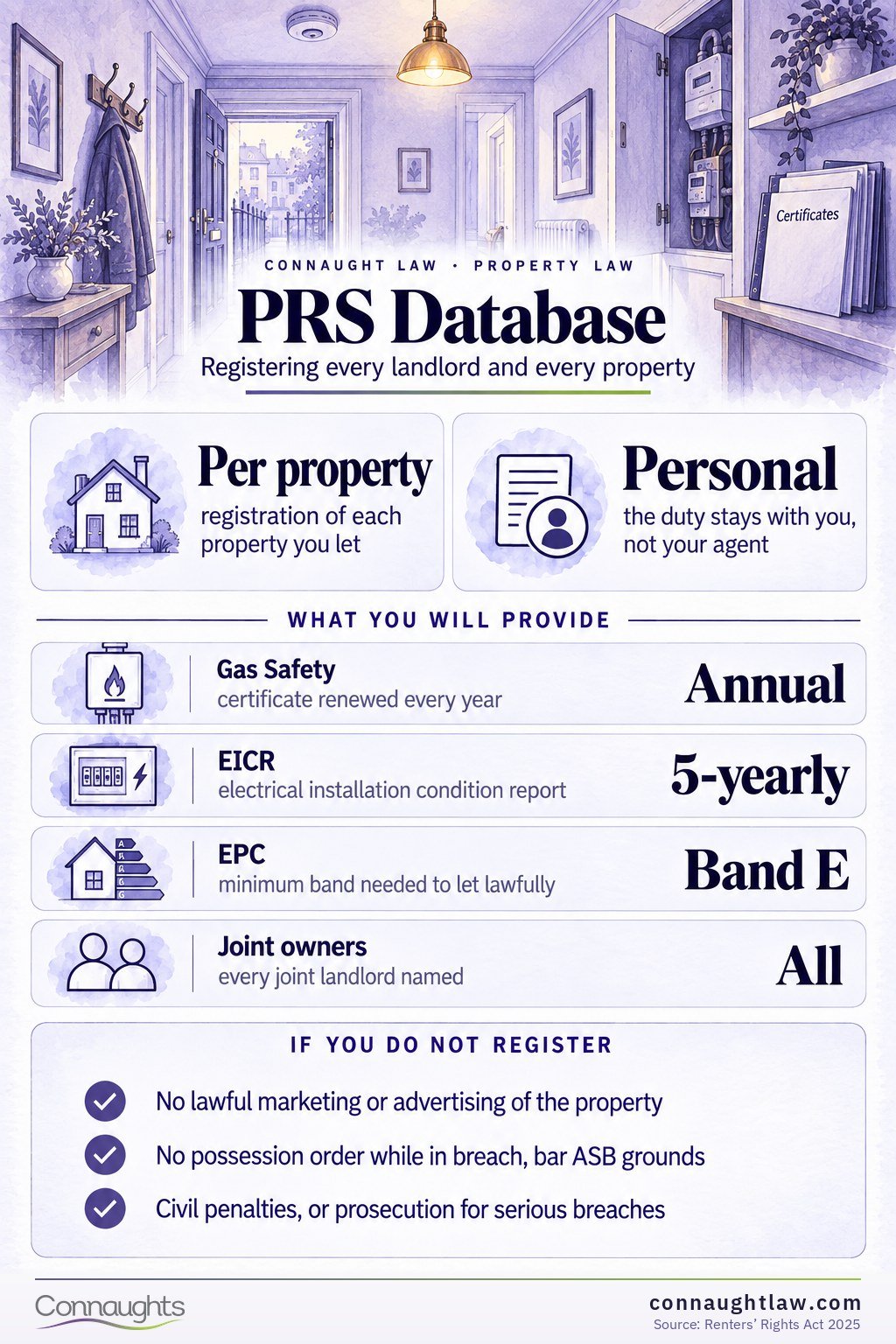
Registration will be mandatory for every private landlord in England, per landlord and per property, through an online portal, for an annual fee the government will confirm closer to launch. Rollout begins in late 2026, region by region. Until you are required to register, there is nothing to file — but there is a file to build.
Who Must Register — and Who Stays Responsible
The duty covers landlords of assured and regulated tenancies in England — which, since every private tenancy became a periodic assured tenancy on 1 May 2026, means effectively the whole sector, from a single inherited flat to an institutional portfolio. Social landlords are regulated separately. Two points catch people out: using a letting agent does not transfer the duty — registration is the landlord's personal obligation — and joint owners must all appear in the registration, not just whoever deals with the agent.
Landlord Categories Caught by the Duty
- Individual landlords, whether or not an agent manages the property.
- Joint landlords — every joint owner named.
- Companies and institutional landlords letting residential property.
- Landlords of the remaining regulated (pre-1989) tenancies.
- Outside the net: registered social housing providers, answerable to the Regulator of Social Housing instead.
When Does the PRS Database Start?
The implementation roadmap, published 13 November 2025, commits to commencing rollout "from late 2026" — in stages, starting with a regional rollout for landlords and councils before extending further. No calendar date or regional order has been announced, and the mandatory deadlines will be set in secondary legislation.
"Late 2026" is indicative, not statutory; the pattern so far is that this government hits its Renters' Rights dates (1 May 2026 landed as promised), but rollout by region means your date depends on where your property sits. What is certain is the direction: registration before marketing, and enforcement funding already flowing — councils received £18.2 million of new burdens funding for 2025/26, and their strengthened investigatory powers have been live since 27 December 2025.
What Registration Will Ask For
The roadmap sets the minimum: the landlord's contact details, the property's address and type, bedroom count and occupancy status, plus safety certification. None of this is new law — the gas, electrical and energy certificates the database will record are documents a compliant landlord already holds. The database's real effect is to make the gaps visible: an expired certificate that once surfaced only during a dispute will sit on a public record.
The Expected Data, Line by Line
- Landlord identity and contact details — all joint landlords included.
- Property address, type, number of bedrooms, furnished status and occupancy.
- Gas Safety Certificate (annual).
- Electrical Installation Condition Report (five-yearly).
- Energy Performance Certificate — minimum band E to let lawfully.
- Smoke and carbon monoxide alarm compliance.
Fees: Annual, Per Property, Amount Unconfirmed
The roadmap confirms three things about money: registration carries an annual fee, the fee attaches per property rather than per landlord, and the amount "will be confirmed closer to launch" on a cost-recovery basis. Anything more specific currently circulating is guesswork — the devolved registration schemes and local licensing regimes all charge annually per property, but none of them is a reliable proxy for a national digital service.
Portfolio landlords should provision per property, not per portfolio: ten flats means ten annual fees. Build the line into 2027 cash-flow forecasts now and treat the eventual figure as an adjustment. The fee is also likely to be a deductible letting expense — confirm with your accountant when the amount is announced.
Penalties: What Non-Registration Costs
The Act arms councils with a civil penalty ladder: up to £7,000 for initial or less serious breaches, and up to £40,000 — or criminal prosecution — for continuing, repeat or serious ones. Alongside the fines sit two structural consequences that bite harder: an unregistered property cannot lawfully be marketed or advertised, and a landlord in breach of the registration duty faces a block on possession orders, with the anti-social behaviour grounds excepted. Rent-to-rent arrangements do not launder the duty away — the enforcement follows whoever is the landlord in law.
Consequences in One View
- Civil penalty up to £7,000 for a first or less serious breach.
- Up to £40,000, or prosecution, for serious, repeat or continuing breaches.
- No lawful marketing or advertising of an unregistered property.
- No possession order while in breach, except on anti-social behaviour grounds.
- Council investigatory powers — document demands, inspections, third-party data — in force since 27 December 2025.
The Landlord Ombudsman: Same Act, Slower Track
The Act also makes membership of a landlord ombudsman scheme mandatory, giving tenants a free, binding complaints route without going to court. It is a separate obligation from the database, and it runs on a different timetable: the roadmap expects the service to launch in 2028, once the Secretary of State is satisfied it is ready, with the scheme built in the 12 to 18 months beforehand. Guides that put the ombudsman alongside the database in late 2026 are reading an older assumption — the roadmap split the two.
What the Scheme Requires
Confirmed so far: membership will be mandatory for landlords whether or not they use an agent; decisions will bind landlords; and the funding model — like the database fee — comes "closer to launch". Breaches sit on the same style of civil penalty ladder as the database. Nothing needs doing today except knowing it is coming and pricing a second annual charge into the medium term.
Getting Ready: The Work Worth Doing Now
Registration will be an exercise in producing documents you are already legally required to hold. Landlords who treat late 2026 as a compliance audit deadline will find the registration itself trivial; those who wait for the portal will discover expired certificates at the worst moment — with a public record waiting for the answer.
The Preparation File
- Check every Gas Safety Certificate, EICR and EPC is current — and diarise the renewals.
- Record each property's address, type, bedrooms and occupancy in one place.
- Confirm how each property is held — joint names on the register mean joint names in the registration.
- Verify contact details are current with agents, insurers and lenders.
- Provision the annual fee per property in the 2027 budget.
- Watch for the secondary legislation that fixes your region's deadline.
The database will also change how the rest of the Act is enforced against you: possession under the reformed section 8 grounds assumes a registered landlord, and the wider post-May regime is covered in our Renters' Rights Act landlord guide.
Frequently askedQuestions about the PRS database
What is the new landlord database?
A national register of private landlords and their properties in England, created by the Renters' Rights Act 2025. Tenants can check it, councils enforce from it, and landlords must be on it before marketing a property. It replaces nothing — it sits on top of existing local licensing.
When does the PRS database start?
Rollout begins in late 2026, region by region, per the November 2025 roadmap. No calendar date or regional order is fixed yet; the mandatory deadlines arrive in secondary legislation. Registration will be required before a property can lawfully be marketed.
How much will registration cost?
Unconfirmed. The government has committed only to an annual, per-property fee set on a cost-recovery basis, announced closer to launch. Treat any specific figure currently circulating as speculation, and budget per property rather than per portfolio.
Does my letting agent handle registration for me?
No. The duty is the landlord's personally, however fully managed the property. An agent can assemble the documents and complete the forms, but the legal responsibility — and every penalty for getting it wrong — stays with the landlord, and all joint landlords must be named.
What happens if I don't register?
Civil penalties up to £7,000, rising to £40,000 or prosecution for serious or repeat breaches; no lawful marketing of the property; and no possession order while in breach, except on anti-social behaviour grounds. Enforcement is funded and the investigatory powers are already in force.
Will tenants be able to see my details on the database?
Tenants will be able to check that a landlord and property are registered and view property information — that transparency is the scheme's point. The precise public/restricted split of the data will be set in secondary legislation; contact details are expected to be visible to authorities rather than the world.
Is the ombudsman the same thing as the database?
No — two separate duties under the same Act, on different clocks. The database rolls out from late 2026; ombudsman membership is expected to become mandatory in 2028. Both will carry annual charges, and both apply whether or not you use an agent.
Tell us how many properties you let, how they are held and whether your safety certificates are current. We will tell you exactly what registration will require and what to have ready before your region's deadline lands.
Get Expert Advice