
Since 1 May 2026 the arithmetic of rent arrears eviction has changed: Ground 8 now requires three months' arrears — thirteen weeks for weekly rents — both when the notice is served and at the hearing, the notice period has doubled to four weeks, and arrears caused by unpaid Universal Credit housing element no longer count towards the threshold. This guide sets out the mandatory and discretionary routes, what the Form 3A notice must say, the court timetable on current Ministry of Justice figures, and how suspended orders actually work.
On This Page

Evicting for Rent Arrears After the Renters' Rights Act
Rent arrears remain the commonest reason landlords seek possession, and arrears are now the only high-volume route left: with section 21 abolished, every arrears eviction runs through section 8 of the Housing Act 1988 and must prove its ground. The Renters' Rights Act rebalanced that process deliberately — a longer runway for tenants to recover, a higher threshold before possession becomes mandatory, and protection for tenants whose benefit payments, not their behaviour, created the debt.
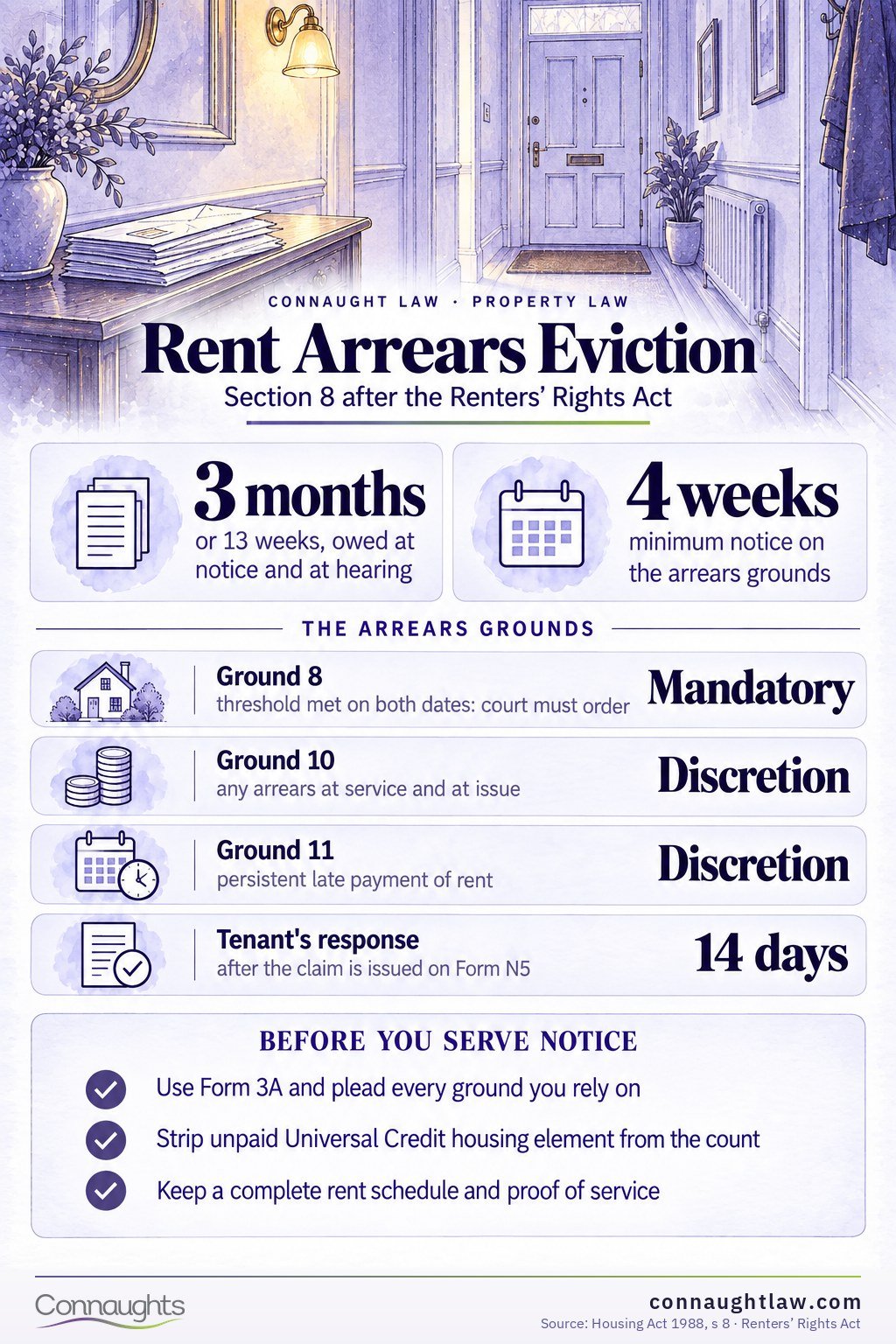
Mandatory possession now needs three months' arrears (thirteen weeks on weekly rent) at both service and hearing, up from two months. Notice on the arrears grounds doubled from two weeks to four. And unpaid Universal Credit housing element the tenant was entitled to receive is disregarded from the count. Practical effect: a landlord is at least four months' rent down before a Ground 8 claim can even be issued.
What Rent Arrears Are — and How They Are Counted
Rent arrears are rent that remains unpaid after the date the tenancy agreement says it falls due. A tenant is "in arrears" from the first missed due date — there is no grace period in law, though most landlords and every court expect early communication before escalation.
Counting matters more than it sounds. The threshold is measured in rent, not calendar time: a tenant paying £1,200 a month is three months in arrears when £3,600 is outstanding, however the debt accrued. Partial payments reduce the figure; lawful deductions the tenant was entitled to make are not arrears at all; and — since May 2026 — missing Universal Credit housing element is stripped out of the calculation for the mandatory ground. A landlord's rent schedule needs to survive all three adjustments in front of a judge.
Ground 8: The Three-Month Mandatory Route
Ground 8 is the only arrears ground that removes the court's discretion: if the threshold is met at service of the notice and still met at the hearing, the court must order possession. That "dual-date" test is where most Ground 8 claims are won or lost — a tenant who pays even a small sum to dip below three months before the hearing defeats the mandatory ground, which is why arrears claims are almost never pleaded on Ground 8 alone.
- Three months' rent unpaid (thirteen weeks where rent is weekly or fortnightly) at the date the section 8 notice is served.
- The same threshold still met at the date of the hearing.
- Universal Credit housing element the tenant was entitled to receive is excluded from both counts.
- Threshold met on both dates → possession is mandatory. Either date missed → the claim survives only on the discretionary grounds.
Before and After the Act
Ground 8 Thresholds Compared
| Element | Before May 2026 | Now |
|---|---|---|
| Arrears threshold (monthly rent) | 2 months | 3 months |
| Arrears threshold (weekly rent) | 8 weeks | 13 weeks |
| Notice period | 2 weeks | 4 weeks |
| Universal Credit delays | Counted towards arrears | Disregarded if the tenant was entitled to the housing element |
Grounds 10 and 11: The Discretionary Routes
Ground 10 covers any arrears — there is no minimum, only the requirement that some rent was unpaid at service and at issue. Ground 11 targets the persistently late payer: the tenant who always pays, eventually, leaving the landlord funding the gap. Both carry the four-week notice period, and both put the outcome in the judge's hands: possession follows only if the court finds it reasonable, and the commonest result on modest arrears is not eviction but a suspended order on payment terms.
What the Court Weighs
- Size and age of the arrears, and the direction they are moving.
- Why they arose — job loss and benefit delay read differently from refusal to pay.
- Payment history across the whole tenancy.
- The tenant's proposals and their realism against income.
- Household circumstances — children, disability, vulnerability.
- The landlord's own conduct, including how arrears were communicated and whether the property was kept in repair.
Universal Credit Delays: The Disregard
Where arrears exist because Universal Credit housing element the tenant was entitled to receive has not been paid, that portion is disregarded when testing the Ground 8 threshold. A tenant three months down solely because of a benefits backlog cannot face mandatory possession for it. The disregard does not erase the debt — the rent is still owed, and the discretionary grounds still run — it only removes the automatic route.
For landlords the practical response is diagnostic: before serving notice, establish how much of the arrears is benefit-shaped. Alternative payment arrangements — paying the housing element direct to the landlord — remain available through DWP and are usually the faster fix for a benefits-driven arrears problem than any court process.
The Notice: Form 3A and Getting It Right
Since 1 May 2026 arrears notices go on Form 3A, the prescribed form for the reformed regime. Defective notices remain the leading cause of dismissed claims, and every dismissal costs the landlord the notice period, the court fee and months of relisting — while arrears keep growing.
Serving It Correctly
- The correct prescribed form (Form 3A), fully completed.
- Every ground relied on, with the statutory wording — a ground not pleaded cannot be argued later without amendment.
- The arrears figure and how it is calculated.
- A notice period of at least four weeks from service.
- Proof of service — the method the tenancy agreement permits, evidenced and dated.
Court: Timetable, Evidence, Outcomes
If arrears persist after the notice expires, the claim is issued on Form N5 with particulars on Form N119; the tenant has 14 days to respond. On the Ministry of Justice's landlord possession statistics for Q3 2025, the median claim ran 7.9 weeks to a possession order and 27.9 weeks to actual repossession where bailiff enforcement was needed — figures worth having in mind before assuming court is the quick route. Evidence wins these hearings: a complete rent schedule, the signed tenancy agreement, proof of service, bank statements corroborating non-payment, and the correspondence trail showing arrears were raised and engagement attempted.
How Hearings End
Possession Hearing Outcomes
| Outcome | When It Happens | Effect |
|---|---|---|
| Outright possession | Ground 8 proved on both dates, or discretionary grounds where eviction is reasonable | Tenant ordered to leave, usually within 14 days, up to 42 in exceptional hardship |
| Suspended possession | Discretionary grounds with a viable payment plan | Tenant stays while current rent plus instalments are paid |
| Adjournment | Evidence incomplete or a counterclaim pending | Relisted — arrears and costs keep accruing |
| Dismissal | Invalid notice, threshold unmet, or possession unreasonable | Landlord starts again, with a corrected notice |
Suspended Orders: Staying Put on Terms
A suspended order requires the tenant to pay current rent plus an instalment against the arrears, commonly set at what income evidence shows is sustainable. Kept up, the order never bites and the tenancy continues. Broken, the landlord can apply for a warrant without a fresh hearing — which is why a tenant should propose a figure they can actually hold, not the largest one that sounds cooperative.
Pleading Multiple Grounds
Competent arrears claims plead Grounds 8, 10 and 11 together. Ground 8 delivers the mandatory order if the threshold holds; Grounds 10 and 11 keep the claim alive when a pre-hearing payment defeats it. For tenants the same structure signals the counter-strategy: reducing arrears below three months converts a mandatory hearing into a discretionary one, where circumstances, history and a realistic payment proposal can keep the tenancy — the defences we cover in our tenant rights during eviction guide, with the landlord's wider toolkit in our section 8 grounds guide.
Frequently askedQuestions about rent arrears and eviction
How much rent arrears before eviction?
For mandatory possession under Ground 8: three months' rent (thirteen weeks if rent is weekly), owed both at notice and at hearing. The discretionary grounds have no minimum — any arrears can found a claim, but the court orders possession only if it considers eviction reasonable.
How much notice does a landlord give for rent arrears?
Four weeks minimum on the arrears grounds, served on Form 3A — double the pre-May 2026 period. The notice must plead each ground relied on and state the arrears; a defective notice is the commonest reason claims fail.
Can a tenant stop a Ground 8 eviction by paying?
Yes. Paying enough to bring arrears below three months before the hearing defeats the mandatory ground. The claim usually continues on Grounds 10 and 11, but the court then has discretion — and a tenant paying current rent with a credible instalment plan often keeps the tenancy.
How long does a rent arrears eviction take?
Realistically six months or more end to end: three months of arrears before notice, four weeks' notice, a median 7.9 weeks from claim to order, and a median 27.9 weeks from claim to repossession where bailiffs are needed, on Q3 2025 Ministry of Justice figures.
Do Universal Credit delays count towards arrears?
Not for Ground 8. Housing element the tenant was entitled to receive but has not been paid is disregarded from the threshold. The rent remains owed, and landlords can seek direct payment of the housing element from DWP while the backlog clears.
Can a landlord still recover the arrears after eviction?
Yes. Possession ends the tenancy, not the debt. A money judgment for the arrears can be enforced for six years — through attachment of earnings, charging orders or bailiffs — though recovery in practice depends on the former tenant's means.
Tell us how much is outstanding, how it accrued and whether any of it is Universal Credit housing element. We will tell you which grounds are available and what the notice has to say.
Get Expert Advice