
A tenant facing eviction in England now holds a stronger hand than at any point in decades: section 21 is gone, every possession claim must prove a statutory ground, and the tenant's side of the case — notice defects, reasonableness, counterclaims — decides real outcomes. The paperwork matters as much as the law: the defence goes in on form N11R within 14 days of the court papers arriving. This guide covers the defences that work, the counterclaims that offset arrears, and how to complete the N11R properly.
On This Page

Facing Eviction: Where a Tenant Stands Since May 2026
Since 1 May 2026 no landlord in England can evict without proving a ground from the reformed section 8 framework — arrears, breach, the landlord moving in or selling, and the rest — each with its own notice period and evidential burden. That changes the psychology of defending: an eviction is no longer an administrative countdown but a case, and cases can be lost by landlords who serve the wrong form, miscount the arrears, or picked a ground the facts do not support.
The right prescribed form, the right notice period for the ground pleaded, the facts making out the ground itself, and — for discretionary grounds — that possession is reasonable in all the circumstances. A tenant does not have to win every point; failing any one of them stalls or sinks the claim. You have the right to remain in the property until a court orders otherwise.
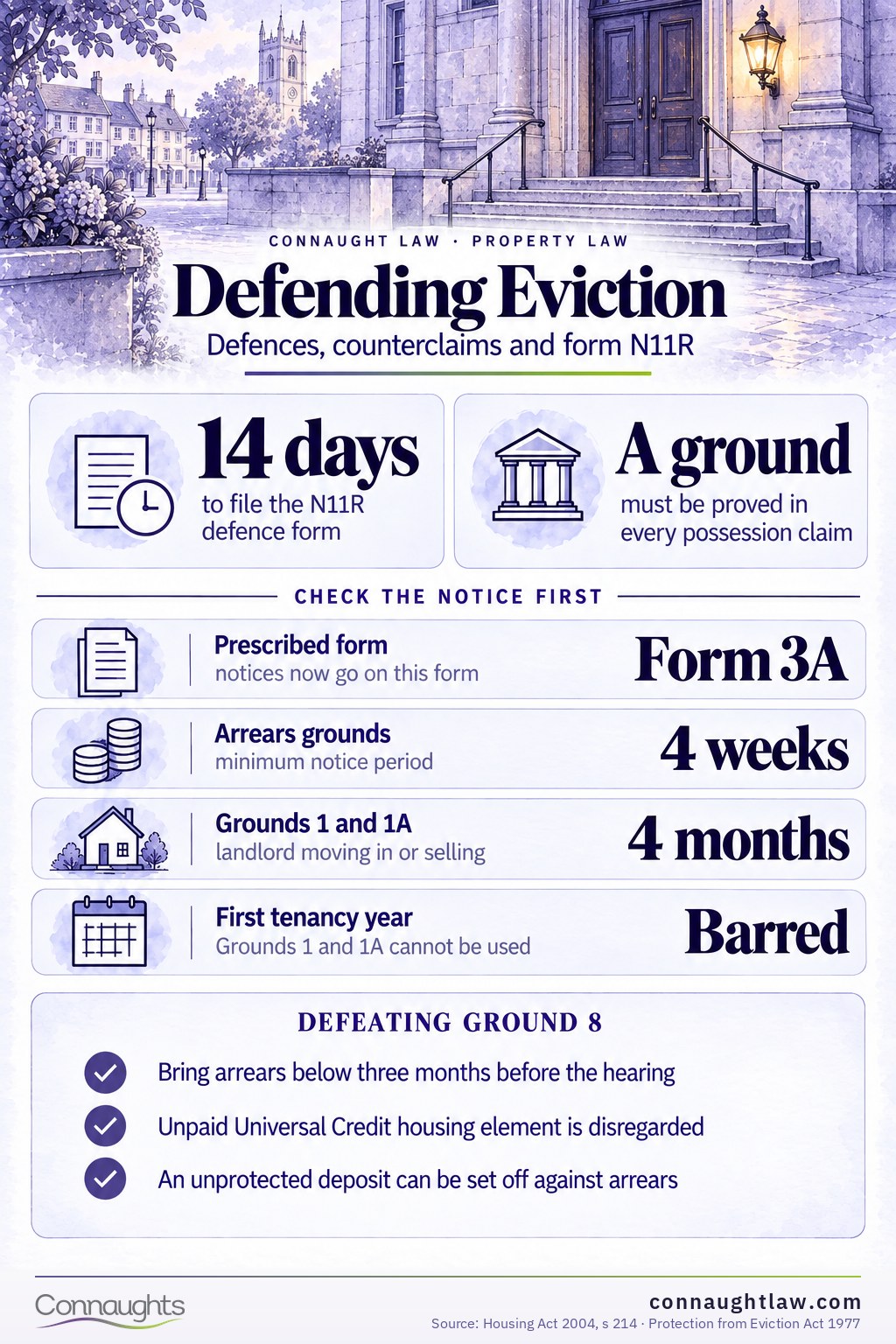
Check the Notice First: Validity Defences
Every defence starts with the notice, because a defective notice ends the claim before the merits are reached. The reformed regime is precise: notices go on Form 3A, the arrears grounds carry four weeks' notice, and the landlord-circumstance grounds — moving in (Ground 1) and selling (Ground 1A) — carry four months' notice and cannot be used at all in the first twelve months of the tenancy. Each requirement is a tripwire, and landlords self-serving without advice hit them constantly.
Defects That Invalidate a Notice
- Wrong or outdated form — Form 3A is required for notices served since 1 May 2026.
- Notice period too short for the ground pleaded, or expiry miscalculated from the service date.
- Ground 1 or 1A used inside the first year, or without the four months' notice they require.
- The ground's statutory wording missing or mangled, or the arrears figure wrong.
- Service by a method the tenancy agreement does not permit, or service that cannot be proved.
- Wrong names, wrong address, unsigned — basic errors still void notices every week.
Discretionary Grounds: Making Possession Unreasonable
For the discretionary grounds the landlord must clear a second hurdle after proving the facts: persuading the judge that possession is reasonable in all the circumstances. This is where a prepared tenant changes the outcome — courts routinely refuse possession, or suspend it on terms, where the tenant shows the problem is being fixed and eviction would be disproportionate.
What the Court Weighs
- Vulnerability: disability, mental health, age, pregnancy — supported by medical evidence, not assertion.
- Children's welfare, schooling and the disruption eviction would cause.
- How the breach arose, and any landlord conduct that contributed to it.
- What the tenant has already done to put things right, and the realism of any proposal.
- Length of tenancy and the record before the problem began.
Counterclaims: Turning Defence into Attack
A counterclaim converts the hearing from a one-way claim into an account between the parties — and sums the landlord owes you are set off against sums you owe them. An arrears claim can dissolve entirely when the deposit was never protected or the property has been left in disrepair, because the tenant's damages come off the arrears before the threshold is tested.
The Counterclaims Available
- Deposit penalties: one to three times the deposit under section 214 Housing Act 2004 where it was unprotected or the prescribed information came late — three times for deliberate non-compliance.
- Disrepair damages: breach of section 11 Landlord and Tenant Act 1985, valued as a percentage of rent for the affected period plus inconvenience.
- Harassment and quiet-enjoyment breaches — with unlawful eviction a criminal offence under the Protection from Eviction Act 1977, and civil damages reaching substantial sums in serious cases.
- Discrimination claims under the Equality Act 2010.
- Rent repayment orders — up to twelve months' rent for qualifying offences, covered in our rent repayment order guide.
Arrears Defences: Working the Threshold
Arrears claims are the commonest and the most defensible, because the mandatory ground runs on arithmetic the tenant can change. The full landlord-side mechanics are in our rent arrears eviction guide; the defence reads the same rules in reverse.
Ground 8: Getting Below Three Months
Ground 8 needs three months' arrears at service and again at the hearing. Any payment that brings the figure below that line before the hearing — a benefit backpayment, a Discretionary Housing Payment, a charitable grant, family help — defeats the mandatory ground and moves the whole claim into the court's discretion. Unpaid Universal Credit housing element you were entitled to receive is disregarded automatically, and a Breathing Space moratorium can pause arrears enforcement for up to 60 days while you get debt advice.
In the discretionary space, the winning shape is consistent: pay current rent from now, offer an instalment against the arrears that your income genuinely supports, and evidence it with a budget. Courts suspend possession on terms like these every day — the order that lets you stay is built on a number you can hold for a year, not the biggest one you can say in court.
Form N11R: The Defence Form and How to Complete It
When court papers arrive, the defence goes in on form N11R — the defence form for possession claims based on rented residential premises. Filing it is what puts your side of the case before the judge ahead of the hearing; without it, the court hears only the landlord.
- The N11R is due within 14 days of service of the claim form.
- Postal service is deemed served two days after posting — the clock starts then, not when you happened to read it.
- File at the court named on the claim, or through Possession Claim Online where the claim was issued there.
- Late is better than never — a late defence can still be considered — but never rely on that.
Completing the N11R, Section by Section
Work through it as four jobs. First, respond to the landlord's facts — admit what is true, deny what is not, and correct the arrears schedule line by line if the figure is wrong. Second, plead the procedural case: identify every notice defect from the checklist above, specifically, not as a general complaint. Third, address reasonableness — circumstances, vulnerability, children, and your payment proposal with the budget behind it. Fourth, set out any counterclaim: what the landlord owes, under which statute, and the arithmetic of the set-off.
- Dated photographs of any disrepair, and the complaint correspondence that preceded them.
- Bank statements showing your payment history against the landlord's schedule.
- The tenancy agreement, every notice received, and proof of your deposit's protection status.
- Medical evidence where vulnerability is part of the case.
- An income and expenditure statement supporting the payment proposal.
N11B and the Old Accelerated Route
Form N11B belongs to the accelerated possession procedure that served section 21 claims. With section 21 abolished from 1 May 2026, new accelerated claims have ended; N11B now appears only in transitional cases begun under the old regime. If you receive accelerated-procedure papers, the deadline logic is the same — 14 days — and the defence turns almost entirely on paperwork validity, so take advice the day the envelope arrives.
Free Help: HLPAS, Duty Solicitors and Advice Lines
The Housing Loss Prevention Advice Service gives anyone with written evidence of a possession threat — a section 8 notice or court papers — free early legal advice, without means testing, and a duty solicitor at court on hearing day. It is the single most under-used right in this area: tenants represented at a first hearing get materially better outcomes than those who attend alone.
Getting Support, Step by Step
Contact a legal aid housing solicitor as soon as you hold a notice or claim form. On hearing day, arrive early and ask court staff for the HLPAS duty solicitor. In parallel: Shelter's emergency helpline (0808 800 4444), Citizens Advice for help completing the N11R, and your local Law Centre for ongoing casework. If the landlord changes the locks or harasses you out without a court order, that is a criminal matter — report it to the local authority's housing enforcement team and take advice on an injunction to get back in; the government's illegal eviction guidance sets out the protections.
Frequently askedQuestions about defending an eviction
What is form N11R and when is it due?
The defence form for possession claims over rented residential premises. It is due within 14 days of service of the court papers — deemed two days after posting — filed at the court on the claim or via Possession Claim Online. It carries your denials, notice challenges, circumstances and any counterclaim.
Can I get an eviction thrown out for a defective notice?
Yes. Wrong form, short notice, a protected-period breach or unprovable service invalidates the notice and the claim built on it. The landlord must re-serve correctly and wait out a fresh notice period — often months, during which circumstances and arrears positions change.
How do I defend a Ground 8 arrears claim?
Get below three months' arrears before the hearing — benefit backpayments, Discretionary Housing Payments, grants or family help all count, and unpaid Universal Credit housing element is disregarded automatically. Below the line, the ground stops being mandatory and your circumstances start to matter.
Can a disrepair or deposit claim cancel out my arrears?
Yes — counterclaim damages are set off against the arrears. An unprotected deposit alone is worth one to three times its amount under section 214, and disrepair damages run as a percentage of rent for the affected period. A successful set-off can leave the landlord owing you.
Is free legal help really available?
Yes. HLPAS provides free advice once you hold written evidence of possession action, with no means test, plus a duty solicitor at the hearing. Shelter (0808 800 4444), Citizens Advice and local Law Centres fill the gaps, including help completing the N11R.
What if my landlord evicts me without a court order?
Changing locks, removing belongings or forcing you out without a court order and bailiffs is a criminal offence under the Protection from Eviction Act 1977. You can lawfully re-enter, seek an emergency injunction, report it for prosecution and claim damages — courts treat deliberate unlawful eviction severely.
Send us the notice, the claim form and your rent statements. We will tell you whether the notice survives scrutiny, what your defence and counterclaims are worth, and exactly what to put on the N11R before the deadline.
Get Expert Advice