
Evicting a tenant in England means proving a legal ground, serving the right notice, and seeing a county court claim through to enforcement — there is no other lawful route. Since section 21 ended on 1 May 2026, every eviction is a case to be made: ground, notice, claim, hearing, warrant. This guide walks the five steps in order, with the current fees, the notice periods by ground, realistic timescales, and the traps — defective service, the twelve-month rules, the registration block — that restart the clock.
On This Page

Evicting a Tenant Now Means Proving a Case
The reform is simple to state: possession requires a ground from Schedule 2 to the Housing Act 1988, as rewritten by the Renters' Rights Act. Mandatory grounds — serious arrears, sale, the landlord moving in, serious anti-social behaviour, redevelopment — compel an order once proved. Discretionary grounds add a second test: the judge must also find eviction reasonable. Everything downstream, from the notice period to the hearing strategy, follows from which ground you choose on day one.
There is no longer any way to recover a property from an assured tenant without proving a statutory ground in court. Self-help — changing locks, cutting services, pressure to leave — is a criminal offence under the Protection from Eviction Act 1977, and transitional paper is dead: notices served before 1 May 2026 lapsed on 31 July 2026, so anything you rely on now must be served under the reformed regime.
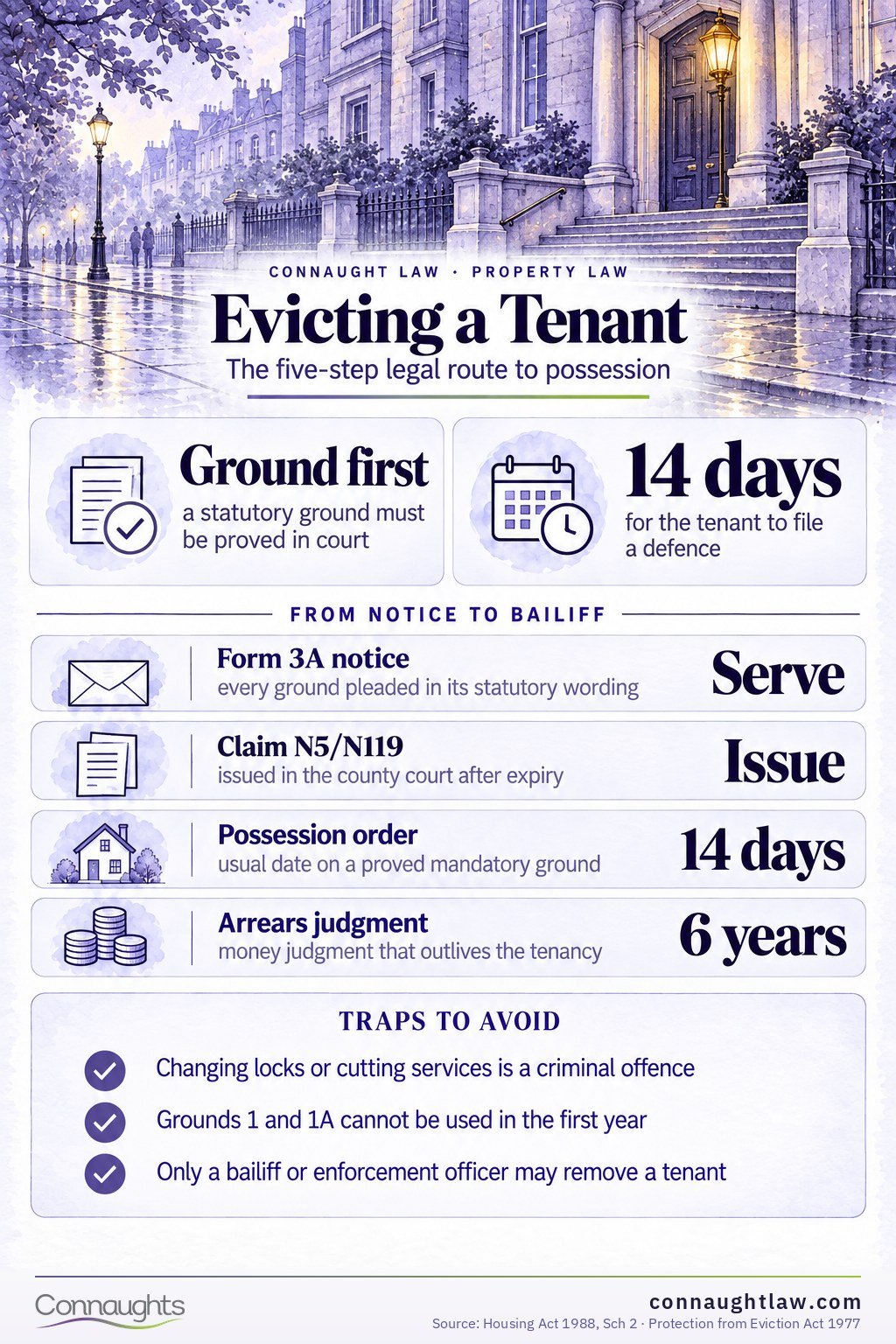
Step 1: Choose the Ground That Fits
Ground selection is strategy, not form-filling. The ground determines the notice period, the evidence you must assemble, whether the court has discretion, and — for the landlord-circumstance grounds — what you can do with the property afterwards. Most contested claims are won at this step, months before the hearing.
Matching Ground to Situation
Ground Selection Quick Guide
| Situation | Ground | Notice | What You Must Show |
|---|---|---|---|
| Three months' arrears or more | 8 (mandatory) | 4 weeks | Threshold met at service and at hearing |
| Selling the property | 1A (mandatory) | 4 months | Genuine intention to sell; tenancy at least 12 months old |
| Landlord or family moving in | 1 (mandatory) | 4 months | Genuine need; tenancy at least 12 months old |
| Serious anti-social behaviour | 7A / 14 | Immediate / short | Conviction, closure order or proven conduct |
| Persistent late payment | 11 (discretionary) | 4 weeks | The pattern, plus reasonableness |
| Breach of tenancy terms | 12 (discretionary) | 2 weeks | The breach, warnings given, proportionality |
| Redevelopment | 6 (mandatory) | 4 months | Works incompatible with the tenancy continuing |
The Twelve-Month Rules
Grounds 1 and 1A carry two twelve-month locks. They cannot be used in the first year of the tenancy, and once possession is obtained on them the property cannot be re-let or re-marketed for twelve months — with civil penalties reaching £40,000 for landlords who evict to "sell" and quietly re-let. Courts and councils both police this, and the PRS database will make breaches visible. Treat the selling and moving-in grounds as one-way doors, not tactics.
Arrears Cases and Negotiated Exits
For arrears, the working combination is Grounds 8, 10 and 11 pleaded together — the mandatory route with discretionary fallbacks if the tenant pays down before the hearing, covered in detail in our rent arrears eviction guide. And before any notice: a negotiated surrender with a modest incentive is routinely cheaper than five months of process — the maths deserves ten minutes before the paperwork starts.
Step 2: Serve a Notice That Survives Scrutiny
The notice is where most claims die. It must be on the prescribed form (Form 3A), plead every ground relied on in the statutory wording, state accurate particulars — the arrears schedule especially — and give the correct period for the most demanding ground pleaded. A tenant's solicitor reads the notice looking for one error, because one error ends the claim.
Service and Proof of Service
- Serve by a method the tenancy agreement authorises — post, personal delivery, or as specified.
- Certificate of posting for postal service; a dated, witnessed note for personal service.
- Photograph the completed notice before it goes.
- Count the notice period from deemed service, not the day you posted it.
- Diarise expiry — a claim issued a day early is a claim struck out.
Step 3: Issue the Claim
If the tenant remains after the notice expires, the claim is issued in the county court on Form N5 with particulars on Form N119 — court fee £415 on the current EX50 schedule (from 13 July 2026). All reformed-regime claims take the standard route with a listed hearing. One gate to check before issuing: once PRS database registration becomes mandatory in your region, courts will not make possession orders for unregistered landlords except on anti-social behaviour grounds — the requirement we cover in our PRS database guide.
Defended or Undefended
The tenant has 14 days to file a defence on form N11R. Undefended claims proceed to a short possession-list hearing on the papers plus brief submissions. A defended claim — notice validity challenged, counterclaims raised — gets directions, disclosure and a longer hearing, adding months and costs. Assume the defence will arrive and build the file to survive it: rent schedule, tenancy agreement, service proof, correspondence.
Step 4: The Hearing and the Order
The district judge tests whether the ground is made out and, for discretionary grounds, whether possession is reasonable. A proved mandatory ground compels an order — possession typically in 14 days, extendable to six weeks for exceptional hardship. Discretionary claims produce the full range: outright orders, suspended orders on payment terms, adjournments where evidence is thin, and dismissals where the notice fails. A money judgment for arrears rides with the possession order and survives the tenancy — collectable for six years.
Step 5: Enforcement
A possession order is not an eviction; if the tenant stays past the order date, enforcement is the county court's job, never yours. The application is for a warrant of possession — £152 on the current schedule — and the bailiff appointment is the real waiting room in the process.
County Court Bailiffs or High Court Writ
- County court warrant: £152, the default route; the wait for a bailiff appointment varies by court and is measured in weeks.
- High Court writ: transfer needs the court's permission; enforcement is usually faster, costs are higher, and the extra outlay is not always recoverable from the tenant.
- Either way, only the bailiff or enforcement officer may remove the tenant — a landlord attending to "help" is committing an offence.
How Long Eviction Takes — and What It Costs
End to end, a contested arrears eviction realistically runs six months or more: the notice period (four weeks to four months by ground), the wait for a hearing — the Ministry of Justice's Q3 2025 median was 7.9 weeks from claim to order — the order period of two to six weeks, then the bailiff queue, with the same MoJ series putting median claim-to-repossession at 27.9 weeks where enforcement was needed. Uncontested cases run faster; defended ones with counterclaims run slower. Nothing shortens the process as reliably as a notice served right first time.
The Cost Stack
- Claim fee: £415 (EX50, from 13 July 2026).
- Warrant of possession: £152.
- Legal costs: rising with every defended stage — and largely wasted if a defective notice restarts the process.
- The hidden line: rent lost while the process runs, usually the largest number of all.
Evicting Outside the Assured Regime: Common Law Tenancies
Company lets, tenancies above the rent limits, genuine lodger arrangements with a resident landlord and other common law tenancies sit outside the assured regime entirely. They end by notice to quit or contractual expiry, followed — for tenancies protected by the Protection from Eviction Act — by an ordinary possession claim rather than section 8. The paperwork is different, the notice rules are contractual, and applying the wrong regime's forms is fatal in both directions.
Questions about evicting a tenant
Can I still evict a tenant without a reason?
No. Section 21 ended on 1 May 2026, and notices served before that date lapsed on 31 July 2026. Every eviction now requires a Schedule 2 ground proved in court — and for the selling and moving-in grounds, a tenancy at least twelve months old.
How long does it take to evict a tenant?
Typically six months or more contested: notice period (four weeks to four months by ground), a median 7.9 weeks from claim to order on Q3 2025 MoJ figures, two to six weeks on the order, then the bailiff queue — median claim-to-repossession 27.9 weeks where enforcement was needed.
How much does it cost to evict a tenant?
Court fees alone: £415 to issue and £152 for the warrant, on the schedule current from 13 July 2026. Legal costs scale with how hard the claim is fought — and the largest cost is usually the rent lost while the process runs.
What notice do I have to give?
It depends on the ground: four weeks for the arrears grounds, four months for selling or moving in, two weeks for breach of terms, and effectively immediate for the most serious anti-social behaviour ground. The notice goes on Form 3A with the ground's statutory wording.
What if the tenant ignores the possession order?
Apply for a warrant of possession, or seek transfer to the High Court for writ enforcement in suitable cases. Only court enforcement agents can remove a tenant — changing locks yourself is a criminal offence, however final the order.
Does the landlord database affect possession claims?
It will. Once registration is mandatory in your region, courts will not make possession orders for unregistered landlords, except on anti-social behaviour grounds. Registration opens from late 2026 — landlords planning possession action should be ready to register early.
Tell us the situation — arrears, sale, moving in, behaviour — and the tenancy start date. We will tell you which ground carries it, what notice to serve and what the realistic timetable looks like.
Get Expert Advice