
Grounds for possession are now the only lawful route to recovering a rented property in England. Since section 21 ended on 1 May 2026, every eviction runs through section 8 of the Housing Act 1988 and its rewritten Schedule 2: mandatory grounds where a proven case compels the order, and discretionary grounds where the judge also weighs reasonableness. This guide maps every mainstream ground to its notice period and evidence, takes Ground 1A — the selling ground — in detail, and corrects the persistent myth about Ground 8A.
On This Page

Grounds for Possession: The Only Route Left
A section 8 notice is the document that starts a possession claim by telling the tenant which statutory ground the landlord relies on. What changed in May 2026 is not the mechanism but its monopoly: with no-fault eviction gone, the ground does all the work. The Renters' Rights Act rewrote Schedule 2 for that job — new grounds for selling and family occupation, a student HMO ground, longer notice periods, and a higher arrears threshold.
Prove a mandatory ground and the court must order possession — no discretion, no balancing. Prove a discretionary ground and you are halfway: the judge must also find eviction reasonable in all the circumstances, and can suspend the order on terms instead. Which family your facts fall into determines the notice, the evidence and the odds.
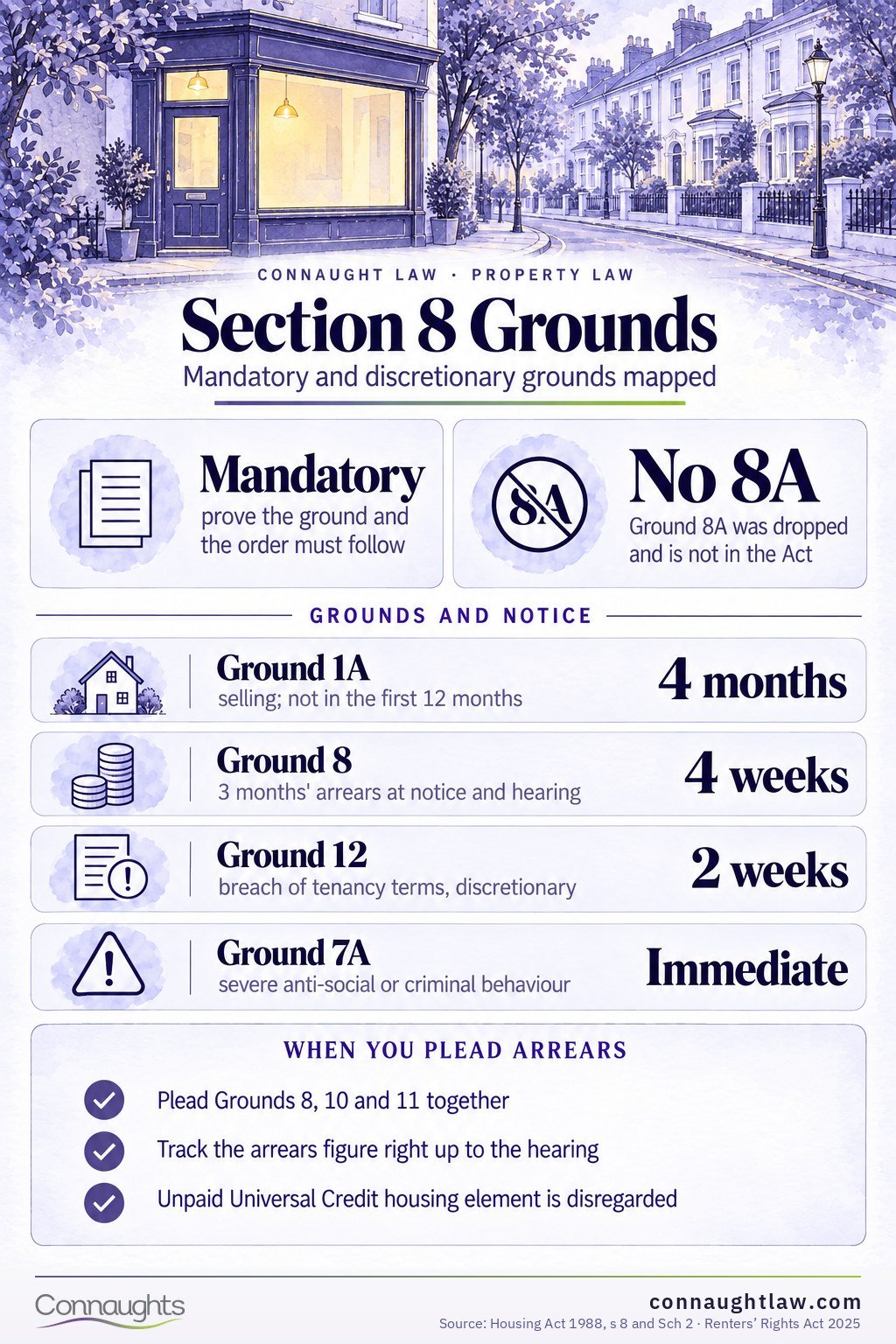
Mandatory Grounds: Prove It and the Order Follows
The Mainstream Mandatory Grounds
Mandatory Grounds at a Glance
| Ground | Covers | Notice | Key Condition |
|---|---|---|---|
| 1 | Landlord or close family moving in | 4 months | Not in the first 12 months of the tenancy |
| 1A | Selling the property | 4 months | Not in the first 12 months; re-letting ban after use |
| 2 | Mortgage lender repossessing | 4 months | Mortgage predates the tenancy |
| 4 | Student lets (institution-linked) | 2 weeks | Specified educational circumstances |
| 4A | Student HMOs for the new academic year | 4 months | Possession window 1 June – 30 September |
| 6 | Redevelopment or demolition | 4 months | Works incompatible with the tenancy |
| 7 | Death of the tenant (no successor) | 2 months | Claim within 12 months of the death |
| 7A | Severe anti-social or criminal behaviour | Immediate | Conviction, closure order or breach of injunction |
| 7B | No right to rent | 2 weeks | Home Office notice |
| 8 | Serious rent arrears | 4 weeks | 3 months' arrears at notice and at hearing |
Ground 1A: Possession to Sell
Ground 1A is the reform's flagship trade: landlords lost section 21 but gained a mandatory route to vacant possession for a genuine sale. The conditions are strict. The tenancy must be at least twelve months old, the notice — served on Form 3A like every section 8 notice — runs four months, and the landlord must genuinely intend to sell, evidenced in practice by agent instructions, a valuation, or conveyancing steps predating the notice. Courts will be asked to infer intention from paper, so the paper should exist before the notice does.
Using Ground 1A (or Ground 1) buys possession at the price of a twelve-month freeze: the property cannot be re-marketed for letting or re-let after the tenancy ends, on pain of civil penalties reaching £40,000. A landlord who "sells", fails to complete and quietly re-lets is the exact case the penalty was written for — and the PRS database will make the sequence visible to councils.
The Twin Twelve-Month Locks
- Neither ground is available during the first twelve months of the tenancy.
- Four months' notice, on the prescribed form, with the ground's statutory wording.
- After possession: no re-letting or re-marketing for twelve months.
- Breach: civil penalties up to £40,000 and a claim built on a false ground can unravel retrospectively.
Specialist and Superior-Lease Grounds
Beyond the mainstream list sit grounds most private landlords never touch: the superior-lease grounds (2ZA–2ZD) covering intermediate landlords whose own lease ends; Ground 1B for Rent-to-Buy providers; the employment and ministry grounds (5–5D); the supported and temporary accommodation grounds (5E–5H, 18); and the social-landlord decant and enforcement grounds (6A, 6B). If your situation touches one of these, the drafting is specialist work — the conditions are narrow and the notice periods vary from four weeks to four months.
Discretionary Grounds: Proof Plus Reasonableness
The Discretionary List
Discretionary Grounds at a Glance
| Ground | Covers | Notice |
|---|---|---|
| 9 | Suitable alternative accommodation available | 2 months |
| 10 | Any rent arrears | 4 weeks |
| 11 | Persistent late payment | 4 weeks |
| 12 | Breach of tenancy terms | 2 weeks |
| 13 | Deterioration of the property | 2 weeks |
| 14 | Anti-social behaviour or nuisance | Immediate |
| 14ZA | Conviction for rioting | 2 weeks |
| 15 | Deterioration of furniture | 2 weeks |
| 17 | Tenancy obtained by false statement | 2 weeks |
Ground 14: Anti-Social Behaviour Without a Notice Period
Ground 14 carries no notice period — proceedings can begin the day the notice is served — but it stays discretionary, so speed of issue buys nothing without evidence that persuades a judge eviction is reasonable. The working file is an incident diary with dates and effects on neighbours, police reference numbers, and warnings given. Where the conduct is at the criminal end, mandatory Ground 7A does the compelling instead, and the court cannot order possession to take effect within 14 days of the order.
The Arrears Grounds — and the Ground 8A Myth
Arrears cases run on three grounds pleaded together: Ground 8, mandatory at three months' arrears held at both notice and hearing; Ground 10, discretionary for any arrears; and Ground 11, discretionary for the tenant who persistently pays late even if the account clears. The full mechanics — thresholds, the Universal Credit disregard, suspended orders — are in our rent arrears eviction guide.
Ground 8A, the repeat-arrears ground from the previous government's Renters (Reform) Bill, was deliberately dropped and does not exist in the Act. Guides still describing it are recycling a dead draft. Repeated arrears that keep dipping below the mandatory threshold are dealt with under discretionary Ground 11 — pattern, not snapshot.
How Tenants Defeat Ground 8
Because the threshold is tested twice, a payment that brings arrears below three months before the hearing collapses the mandatory ground — benefit backpayments and Discretionary Housing Payments do it constantly, and arrears attributable to unpaid Universal Credit housing element are disregarded from the count altogether. That is why competent claims never plead Ground 8 alone, and why landlords should track the arrears figure to the hearing door, not to the day of service.
Notice Periods and Evidence, Ground by Ground
Notice periods group cleanly: immediate for the anti-social grounds (7A, 14); two weeks for the conduct and breach grounds (4, 7B, 12, 13, 14ZA, 15, 17); four weeks for the arrears grounds (8, 10, 11); two months for Grounds 5, 7 and 9; four months for the landlord-circumstance and structural grounds (1, 1A, 2, the superior-lease grounds, 4A, 6). Where a notice pleads several grounds, it must give the longest period any of them requires — pleading Ground 12 alongside Ground 1A does not shorten anything.
The Evidence That Proves Each Family
- Arrears: a complete rent ledger, the tenancy agreement, bank statements, and the correspondence trail.
- Sale (1A): agent instructions, valuation, conveyancer engagement — dated before the notice.
- Occupation (1): evidence of the family member's identity and genuine need.
- Behaviour (7A/14): incident diary, police numbers, convictions or injunctions, neighbour statements.
- Breach (12): the clause, the breach, and the warnings that preceded action.
From Notice to Order: The Court Stage
After the notice expires, the claim issues on Form N5 with N119 particulars — £415 on the current fee schedule, £152 more for the warrant if enforcement is needed. One precondition is coming: once PRS database registration is mandatory in your region, courts will not make possession orders for unregistered landlords except on the anti-social behaviour grounds — the gate we cover in our database registration guide. The step-by-step procedure, timescales and enforcement options are in our five-step eviction guide.
Frequently askedQuestions about the possession grounds
What are the grounds for possession since the Renters' Rights Act?
A rewritten Schedule 2: mandatory grounds including arrears (8), sale (1A), landlord occupation (1), severe anti-social behaviour (7A) and redevelopment (6), plus discretionary grounds — lesser arrears, breach, nuisance — where the court also weighs reasonableness. Every eviction must now prove one of them.
What is Ground 1A and what does it require?
The mandatory selling ground: four months' notice on Form 3A, a tenancy at least twelve months old, and genuine intention to sell you can evidence. After possession, the property cannot be re-let or re-marketed for twelve months — civil penalties reach £40,000.
Does Ground 8A exist?
No. It appeared in the previous government's draft bill and was dropped from the Act that passed. Persistent arrears that repeatedly dip below the Ground 8 threshold are addressed through discretionary Ground 11, which looks at the pattern rather than the balance on two dates.
Which grounds have no notice period?
Ground 7A (severe anti-social behaviour, mandatory) and Ground 14 (anti-social behaviour, discretionary) allow proceedings immediately after service. Speed is real but not decisive: 14 still needs the court to find eviction reasonable, and 7A needs a conviction, closure order or injunction breach.
What notice do the arrears grounds need?
Four weeks for Grounds 8, 10 and 11. Ground 8 must hold three months' arrears (thirteen weeks on weekly rent) at both service and hearing, with entitled-but-unpaid Universal Credit housing element disregarded — so the pleaded figure needs to survive both dates and that adjustment.
Can a landlord use several grounds at once?
Yes, and usually should — arrears claims plead 8, 10 and 11 together so a pre-hearing payment does not end the case. The notice must state each ground's statutory wording and give the longest notice period among the grounds pleaded.
Tell us the facts — arrears figures, sale plans, conduct, tenancy start date. We will tell you which grounds fit, what evidence each needs, and the notice that starts the clock correctly.
Get Expert Advice