
A rent repayment order lets a tenant claw back rent from a landlord who committed a housing offence — no conviction required, and since 1 May 2026 the ceiling is 24 months' rent, double what it was. The tribunal route runs on Form RRO1, a £100 fee and evidence, and the commonest winning claim is the unlicensed HMO. This guide covers who can apply, the time limits and when the clock actually starts, the qualifying offences old and new, what the tribunal data says about success rates, and how to build the application.
On This Page
Rent Repayment Orders: Two Years of Rent on the Line
Most tenant remedies compensate for loss; a rent repayment order simply reverses the flow of rent for the period a landlord was offending. That design makes it the sharpest compliance tool in the private rented sector — a landlord who skipped a £1,100 HMO licence can face repaying tens of thousands in rent — and the Renters' Rights Act sharpened it further from 1 May 2026: double the recovery, double the application window, more offences, and liability reaching superior landlords and company directors.
The First-tier Tribunal can order a landlord who committed a qualifying housing offence to repay up to 24 months' rent to the tenant who paid it — on the civil standard where no conviction exists, and without the tenant needing to prove any loss beyond the rent itself.
What an RRO Is — and Why No Conviction Is Needed
The order is made by the First-tier Tribunal (Property Chamber) under the Housing and Planning Act 2016. Where the landlord has already been convicted, the offence is proved; where there is no conviction, the tribunal decides for itself whether the offence was committed, beyond reasonable doubt, on the evidence the tenant files. Most successful RROs involve landlords never prosecuted by anyone — the tenant's application is the enforcement.
Who Can Apply
- Current tenants who paid the rent during the offence period.
- Former tenants, within the application window.
- Property guardians — the tribunal has treated guardianship arrangements as licences capable of founding claims.
- Local housing authorities, recovering Housing Benefit or Universal Credit housing element they funded.
- Since 1 May 2026: claims can also reach superior landlords in rent-to-rent chains and directors of landlord companies.
Time Limits: The 24-Month Regime
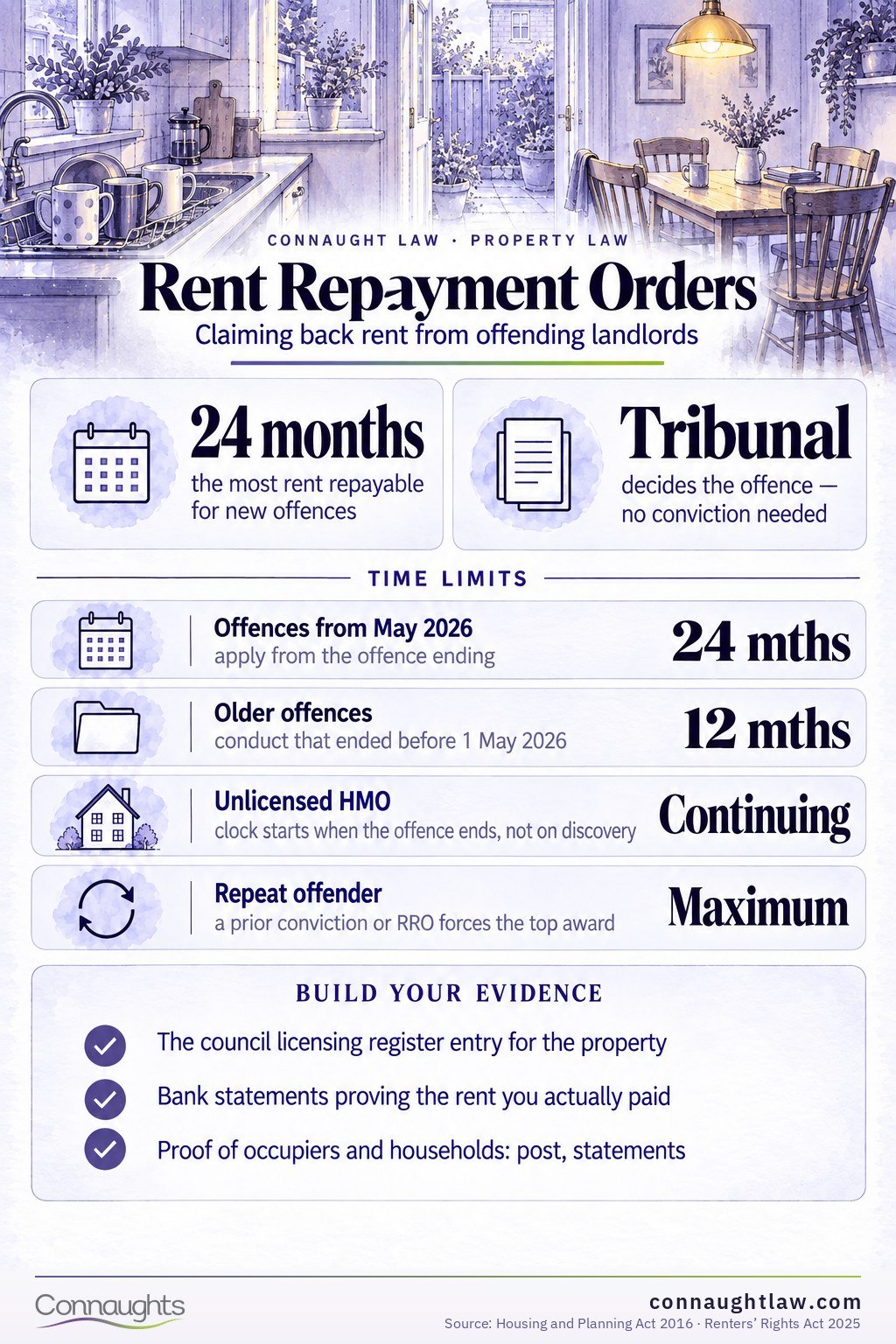
For offences committed on or after 1 May 2026, the application must be made within 24 months of the offence ending, and the tribunal can order repayment of up to 24 months' rent. Both figures doubled from the old regime, and the doubling changes claim economics: a two-year unlicensed period at £1,500 a month is now a £36,000 exposure.
The Old Framework and the Transition
Conduct that ended before 1 May 2026 stays under the previous framework: 12 months to apply, a 12-month recovery ceiling. An offence that straddles commencement needs advice on how the periods split. Nobody should assume the new ceilings reach backwards — tribunals apply the regime in force when the offence was committed.
Time Limits Compared
| Element | Offences Before 1 May 2026 | Offences From 1 May 2026 |
|---|---|---|
| Application deadline | 12 months from the offence ending | 24 months from the offence ending |
| Maximum recovery | 12 months' rent | 24 months' rent |
When the Clock Starts
Time runs from when the offence was last being committed, not from when the tenant found out. For an unlicensed HMO the offence is continuing — the clock starts only when the landlord obtains a licence, a valid application is duly made, or the letting ends. Tenants who discover the breach late in a tenancy usually have more time than they fear; tenants who moved out long ago have less.
Qualifying Offences
The 2016 Act Offences
- Managing or letting an unlicensed HMO — the workhorse of RRO claims.
- Letting an unlicensed property in a selective licensing area.
- Breach of a banning order.
- Illegal eviction or harassment under the Protection from Eviction Act 1977.
- Violence for securing entry.
- Breach of an improvement notice or prohibition order.
New Offences Since May 2026
The Renters' Rights Act added offences to the RRO list from 1 May 2026, extending the remedy to breaches of the new regime itself — including misusing the possession grounds and continuing breaches of the Act's landlord duties, with the PRS database and ombudsman requirements joining as they commence. It also hardened outcomes: where a landlord has a relevant previous conviction or RRO against them, the tribunal must award the maximum. The offence list now polices the reformed system, not just licensing.
HMO Claims: The Engine Room of RROs
Licensing failures dominate the caseload — in one council's published analysis, 93% of successful local RROs involved HMO licensing breaches — because liability is close to strict: the property either needed a licence or it did not, and the register answers that in minutes.
Not knowing the property needed a licence does not defend the claim. The recognised escape is narrow: a "reasonable excuse", such as a complete licence application already duly submitted and pending when the offence period is alleged. Everything else — agent's fault, paperwork delays, not realising the household counted as an HMO — goes to the size of the award, not to liability.
Which HMOs Need a Licence
The Three Licensing Regimes
| Regime | Applies To | Where |
|---|---|---|
| Mandatory HMO licensing | 5+ occupants forming 2+ households sharing facilities | England-wide |
| Additional licensing | Smaller HMOs, typically 3+ occupants | Council-designated areas |
| Selective licensing | All private rentals, HMO or not | Council-designated areas |
Evidence for an HMO Claim
- The council's licensing register entry (or absence) for the property and period.
- Tenancy agreements and proof of rent actually paid — bank statements, not just the agreement.
- Evidence of occupation numbers and households: post, council tax, witness statements from housemates.
- Photographs of shared facilities and room use.
- Any correspondence showing the landlord knew, or was told, about licensing.
Success Rates: The Honest Numbers
What the Tribunal Data Shows
Published analyses of First-tier Tribunal decisions put applicant success in the high seventies to low eighties per cent, with the caseload growing steeply — from a few dozen applications a year when the 2016 Act regime began to several hundred a year by 2023. What headline rates hide is the split between winning and recovering: tribunals award a percentage of the rent claimed, and that percentage moves with conduct on both sides.
What Tribunals Actually Award
An order is discretionary, not automatic, and full recovery is unusual. The tribunal begins with the rent paid over the offence period, strips out any part of it that covered utilities rather than occupation, then adjusts for the seriousness of the offence, the landlord’s conduct and financial circumstances, and the tenant’s own behaviour. The structured approach comes from the Upper Tribunal in Acheampong v Roman [2022] UKUT 239 (LC), and it is where most of the argument in a contested claim happens. No official statistics are published on average award levels, so treat any percentage you are quoted as an impression of the case law rather than a measured figure.
Examples from Reported Decisions
Reported awards run from four figures for short unlicensed periods to £40,000 and beyond where multiple tenants claim across a long offence period. The pattern in the decisions is consistent: complete rent evidence and a clean tenant record push awards towards the top of the range; professional landlords with portfolios are treated more severely than genuine one-property amateurs.
What Moves the Percentage
Since Williams v Parmar [2021] UKUT 244 (LC), tribunals set the award by weighing the section 44 factors — seriousness of the offence, the landlord's conduct and financial circumstances, prior convictions, and the tenant's own conduct — rather than starting at the full rent. Well-evidenced claims against non-compliant professional landlords attract the highest proportion of the rent; the weaker the evidence and the more sympathetic the landlord’s circumstances, the further the award falls. Rent covering utilities is netted down before any of that is decided.
Applying: Form RRO1 and the Tribunal
Preparing the Application
- Form RRO1 — the prescribed application, naming the offence and the repayment sought.
- The £100 application fee, with a £220 hearing fee later — fee remission available for applicants on qualifying benefits.
- The evidence bundle: licensing search, tenancy agreement, rent proof, occupation evidence, correspondence.
- A rent schedule showing exactly what was paid, by whom, over the claimed period.
At the Tribunal
The tribunal issues directions, the landlord responds, and most cases resolve at a single hearing — expect several months end to end rather than weeks. Representation is not compulsory, and no-win-no-fee arrangements are common in this field; the published data consistently shows represented applicants recovering more, largely because the award percentage turns on how well the section 44 factors are argued. Where an RRO offence overlaps with an eviction dispute, the claims reinforce each other — an unlicensed landlord facing possession proceedings is also exposed to the counterclaims covered in our eviction defence guide.
Frequently askedQuestions about rent repayment orders
What does an RRO mean in practice?
A tribunal order making a landlord repay rent — now up to 24 months of it — for the period a qualifying housing offence was being committed. No conviction is needed: the tribunal decides the offence itself on the tenant's evidence, to the criminal standard.
What is the time limit for a rent repayment order?
Twenty-four months from the offence ending, for offences committed since 1 May 2026; twelve months for older conduct. For unlicensed properties the offence continues until a licence is obtained or the letting ends, so the clock often starts later than tenants assume.
How much can I get back?
Up to 24 months' rent for post-May 2026 offences, but tribunals award a percentage of the claim based on the section 44 factors. Published analyses show averages between roughly 46% and 72% of rent claimed in recent years — strong evidence and a professional landlord push it higher.
Do I need a solicitor for an RRO?
No, but the data favours representation — the award percentage turns on argument, not just facts. No-win-no-fee arrangements are widely available for strong licensing claims, which changes the economics of instructing someone.
How long does a rent repayment order take?
Several months from application to decision is typical: the tribunal issues directions, both sides file evidence, and most claims resolve at one hearing. Straightforward unlicensed-HMO claims with clean paperwork move fastest.
What if the landlord does not pay?
The order is enforceable like a debt: county court proceedings, charging orders against property, attachment of earnings or bailiff action. Councils also treat an unpaid RRO as intelligence — repeat offenders now face mandatory maximum awards.
Tell us the property, the dates you paid rent and what you know about licensing or the landlord's conduct. We will check the register, size the claim under the 24-month rules and tell you whether Form RRO1 is worth filing.
Get Expert Advice