
Section 21 is gone. Since 1 May 2026 no new no-fault notice can be served in England, every private tenancy runs as a periodic assured tenancy, and possession stands or falls on the reformed section 8 grounds. The transition itself is now complete: pre-May notices had to become issued court claims by 31 July 2026, and notices that never did expired automatically. This guide records how the abolition landed, what happened to the old notices, and where landlords and tenants stand under the new framework.
On This Page
The End of No-Fault Eviction, Completed
For thirty-seven years section 21 of the Housing Act 1988 let a landlord recover possession without giving a reason. The Renters' Rights Act 2025 removed it in one move: from 1 May 2026, assured shorthold tenancies ceased to exist, existing fixed terms converted to periodic assured tenancies, and every possession claim must now prove a statutory ground. The reform's second act — the transitional wind-down of notices already served — finished on 31 July 2026.
Is section 21 abolished? Yes — fully, for new notices, since 1 May 2026. The only remaining traces are transitional: possession claims issued by 31 July 2026 on pre-May notices continue under the old rules until they conclude. Everything else now runs through section 8.
Implementation Timeline: What Landed When
Dates on the Record
Implementation Dates
| Date | What Happened |
|---|---|
| 27 October 2025 | Royal Assent |
| 27 December 2025 | Early provisions: long-lease AST exclusion; council investigatory powers |
| 1 May 2026 | Section 21 abolished; tenancies periodic; reformed grounds; rent rules; pet rights |
| 31 May 2026 | Deadline to give existing tenants the government information sheet and written terms |
| 31 July 2026 | Last day to issue court claims on pre-May section 21 or section 8 notices |
| Late 2026 | PRS database rollout begins, region by region |
| Expected 2028 | Landlord ombudsman membership becomes mandatory |
Deadlines That Have Bitten
Three deadlines have now passed with consequences attached: 1 May 2026 ended new section 21 notices outright; landlords who failed to give existing tenants the prescribed information by 31 May 2026 face civil penalties of up to £7,000; and the 31 July 2026 cut-off extinguished every pre-May notice not converted into an issued claim. From 1 August 2026, every new possession claim stands on the reformed grounds alone.
What Has Not Commenced Yet
The May commencement was broad, not total. Still ahead: the PRS database (rollout from late 2026, and with it the registration precondition for possession claims — see our database registration guide), the landlord ombudsman (expected 2028), the Decent Homes Standard for the private sector and the extension of Awaab's law, both subject to consultation. Anyone told "the database is compulsory now" is being sold ahead of the law.
New Grounds in Brief: How Landlords Evict Now
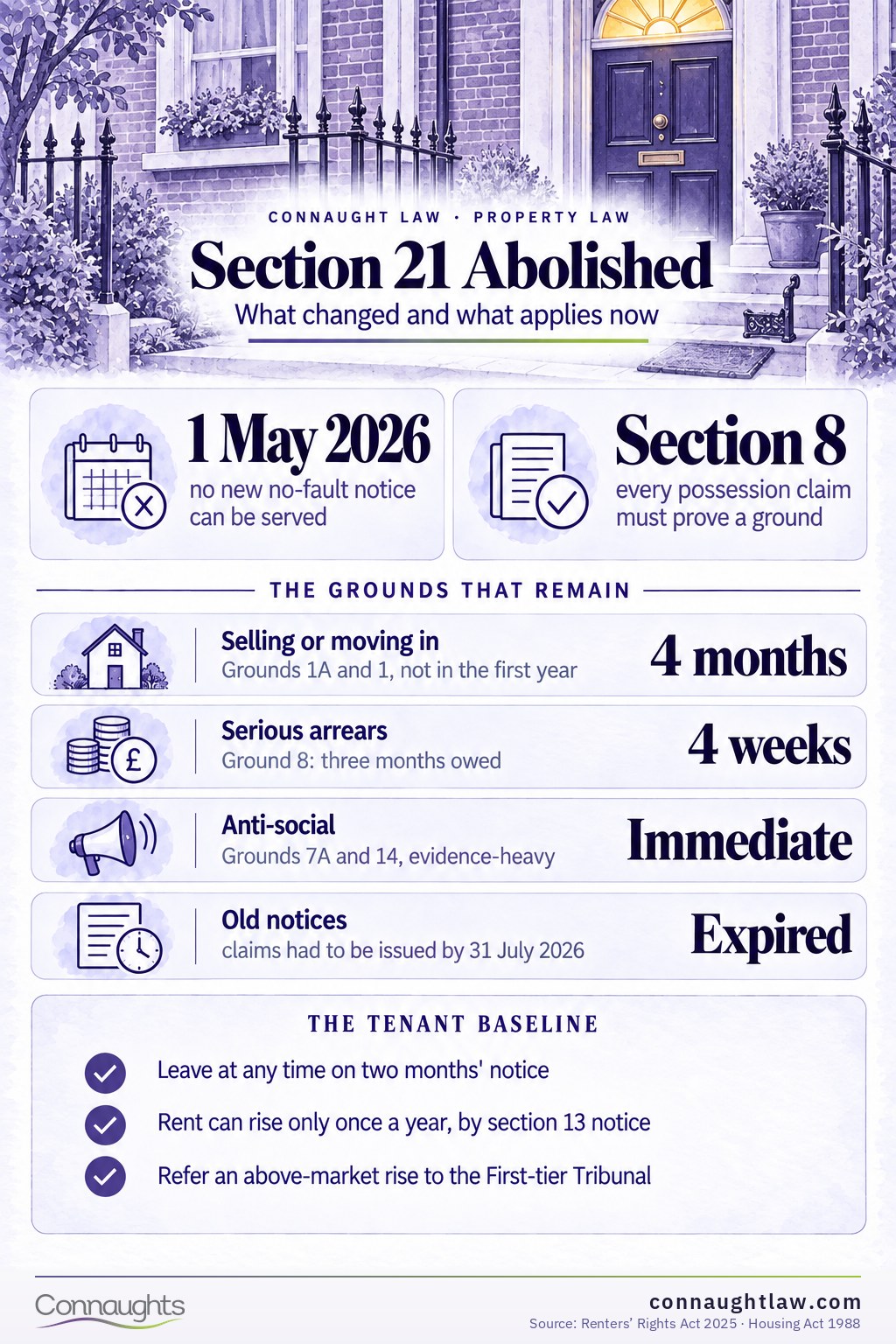
Possession now runs exclusively through section 8 and its rewritten Schedule 2 — mandatory grounds where proof compels the order, discretionary grounds where the court also weighs reasonableness. The full ground-by-ground map, with notice periods and evidence, is in our section 8 grounds guide; the shape of the new system fits in a box.
- Selling (Ground 1A) and moving in (Ground 1): mandatory, four months' notice, unavailable in the tenancy's first year, and a twelve-month re-letting ban after use.
- Serious arrears (Ground 8): mandatory at three months' arrears held at notice and hearing, four weeks' notice — with Universal Credit delays disregarded. Detail in our rent arrears guide.
- Anti-social behaviour (7A, 14): immediate notice, evidence-heavy.
- Student HMOs (4A): four months' notice, possession windowed to the academic cycle.
- No Ground 8A: the repeat-arrears ground from the earlier draft bill was dropped and never became law.
Old Notices: The Window That Closed on 31 July
Schedule 6, paragraph 4 of the Renters' Rights Act gave pre-May notices a strictly limited afterlife: possession proceedings had to be issued within six months of the notice or by 31 July 2026, whichever came first — and the test was asking the court to issue the claim, not merely serving the notice. The government's transition guidance confirmed the same long-stop for pre-commencement section 8 notices.
A section 21 notice served before 1 May 2026 kept its force only while both clocks ran: its own six-month life, and the statutory long-stop of 31 July 2026. A notice not converted into an issued court claim by the earlier of those dates expired automatically, whatever dates it stated on its face. There is no revival, no late filing, no discretion.
How the Scenarios Landed
Three outcomes now cover every pre-May notice. A claim issued in time — including proceedings already running before 1 May — continues under the old rules until it concludes, accelerated procedure included. A notice never converted into a claim expired on its deadline and is now waste paper. And a "section 21" notice served on or after 1 May 2026 was never valid at all. Landlords in the second and third groups start again with a Form 3A notice on a reformed ground; landlords in the first should let the issued claim run rather than abandoning a procedural position that no longer exists for anyone else.
Tenant Protections: The New Baseline
- Open-ended periodic tenancies — no fixed term to be held to, and the tenant can leave on two months' notice at any time.
- A twelve-month protected period against the selling and moving-in grounds.
- Rental bidding banned — no offers above the advertised rent can be invited or accepted.
- Pet requests must be considered and cannot be refused without good reason.
- Possession requires a proven ground, with the defences covered in our eviction defence guide.
Rent Rises After Abolition
With section 21 gone, the retaliatory-rise-or-leave dynamic went with it. Rent can now increase only once a year, by section 13 notice on the prescribed form, with two months' warning — and a tenant who considers the new figure above market can refer it to the First-tier Tribunal, which sets the rent no higher than the open-market level. Landlords cannot sidestep the cycle with contractual review clauses; the statutory route is the only route.
Landlord Compliance: The Duties That Remain
The transition deadlines have passed, but the regime they introduced is permanent. The standing duties: Form 3A for every possession notice, section 13 for every rent rise, the government information sheet and written terms for every new tenancy, and records — rent schedules, condition evidence, correspondence — kept to a standard that survives a defended hearing, because every possession claim is now a proved case.
- Prescribed forms: Form 3A for notices, the prescribed section 13 form for rent increases.
- Written statement of terms and the information sheet for all tenancies.
- Deposit protection and safety certification current at all times — defects surface in possession claims.
- PRS database registration when rollout reaches your region — unregistered landlords will face a possession-order block.
- Evidence discipline from day one of any problem: the ground you may need later is built now.
Running Tenancies Without Section 21
The strategic shift is from exit rights to evidence. Under the old law a difficult tenancy could be ended without explanation; under the new one it must be ended for a reason the landlord can prove. That premium lands on selection and management: thorough referencing, early engagement when rent slips, documented responses to complaints, and realistic use of the grounds that exist rather than nostalgia for the one that does not. The mechanics, timescales and costs of the new process are in our step-by-step eviction guide.
Frequently askedQuestions about the abolition of section 21
Is section 21 fully abolished now?
Yes. No section 21 notice can have been validly served since 1 May 2026, and the transitional window for old notices closed on 31 July 2026. The only remaining traces are claims issued in time on pre-May notices, which continue under the old rules until they conclude.
Can I still rely on a section 21 notice served in April 2026?
No — that window closed on 31 July 2026. The notice could be relied on only if you asked the court to issue a possession claim by that date while the notice remained valid. Otherwise it expired automatically, and possession now needs a fresh Form 3A notice on a reformed ground.
How do landlords evict tenants now?
Through section 8 only: prove a ground — arrears, sale, moving in, anti-social behaviour, breach — serve the right notice period, and take the claim through the county court. Mandatory grounds compel an order once proved; discretionary grounds add a reasonableness test.
What is the twelve-month protected period?
For a tenancy's first year, the selling and moving-in grounds (1A and 1) cannot be used, so a new tenant cannot be evicted to sell or occupy. Fault-based grounds — arrears, anti-social behaviour, breach — remain available from day one.
Can a tenant leave before the end of a fixed term now?
There are no fixed terms left to serve out. Every private tenancy is periodic, and a tenant can end it with two months' notice at any point — a right that works alongside the protections against being evicted without a proven ground.
What happened to claims issued before the cut-off?
A possession claim issued by 31 July 2026 on a valid pre-May notice proceeds under the old procedure until it concludes, including accelerated claims. The reformed rules apply to everything started since.
Tell us the date on the notice, whether the court issued a claim before 1 August 2026, and where that claim has reached. We will tell you whether it still runs under the old rules, or which reformed section 8 ground now applies.
Get Expert Advice