
A declaration of trust remains the single most effective legal tool for protecting money invested in jointly owned property in 2026 - whether you are contributing unequal deposits, receiving family help through gifted deposit arrangements, or buying with a partner while unmarried. Around 3.6 million cohabiting couples in England and Wales have no automatic property rights on relationship breakdown, and the Ministry of Justice's June 2026 reform consultation would still leave legal ownership as the starting point.
On This Page
How a Declaration of Trust Protects Your Money
A declaration of trust - also called a deed of trust - is a legally binding document recording who owns what share of a property and on what terms. It sits behind the legal title, fixing each party's beneficial interest: the right to sale proceeds, rental income, and a say in what happens to the home. Because English law separates legal ownership from beneficial ownership, the names on the Land Registry title tell only half the story; the declaration completes it.
The stakes in 2026 are considerable. Even a modest deposit often represents years of saving or a substantial family gift, while blended households, friends buying together, and joint borrower sole proprietor mortgages create ownership patterns that standard registration forms cannot fully record. Without express documentation, disputes fall back on the courts' interpretation of conduct and contributions under trust law principles - an expensive and unpredictable exercise.
This guide explains how declarations of trust operate within the framework of the Trusts of Land and Appointment of Trustees Act 1996, what professional drafting costs and involves, what HM Land Registry requires, and the stamp duty and tax consequences of restructuring ownership - including where the June 2026 cohabitation reform proposals leave co-owners who never marry.
What is a Declaration of Trust for Property?
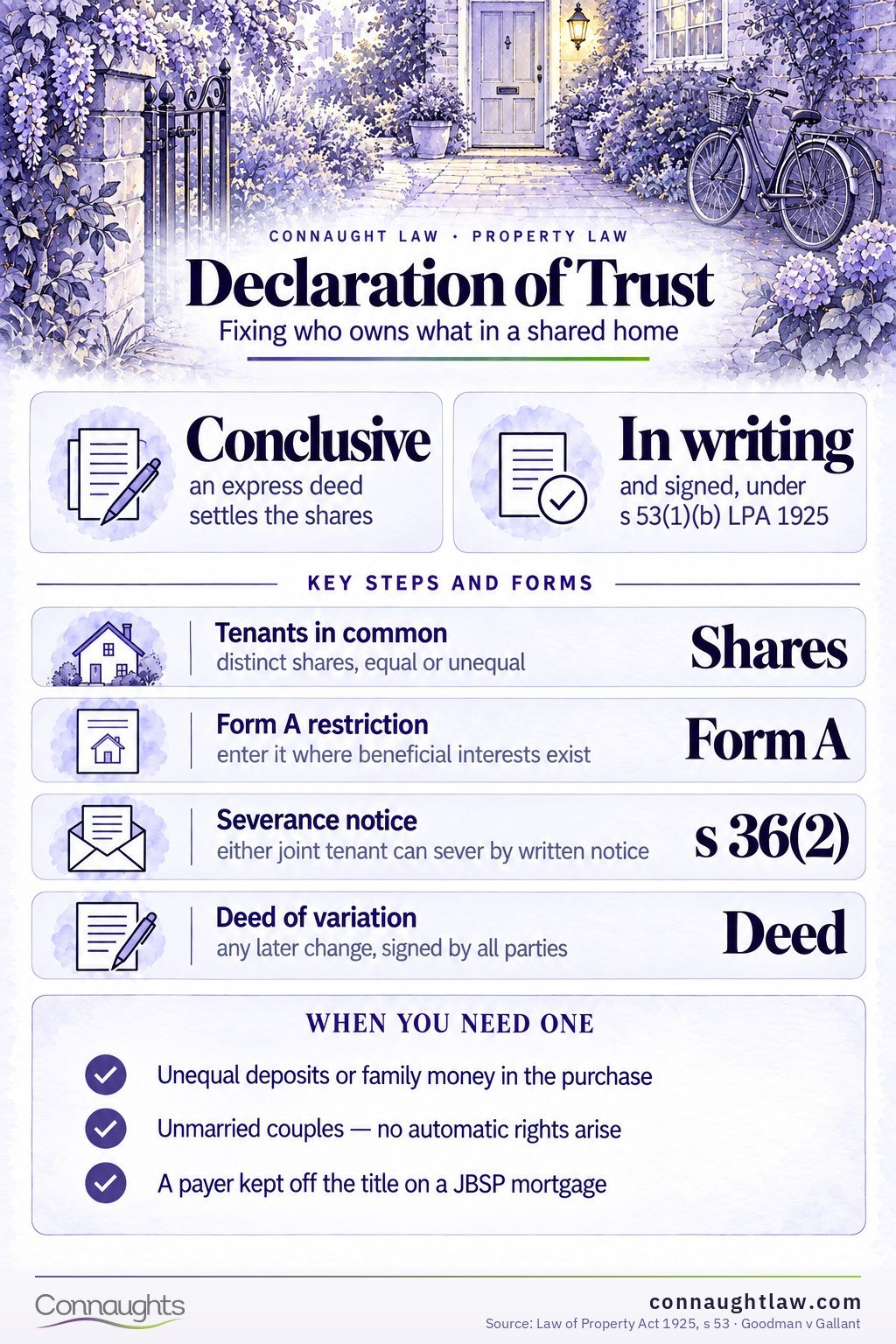
A declaration of trust for property is a formal deed executed by the legal owners - and, where relevant, non-owning contributors - declaring the beneficial shares in which a property is held. Under section 53(1)(b) of the Law of Property Act 1925, a declaration of trust respecting land must be evidenced in writing and signed. Informal promises, however sincere, are difficult and costly to prove; a properly executed deed removes that doubt at the outset.
Fixed Shares or a Floating Deed?
Declarations take two broad forms. A fixed-share declaration states percentages at the outset - 70/30, 60/40 - and leaves them unchanged until formally varied. A floating-share declaration instead records a formula: initial contributions are repaid first on sale, with the balance divided to reflect mortgage payments, capital improvements or other defined contributions over time. Floating deeds suit co-owners whose financial input will diverge over the life of the ownership.
Key Elements Every Declaration of Trust Should Include
- Beneficial shares: fixed percentages or the formula by which shares are calculated on sale
- Contribution record: deposits, purchase costs and any family money, with its intended status
- Mortgage responsibility: who pays what, and how overpayments or defaults adjust the shares
- Sale mechanics: trigger events, rights of first refusal and how the price is fixed
- Occupation and outgoings: who may live in the property and how bills and repairs are divided
- Variation and review: how the deed is updated as circumstances change
How Binding Is an Express Declaration of Trust?
The Court of Appeal in Goodman v Gallant confirmed that an express declaration is conclusive as to the parties' shares unless set aside for fraud or mistake, or later varied. The better-known Supreme Court decisions in Stack v Dowden and Jones v Kernott - which allow courts to infer or impute shares from the parties' whole course of conduct - apply only where no express declaration exists, which is precisely why executing one avoids litigation.
Conclusive does not mean immutable. In Nilsson v Cynberg (2024) the High Court held that an express declaration can be displaced by a later common intention constructive trust where the parties clearly agreed different shares after separating. In Hudson v Hathway (2022) the Court of Appeal treated signed emails as sufficient writing to give away a beneficial interest. The practical lesson is simple: record any change in a formal deed of variation, and never rely on loose correspondence to define property rights.
When is a Declaration of Trust Needed?
Any purchase where money, risk or intentions differ between the parties justifies a declaration of trust. The most common trigger is an unequal deposit, where one buyer contributes substantially more and expects that difference recognised on sale. Family assistance raises the same need from the other direction: parents helping a child onto the ladder can have the sum recorded as a defined beneficial share or protected loan rather than an undocumented gift.
Common Scenarios Requiring Declaration of Trust Documentation
- Unequal contributions: different deposits, purchase costs or planned mortgage payments
- Bank of Mum and Dad: protecting family money as a share, loan or secured interest
- Unmarried couples: no automatic rights arise from the relationship itself
- Friends and siblings: co-purchases that need clear exit and valuation rules
- Joint borrower sole proprietor: a payer who is deliberately kept off the title
- Investors and business partners: shares, income splits and buy-out terms
- Unregistered contributors: someone funding part of the price without appearing on the register
Buyers should raise trust documentation at the start of a purchase so it completes alongside the transfer - a point our guide to first-time buyer conveyancing develops in detail. Retrofitting protection after completion is possible, but it is slower, more expensive and can carry tax consequences that early planning avoids.
Without an express declaration, a disappointed contributor must ask a court to find a resulting or common intention constructive trust - proving conversations from years earlier, tracing payments, and funding proceedings under sections 14 and 15 of the 1996 Act, with specialist litigation support. Recent developments have modernised procedure rather than removed the risk: Savage v Savage (2024) clarified how courts weigh majority beneficiaries' interests, and since October 2024 the courts' post-Churchill powers allow judges to order mediation and penalise unreasonable refusal in costs.
Where no declaration exists, Stack v Dowden and Jones v Kernott let courts infer shares from the whole course of dealing - an unpredictable, evidence-heavy exercise. Contested beneficial interest claims routinely cost many times more than professional drafting at the outset, and the outcome is never guaranteed.
Cohabiting Couples and the June 2026 Reform Consultation
Cohabiting couples remain the least protected group. "Common law marriage" has no legal status in England and Wales, and a separating partner has no automatic claim on property held in the other's name. The Ministry of Justice consultation A Fairer End to Relationships, published on 5 June 2026, proposes a statutory scheme for couples who have lived together for at least three years or share a child.
Critically, the consultation's starting point is that each person keeps what they legally own, with departures limited to defined needs - so an express declaration of trust would remain decisive even under a reformed law. Until legislation arrives, couples should pair a declaration with a cohabitation agreement covering wider finances, and understand the current position of unmarried couples on separation before assuming any safety net exists.
How Much Does a Declaration of Trust Cost?
Drafting a declaration of trust is a fixed-fee service at most firms, ours included, and the fee turns on design rather than length. A simple fixed-share deed - two owners, stated percentages, standard sale mechanics - sits at the bottom of the scale. Floating-share declarations with repayment waterfalls, valuation mechanics and dispute provisions cost more because they demand more design. Family loans, joint borrower sole proprietor structures and lender consent requirements each add a layer.
Whatever the figure, the comparison that matters is with the alternative: contested beneficial interest proceedings routinely run to tens of thousands of pounds and can exceed the equity in dispute. We quote a written fixed fee before any work starts - our published fees set out how we charge - and the deed completes alongside your purchase so there is nothing to retrofit later.
The Drafting Process Step by Step
- Disclosure: each party sets out contributions, expectations and future plans
- Structure: fixed or floating shares, loan versus gift treatment of family money
- Drafting: the deed is prepared alongside mortgage terms, with lender consent checked where required
- Execution: signed as a deed and witnessed by all parties
- Registration: Form A restriction, Form JO or severance applications lodged as needed
- Review: the deed is revisited on marriage, children, re-mortgage or major works
Should You Use a Declaration of Trust Template?
Online templates exist because simple cases exist - and for genuinely simple ones, with equal shares, no family money and no one off the title, a template records little more than the transfer form could have anyway. The trouble is that people who need a declaration rarely have the simple case.
Templates fail in predictable places: severance never effected, the Form A restriction never entered, mortgage-contribution formulas that do not add up, family money left ambiguous between gift and loan, and no thought given to tax. And Goodman v Gallant cuts both ways - a deed that conclusively records the wrong arrangement binds you just as firmly as one that gets it right.
Declaration of Trust vs Cohabitation Agreement
| Aspect | Declaration of Trust | Cohabitation Agreement |
|---|---|---|
| Scope | Beneficial ownership of a specific property | Wider finances: bills, savings, contents, arrangements on separation |
| Form | Deed, conclusive under Goodman v Gallant | Contract, upheld when entered fairly with advice |
| Timing | Ideally at purchase; possible later by variation | Any point in the relationship |
| Best used | Fixing shares and sale mechanics | Everything the trust deed does not cover |
The two documents work together rather than compete: the declaration fixes ownership of the home, while the agreement handles day-to-day finances and what happens practically if the relationship ends. Marriage changes the landscape again - on divorce the family court exercises a discretionary jurisdiction that can depart from strict shares - but a clear paper trail of contributions still carries real evidential weight, and for investment properties the declaration remains central.
Land Registry Registration and Form A Restrictions
The declaration of trust itself is not registered at HM Land Registry - it stays with your title documents - but the registration choices made at purchase determine how the trust operates in practice. Joint owners must decide whether to hold the legal title as joint tenants or tenants in common, recorded in the transfer deed (TR1) or a separate Form JO joint ownership declaration.
Registering the trust
| Feature | Joint Tenants | Tenants in Common |
|---|---|---|
| Shares | No separate shares - each owns the whole jointly | Distinct shares, equal or unequal |
| On death | Survivorship: passes automatically to the co-owner | Share passes under your will or intestacy |
| Best suited to | Couples wanting simple, equal ownership | Unequal contributions, family money, investors |
| Declaration of trust | Executing one for unequal shares generally severs the joint tenancy | Essential to record the agreed shares |
Land Registry Forms for Declaration of Trust Registration
Tenants in common should ensure a Form A restriction appears in the register. The restriction prevents a sole surviving owner giving valid receipt for purchase money, signalling to buyers and lenders that beneficial interests exist behind the title. HM Land Registry Practice Guide 24 sets out how trusts of land are recorded and how trustees' powers can be limited on the register.
Where owners already hold as joint tenants, either can sever unilaterally by written notice under section 36(2) of the Law of Property Act 1925 and an application on Form SEV; the declaration of trust then records the shares intended to apply after severance. Contributors who are not on the title at all should take advice on protecting their interest by restriction, since occupation alone will not always protect them against a sale or further borrowing.
choose tenants in common where shares differ; enter the Form A restriction; keep the executed declaration safely with your deeds; and revisit the register after any transfer, re-mortgage or severance so the entries still match the real arrangement.
Stamp Duty and Tax Implications
Executing a declaration of trust alongside a purchase does not normally create any extra stamp duty: SDLT is assessed on the purchase itself, and the declaration merely records how the buyers hold what they have bought. Problems arise when beneficial interests move later. Transferring a share - including where the incoming co-owner takes over responsibility for part of an existing mortgage - can amount to chargeable consideration under the SDLT rules, with a return generally required where the consideration exceeds £40,000.
chargeable consideration includes assumed mortgage debt, not just cash changing hands. Restructuring beneficial shares in a mortgaged property without advice can trigger unexpected SDLT - including the 5% higher-rate surcharge where the recipient already owns another dwelling. Take advice before signing any deed of variation.
Income Tax, Form 17 and Rental Income
Married couples and civil partners letting a jointly owned property are taxed 50/50 on rental income by default, whatever their actual shares. To be taxed on true entitlements they must hold unequal shares as tenants in common and submit HMRC's Form 17, supported by evidence - typically the declaration of trust - within 60 days of signing the form. Unmarried co-owners are simply taxed on their actual beneficial shares, which makes the declaration the primary evidence for how rental income should be allocated.
Capital Gains Tax When Shares Change
Between spouses and civil partners, transfers of beneficial interests pass on a no-gain, no-loss basis. Between unmarried co-owners, varying shares is a disposal for capital gains tax: the person reducing their share may realise a gain on an investment property or second home, although private residence relief usually covers a main residence. Because the declaration of trust fixes who owns what and from when, it is also the document HMRC will expect to see if ownership history is ever questioned.
Frequently askedQuestions about declarations of trust
Is a declaration of trust legally binding in the UK?
Yes. Executed as a deed and satisfying section 53(1)(b) of the Law of Property Act 1925, an express declaration is conclusive as to the shares it records, following Goodman v Gallant. Courts will only go behind it for fraud or mistake, a later valid variation, or - as Nilsson v Cynberg (2024) shows - a clearly proved subsequent agreement.
How much does a declaration of trust cost in the UK?
Most firms, ours included, charge a fixed fee that rises with complexity: a simple fixed-share deed costs least, while floating-share structures with repayment and valuation provisions cost more. We confirm the figure in writing before starting - see our published fees. Whatever the quote, it is a fraction of the cost of litigating an undocumented ownership dispute.
What is the difference between joint tenants and tenants in common?
Joint tenants own the whole property together with no separate shares, and survivorship passes it automatically to the surviving owner on death. Tenants in common hold distinct shares, equal or unequal, which pass under each owner's will or intestacy. Unequal contributions almost always point to a tenancy in common supported by a declaration of trust.
Do married couples need a declaration of trust?
On divorce the family court can redistribute property regardless of strict legal shares, so a declaration offers less protection between spouses than between unmarried owners. It still matters for evidencing family or third-party contributions, for jointly held investment property, and for income tax planning through HMRC's Form 17 route.
Can a declaration of trust be changed or updated?
Yes, by a deed of variation signed by all parties. Take tax advice first: changing beneficial shares can be a disposal for capital gains tax and, where mortgage debt is assumed, can trigger stamp duty. Avoid informal changes - loose emails or conversations can create exactly the uncertainty the deed was meant to remove.
Does a declaration of trust need to be registered with the Land Registry?
No. The deed itself stays with your title papers. What appears on the register is the supporting architecture: a Form A restriction for tenants in common, any Form JO declaration made at purchase, and the outcome of any severance application on Form SEV. Keep the original deed safe - it is the document that decides shares.
Does a declaration of trust affect our mortgage?
It does not change your obligations to the lender: joint borrowers remain jointly and severally liable for the whole debt. The deed governs how the owners share value and responsibility between themselves, and it must be drafted consistently with mortgage conditions - some lenders expect notice or consent, particularly in joint borrower sole proprietor arrangements.
What happens to a declaration of trust when an owner dies or the property is sold?
On sale, proceeds are divided in the declared shares after repaying the mortgage and costs. On death, a tenant in common's share passes under their will or the intestacy rules, so wills should be kept aligned with the deed. The June 2026 reform consultation proposes intestacy rights for qualifying cohabitants, but that is not yet law.
Tell us who is putting in what, whether either of you is contributing a mortgage and how you want the property to pass on death. We’ll tell you what the declaration needs to record and how to register it.
Get Expert Advice