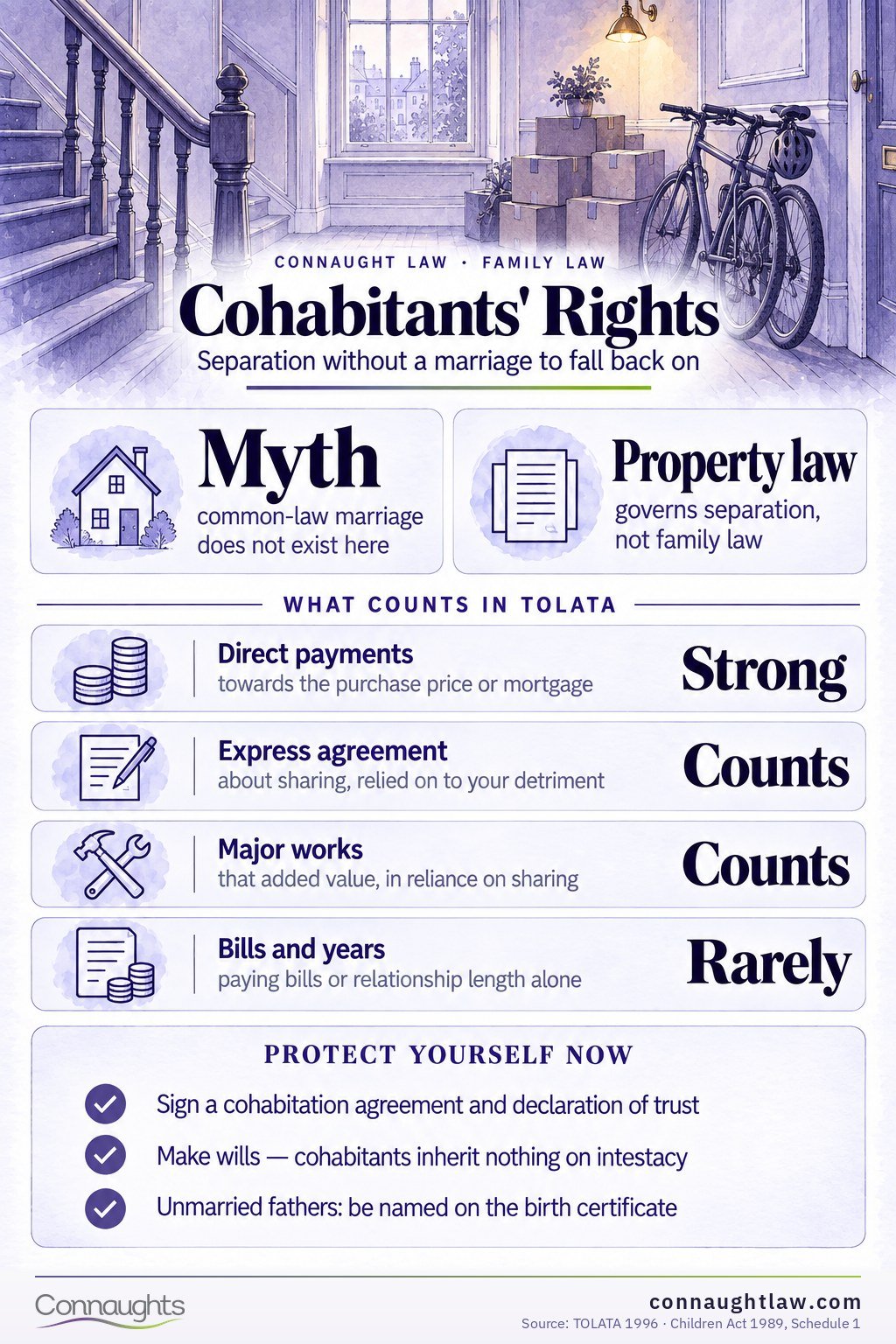
Unmarried couples rights on separation UK law is brutally simple: there are almost none. However long you lived together, whatever you sacrificed for the relationship, the law of England and Wales gives cohabitants no divorce-style claims - no maintenance for yourself, no automatic share of your partner’s property, no redistribution of pensions. What you own is what you leave with, unless you can prove more through trust law or claims for the children. This guide sets out the real legal position in 2026, the property and financial claims that do exist, and how the government’s June 2026 cohabitation reform consultation may - eventually - change the landscape.

Understanding Unmarried Couples Rights on Separation UK
Around 3.5 million UK families are cohabiting couples - 17.7% of all families and the fastest-growing family type, per the Office for National Statistics. Surveys consistently find that close to half of the public believes living together creates “common-law marriage” rights. It does not, and never has in modern law.
The scale of the exposure is documented in the ONS families and households data: cohabiting families grew by roughly 400,000 in a decade, and a large share include dependent children - households where one adult has often traded earnings for childcare on the strength of a legal protection that does not exist.
The result is a two-tier system. Married couples and civil partners separate under family law, where courts redistribute assets by reference to needs and fairness. Cohabitants separate under property and trust law, where the only question is who actually owns what - a regime built for commercial disputes, applied to the end of a life shared.
None of this depends on why the relationship ended or who ended it. Trust law has no concept of fault, contribution to the family, or need. A partner can behave impeccably for twenty years and leave with nothing; the other can behave badly and keep everything in their name. Understanding that unsentimental baseline is the first step to protecting against it.

Legal Rights of Unmarried Couples on Separation: The Reality
Start with what does not exist. A cohabitant cannot claim maintenance for themselves, however long the relationship or however great the economic sacrifice. There is no claim on the other partner’s pension, savings or business. Contributions to family life - childcare, running the home, supporting a career - generate no financial entitlement by themselves.
What does exist is narrower: property claims under trust law where you can prove an ownership interest; claims for the benefit of children under Schedule 1 of the Children Act 1989; occupation orders in domestic abuse situations; and rights you created deliberately - joint ownership, a cohabitation agreement, life insurance, a will.
Domestic abuse protections, by contrast, do not depend on marriage at all. Non-molestation orders and occupation orders under the Family Law Act 1996 are fully available to cohabitants and former cohabitants, and an occupation order can regulate who lives in the home in the short term regardless of whose name is on the title.
Unmarried Couples Rights on Separation UK vs Married Couples
The comparison is stark on every axis. Maintenance: spouses can claim it, cohabitants cannot. Property: courts can transfer a matrimonial home regardless of title; for cohabitants title is presumptively decisive. Pensions: sharing orders exist only on divorce. Death: a spouse inherits on intestacy, a cohabitant inherits nothing automatically and must litigate under the Inheritance (Provision for Family and Dependants) Act 1975 as a dependant or two-year cohabitant.
Tax law draws the same line. Transfers between spouses are free of capital gains tax and inheritance tax; transfers between separating cohabitants enjoy no such relief, so moving a share of a property to a former partner can itself trigger a CGT bill. Pension death benefits, survivor pensions and bereavement benefits all similarly privilege marriage - death-in-service nominations and scheme expression-of-wish forms are the cohabitant’s substitute and need keeping current.
The practical translation: a cohabiting couple’s financial architecture has to be built deliberately. Where a married couple gets survivorship, sharing and exemptions by default, cohabitants get only what they construct - joint ownership chosen consciously, nominations completed, insurance written in trust, and wills professionally drafted and reviewed after every major life event.
Property Rights for Unmarried Couples: Trust Law in Practice
For the family home, everything turns on ownership. Joint legal owners share the property in the shares recorded when they bought - usually in the TR1 form or a declaration of trust; if nothing was recorded, a joint tenancy points to equal shares. Those documents are close to conclusive: signing them casually at purchase decides the outcome years later.
Where the home is in one partner’s sole name, the other must establish a beneficial interest under a resulting or constructive trust - broadly, by proving a common intention to share ownership plus reliance on it, through direct financial contributions, an express assurance, or (rarely) conduct from which intention can be inferred. Claims run under the Trusts of Land and Appointment of Trustees Act 1996 (TOLATA), and the leading cases of Stack v Dowden and Jones v Kernott govern how shares are quantified.
What Counts - and What Does Not - in a TOLATA Claim
Mortgage payments and deposit contributions count heavily. Paying for renovations that add value can count. Paying bills, buying food, raising children and decorating usually do not, however unfair that feels - the law looks for evidence of a deal about ownership, not evidence of a shared life. Documentation beats recollection: transfers, messages and emails contemporaneous with the purchase carry the day.
A related doctrine, proprietary estoppel, can rescue the partner who acted on a clear promise: where one partner assured the other the home was “as much yours as mine” and the other relied on that to their detriment - funding an extension, giving up a secure tenancy - equity can hold the promisor to it. But promises must be proved, and vague reassurances rarely clear the bar.
Timing matters too. There is no divorce-style deadline, but delay degrades evidence and can bar equitable claims; and a partner who stays in a jointly owned home may face occupation-rent arguments while excluding the other. Early advice - before anyone moves out, refinances or transfers anything - keeps options open on both sides.
TOLATA litigation is expensive, slow and confrontational, with costs that can consume the disputed equity. That economic reality pushes most disputes to negotiated settlement - and makes the case for recording intentions in advance overwhelming.
The rented sector has its own traps. A sole-name tenancy leaves the other partner with no right to stay if the named tenant leaves or excludes them, subject to short-term occupation orders. Joint tenants are each liable for all the rent, and one tenant’s notice can end a periodic joint tenancy for both - so tidying up the tenancy is as urgent on separation as the mortgage.
Joint bank accounts and debts follow contract, not fairness: both account holders can each withdraw everything, and joint borrowing leaves each liable for the full balance whatever any private deal says. Lenders are not bound by separation agreements, so joint products need closing or refinancing, and credit-file associations formally dissolving, as part of any clean split.
Where negotiation fails, choose the forum to fit the issue: TOLATA proceedings for ownership and sale of property, Schedule 1 for children’s provision, the CMS for maintenance, and the family court for abuse-related protection. They can run in parallel, but sequencing them well - and settling the ones that can settle - is where specialist advice earns its fee.
Above all, act on the position rather than resenting it. The couples who fare worst are those who assumed protection existed and discover its absence at separation or bereavement; the ones who fare best treated their arrangements as legal documents to be written, not understandings to be remembered. Until Parliament legislates and any new scheme actually commences, that remains the whole game - and the documents cost a fraction of the disputes they prevent.
Rights of Unmarried Couples Involving Children
Children change the financial picture. Child maintenance applies identically to married and unmarried parents through the Child Maintenance Service. Beyond maintenance, Schedule 1 of the Children Act 1989 lets a parent claim housing provision, lump sums for the child’s needs, and in bigger-money cases school fees - all for the child’s benefit, typically reverting to the paying parent when the child grows up.
A Schedule 1 housing order can keep a primary carer and children in a home the other parent owns, but ownership does not change: the carer occupies as the child’s carer, not as an owner, and the arrangement ends with the child’s dependency. Arrangements for where children live follow the same welfare framework as for divorcing parents, covered in our guide to child living arrangements.
Schedule 1 claims are underused in ordinary-money cases, partly because costs risk deters them, but they remain the main financial lever for an unmarried primary carer. Interim provision can cover housing and essentials while a claim proceeds, and settlements commonly pair a housing fund with allowances framed as part of the child’s costs.
Parental Responsibility for Unmarried Fathers
An unmarried mother has parental responsibility automatically. An unmarried father acquires it by being named on the birth certificate (for registrations from 1 December 2003), by agreement, or by court order. Without it he still owes child maintenance but lacks the legal authority over schooling, medical care and religion that married fathers hold automatically.
Engagement changes little, legally. An engaged couple who never marry are cohabitants, though a narrow statute lets contributions to property during engagement count more readily. The engagement ring is presumed an absolute gift unless it was expressly conditional on the marriage happening - a rule that surprises people on both sides of it.
Weddings that never legally happened produce the same result by a different route: a religious-only ceremony - a nikah, or any marriage not meeting civil formalities - creates no marriage in law, so the couple are cohabitants whatever their community status. The Court of Appeal confirmed in Akhter v Khan that such ceremonies are non-qualifying, leaving no route to matrimonial financial remedies.
Pensions deserve their own audit because they are often the largest asset after the home and are completely untouchable between cohabitants. There is no pension sharing outside divorce, and an ex-partner has no claim on decades of contributions - while an out-of-date nomination can send death benefits to a former partner years after separation. Reviewing nominations at the start and end of cohabitation is five minutes of paperwork with five-figure consequences.
Separation Agreements for Unmarried Couples
Separating cohabitants can - and usually should - record their deal in a separation agreement: who keeps or buys out the home, how the deposit is repaid, division of contents, cars and debts, arrangements and support for children, and timing for moving out. Executed properly after disclosure, it is an enforceable contract that closes the door on later trust claims.
The agreement is also the cheap alternative to litigation. A negotiated settlement documented in a deed costs a fraction of a TOLATA trial and preserves the co-parenting relationship. Mediation works for cohabitants exactly as it does for divorcing couples, including the Family Mediation Council network and the £500 voucher for cases involving children.
Practical first steps on separation follow a pattern: secure the paperwork (title documents, TR1, bank statements, evidence of contributions), freeze or monitor joint accounts and agree interim bill payments, take early advice before moving out where occupation matters, and put child arrangements on a stable footing quickly. The free guidance at Advicenow’s Living Together project is a reliable orientation while you arrange advice.
Cohabitation Agreements: Protection Before Problems
Prevention beats every cure above. A cohabitation agreement made while the relationship is healthy fixes ownership shares, contributions and separation terms as enforceable contract terms - and a declaration of trust settles the home’s shares conclusively. Wills complete the package, because intestacy gives a surviving cohabitant nothing.
These documents convert the law’s indifference into chosen, documented fairness. They matter most for the economically weaker partner - the one who moved into the other’s house, gave up work for children, or funded improvements to a home in the other’s name.
Cohabitation Law Reform: The June 2026 Consultation
Change is finally on the table. The Law Commission recommended cohabitation remedies in 2007; nothing followed for nearly two decades. In June 2026 the government opened a formal consultation on cohabitation reform, examining an opt-out scheme under which qualifying couples - defined by a period of living together or having a child - could seek financial remedies on separation and stronger protection on death unless they opted out.
What Reform Could Mean for Separating Cohabitants
If an opt-out scheme passes, the change would be generational: economic disadvantage from the relationship - lost earnings from childcare, contributions to the other’s assets - could ground claims without proving trust-law intentions. Scotland has run a more limited scheme since 2006, and its experience shapes the design questions about qualifying periods, remedies and contracting out now being consulted on.
Frequently Asked Questions
What rights does a common-law wife or husband have in the UK?
None as such - common-law marriage does not exist in England and Wales. A cohabitant has only the property they own or can prove an interest in, claims for the benefit of children, and any rights created by agreement, joint ownership, insurance or wills.
Is my partner entitled to half my house if we are not married?
Only if they own half - through joint ownership, a declaration of trust, or by proving a beneficial interest under trust law from contributions or a common intention. Simply living there, paying bills or raising children in the house does not create ownership.
Can I claim maintenance from my ex-partner if we never married?
Not for yourself. Maintenance between former cohabitants does not exist. Child maintenance applies for children through the CMS, and Schedule 1 of the Children Act can provide housing and lump sums for a child’s benefit - but nothing is payable for the adult’s own support.
What is a TOLATA claim?
A claim under the Trusts of Land and Appointment of Trustees Act 1996 asking the court to declare who owns what share of a property and whether it should be sold. It is how cohabitant property disputes are decided, using trust-law principles from Stack v Dowden and Jones v Kernott.
What happens if my unmarried partner dies without a will?
Intestacy gives you nothing automatically. If you lived together for two years, or were financially dependent, you can claim reasonable provision under the Inheritance Act 1975 - but that means litigation against the estate. Wills and death-benefit nominations avoid the whole problem.
Do unmarried fathers have parental responsibility?
Yes if named on the birth certificate (registrations from December 2003), by agreement with the mother, or by court order. Parental responsibility governs major decisions about the child; child maintenance is owed regardless of it.
Are separation agreements between unmarried couples binding?
Yes - properly executed after honest disclosure, they are enforceable contracts. Terms about children remain reviewable for welfare, but property and financial terms bind, which is why documenting a negotiated split beats leaving matters open.
Will the 2026 cohabitation reforms give me rights now?
No. The June 2026 consultation is the first step in a process that requires a government response and legislation - years, not months. Your position today is governed by current law, so agreements, declarations of trust and wills remain the only reliable protection.
Realistic assessment and firm handling of property disputes between former partners.
Housing and financial provision claims run for your children’s security.
Cohabitation and separation agreements drafted to be enforced, not argued about.
For advice on your rights as an unmarried partner - before or after separation - contact the family law team at Connaught Law for a confidential consultation.