
"Unreasonable behaviour" was, for decades, the most-used route to divorce in England and Wales — and since 6 April 2022 it no longer exists for new applications. No-fault divorce removed the need to blame anyone. This guide explains what unreasonable behaviour meant, the examples that founded petitions, why searchers still ask about it, and what the question you are really asking looks like under the current law.
On This Page

A Ground That No Longer Exists for New Divorces
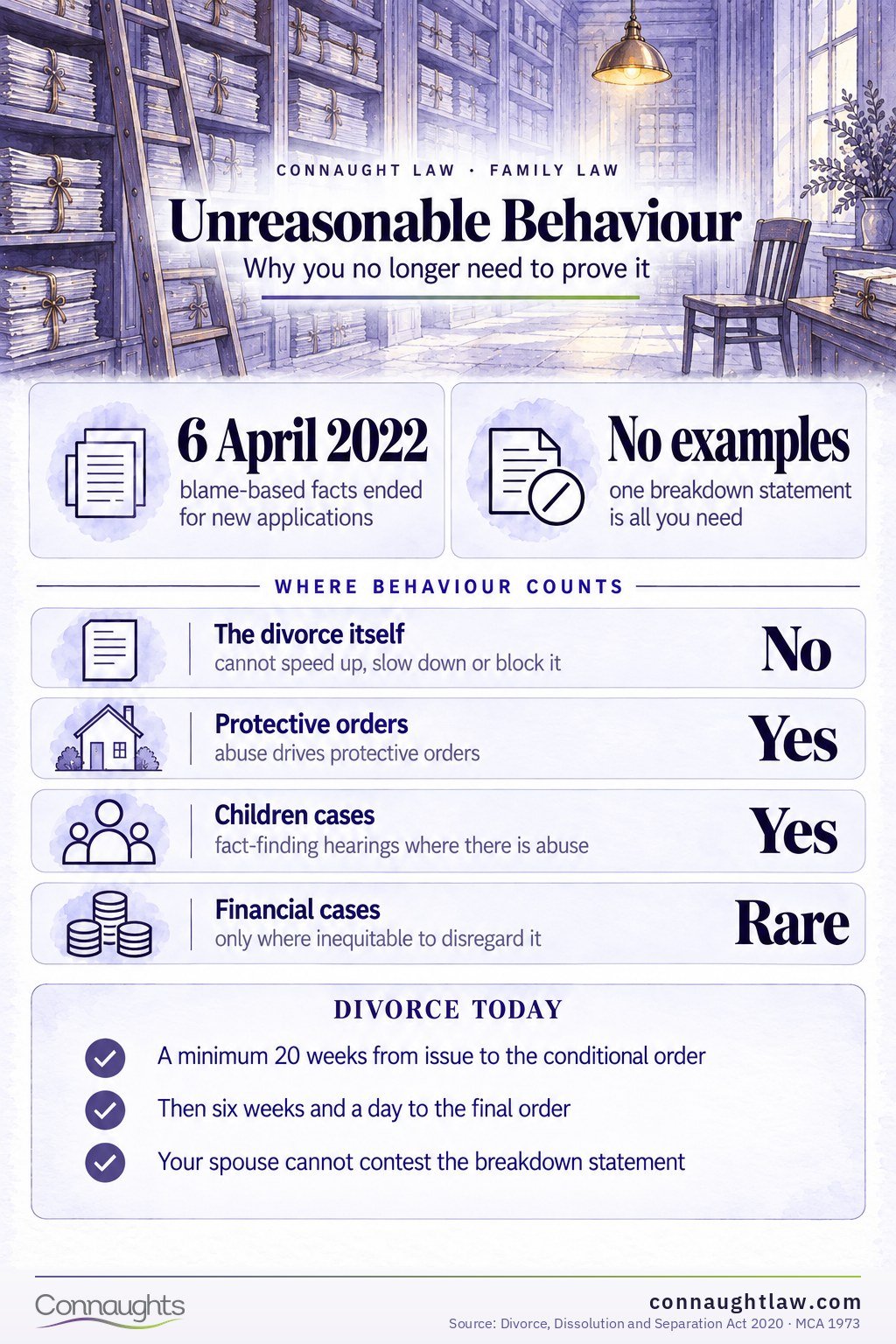
If you are searching for unreasonable behaviour examples because you want a divorce, the practical answer is liberating: you no longer need any. Since 6 April 2022 a divorce application requires only a statement that the marriage has irretrievably broken down — no examples, no blame, no proof of anyone's conduct, and no ability for the other spouse to contest the breakdown.
Unreasonable behaviour was one of five facts used to evidence marriage breakdown under the old law. The Divorce, Dissolution and Separation Act 2020 abolished the facts entirely for applications from 6 April 2022: a breakdown statement is conclusive. Behaviour now matters to a divorce case only in rare, indirect ways — never as a hurdle to the divorce itself.
How the Behaviour Ground Worked
Under the Matrimonial Causes Act 1973, a petitioner had to prove irretrievable breakdown through one of five facts — adultery, behaviour, desertion, two years' separation with consent, or five years' separation. "Behaviour" asked whether the respondent had behaved such that the petitioner could not reasonably be expected to live with them — a subjective-objective test that, in practice, made spouses catalogue each other's failings to end a marriage both knew was over.
Abolished for Applications from 6 April 2022
Why the Law Changed
The blame system inflamed exactly the relationships that divorcing parents most needed to preserve, and the Divorce, Dissolution and Separation Act 2020 swept it away: sole or joint applications, a conclusive breakdown statement, and no defence to the divorce beyond jurisdiction and validity. Allegations that once filled petitions now have no form to live in — and negotiations over children and money start calmer for it.
The Cut-Off
Applications issued from 6 April 2022 use the no-fault process. Only petitions issued before that date — a dwindling handful still working through the system — proceed on the old facts.
Where Behaviour Still Matters
Legacy Petitions
A pre-April-2022 petition pleading behaviour continues under the old rules to its conclusion, examples and all — though courts pushed even those towards mild, anodyne particulars.
Behaviour Elsewhere in Family Law
Abolition removed behaviour from the divorce itself, not from family law. Serious misconduct can still surface where it belongs: domestic abuse drives protective orders and fact-finding hearings in children cases; and in financial proceedings, conduct is relevant only in the rare cases where it would be inequitable to disregard it — a deliberately high bar. What no longer exists is any need to prove behaviour to get divorced.
The Examples That Used to Found Petitions
For readers who want the historical substance — or who are still running a legacy petition — these were the recurring categories, from gravest to most mundane.
Violence and Abuse
Physical violence, threats and intimidation were the clearest particulars — and today they are better addressed through non-molestation and occupation orders, which exist precisely so that safety never has to wait for a divorce.
Emotional and Psychological Conduct
Sustained belittling, controlling behaviour, isolation from friends and family — patterns the law now names as coercive control in the protective-order and criminal frameworks.
Financial Conduct
Gambling away joint savings, secret debts, rigid financial control. Under current law these fuel disclosure scrutiny in financial proceedings rather than divorce particulars.
Addiction
Alcohol and drug misuse that dominated home life — still highly relevant to children arrangements, as our substance misuse and custody guide explains, but no longer to the divorce.
Infidelity Short of Adultery
Emotional affairs and online relationships that adultery's narrow legal definition missed were pleaded as behaviour instead — a distinction that no longer matters at all.
Withdrawal of Affection
The "milder" petitions: emotional coldness, absence of intimacy, living entirely separate lives under one roof.
Abdication of Family Life
Refusing to work or contribute, disengagement from children, prioritising work or hobbies to the marriage's exclusion — the everyday erosion that ended most marriages and had to be dressed up as blame.
Wording Particulars, Then — and the Statement Now
How Particulars Were Drafted
The craft was mildness: four to six factual, dated examples strong enough to satisfy the test, bland enough not to poison negotiations. First and worst incidents, effects on the petitioner, no rhetoric.
What You Write Today
One sentence, provided by the form itself: the marriage has broken down irretrievably. There is nothing to draft, nothing to soften, and nothing for the other side to answer. The energy that went into particulars now goes where it pays — the financial settlement and the children's arrangements.
How Long Divorce Takes Now
The no-fault timetable is fixed by structure: a minimum 20 weeks from issue to conditional order, then six weeks and a day to the final order — around seven months at minimum, with the £628 application fee (from 13 July 2026). Most couples use that built-in runway to settle finances so a consent order is approved alongside the divorce rather than after it.
Frequently askedQuestions about unreasonable behaviour and divorce today
Do I still need unreasonable behaviour examples to divorce?
No. For all applications since 6 April 2022 you only state that the marriage has irretrievably broken down — no examples, no blame, no proof. The statement is conclusive and your spouse cannot contest the breakdown itself.
What counted as unreasonable behaviour under the old law?
Anything making it unreasonable to expect the petitioner to continue living with the respondent: violence, emotional abuse, financial recklessness, addiction, infidelity short of adultery, or simple sustained neglect of the marriage. Courts accepted quite mild particulars by the end.
Does my spouse's behaviour affect the divorce at all now?
Not the divorce itself. Serious conduct still matters where it belongs — protective orders, children proceedings, and exceptionally in financial cases where it would be inequitable to ignore. But it cannot speed up, slow down or block the divorce.
How long does a divorce take for unreasonable behaviour?
The question no longer arises for new cases — every divorce follows the same no-fault timetable: a 20-week minimum to the conditional order, six weeks and a day more to the final order, so around seven months at minimum regardless of anyone's behaviour.
Can I mention my ex's behaviour anywhere in the process?
Not on the divorce application — there is no field for it. Raise abuse with the court where it is relevant: in children proceedings, in applications for protective orders, or through the domestic abuse exemptions that apply to mediation requirements and legal aid.
Tell us your situation and what worries you most — the process, the money or the children. We will start the application and point the effort where it actually changes your outcome.
Get Expert Advice