
A parent's drink or drug use only decides a children case when it affects their parenting. Courts distinguish past use from present risk, and a parent in genuine recovery is treated very differently from one still minimising. This guide explains how family courts approach substance allegations, the testing they order, how use is proved and disproved, sobriety conditions in contact arrangements, and what recovering parents can realistically expect.
On This Page
Drink, Drugs and the Family Court's Real Question
The court's question is never "has this parent used substances?" but "is this child safe in this parent's care?" Use that never touches the children — historic, occasional, managed — may carry little weight; use that impairs supervision, judgment or the home environment goes to the heart of the welfare checklist. Both mothers and fathers can and do lose or restrict their arrangements over it, and both can rebuild them through evidenced recovery.
A parent can lose the care of a child for drug or alcohol misuse where it creates a risk of harm, usually proved by hair-strand or other testing and pattern evidence. Contact is rarely stopped outright: courts prefer supervised or conditional contact with testing, moving back to normal arrangements as sobriety is evidenced.
How Courts Frame Substance Allegations
Substance misuse features in a substantial proportion of both private disputes and care proceedings, and the official adult treatment statistics show how commonly parents are among those in treatment. Judges are therefore neither shocked by these allegations nor casual about them: the framework is the welfare checklist, with any risk of harm weighed against the value of the parent-child relationship.
Mothers, Fathers and the Same Test
The legal test is identical for both parents. In practice allegations are raised against mothers and fathers alike, and the searching questions are the same: who supervises the children during use, what happens on a bad day, and who else is in the home.
Why Alcohol Cases Are Different
Alcohol is legal, socially embedded and easy to minimise, so courts focus on pattern and function: drinking that starts before school pickup is not the same as wine after bedtime. Alcohol testing reflects that nuance — markers can distinguish chronic excess from social drinking — which is why courts order it rather than accept assertions either way.
Drug and Alcohol Testing Ordered by the Court
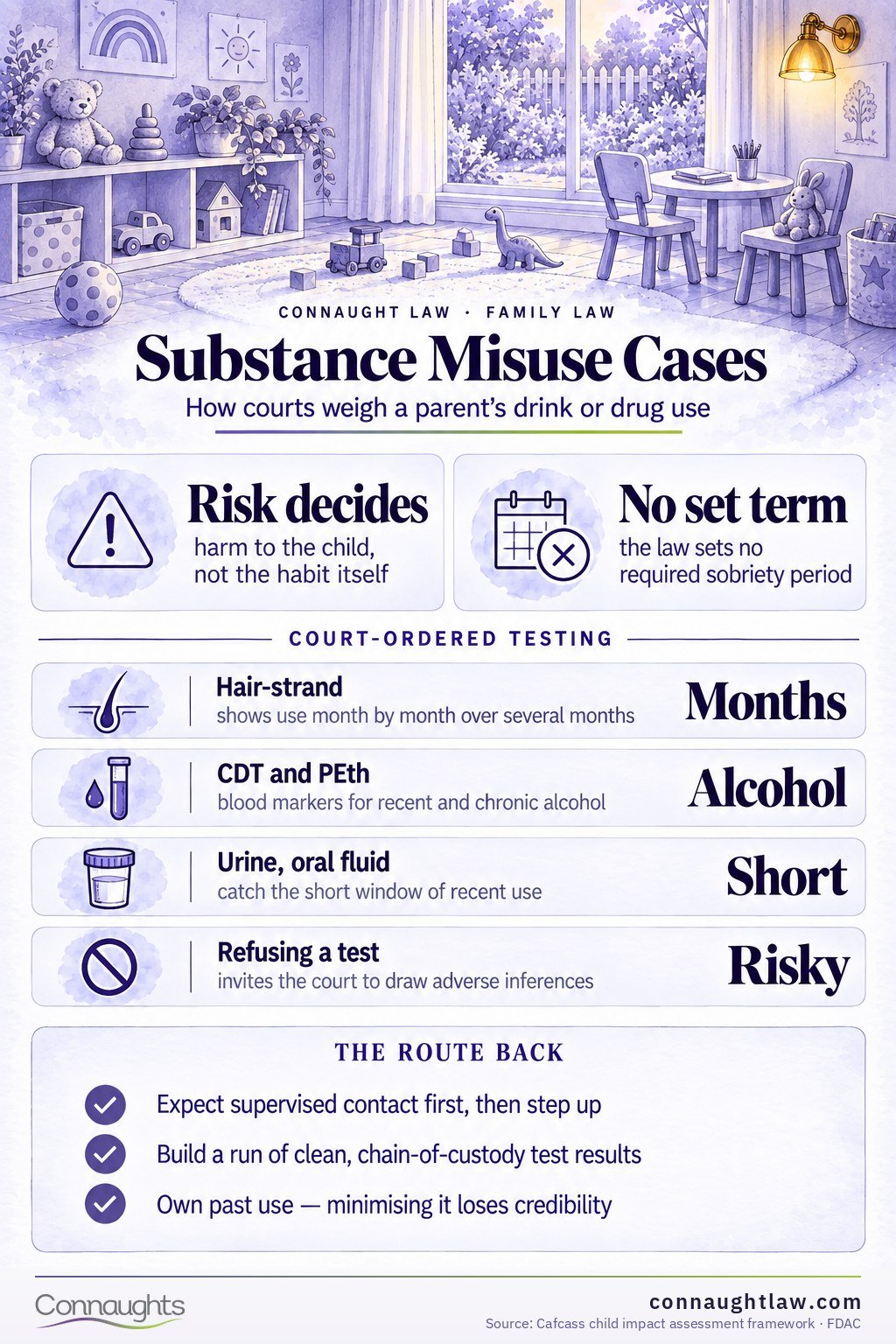
Testing is the court's reality check. Hair-strand testing can show substance use month by month over several months; blood markers such as CDT and PEth speak to recent and chronic alcohol use; urine and oral fluid catch the short window. Samples are collected under chain-of-custody conditions, and refusing a test without good reason invites the court to draw adverse inferences.
Who Asks for Testing and When
Testing is usually directed at the first hearing where allegations are live — raised by a party, recommended by Cafcass after safeguarding checks, or ordered by the judge. The scope should match the allegation: months of hair testing for a claimed pattern, alcohol markers for drink allegations, repeat panels where recovery is asserted.
Paying for the Tests
The court decides who pays — commonly the party whose use is alleged, or shared — and costs vary with the panel of substances and time window tested, so get a quote before the hearing. Where legal aid is in place, testing the assisted party is directed to undergo can be covered as a disbursement.
Proving — and Disproving — Substance Misuse
What Counts as Evidence
- Test results with a proper chain of custody, read alongside their limitations
- Police incident reports, drink-driving convictions and cautions
- Medical and treatment records showing diagnosis, treatment or relapse
- Witness evidence of the children's care during episodes of use
- Messages and photographs evidencing use during contact time
Answering a False Allegation
The fastest answer to a false allegation is usually a clean test: volunteering for testing early costs less than months of contested hearings and reads as confidence rather than concealment. Allegations found to be invented do real damage to the accusing parent's credibility and can themselves become a welfare concern about that parent's judgment.
Cafcass Assessment Where Substances Are Alleged
Cafcass safeguarding checks pull police and local authority records before the first hearing, and its child impact assessment framework treats parental substance misuse as a recognised harm pathway — looking at the child's lived experience rather than the label.
What the Officer Weighs
The officer considers the pattern and severity of use, insight and honesty about it, engagement with treatment, the other adults around the child, and the child's own account where age-appropriate. Minimising verified use is the fastest way to lose an officer's confidence; owning it and evidencing change is the fastest way to rebuild it.
Recovery, Sobriety Conditions and Getting Arrangements Back
Sobriety Conditions in Orders
Orders and agreements routinely carry conditions: no alcohol or drugs during and before contact, ongoing testing at defined intervals, attendance at treatment, and review hearings to step arrangements up as results come in. Breaching a condition suspends progress; a run of clean results is the strongest application for more time a parent can file.
Can a Recovering Parent Get Custody?
Yes. Courts back evidenced recovery — stability, treatment engagement, clean tests over months, insight into the impact on the children. There is no fixed sobriety period the law requires; in practice courts want to see a sustained, tested track record whose length reflects the seriousness of the history. Past addiction alone, without present risk, does not disqualify a parent.
Family Drug and Alcohol Courts
A Problem-Solving Track in Care Cases
In care proceedings, Family Drug and Alcohol Courts offer a problem-solving approach: the same judge throughout, a specialist multi-disciplinary team, frequent non-lawyer review hearings and a trial-for-change plan. FDAC operates in participating areas rather than nationally, and evaluations have repeatedly found higher rates of family reunification than standard proceedings. Where local authority involvement is already underway, our guide to local authority involvement with children explains the wider process.
Protective Arrangements While Trust Rebuilds
The Graduated Ladder
The standard shape is a ladder: supervised contact in a centre or with a trusted family member; unsupervised daytime contact once testing supports it; then overnights and holidays as the record lengthens. Each rung is evidence for the next, which is why parents in recovery are well advised to accept a modest starting point and climb, rather than litigate for everything at once.
Reviews and What Ends Them
Review hearings track compliance while risk remains live, but courts aim to close cases, not supervise families indefinitely: once arrangements are stable and testing is consistently clean, orders are finalised and the family exits the process. Our family law team manages both sides of these cases — protecting children from genuine risk, and rebuilding contact for parents who have done the work.
Frequently askedQuestions about substance misuse in children cases
Can a mother or father lose custody for drug use in the UK?
Yes, either parent can, where use creates a risk of harm to the child — but total loss of contact is rare. Courts usually impose supervised or conditional contact with testing, restoring normal arrangements as sustained sobriety is evidenced. The test is identical for mothers and fathers.
How long do you have to be sober to get custody of a child?
No statutory period exists. Courts look for a sustained, tested track record — typically months of clean results alongside treatment engagement and stability — with the length reflecting how serious and recent the history was. Evidenced recovery, not the calendar, is what moves arrangements forward.
How do you prove substance abuse in family court?
Through court-directed testing — hair-strand for pattern, blood markers for alcohol — plus police records, medical and treatment records, convictions, and witness evidence of the children's care during use. Allegations are decided on the balance of probabilities, and refusal to test invites adverse inferences.
What alcohol tests do family courts use?
Hair-strand alcohol markers combined with blood tests such as CDT and PEth, which together distinguish chronic excessive drinking from social drinking, alongside the shorter windows caught by urine or breath testing. Samples are taken under chain-of-custody conditions so results stand up in court.
Does past drug use affect child custody?
Historic use without present risk carries limited weight. Courts are concerned with current parenting capacity, so evidenced recovery — clean tests, treatment completion, insight — answers most historic allegations. Concealing the history damages credibility far more than owning it.
What is a sobriety clause in a contact arrangement?
A condition that the parent will not use alcohol or drugs during, and for a defined period before, contact — often paired with ongoing testing and review hearings. Breach suspends or steps contact back; sustained compliance is the evidence base for extending it.
Tell us what is alleged, what testing exists and what the current arrangements are. We will tell you what the court will order next and how to strengthen your position.
Get Expert Advice