
When the local authority becomes involved with your children, the process runs on two sections of the Children Act 1989: section 17, support for children in need, and section 47, investigation where significant harm is suspected. The difference between them decides everything about your position. This guide explains both routes, the Working Together 2023 framework, care orders and emergency powers, and your family's rights at every stage.
On This Page
Two Very Different Doors Into Your Family
Social services involvement is not one process but two. Section 17 is a support duty: the family is offered services for a child in need, and engagement is voluntary. Section 47 is an investigative duty: the authority must find out whether a child is suffering or likely to suffer significant harm, and it proceeds with or without your consent. Knowing which door you are standing at — and when one becomes the other — is the first piece of advice any parent needs.
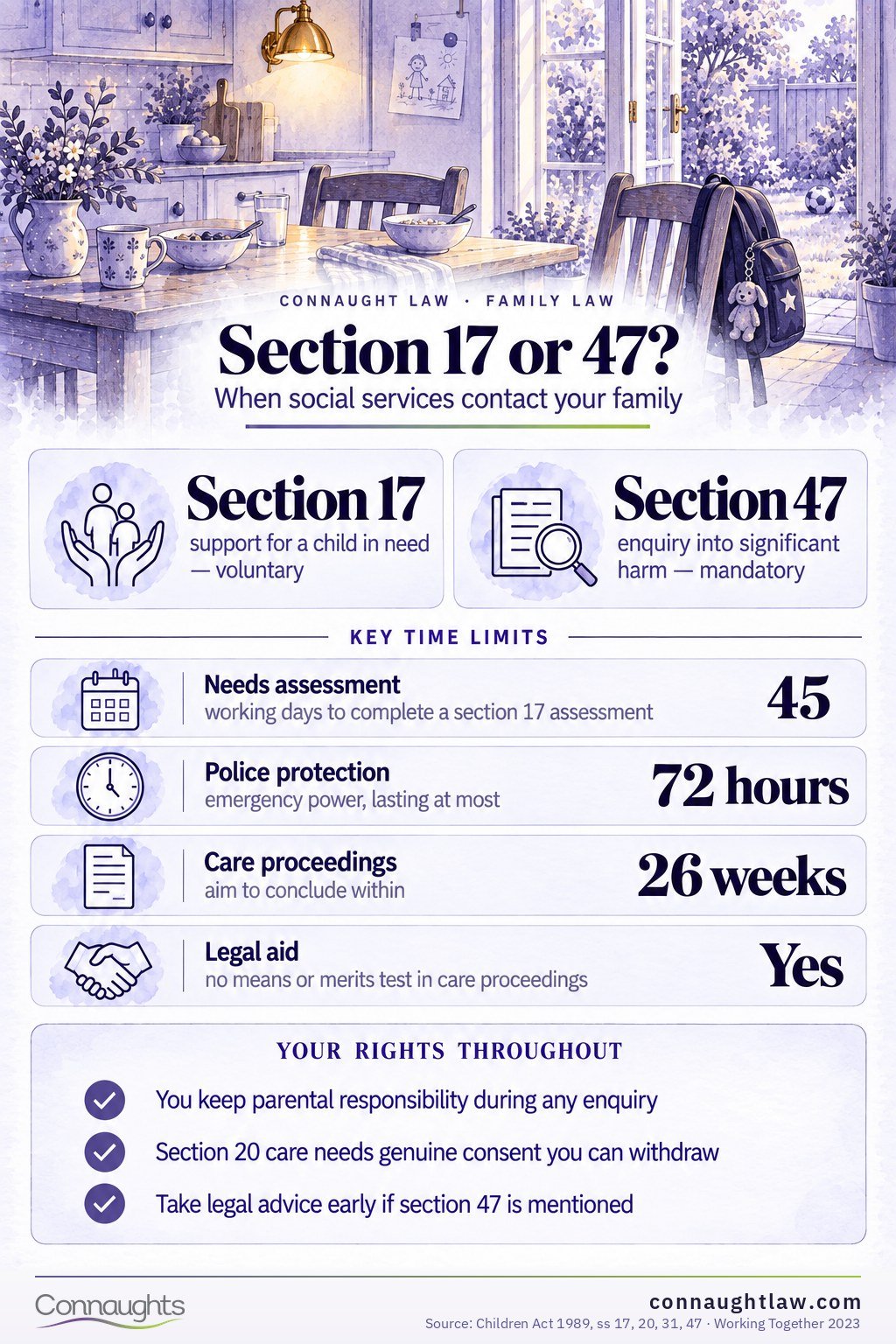
A section 17 assessment offers services to a child in need, and parents can decline them. A section 47 enquiry investigates suspected significant harm, can proceed without parental agreement, and can lead to a child protection plan or court proceedings. You are entitled to legal advice at every stage — and should take it early if section 47 is mentioned.
The Children Act Framework
One Act, Graduated Powers
The Children Act 1989 builds intervention as a ladder: family support, then investigation, then — only through a court — compulsory orders. At every rung the child's welfare is paramount and the authority must work in partnership with parents so far as is consistent with the child's safety.
The Principles That Protect Families
Proportionality runs through the scheme: the state may only intervene to the extent the child's protection requires, compulsory orders need a court to find the significant-harm threshold met, and children should be raised in their own families wherever safely possible. These are enforceable principles, not aspirations — they are what your solicitor holds the authority to.
How Practice Has Tightened
Serious case reviews and reforms have pushed practice toward earlier help and clearer multi-agency responsibility, so families now often meet "early help" offers before any statutory assessment. Early help is voluntary; it is also watched, so engage thoughtfully and ask what is being recorded.
Working Together 2023
Working Together to Safeguard Children 2023 is the statutory guidance every agency must follow. It restructured multi-agency safeguarding around lead roles for the local authority, police and health, and put families' participation in decision-making — including family group decision-making — at the centre of the process.
Who Holds Parental Responsibility During Involvement
Assessment and enquiry give the authority no parental responsibility at all: you keep every legal right you had. Only a care order (or emergency order) shares parental responsibility with the authority — and even then it is shared, not transferred.
Section 17: Children in Need
The Support Duty
Under section 17, the authority must safeguard and promote the welfare of children in need in its area — children unlikely to achieve a reasonable standard of health or development without services, or who are disabled. The government's children in need statistics show how wide this cohort is: need, not blame, is the trigger.
What Support Looks Like
Services range from practical help in the home and short breaks for disabled children to financial assistance in exceptional circumstances. A child in need plan records what will be provided; it is reviewed with the family and can end simply because it has worked.
The Assessment
A social worker assesses the child's needs, the parents' capacity and the wider family context, normally completing within 45 working days. It is consent-based: you can decline — though where the assessment was prompted by concerns, declining without understanding the consequences can escalate matters, which is why advice first is the better sequence.
Section 47: Child Protection Enquiries
The Threshold
Section 47 is triggered where the authority has reasonable cause to suspect a child is suffering, or is likely to suffer, significant harm. The duty to enquire is mandatory once the threshold is met — the authority cannot be talked out of it, and obstruction tends to be read as risk.
What "Significant Harm" Means
Harm means ill-treatment or the impairment of health or development — physical, emotional, sexual abuse or neglect, including seeing or hearing the ill-treatment of another, as with domestic abuse. Whether harm is "significant" is judged against what could reasonably be expected for a similar child.
How the Enquiry Runs
The enquiry gathers information from school, health, police and family, normally includes seeing and speaking to the child, and may involve a strategy discussion between agencies. It ends in one of three places: no further action, a child in need plan, or an initial child protection conference which decides whether the child needs a child protection plan.
Multi-Agency Duties in Practice
Working Together 2023 makes safeguarding a shared statutory responsibility: schools, health services and the police feed information into the local authority's assessment, and a child protection conference brings them together with the family. Parents should attend conferences, ideally advised beforehand — the conference hears you, and its records follow the case.
Care Orders and Emergency Protection
What a Care or Supervision Order Does
Only a court can make a care or supervision order, and only where the section 31 threshold is proved: the child is suffering or likely to suffer significant harm attributable to the care given, or the child being beyond parental control. A care order shares parental responsibility with the authority; a supervision order appoints it to advise and assist while the child stays at home.
Emergency Powers
In immediate danger the authority can seek an emergency protection order — short, court-controlled and reviewable — and the police have a 72-hour protective power. Emergency removal is the exception, tightly policed by the courts, and never the end of the story: full proceedings with full representation follow.
Care Proceedings
Care proceedings aim to conclude within 26 weeks. Parents get non-means-tested legal aid, the child has a guardian, and the court tests the authority's evidence and care plan against the least-interventionist outcome that keeps the child safe — which in many cases is the child remaining at, or returning, home under a plan.
Your Rights and Representation
Rights That Apply Throughout
- To know what the concerns are, and under which section the authority is acting
- To be consulted, attend conferences and contribute to plans
- To see records about your family, subject to limited exceptions
- To decline voluntary services under section 17
- To legal advice at any stage — and free legal aid once care proceedings are contemplated
When to Get a Solicitor Involved
The unmistakable signals are: a section 47 enquiry, an invitation to a child protection conference, a request that your child live elsewhere "voluntarily" under section 20, or a letter before proceedings. Section 20 arrangements deserve particular care — they require your genuine consent, which you may withdraw, and no one should sign one unadvised. The Commons Library briefing is a sound plain-English overview; our children team can act from the first letter.
Contact and the Road Back
Seeing Your Child While They Are Looked After
Where a child is in care, the authority must allow reasonable contact with parents, and the court can define it. Contact is the artery of reunification — attend reliably, engage with the plan, and challenge unreasonable restrictions through your solicitor rather than through conflict with the social worker.
Reunification
Care plans must consider return home wherever safe. The route back is evidenced change against the concerns that brought the authority in — completed work, stable home, engagement with support — tested through increasing contact and, where needed, a further court application. Families who understand the process from day one, with advice beside them, come through it best; see also our guide to child living arrangements for the private-law side.
Frequently askedQuestions about social services involvement with children
What is the difference between section 17 and section 47?
Section 17 is voluntary support for a child in need — services offered to help the family, which parents can decline. Section 47 is a mandatory investigation where significant harm is suspected, which proceeds without consent and can lead to a protection plan or court proceedings.
What is a section 17 referral?
A referral asking the local authority to assess whether a child is "in need" — unlikely to achieve reasonable health or development without services, or disabled — and to provide support. It is about help, not blame, and any resulting plan is agreed with the family.
Can social services take my child without a court order?
No — except through police protective powers in an emergency, lasting at most 72 hours. Otherwise removal requires a court order, or your genuine consent under section 20, which you can withdraw. Take legal advice before agreeing to any section 20 arrangement.
Do social services have parental responsibility for my child?
Not during assessment or enquiry — you keep every right you had. Only a care order or emergency protection order shares parental responsibility with the authority, and even then parents retain it too; it is shared, not removed.
Do I get legal aid for care proceedings?
Yes. Parents facing care proceedings receive legal aid without means or merits testing, and representation is strongly advisable from the letter before proceedings onwards. Earlier stages — conferences, section 47 enquiries — are worth advised preparation even where legal aid is narrower.
What is Working Together to Safeguard Children 2023?
The statutory guidance all agencies must follow on safeguarding: it sets multi-agency roles for local authorities, police and health, structures child protection conferences and plans, and requires families to be involved in decision-making about their own children.
Tell us which section they have mentioned, what has been said and what you have been asked to sign. We will tell you exactly where you stand and stand with you from there.
Get Expert Advice