
A stateless person — recognised by no country as a national — has a dedicated UK route: Appendix Statelessness grants five years' leave without fee to applicants who can show no other country will admit them, leading to settlement, a travel document in place of the passport they cannot hold, and ultimately citizenship. The route's difficulty is proof of a negative. This guide covers the definition, the evidence, the 2024 rules and their family-member restriction, and the road to a British passport.
On This Page

A Route for People No State Will Claim
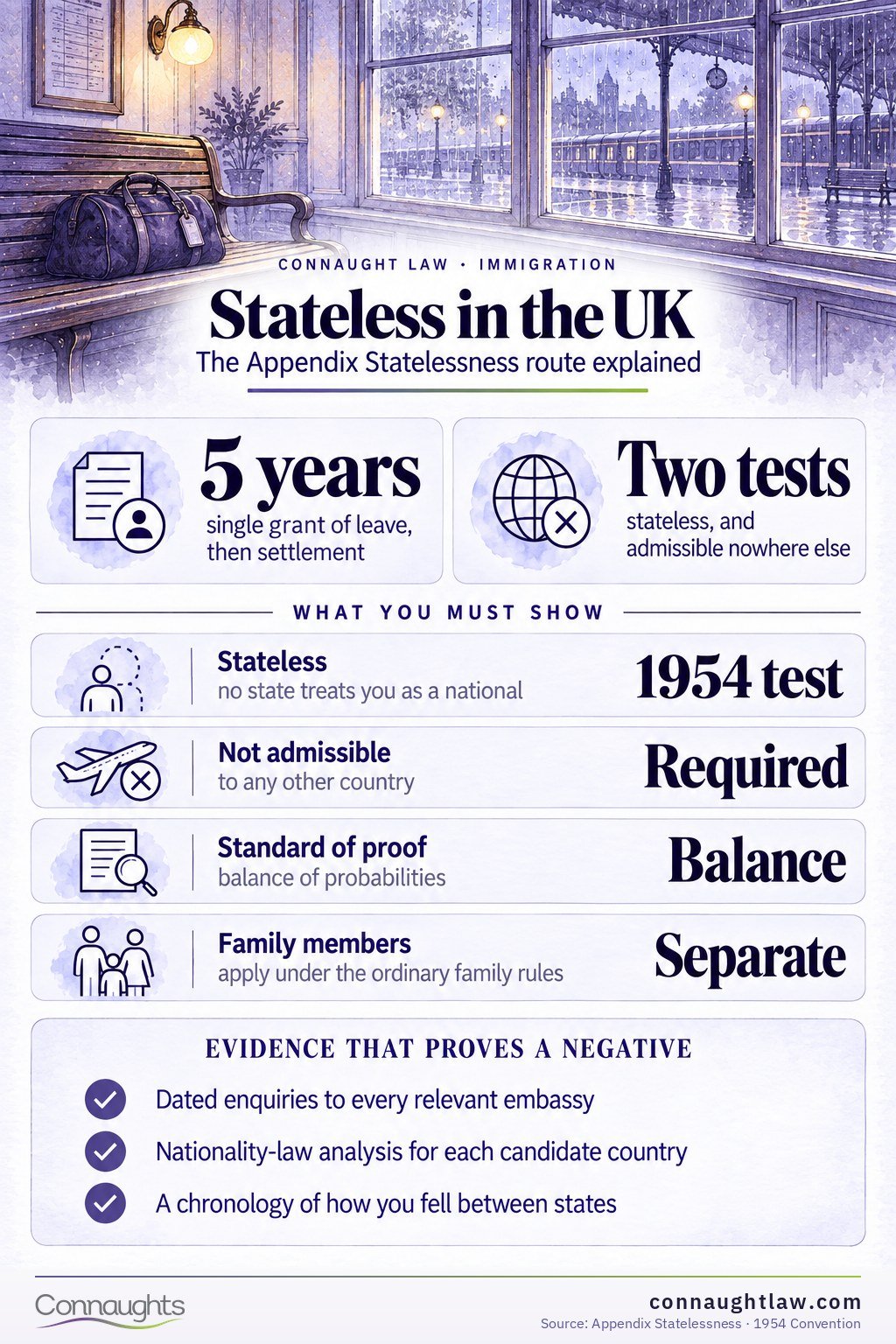
Adults recognised as nationals by no state — the 1954 Convention test, applied to how nationality laws actually operate — have a dedicated route under Appendix Statelessness: a fee-free application, five years' leave, then settlement, with a Convention travel document in place of the passport no country will issue. Admissibility to another country defeats the claim. Proving the negative is the real work, and documented embassy refusals carry it.
Definition and Proof
Statelessness Under UK Law
The UK applies the 1954 Convention definition: a person not considered a national by any state under the operation of its law — a question of how nationality laws actually operate, not how they read. State succession, gender-discriminatory nationality laws, registration failures and deprivation all manufacture statelessness, and the Home Office's statelessness guidance requires caseworkers to analyse each candidate country's law and practice.
Standard of Proof
The applicant proves statelessness on the balance of probabilities — but proving a negative demands method: embassy enquiries and their refusals documented, nationality law analysis for every candidate state, and the paper trail of attempts to obtain documents. A refusal letter from a consulate is worth pages of assertion, which is why the evidence phase starts months before the application.
- Written enquiries to every embassy whose nationality might arguably attach — and their refusals or silence, dated.
- Nationality-law analysis for each candidate country: what the law says and how it is actually applied.
- Identity and family history documents as far as they exist — birth, parents' nationality, registration attempts.
- A chronology explaining how the applicant fell between states: succession, discrimination, deprivation or registration failure.
Routes to Citizenship
Pathways for Adults
Registration Against Naturalisation
The adult arc runs leave → settlement → naturalisation on the ordinary requirements, with statelessness easing the impossible ones — no national passport is demanded of a person who cannot hold one. Children born in the UK who have always been stateless have their own registration entitlements, faster and cheaper, covered in our stateless children guide — a family's strategy should always check the children's entitlements first.
Appendix Statelessness
Five-Year Leave
Since 31 January 2024 the route lives in Appendix Statelessness: a fee-free application, and for those who qualify a single five-year grant — replacing the old 30-month cycle — with settlement at its end. The appendix added a decisive second limb: the applicant must show they are not admissible to any other country, which folds the "could you live elsewhere?" question into the grant itself.
Settlement Requirements
Settlement after the five years runs on the standard machinery — continuous residence, knowledge requirements where applicable, suitability — with the £3,226 settlement fee applying at that stage even though the leave was free. Budget for the endpoint from the start.
Validity and Suitability
When an Application Is Valid
Suitability and Exclusion
Applications fail on validity where the person holds another route's leave or an outstanding asylum claim answers the same need, and on suitability where criminality or security grounds bite — statelessness is a status, not an amnesty. The asylum interface matters: many applicants belong in both systems, and sequencing them is strategy our human rights and asylum team owns.
Travel Documents
The Stateless Travel Document
Leave brings eligibility for the UK's 1954 Convention travel document — the red booklet that substitutes for the passport no state will issue, applied for through the Home Office travel documents service at its published fee. Where it is accepted, and where visas are still required, follows the country-by-country reality mapped in our travel documents guide.
International Recognition
Recognition tracks the 1954 Convention's ratification map imperfectly — fewer states honour the stateless document than the refugee one, so every trip runs on the verify-first discipline: name the document to the destination's embassy and get the answer in writing before booking.
Applying
Process and Documentation
The application files online without fee, built on the statelessness evidence: identity as far as it can be shown, the nationality-law analysis, embassy correspondence, and the personal history explaining how the applicant fell between states. Incomplete identity documentation is expected — the route exists for people whose documents were the problem.
Interviews and Timelines
Stages, Timelines and Costs
Caseworkers may interview, and decisions run long — the verification is international and no service standard applies. The cost picture across the arc: free leave application, travel document fee, £3,226 at settlement, £1,839 at naturalisation, with legal costs scoped in advance against the published guideline rates.
Family Members
The 2024 Family Restriction
Mixed-Status Families
The 2024 appendix removed the old dedicated family provisions: partners and children of stateless leave holders now apply under the ordinary family rules — Appendix FM, with its financial and evidential requirements — rather than riding the stateless grant. For mixed-status families that changes sequencing entirely: the stateless application, the family applications and any children's registration entitlements need mapping together before the first form goes in.
Challenges
Administrative Review
Refusals carry administrative review for caseworking error — the wrong country analysed, evidence overlooked — with the review's narrowness meaning precise error identification decides it.
Judicial Review
Where the refusal misapplies the definition or the admissibility limb irrationally, judicial review remains, and the pre-action letter citing the guidance's own analytical requirements resolves the clearest cases. Character-based refusals interact with the framework in our good character guide at the citizenship stage.
Frequently askedQuestions about statelessness
Who counts as a stateless person in the UK?
Someone no state considers a national under the operation of its law — the 1954 Convention definition, assessed against how each candidate country's nationality law actually works, on the balance of probabilities.
What does stateless leave give me?
Five years' leave in a single fee-free grant under Appendix Statelessness, with work rights, then settlement — plus eligibility for the stateless travel document in place of a passport.
How do I prove I am stateless?
Document the negative: embassy applications and their refusals, analysis of each relevant country's nationality law, and your family and registration history. Written consular refusals are the strongest single category of evidence.
Can a stateless person get a passport?
Not a national one — that is the condition's definition — but the UK issues a 1954 Convention travel document to stateless residents, and British citizenship at the road's end brings a full passport.
Can my family join my stateless application?
Not under the appendix since 2024 — partners and children use the ordinary family rules with their own requirements. Family strategy should be mapped before applying, especially where children hold their own registration entitlements.
How does a stateless person become British?
Leave, settlement after five years (£3,226), then naturalisation (£1,839) on the ordinary requirements — with UK-born stateless children often holding faster registration entitlements of their own.
Tell us the family history and every nationality that might arguably attach. We'll run the country analysis, build the embassy evidence and file the application the guidance cannot brush aside.
Get Expert Advice