
Section 50(9A) of the British Nationality Act 1981 decides who counts as a child's father — and for decades it refused to see the biological father of a child whose mother was married to someone else, costing those children automatic British citizenship. The courts declared the result incompatible with human rights law, and a set of registration routes now exists to repair it. This guide explains the definition, the K (A Child) ruling, and every route to fixing a 50(9A) case.
On This Page

When the Law Refused to See a Father
Section 50(9A) of the British Nationality Act 1981 sets out who counts as a child's father, and it takes the mother's husband first. A child born to a British biological father while the mother remained married to another man therefore acquired no citizenship from him. The High Court held that scheme incompatible with the Convention in K (A Child), and registration routes now exist to repair it. Which route applies turns on the birth date and the discrimination being repaired.
Legal Framework
Who Counts as a Father
Who Counts as Father in Practice
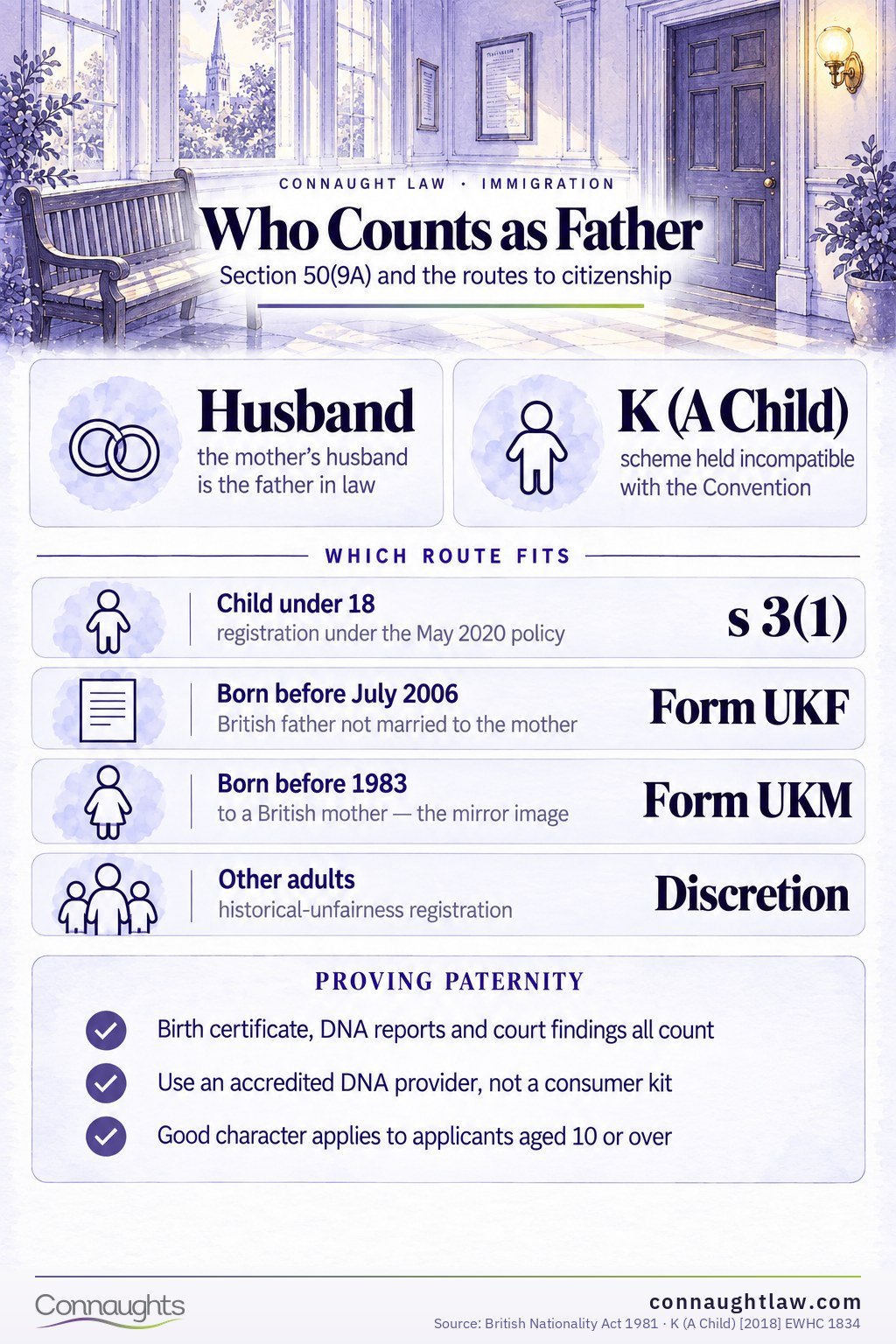
Section 50(9A) recognises three fathers: the mother's husband at the time of birth, a man treated as father under the fertility legislation, or a man who satisfies the prescribed proof-of-paternity requirements. The order is the trap — where the mother was married to another man, her husband is the father in law, and the biological father drops out entirely. A child born to a British biological father in that position took no citizenship from him, however clear the DNA.
The K (A Child) Ruling
Background and Facts
K was born in the UK to a British biological father, but her mother's marriage to another man had not yet ended — so the statute assigned paternity to the estranged husband, and K, unlike any half-sibling born a year later, was not British at birth and faced the child registration fee to fix it.
The Court's Human Rights Analysis
In K (A Child) v Secretary of State for the Home Department [2018] EWHC 1834 (Admin) the High Court held the scheme incompatible with the Convention: distinguishing between children solely by their mother's marital status engaged article 14 discrimination in the enjoyment of article 8 family life, and could not be justified. The declaration of incompatibility left the statute standing but put Parliament and the Home Office on notice to repair it.
Reforms
May 2020 Policy Change
The first repair was administrative: from May 2020, guidance directed caseworkers to register children caught by section 50(9A) as British citizens under the section 3(1) discretion where biological paternity is shown — normally granted, rather than fought for case by case.
New Plan for Immigration
Nationality and Borders Act 2022
What the Reforms Achieve
Statutory repair followed through the New Plan for Immigration and the Nationality and Borders Act 2022, which created a discretionary registration route for adults who would have become British but for historical legislative unfairness, an act or omission of a public authority, or exceptional circumstances. A 50(9A) case is the paradigm historical unfairness: the adult who missed automatic citizenship because of their mother's marriage now has a named route, without the fee barrier that shadowed the child cases.
Proving Paternity
Acceptable Evidence
Every repair route runs through the same gate: proving the biological relationship. A birth certificate naming the father, DNA test reports from an accredited provider, court findings of paternity and supporting family evidence all count, and the Home Office may consider any relevant evidence rather than a closed list. DNA evidence is voluntary but, in contested or thinly documented histories, usually decisive — commission it to the standard the guidance expects, not from a consumer kit.
Registration Routes
Section 3(1) Discretion
UKF and UKM Forms
Sections 4E to 4J
Route by Birth Date
- Child under 18 caught by 50(9A): section 3(1) registration under the May 2020 policy.
- Born before 1 July 2006 to a British father not married to the mother: sections 4E to 4J, Form UKF.
- Born before 1983 to a British mother: section 4C, Form UKM — the mirror-image discrimination.
- Adult outside all of these: the historical-unfairness registration discretion introduced in 2022.
The right route depends on the birth date and the discrimination being repaired, and choosing it is the first strategic decision in every case — the full children's landscape sits in our registration guide.
Applying
Standard Process
Applications go through the register as a British citizen service with the paternity evidence at the core of the file, and good character applies to applicants aged 10 or over — the framework in our good character guide.
Fees and Waivers
Timelines and Decision Factors
The historical-unfairness routes — UKF, UKM and the adult discretion — carry no application fee, a deliberate feature of routes that exist to correct the state's own past rules; a child registering under section 3(1) pays the standard child registration fee, with the waiver framework in our fees and waivers guide. Decisions on well-evidenced paternity cases are usually a matter of months; contested paternity, missing records and character issues are what extend them.
Future Reform
Nationality law's direction of travel is towards closing historical anomalies rather than opening new ones, and the discretionary routes are drafted widely enough to absorb injustices not yet named. Anyone whose British parent's status was lost in the machinery of an older rule — marital status, legitimacy, a mother's line before 1983 — should have the current guidance checked before assuming the law still says no.
Frequently askedQuestions about section 50(9A)
What is section 50(9A) of the British Nationality Act 1981?
The provision defining who counts as a child's father for citizenship: the mother's husband at birth, a father under the fertility legislation, or a man proving paternity by prescribed evidence — in that order, which is what excluded biological fathers of children born inside another man's marriage.
My mother was married to someone other than my British father — am I British?
Not automatically, but the position is repairable: children register under the section 3(1) policy, and adults use the historical-unfairness discretion or, for pre-2006 births, Form UKF. Paternity evidence is the key to all of them.
What did K (A Child) decide?
The High Court declared the 50(9A) scheme incompatible with articles 14 and 8 of the Convention — children could not be treated differently solely because of their mother's marital status. The ruling drove the 2020 policy change and the 2022 statutory routes.
What evidence proves paternity for citizenship?
A birth certificate naming the father, accredited DNA reports, court findings and any other relevant evidence — the list is open. DNA testing is voluntary but usually decisive where documents are thin or the history is contested.
Do these applications cost anything?
UKF, UKM and adult historical-unfairness registrations carry no application fee. A child registering under section 3(1) pays the standard child registration fee, and a fee waiver exists for families who cannot afford it.
What is Form UKF and who uses it?
The application for people born before 1 July 2006 to a British father who was not married to their mother — the sections 4E to 4J routes. Form UKM is its counterpart for people born before 1983 to a British mother.
Tell us the family history — who was married to whom, and when. We'll identify the right registration route, build the paternity evidence and file the case that repairs it.
Get Expert Advice