
British citizenship can be taken away — on two distinct legal grounds: deprivation "conducive to the public good" for the gravest conduct, and deprivation for fraud, false representation or concealment in the application that granted it. The second reaches ordinary people who hid a conviction years ago. This guide explains section 40, the Hysaj and N3 Supreme Court rulings, the appeal routes through the tribunal and SIAC, and what deprivation means for families.
On This Page
The Passport That Can Be Recalled
British citizenship can be taken away. Section 40 provides two routes: deprivation conducive to the public good, reserved for terrorism and the gravest criminality, and deprivation for fraud, false representation or concealment in the application that granted it. The second ground carries no time limit and reaches ordinary naturalised citizens whose earlier convictions went undeclared. Which ground applies decides the statelessness limits, the realistic defence and, where closed material features, the forum.
Concealment Cases
Why Disclosure Decides These Cases
Most deprivation casework is not terrorism — it is paperwork archaeology: a naturalisation granted years ago re-examined against what the applicant knew and did not say. A conviction concealed, an identity massaged, an asylum history that unravels — each grounds deprivation for fraud however long ago the certificate issued, which is why the good character guidance's disclosure demands, covered in our good character guide, are really deprivation insurance.
Consequences of Non-Disclosure
Discovery triggers a staged unravelling: investigation, a deprivation decision, loss of the passport and — where the person's other status died at naturalisation — exposure to removal. The consequences reach benefits, employment and travel long before any final determination, which is why early legal engagement at the investigation letter, not the order, changes outcomes.
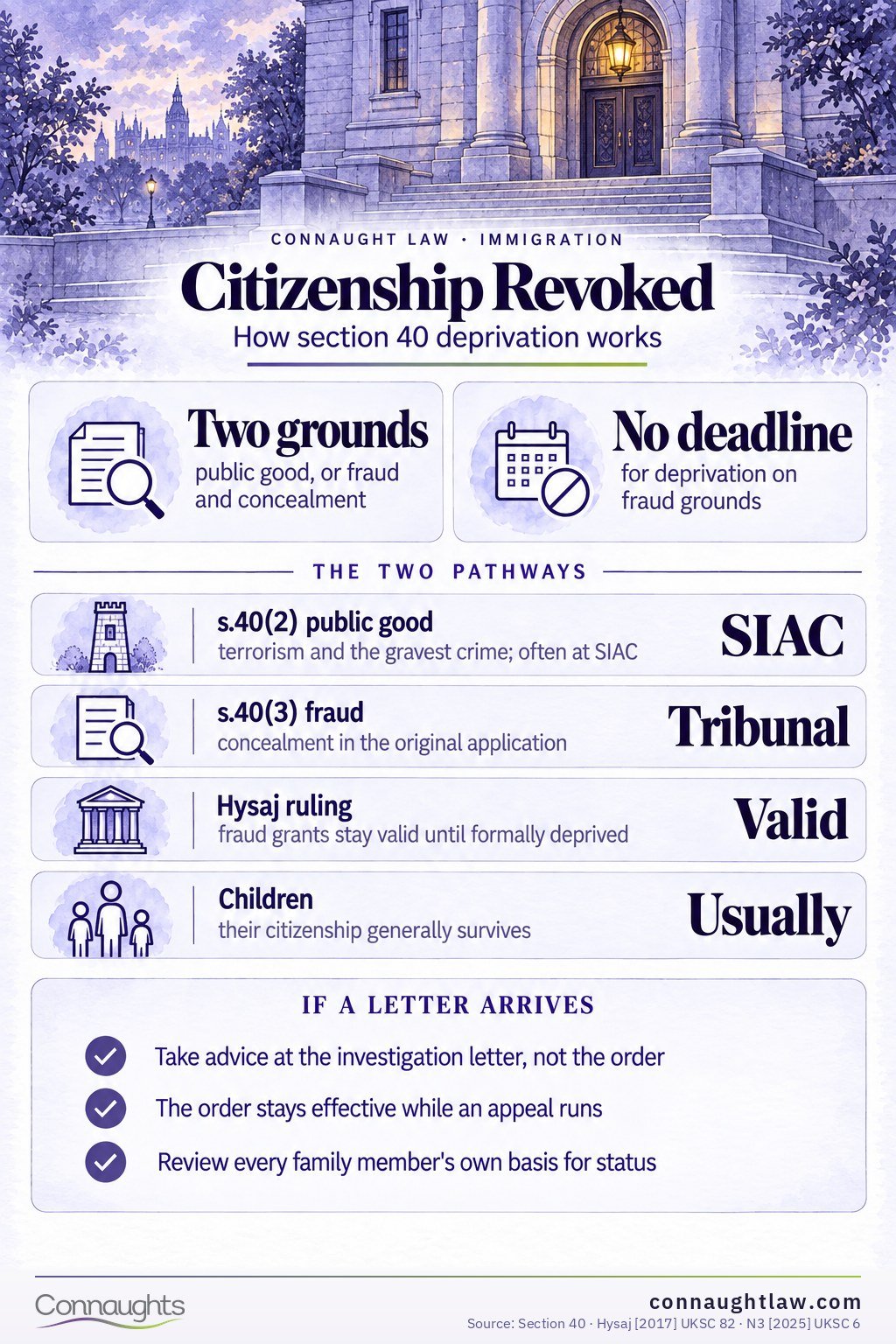
Deprivation for conduct "conducive to the public good" — terrorism-grade cases, decided at the top and often appealed through SIAC — and deprivation for fraud or concealment in the original application, which has no time limit, reaches ordinary naturalisation files, and appeals to the First-tier Tribunal.
Section 40 Grounds
Two Distinct Pathways
Conducive to the Public Good
Fraud and Concealment
Section 40 splits the power in two. Section 40(2) — deprivation conducive to the public good — serves national security, serious criminality and war crimes cases, constrained by the statelessness limits and decided at the Home Secretary's level. Section 40(3) — fraud, false representation or concealment of material fact — polices the grant itself: if the citizenship was obtained by deception, it can be removed whenever the deception surfaces, with no time limit.
Deprivation Grounds Compared
| Feature | s.40(2) conducive | s.40(3) fraud |
|---|---|---|
| Typical conduct | Terrorism, serious organised crime, war crimes | Concealed convictions, identity and history deception |
| Statelessness limit | Cannot generally make a person stateless | Can, where the grant itself was fraudulent |
| Appeal venue | Often SIAC (closed material) | First-tier Tribunal |
| Who it reaches | A small, grave cohort | Ordinary naturalised citizens with hidden histories |
The Hysaj Ruling
Background to the 2017 Decision
Before Hysaj the Home Office treated some fraud-tainted grants as nullities — citizenship that never existed, stripping status without process. The Supreme Court in Hysaj — R (Hysaj) v SSHD [2017] UKSC 82 — rejected that shortcut for identity embellishment cases: a grant obtained by fraud is valid until deprived under section 40(3), with the process and appeal rights deprivation carries.
What the Court Decided
Nullity After Hysaj
Nullity survives only for true impersonation — the applicant who adopted a real other person's identity — while everything short of that routes through deprivation. For affected families the difference is everything: deprivation can be fought, and children's derivative citizenship generally survives the parent's fraud where the grant was merely voidable.
The N3 Case
What the 2025 Ruling Decided
In the N3 (ZA) litigation — N3 and ZA v SSHD [2025] UKSC 6 — the Supreme Court held that a successful deprivation appeal revives citizenship retrospectively — the person is treated as never having lost it, with everything that follows for passports, residence and family rights during the appeal years.
Parliament’s Response
Parliament answered within months. The Deprivation of Citizenship Orders (Effect during Appeal) Act 2025 (c. 25) came into force on Royal Assent and keeps a deprivation order effective while an appeal runs, restoring the practical position N3 disturbed. The interplay between order, appeal and status in the interim is exactly where these cases are now won and lost.
Appeals
First-tier Tribunal Appeals
Section 40(3) deprivations appeal to the First-tier Tribunal under section 40A, where the Home Office must prove the fraud and its materiality — the grant would not have been made had the truth been told — and the tribunal weighs discretion, family life and the years since. Well-defended cases attack materiality and proportionality rather than denying documented history; our appeals team runs them.
SIAC Cases
Conducive-grounds deprivations resting on closed material go to the Special Immigration Appeals Commission, with special advocates seeing evidence the appellant cannot. It is the system's hardest forum, and specialist representation from the first notice is not optional.
Family Impact
Children's citizenship generally survives a parent's deprivation where it arose from a valid-though-voidable grant — the Hysaj legacy — while nullity cases can unravel the family's chain, and dependants' immigration statuses built on the deprived person's need their own urgent review. Families should map every member's independent basis for status early, using the registration routes in our child registration guide and, for EU-linked households, our EU nationals citizenship guide — and remember that time abroad during the dispute still counts against residence clocks, per our absence calculator.
Frequently askedQuestions about losing citizenship
Can British citizenship be revoked?
Yes — by deprivation under section 40: for conduct seriously prejudicial to the public good, or where the citizenship was obtained by fraud, false representation or concealment. The second ground has no time limit and reaches ordinary naturalisation cases.
What crimes affect citizenship after naturalisation?
Post-naturalisation offending alone rarely deprives — the fraud ground looks backwards at what was concealed when you applied. The gravest conduct engages the conducive ground; a conviction hidden from the original application engages section 40(3) whenever it surfaces.
Can deprivation make me stateless?
Conducive-grounds deprivation generally cannot; fraud-grounds deprivation can, where the grant itself was fraudulent. Whether another nationality actually revives is a fact question that decides many appeals.
What did Hysaj decide?
That fraud-tainted grants are valid until formally deprived — nullity survives only for true impersonation. The ruling preserved process, appeal rights and, usually, children's derivative citizenship in concealment cases.
What happens to my status while I appeal?
N3 v SSHD [2025] UKSC 6 made successful appeals retrospective; the Deprivation of Citizenship Orders (Effect during Appeal) Act 2025 then kept orders effective while an appeal runs. Take advice on the position the week your notice arrives.
Do my children lose citizenship if I do?
Usually not, where your grant was valid until deprived — their citizenship stands on its own once conferred. Impersonation-nullity cases are the dangerous exception, and every family member's position should be reviewed independently.
The early stage is where these cases are shaped. Send us the notice and the original application's history — we'll assess the ground, the materiality and the appeal before anything is conceded.
Get Expert Advice