
Who keeps the pet when a marriage ends? In law a dog or cat is property — a chattel, like the car — but in FI v DO the family court decided the question by asking who actually cares for the dog, not who paid for her. This guide covers the current law, the evidence that wins these disputes, petnup agreements, shared care after separation, and when mediation beats court.
On This Page

Who keeps the pet — and how the law decides
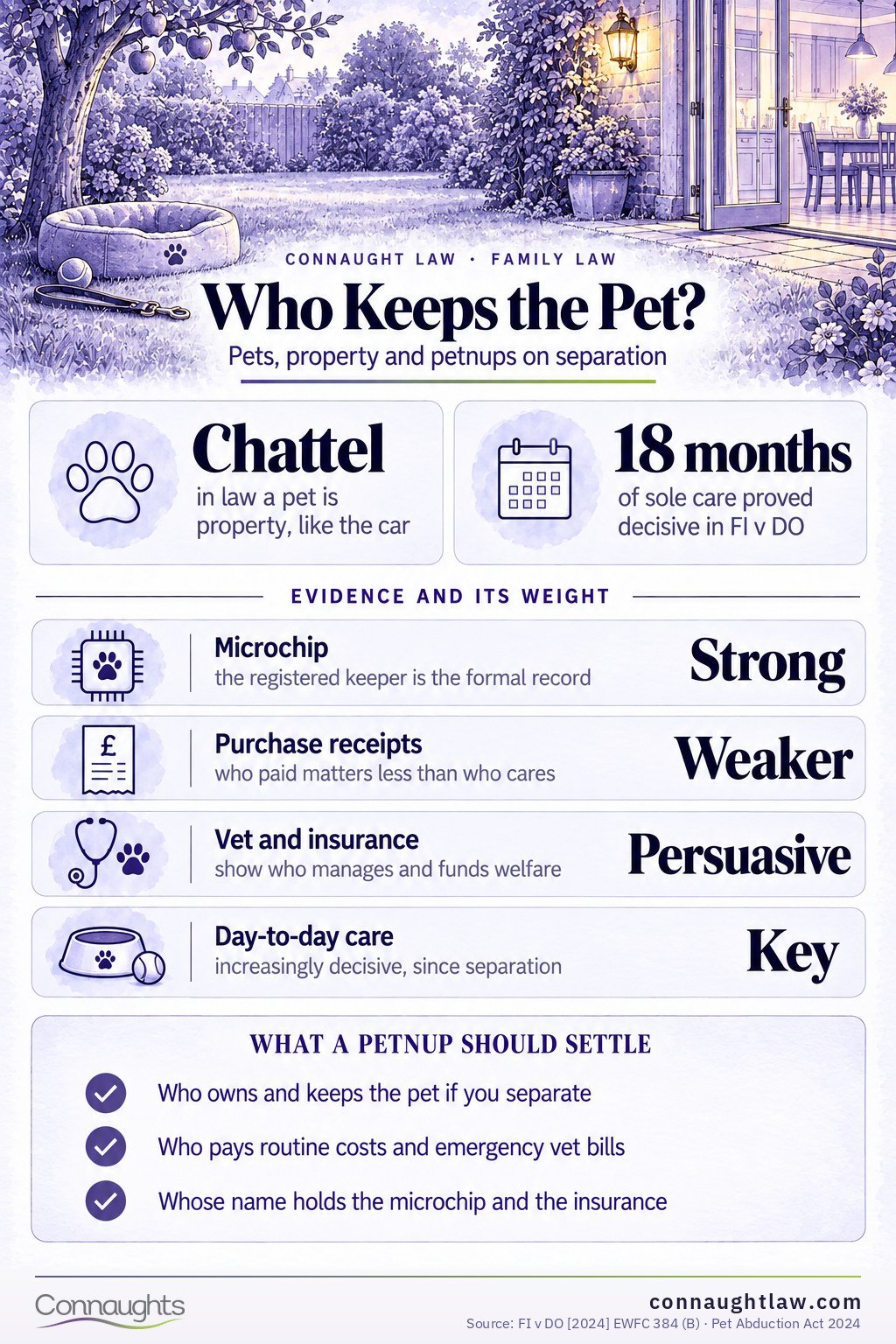
In England and Wales a pet is legally property, so a dispute is decided as ownership, not custody — there is no welfare jurisdiction as there is for children. But FI v DO shows judges giving decisive weight to who cares for the animal day to day, and a written agreement made in calm times still beats litigation every time.
No official statistic counts how many separations involve a dispute over a pet, but every family lawyer sees them, and they are fought with an intensity out of all proportion to the animal's market value. The legal framework has not caught up with that reality: it remains property law, applied to a family member. Understanding that gap — and how judges have started to bridge it — is the key to keeping your pet.
The Current Law: Pets Are Property
A pet is a chattel in English law — the same legal category as furniture or a vehicle, and the same one that governs chattels and fixtures in a property sale. On divorce, the family court allocates chattels between spouses within financial remedy proceedings, and the pet is dealt with alongside everything else. There is no statutory welfare test, no best interests of the dog, and no power to order contact.
Two recent developments sit alongside that framework. The Pet Abduction Act 2024 made taking or detaining a dog — or taking a cat — from someone's lawful control a specific criminal offence in England and Wales from August 2024, so seizing the pet mid-separation can now cross into criminal territory. And FI v DO showed the family court deciding the property question through a distinctly welfare-shaped lens.
Where Pet Disputes Are Decided
The venue depends on the relationship. Married couples resolve the pet inside financial remedy proceedings. Unmarried couples have no equivalent forum: their dispute is a pure ownership claim, and because most pets are worth under the £10,000 small claims threshold, it typically belongs in the county court's small claims track — where costs recovery is minimal even if you win. That economics pushes almost every unmarried dispute towards agreement or mediation rather than a claim.
FI v DO: The Manchester "Fido" Ruling
FI v DO [2024] EWFC 384 (B) was a financial remedy case in the Family Court at Manchester, decided by District Judge Crisp on 20 December 2024 — and the reason it travelled far beyond Manchester is the family's golden retriever. The husband had paid £1,200 for her and argued ownership; the wife and daughter had contributed to the purchase, the wife had been the dog's sole carer in the 18 months since separation, and she paid the vet's bills.
The judge's answer reframed the question: "it matters not who paid for the dog. The dog is a chattel." What mattered was who the dog sees as her carer — and on that, 18 months of sole care since separation was effectively decisive. The wife kept the dog. Purchase receipts, the judgment makes clear, will not outweigh the practical record of who feeds, walks and pays for the animal.
Factors Weighed in FI v DO
| Factor | Husband's Case | Wife's Case |
|---|---|---|
| Purchase | Paid the £1,200 | Contributed with the daughter |
| Registration | Disability-support registration, made after separation | Kennel Club registration |
| Care since separation | None — 18 months apart from the dog | Sole carer throughout |
| Running costs | Not evidenced | Paid the veterinary bills |
The ruling has been read by some as a revolution in how pets are treated on divorce. Three cautions before relying on it:
- A first-instance decision binds no other court: a different judge may still decide the same dispute on strict ownership lines.
- It is, though, a published judgment other district judges will be shown — and its caregiving logic is easy to adopt.
- The safest reading: build your case on both limbs, ownership evidence and the caregiving record together.
Proving Ownership: The Evidence That Counts
Because the starting point is property, ownership evidence still frames every dispute — FI v DO adjusted the weighting; it did not abolish the exercise. Assemble both layers: the paper that shows whose animal she is, and the record that shows whose life she is part of.
Evidence and Its Weight
| Evidence | Weight | Why It Matters |
|---|---|---|
| Microchip registration | Strong starting point | The registered keeper is the formal record courts begin from |
| Purchase receipts and pedigree papers | Weaker after FI v DO | Who paid matters less than who cares |
| Vet and insurance records | Persuasive | Show who manages and funds the animal's welfare |
| Day-to-day care record | Increasingly decisive | Feeding, walking, photographs — above all, the period since separation |
Petnup Agreements: Deciding in Advance
A petnup is a written agreement recording who owns the pet, who cares for her, and what happens on separation. It can stand alone or sit as clauses inside a prenuptial agreement or a cohabitation agreement — and for unmarried couples, whose disputes otherwise land in the small claims track, it is the single most effective protection available.
Is it binding? Between unmarried partners, a properly made petnup is an ordinary contract about property and should be enforced as one. Between spouses it operates like any nuptial agreement: not automatically binding, but a court deciding who keeps the pet will rarely look past a document both parties signed freely, with the arrangements it records already running in practice.
The Petnup Checklist
- Ownership, and who keeps the pet if you separate.
- Who pays routine costs, and how emergency vet bills are shared.
- Whose name holds the microchip registration and the insurance.
- Living arrangements on separation, including any shared-care pattern.
- Decision-making for major medical treatment and end-of-life choices.
- How disagreements get resolved — mediation before litigation.
Shared Care After Separation
A court dealing with a pet as property decides who keeps her — it will not impose an ongoing shared-care regime. Shared arrangements therefore exist only by agreement, and plenty of separated couples run them successfully: week-on-week-off patterns, weekends with one party, or one home as base with visits. The pet's temperament matters as much as the diary — some dogs travel happily between two homes; others find the shuttling harder than either owner does.
Making Shared Arrangements Work
- A handover pattern, with a named fallback when work or holidays intervene.
- Cost-splitting for food, insurance and vets — with a cap-and-consult rule for large bills.
- Consistency of routine, diet and house rules across both homes.
- A review point, and an agreed tie-break — usually mediation — for when circumstances change.
Mediation or Court for a Pet Dispute?
Litigating over a pet has brutal economics: legal costs quickly dwarf any animal's market value, courts allocate limited patience to chattel disputes, and in the small claims track you bear your own costs win or lose. Family mediation inverts all three — it is priced in sessions rather than proceedings, it can produce shared-care outcomes no court would order, and it keeps the dispute private.
The Two Routes Compared
| Factor | Mediation | Court |
|---|---|---|
| Cost profile | Fixed session rates, shared between you | Builds with every hearing; rarely recovered in small claims |
| Outcome range | Anything you both accept, shared care included | Ownership to one party |
| Privacy | Confidential | Public proceedings |
| Relationship | Designed to preserve it | Adversarial by structure |
Questions about who keeps the pet and how it is decided
How does UK law treat pets in a divorce?
As property. A pet is a chattel allocated in financial remedy proceedings, with no welfare jurisdiction and no contact orders. FI v DO showed the court answering the property question by asking who cares for the animal, and the Pet Abduction Act 2024 made taking a dog or cat a criminal offence.
Can I get shared custody of my dog after divorce?
Only by agreement — no court will order it. Separated couples run shared care successfully through written arrangements covering handovers, costs and routine consistency. Whether it suits the dog matters as much as whether it suits the diary; some animals cope poorly with two homes.
What is a petnup agreement and is it legally binding?
A written agreement setting out ownership, care and what happens on separation. Between unmarried partners it is an ordinary contract about property; between spouses it carries the weight of a nuptial agreement — not automatic, but rarely ignored where it was signed freely and reflects reality.
How much does a pet custody dispute cost?
It depends entirely on how far it runs. Mediation is priced in sessions; contested litigation builds with every hearing, and in the small claims track each side bears its own costs win or lose. We quote fixed fees after an initial discussion — see our fees page.
What evidence proves pet ownership in a divorce?
Microchip registration, purchase receipts, vet and insurance records, and the day-to-day care record. After FI v DO the last layer carries the most weight — above all, who has cared for the animal since separation. Assemble both the paper trail and the practical record.
Can UK courts order shared pet custody?
No. Because a pet is property, the court's power is to decide who owns and keeps her — not to impose a contact or shared-care regime. Any ongoing arrangement exists only because the two of you agree it, which is exactly what a petnup records.
How long do pet custody disputes take to resolve?
Agreement or mediation moves at your own diary — typically weeks. A contested dispute runs to the court's timetable inside wider proceedings, which means months. The pet usually stays where she is in the meantime, which is one more reason the status quo evidence matters.
What was the FI v DO ruling about?
A Manchester financial remedy case decided in December 2024. The husband had paid for the family's golden retriever; the wife had been her sole carer since separation. The judge held "it matters not who paid for the dog" and the wife kept her — caregiving outweighed purchase.
Tell us who bought the pet, who has cared for her since you separated and what you want to happen. We will tell you where the evidence points and the quickest route to keeping her.
Get Expert Advice