
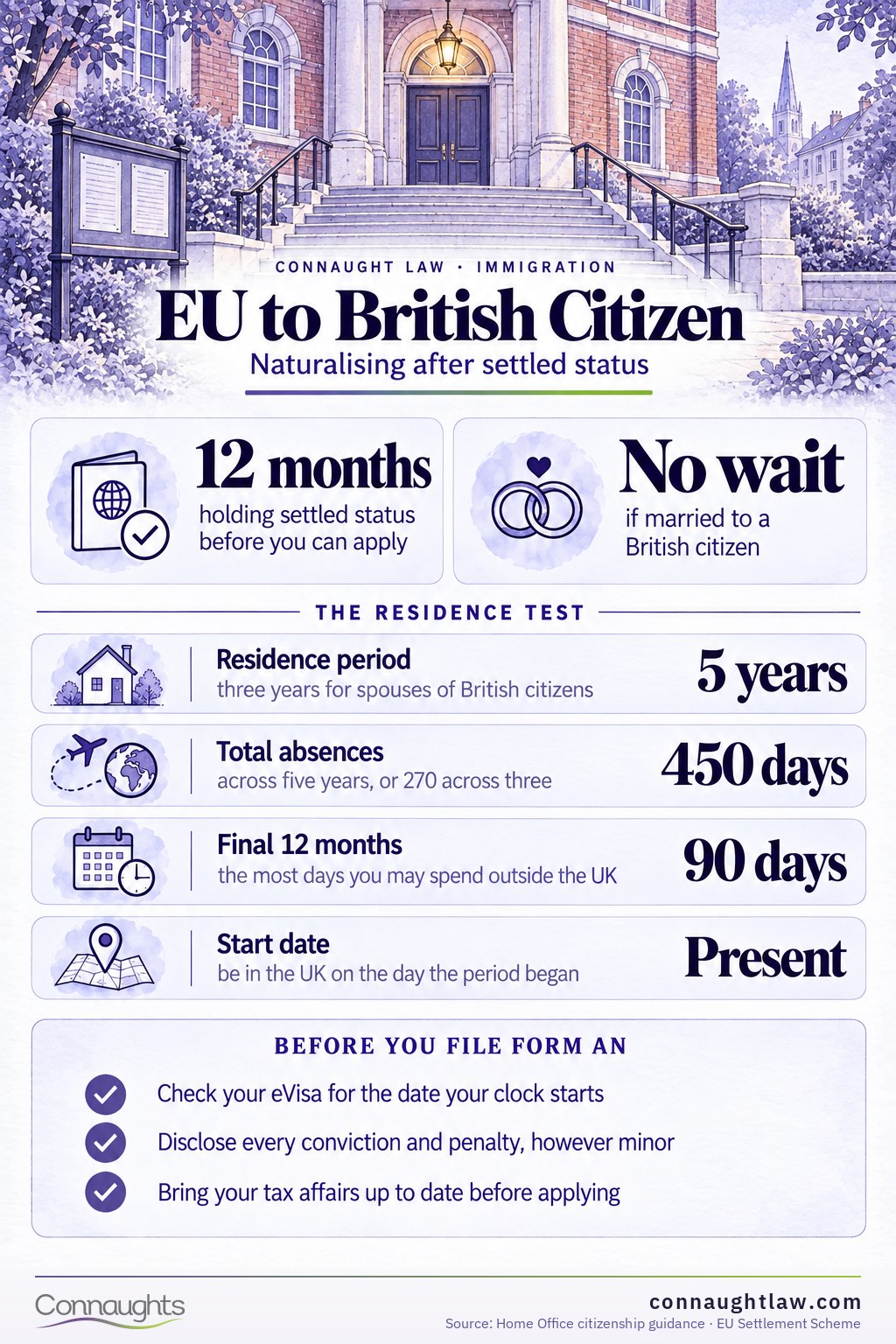
Settled status is the launchpad, not the destination: twelve months after receiving it — immediately, if married to a British citizen — EU nationals can naturalise for £1,839, ending ETA complications, absence clocks and status admin for good. The application turns on residence arithmetic, the good character requirement and a little Brexit history. This guide covers timing, the requirements, the old sickness insurance question, dual nationality and the process end to end.
On This Page

The Last Step Most EU Nationals Delay
Millions of Europeans hold settled status and treat it as the end of the story — until a passport renewal, an ETA question or a long posting abroad shows its edges. Naturalisation under the framework in the Home Office's citizenship guidance removes them all, and for most EUSS holders the requirements are already met by the life they are living. The work is arithmetic and paperwork, not eligibility.
Eligibility
Settled Status as the Foundation
The foundation is settled status under the EU Settlement Scheme — pre-settled status does not qualify — held for twelve months before applying, unless you are married to or in a civil partnership with a British citizen, in which case you can apply as soon as settled status arrives. Automatic conversion from pre-settled status counts from the conversion date, so check your eVisa for the date that actually starts your clock.
Residence Rules
The Calculation Framework
The residence requirement runs backwards from the application date: five years' residence (three for spouses of British citizens), presence in the UK on the exact day that period began, absences within 450 days across the five years (270 across three), and no more than 90 days in the final twelve months. The day-counting is unforgiving enough that we built a tool for it — our citizenship absence calculator runs the arithmetic trip by trip.
The Brexit-era wrinkle is lawful residence: for years the comprehensive sickness insurance question haunted students and self-sufficient residents whose EU-law residence technically required it. Current caseworking treats EUSS holders generously — discretion is normally exercised over historic CSI gaps — but the history belongs in the application honestly rather than omitted, and the background sits in our EU rights timeline and EEA worker categories guide.
Tests
Life in the UK Test
The £50, 24-question Life in the UK test applies to applicants aged 18 to 64, passed once and valid forever — details and the proposed refresh in our test guide.
English Language
English at B1 is required, with the practical mercy that most EU applicants meet it by qualification: a degree taught in English, evidenced through Ecctis where it was earned abroad, replaces any test. Nationals of the majority-English-speaking countries list are exempt outright — most EU nationals are not, so the degree and test routes carry the caseload.
Good Character
Criminal History
The good character requirement reviews the last ten years across criminality, immigration compliance and financial conduct — with drink-driving convictions and undisclosed penalties the recurring EU-applicant surprises. The framework, sentence bands and disclosure rules are covered in our good character guide; the rule of thumb is disclose everything, however minor, because concealment outweighs the offence.
Financial and Tax Conduct
Caseworkers check tax affairs and serious debt to public funds — an issue mainly for the self-employed whose HMRC records lag. Bring tax up to date before applying, not during the application.
Applying
Form AN Procedure
The application runs online through Form AN at £1,839 including the ceremony, with identity through the UKVI account, referees who have known you for three years, and a decision within the six-month standard — commonly faster for clean EUSS-based files. The ceremony books after approval, and citizenship takes effect there, not at the decision.
Supporting Documentation
Documents You Will Need
- Settled status confirmation and its grant (or conversion) date from your eVisa.
- Passport or national identity card, and travel history for the absence calculation.
- English evidence: qualification, Ecctis confirmation, or test certificate.
- Life in the UK pass reference.
- Full disclosure: convictions, penalties, tax position, and any historic status gaps.
- Two referees meeting the requirements, one professionally qualified.
Why Naturalise
What Citizenship Adds
A British passport ends the absence clocks — settled status lapses after five years abroad; citizenship never does — adds full political rights, and passes automatically to children born in the UK. It also resolves the travel-document questions of the ETA era: a British dual national's options are a British passport or a certificate of entitlement, as our dual national passport guide explains — worth reading before the first post-naturalisation trip.
Dual Nationality
The UK permits dual citizenship without conditions; the question is your home country's law, and Europe is a patchwork — Germany now embraces dual citizenship following its 2024 reform, while several member states still restrict or tax the choice. Check the home-country position through official sources before applying, because renunciation obligations discovered after a ceremony are misery of an avoidable kind.
Policy Changes
Automatic Conversion Effects
The Home Office's automatic conversion of pre-settled to settled status quietly starts citizenship clocks: the twelve-month wait runs from the settled status date, so a conversion you barely noticed may mean you are already eligible. Check the eVisa date rather than assuming.
White Paper Direction
Character and Integration Tightening
Test Refresh Proposals
The white paper's integration agenda — a refreshed Life in the UK test, higher English expectations, tighter character rules — remains proposals without implementation dates, but its direction is one-way. For eligible EUSS holders the strategic conclusion writes itself: naturalise under the requirements you already meet rather than the harder ones being drafted. Our settlement and citizenship team runs the eligibility check in one sitting.
Frequently askedQuestions from EU applicants
When can I apply for citizenship after settled status?
Twelve months after the settled status grant — or immediately upon it if married to a British citizen. Automatic conversions count from the conversion date shown in your eVisa, which may be earlier than you think.
How much does a British passport cost for EU citizens?
Naturalisation costs £1,839 including the ceremony; the passport itself is a separate, much smaller fee afterwards. There is no cheaper EU-specific route — the EUSS discount ended at settled status, which was free.
Does the old sickness insurance problem still block applications?
Rarely — current guidance exercises discretion generously over historic CSI gaps for EUSS holders. Disclose the history honestly and let the discretion work; concealing it converts a resolved problem into a live one.
Can I keep my EU citizenship?
The UK side, yes — dual citizenship is fully permitted. Your home country decides the other half: Germany now allows it, several states still restrict it. Confirm through official home-country sources before the ceremony.
What absences are allowed for naturalisation?
No more than 450 days across the five qualifying years (270 across three for spouses) and 90 in the final twelve months — plus presence in the UK on the day the period began. Discretion exists above the limits but must be argued.
Is it worth naturalising if I already have settled status?
For most, yes: settled status lapses after five years abroad and lives in a database; citizenship is permanent, votes, passes to your children and ends the travel-document questions. The £1,839 buys finality.
Send us your eVisa dates, travel history and any character disclosures. We'll confirm eligibility, run the absence arithmetic and file Form AN properly the first time.
Get Expert Advice