
UK immigration history for European nationals begins on 1 January 1973, when the United Kingdom joined the European Communities, and turns at 11pm on 31 December 2020, when free movement ended. Between those dates sits the law that still decides what EU citizens may do here. This timeline gives each step, names the instrument behind it, and separates what was revoked from what still applies. The dates are the ones the legislation itself records.
On This Page

The Dates That Built and Ended EU Free Movement
European free movement was never part of the UK Immigration Rules in the ordinary sense. It arrived through Community law in 1973, was widened by treaty and directive, and was implemented here through successive sets of regulations made under the European Communities Act 1972. That is why it could be removed in a single step: when the 1972 Act went, the regulations made under it went too. What replaced it is a scheme inside the Immigration Rules, plus a treaty right that domestic legislation makes enforceable in the courts.
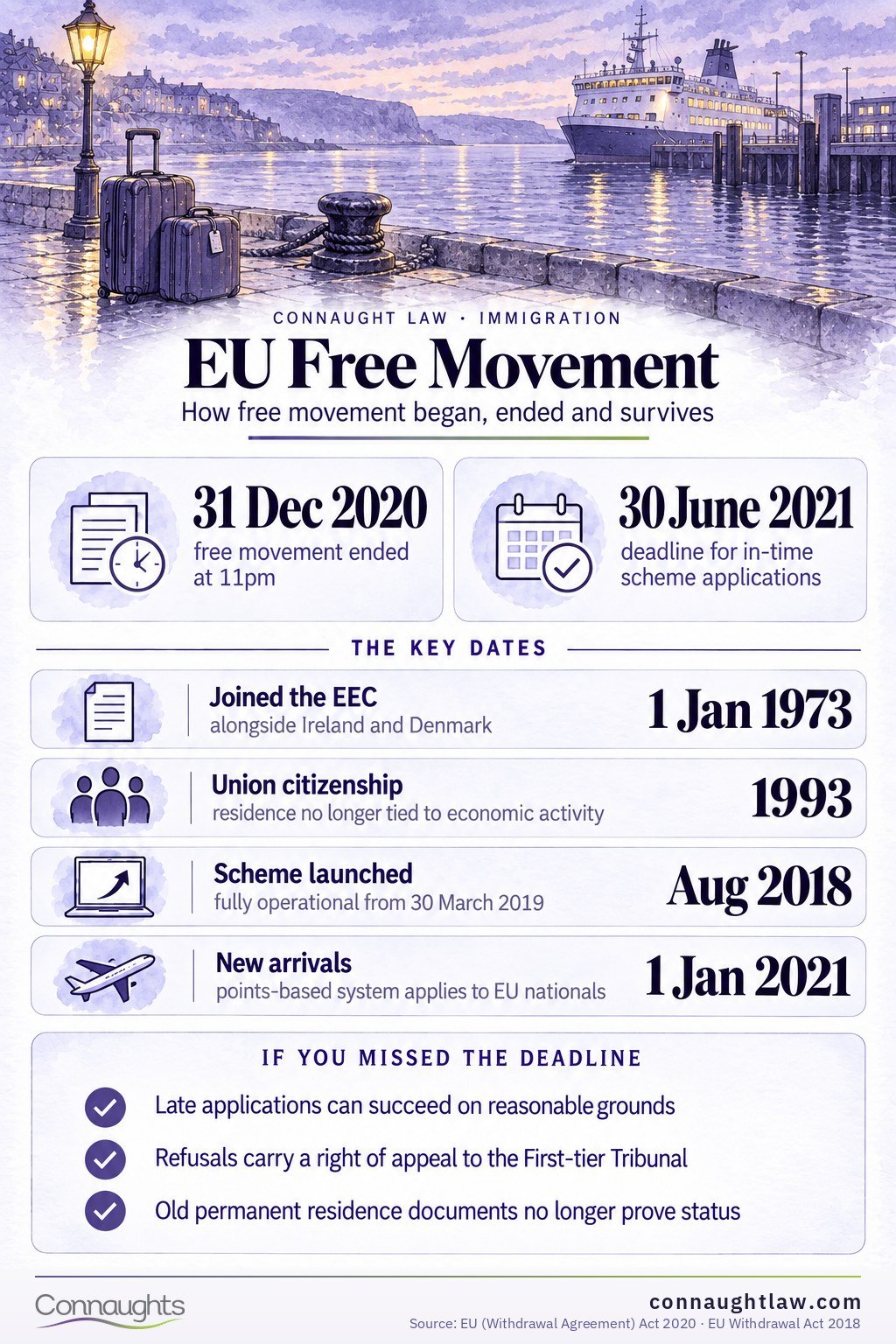
- The UK joined the European Communities on 1 January 1973; workers’ rights came from the Treaty, not from a grant of leave.
- Union citizenship arrived in 1993, detaching the right to reside from economic activity.
- Directive 2004/38/EC gave the five-year route to permanent residence that people still call EEA permanent residence.
- Free movement ended at 11pm on 31 December 2020, and the EEA Regulations 2016 were revoked at the same moment.
- The EU Settlement Scheme launched on 28 August 2018 and became fully operational on 30 March 2019.
- In-time applications closed on 30 June 2021; late applications still succeed on reasonable grounds.
Accession and the First Two Decades
The United Kingdom joined the European Economic Community on 1 January 1973. The European Communities Act 1972 gave Community law effect here, and a referendum in 1975 confirmed that membership should continue. For immigration purposes the significant point is that workers from other member states did not need leave to enter or remain. Their right came from the Treaty and was recognised by the Home Office rather than granted by it, which is the opposite of how every other route then worked.
1 January 1973: Joining the European Communities
Accession took effect on 1 January 1973, alongside Ireland and Denmark. Free movement of workers applied from that date, subject to transitional arrangements. The record for section 1 of the European Communities Act 1972 still carries the two later cut-offs written into it, exit day at 11pm on 31 January 2020 and the end of the implementation period on 31 December 2020, which is the clearest single trace of the beginning and the end in one place.
Confirming Membership and Building the Case Law
Through the 1970s and 1980s the content of free movement was settled largely by the European Court, which read the worker provisions broadly and narrowed the grounds on which a member state could exclude a national of another. Domestic law adapted around it. Section 7 of the Immigration Act 1988 removed the requirement for leave for those exercising Community rights, and that provision survived until 2020, when it was omitted by the same Schedule that revoked the EEA Regulations.
Maastricht and the Citizenship Right
The Treaty on European Union created citizenship of the Union in 1993. It mattered because the right to move and reside stopped being tied exclusively to economic activity: students, the self-sufficient and family members acquired rights of their own. This is the period in which the categories that later appeared in the EEA Regulations took shape — worker, self-employed person, self-sufficient person and student — and in which family membership became a route to residence in its own right.
The same years produced the administrative apparatus that outlived the rights themselves: registration certificates, residence cards, and documents certifying permanent residence once the five-year rule applied. None of those documents confers status today. They matter now as evidence of a period of residence, which is often exactly what a late application to the settlement scheme needs.
Enlargement and the Worker Registration Scheme
Ten states joined on 1 May 2004, and Directive 2004/38/EC consolidated the free movement rules in the same year. Article 16(1) of the Directive gave Union citizens who had resided legally for a continuous period of five years the right of permanent residence, and that five-year rule is still what most people mean when they refer to EEA permanent residence. Bulgaria and Romania joined on 1 January 2007 under a separate set of transitional arrangements.
It is often said that the UK opened its labour market to the 2004 accession states without restriction. It did not. The Accession (Immigration and Worker Registration) Regulations 2004 created a registration requirement running from 1 May 2004 to 30 April 2009. A parallel authorisation scheme applied to Bulgarian and Romanian nationals from 1 January 2007 until 31 December 2011.
Tightening Before the Referendum
From 2014 the government narrowed access to benefits and to residence for those who were not working, and the Immigration (European Economic Area) Regulations 2016 then restated the whole framework in a single instrument made on 2 November 2016. The 2016 Regulations are the version most current cases refer to, because they were the rules in force when free movement ended. They were not the last word: they were revoked four years later, with savings that still decide cases today.
Referendum to IP Completion Day
The referendum was held on 23 June 2016 and Article 50 notice was given on 29 March 2017. The United Kingdom left the European Union at 11pm on 31 January 2020 and entered a transition period which ended at 11pm on 31 December 2020, the moment the legislation calls IP completion day. The government’s 2017 commitments on EU citizens’ rights set the direction that the Withdrawal Agreement later fixed in treaty form.
At that moment the Immigration and Social Security Co-ordination (EU Withdrawal) Act 2020 took effect. Schedule 1 revoked the EEA Regulations 2016 outright and omitted section 7 of the Immigration Act 1988, and the commencement regulations brought Schedule 1 into force on IP completion day. Free movement did not lapse or expire. It was repealed, on a fixed date, by a named instrument.
The Brexit Timetable in Law
| Date | What changed | Where it is set out |
|---|---|---|
| 23 June 2016 | Referendum vote to leave the European Union | — |
| 29 March 2017 | Article 50 notice given | — |
| 11pm, 31 January 2020 | UK leaves the EU; transition period begins | European Union (Withdrawal Agreement) Act 2020 |
| 11pm, 31 December 2020 | IP completion day; free movement ends; EEA Regulations 2016 revoked | EU(WA)A 2020 s.39; ISSC(EUW)A 2020 Sch 1 para 2(2); S.I. 2020/1279 |
| 1 January 2021 | Points-based system applies to EU nationals arriving | Immigration Rules |
| 30 June 2021 | Deadline for in-time settlement scheme applications; grace period ends | S.I. 2020/1209 reg 2 |
When the Settlement Scheme Opened and Closed
The EU Settlement Scheme launched on 28 August 2018 and became fully operational on 30 March 2019. Applications made in time had to be submitted by 30 June 2021. As of 30 June 2025 there had been 8.6 million applications since launch, a total that keeps moving because the scheme is still open to late applicants who show reasonable grounds for missing the deadline.
Commentary frequently gives 30 March 2019 as the opening date and describes 2018 as a testing phase. The Home Office’s own statistical releases date the scheme from its launch on 28 August 2018 and treat 30 March 2019 as the point at which it became fully operational. If you are counting continuous residence or comparing application dates, the earlier date is the one the department uses.
Rights EU Citizens Still Hold
Rights under the Withdrawal Agreement are recognised and enforceable in domestic law through section 7A of the European Union (Withdrawal) Act 2018, and every other enactment is read subject to them. In practice a person with settled status may live, work and study here without time limit. Pre-settled status carries the same right to work and study, with a route to settled status once the qualifying residence is complete.
Family members can still be brought within the scheme in defined circumstances, including relationships that existed before the end of transition and children born or adopted since. The rules on family members are narrower than the free movement rules they replaced, and the distinctions turn on dates and on the point at which the relationship began, not on how close it is.
Appeals and the Saved EEA Rules
A refusal, cancellation or variation of leave under the settlement scheme carries a statutory right of appeal. The Immigration (Citizens’ Rights Appeals) (EU Exit) Regulations 2020 created it, and it now stands alone, because administrative review is no longer available for these decisions. The appeal lies to the First-tier Tribunal, which may consider whether the decision breaches rights under the Withdrawal Agreement, not only whether the rules were applied correctly.
The EEA Regulations 2016 were revoked at the end of 2020, but the Citizens’ Rights (Application Deadline and Temporary Protection) (EU Exit) Regulations 2020 kept specified provisions alive through a grace period ending on 30 June 2021, and kept them alive beyond that date for anyone whose in-time application has not been finally determined. For those applicants the old rules continue to apply until the application, and any appeal, is decided.
Where EU Nationals Stand Now
Since 1 January 2021 European nationals arriving for the first time use the same points-based system as everyone else. There is no free movement route, no EEA permanent residence to apply for and no separate treatment on nationality grounds. The dividing line is residence before the end of transition: those who were here in time hold rights under the Withdrawal Agreement, and those who were not are ordinary applicants under the Immigration Rules.
Holders of pre-settled status no longer have to apply for settled status in every case. The Home Office checks tax and benefit records and converts eligible cases automatically. Where the records do not yet show enough residence, pre-settled status is extended by five years rather than allowed to lapse. That extension pre-dates the automation and does not by itself grant settled status.
For advisers the practical question is rarely nationality. It is whether the client was resident here before 11pm on 31 December 2020, whether an application was made in time, and whether any application remains undetermined. Each answer points to a different body of law: the Immigration Rules, the settlement scheme, or the saved provisions of the revoked 2016 Regulations.
Frequently askedQuestions about the dates and what they changed
When did the UK join the EU?
The United Kingdom joined the European Economic Community, the EU’s predecessor, on 1 January 1973 under the European Communities Act 1972. A referendum in 1975 confirmed that membership should continue. The European Union itself came into being in 1993, so rights held before that date derived from Community law rather than from Union citizenship.
When did free movement end in the UK?
At 11pm on 31 December 2020, the moment the legislation calls IP completion day. The same Act revoked the Immigration (European Economic Area) Regulations 2016. Anyone resident before that point could protect their position through the settlement scheme; anyone arriving afterwards needs leave under the Immigration Rules.
When did the EU Settlement Scheme start?
It launched on 28 August 2018 and became fully operational on 30 March 2019. The deadline for in-time applications was 30 June 2021. The scheme has not closed: late applications are still accepted where the applicant shows reasonable grounds for having missed that deadline.
Can I still apply if I missed the June 2021 deadline?
Yes, if you can show reasonable grounds for the delay. Home Office guidance treats being a child, a serious medical condition, an abusive relationship and having been misinformed about the need to apply as capable of amounting to reasonable grounds. The application is otherwise decided on the same criteria as an in-time one.
What happened to EEA permanent residence?
It ceased to exist as a status you can apply for when the EEA Regulations 2016 were revoked at the end of 2020. Permanent residence documents issued before then no longer prove immigration status. Anyone relying on long residence as an EEA national needs settled status under the settlement scheme instead.
Is there a right of appeal against a settlement scheme refusal?
Yes. The Immigration (Citizens’ Rights Appeals) (EU Exit) Regulations 2020 give a right of appeal to the First-tier Tribunal against refusals, cancellations and variations under the scheme. The tribunal can consider whether the decision breaches rights under the Withdrawal Agreement, not only whether the rules were correctly applied.
Tell us the date you arrived in the UK, what status you hold under the settlement scheme and the date it was granted. We’ll tell you what your rights are now and what still needs doing.
Get Expert Advice