A family member of an EU, EEA or Swiss citizen with status under the EU Settlement Scheme can still join them in the UK — through a family permit to travel, and then a status application once here. The rules are narrower than they were, two of the old routes have closed, and since April 2026 an application without the sponsor’s details is rejected as invalid rather than refused. The distinctions below decide which route, if any, is open.
On This Page

How the Family Routes Work
Appendix EU governs status for people already in the UK. Appendix EU (Family Permit) governs the document that lets a non-Irish, non-EEA family member travel here in the first place. Both sit in the Immigration Rules. They are separate appendices with separate requirements, and confusing them is the commonest reason an application is made in the wrong place.
The family permit is a travel document, valid for six months, granted so that the holder can come to the UK and then apply for status under Appendix EU. It confers permission to work and study while it is valid. It is not itself settled or pre-settled status, and it does not lead anywhere on its own.
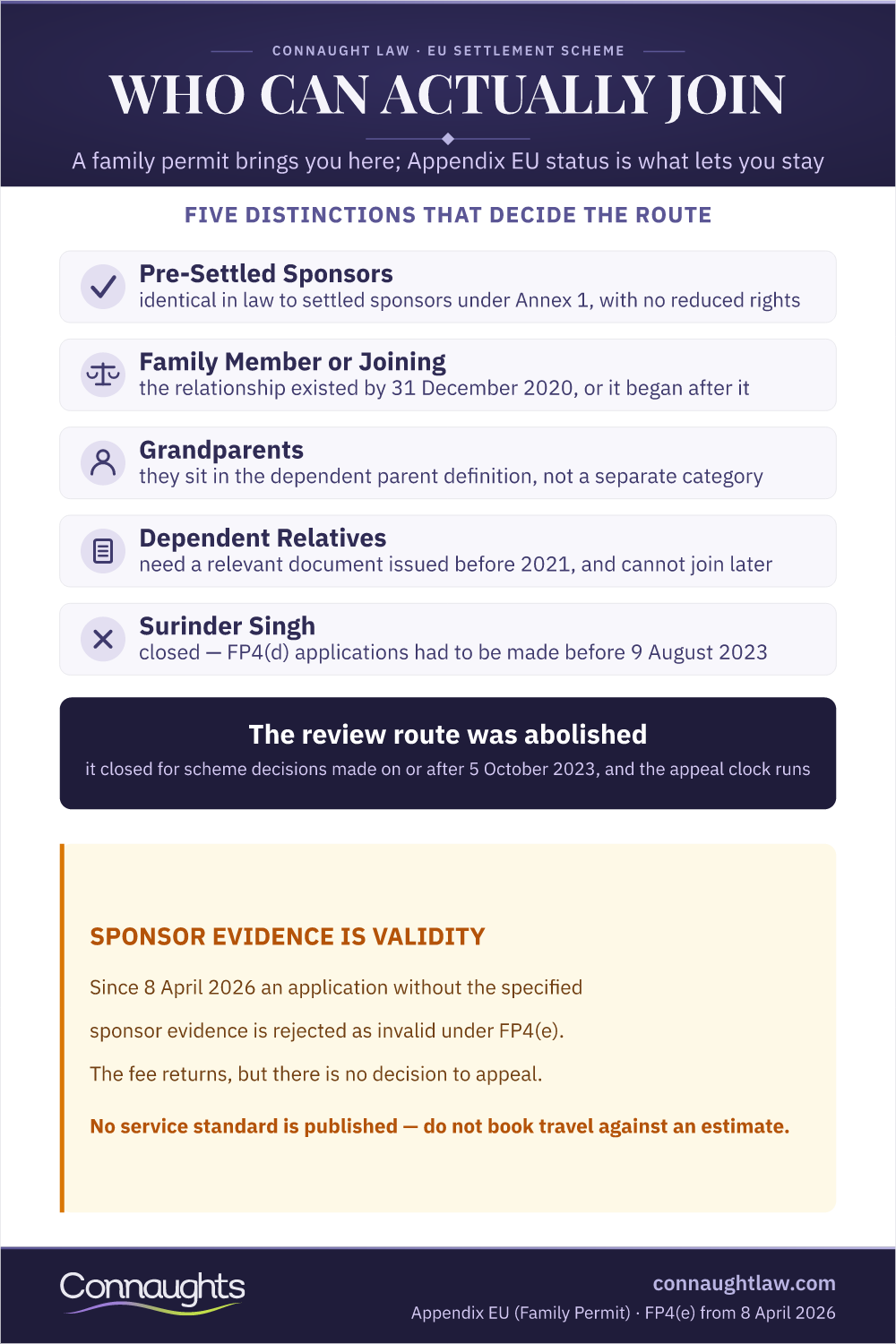
One route has closed entirely. A family member of a British citizen who lived together in an EU member state — the Surinder Singh route — could apply under FP4(d) only where the date of application was before 9 August 2023. That door is shut, and gov.uk says so directly. Anyone told otherwise is working from an old page.
Two Routes, Not One
Which route applies depends on when the relationship existed, not on where anyone lives now. Appendix EU distinguishes a family member of a relevant EEA citizen — a relationship that existed by the end of the transition period on 31 December 2020 — from a joining family member of a relevant sponsor, who joins later. The first is dealt with under EU11 and EU14, the second under EU11A and EU14A.
The distinction matters because it decides what has to be proved and what follows afterwards. It is the first question to answer on any family case, and it is the question the old version of this page never asked.
Who Can Sponsor
Here is a widely repeated error worth correcting plainly: settled and pre-settled sponsors are identical in law. Annex 1 defines a relevant sponsor as an EEA citizen granted indefinite leave under paragraph EU2 or limited leave under paragraph EU3. A pre-settled sponsor does not have reduced sponsorship rights and is not confined to immediate family.
Irish citizens are relevant sponsors in their own right under Annex 1, not by virtue of the Common Travel Area — a distinction that matters when evidencing the sponsor’s position, because a CTA argument produces no document to file.
Family Members Who Qualify
Spouses, civil partners, durable partners, children and grandchildren under 21 or dependent, and dependent parents and grandparents are the core categories. Two points are consistently got wrong.
- Grandparents are dependent parents, not a separate category — the definition covers the direct relative in the ascending line.
- Adult children are children, either under 21 or dependent, rather than an exceptional case.
- Dependent relatives are different again. The Annex 1 definition requires the person to hold a relevant document as the dependent relative of their sponsoring person for the period relied on — a document issued before 2021. There is no discretionary assessment on compassionate grounds.
- A dependent relative cannot be a joining family member. If there is no pre-2021 relevant document, this route is not available however strong the dependency.
Where an extended or dependent relative was refused, the appeal position is set out below, and our guide to extended family member appeal rights covers the case law in detail.
Relationships Formed After 2020
A relationship that began after the transition period ended does not close the door, but it changes the route. A spouse or civil partner married after 31 December 2020 can qualify as a joining family member, provided the marriage or partnership existed before the application and the sponsor holds status. A durable partnership formed after that date does not.
Children born after 31 December 2020 to a sponsor with status are covered, and a couple who were durable partners before the transition period and married afterwards are treated by reference to the earlier relationship rather than the later marriage.
Once here, a joining family member is subject to a hard deadline that catches people out: the required date is three months after arrival, and an application made outside it engages the EU9(e) validity provisions. Late is not merely late on this route — it can mean there is no valid application at all.
Applying, Evidence and Refusals
Apply for the family permit from outside the UK, with the sponsor’s status details and evidence of the relationship. From 8 April 2026, FP4(e) makes an application without the specified sponsor evidence invalid rather than refused — the fee is returned, but no decision is made, and there is nothing to appeal. That is the newest trap on this route and the one most likely to catch a family applying without advice.
There is no published processing time. Neither gov.uk’s family permit page nor the visa decision waiting times page states a service standard for EUSS family permits, so any figure quoted in weeks is not coming from the Home Office. Plan on the basis that you do not know, and do not book travel against an estimate.
Administrative review closed for EU Settlement Scheme decisions made on or after 5 October 2023, under AR(EU)1.4. The remedy is a statutory appeal to the First-tier Tribunal under the Immigration (Citizens’ Rights Appeals) (EU Exit) Regulations 2020 — 14 days in country, 28 days from receipt outside the UK. Anyone still being told to apply for administrative review is being sent to a route that was abolished nearly three years ago, and the appeal deadline runs while they wait. Where the refusal has to be challenged, our litigation team handles the tribunal work.
On what status brings: the family permit allows work and study. Broader claims about access to public services are not what gov.uk says, and should not be relied on. Pre-settled status is now extended automatically and converted to settled status automatically where the criteria are met — but that automation expressly does not reach non-EEA family members or joining family members, who still have to apply.
Frequently askedQuestions about the EU Settlement Scheme family permit
How long does an EUSS family permit take?
There is no published service standard. Neither the gov.uk family permit page nor the visa decision waiting times page states one for EUSS family permits, so any figure in weeks is not an official estimate. Do not book travel against one.
Can a pre-settled sponsor bring family?
Yes, on the same terms as a settled sponsor. Annex 1 defines a relevant sponsor as an EEA citizen with indefinite leave under EU2 or limited leave under EU3. There is no reduced sponsorship right for pre-settled status.
Can I still use the Surinder Singh route?
No. A family member of a British citizen who lived with them in an EU member state could apply under FP4(d) only where the application date was before 9 August 2023. The route is closed.
What if I married after 31 December 2020?
You may qualify as a joining family member, provided the marriage or civil partnership existed before the application and your sponsor holds status. A durable partnership formed after that date does not qualify.
Can I appeal a refusal?
Yes, to the First-tier Tribunal under the 2020 Citizens' Rights Appeals Regulations — 14 days in country, 28 days from receipt outside the UK. Administrative review closed for decisions made on or after 5 October 2023.
What happens if my application is rejected as invalid?
There is no decision to appeal. Since 8 April 2026, an EUSS family permit application without the specified sponsor evidence is rejected as invalid under FP4(e), which means starting again rather than challenging it.
Do dependent grandparents qualify?
Grandparents sit within the dependent parent definition as direct relatives in the ascending line. That is different from the dependent relative category, which requires a relevant document issued before 2021.
Is pre-settled status converted automatically?
It is extended automatically and converted to settled status automatically where the criteria are met. That automation does not extend to non-EEA family members or joining family members, who still have to apply.
Tell us your relationship, when it began and what status your family member holds. We'll tell you which route is open, what evidence it needs and whether any deadline is running.
Get Expert Advice