
A certificate of entitlement proves the right of abode — the right to live in the UK free of immigration control — for people who hold that right without a British passport to show it. The certificate is now digital: £589, held in a UKVI account, and no longer dying with the passport it used to be stuck into. This guide covers who actually has right of abode, who needs the certificate, the digital changes, the evidence, and the refusals that recur.
On This Page

Proof for a Right You Already Hold
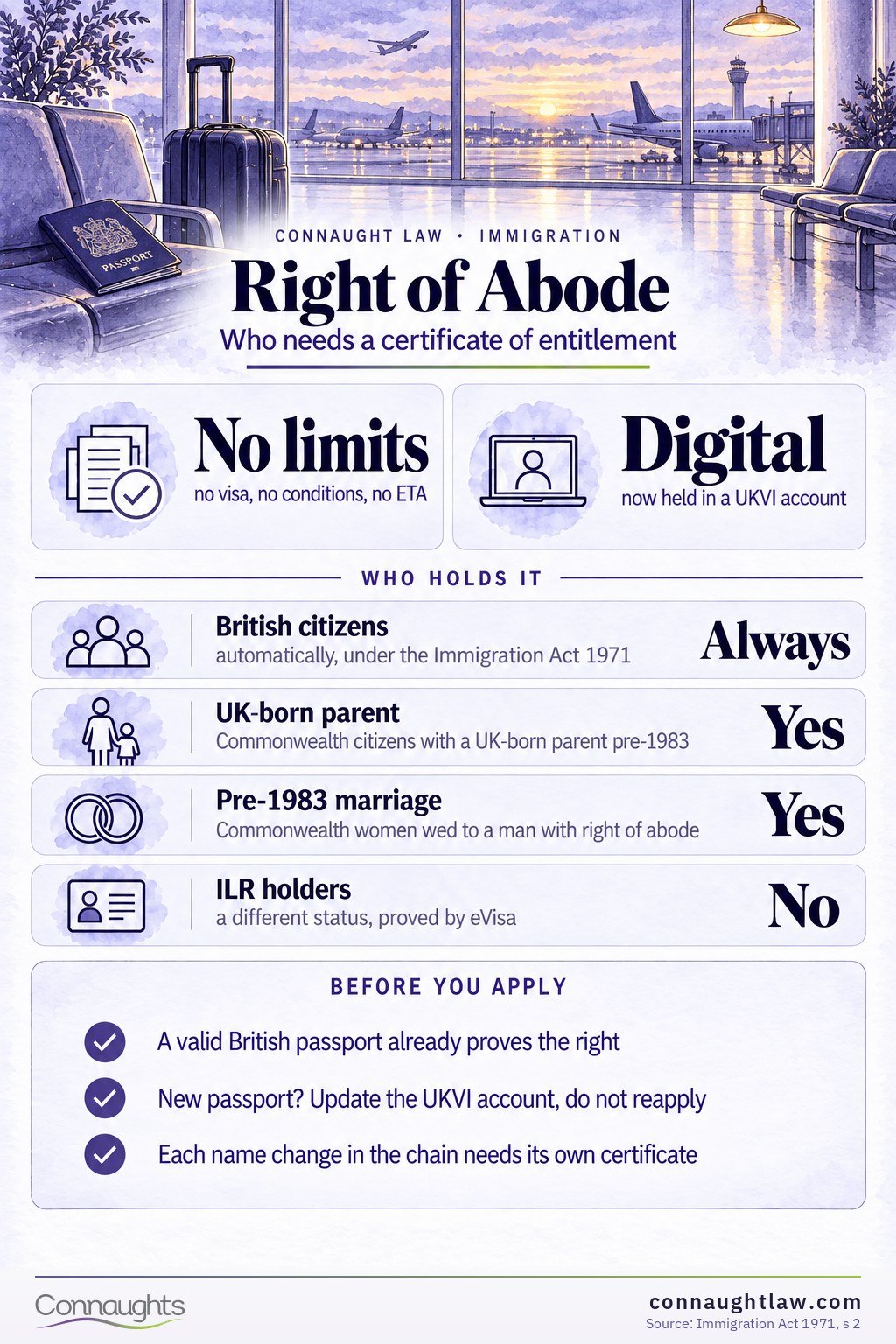
Right of abode is the strongest immigration position UK law recognises — no visa, no conditions, no time limits, no ETA. Every British citizen holds it automatically under section 2 of the Immigration Act 1971, as do a defined class of Commonwealth citizens through pre-1983 rules. The certificate of entitlement exists for the second group and for British citizens travelling on foreign passports: it is not the right itself, only the government's confirmation of it, priced at £589 and now issued digitally.
Who Holds Right of Abode
Beyond British citizens, the surviving qualifying class is narrow and historical: Commonwealth citizens who, before 1 January 1983, had a parent born in the UK, and Commonwealth women married before 1983 to a man who held right of abode. The status had to exist on 31 December 1982 and continue — a person who later ceased to be a Commonwealth citizen lost it. Every application therefore reconstructs a family position as it stood more than four decades ago, which is why the evidence, not the law, decides most cases.
People Who Need the Certificate
Applying Groups and Excluded Groups
- Commonwealth citizens with right of abode through a UK-born parent or pre-1983 marriage — the certificate is their only proof.
- Dual nationals with British citizenship who travel on their foreign passport — a certificate or a British passport, and since the ETA era the choice has real consequences.
- Not ILR holders: indefinite leave is a different status entirely, proved by eVisa, and carries no right of abode.
- Not British passport holders: a valid British passport already proves the right, and a certificate cannot be held alongside one.
The Digital Certificate
What Changed
The certificate has moved from a passport vignette to a digital record in a UKVI account, applied for at £589 through the gov.uk process — with the framework updated by 2026 regulations. The practical wins are real: the old certificate died with the passport that carried it, forcing a fresh fee each renewal, while the digital certificate persists — a new passport means updating the UKVI account, not reapplying. Carriers check status electronically, which makes keeping the passport link current the one maintenance task that matters, exactly as with the wider eVisa system.
Applying and Evidence
Evidence by Category
Commonwealth-parent cases build a documentary chain: your birth certificate naming the parent, the parent's UK birth certificate, and continuity of your Commonwealth citizenship since 1982. Marriage cases add the pre-1983 marriage certificate and the husband's qualifying status. Dual-national British citizens prove citizenship — naturalisation or registration certificate, or the birth-and-parentage chain — plus the foreign passport the certificate will attach to. Name changes across the chain need their own certificates; the standard is a chain a stranger can follow without inference.
Applicants who discover mid-preparation that their real position is ILR or a family status rather than right of abode should pivot early — our family settlement guide and settlement routes guide map those adjacent positions.
Refusal Reasons and How to Avoid Them
Refusals cluster in four places: chains broken by a missing certificate or an unexplained name change; Commonwealth citizenship lost between 1983 and today without the applicant realising the consequence; confusion cases where the applicant's real status is ILR or a citizenship claim rather than right of abode; and holding a valid British passport, which makes the application unnecessary and invalid. The pre-application discipline is diagnosis — establish which status you actually hold before paying £589 to prove the wrong one.
Where the diagnosis points to citizenship instead, our citizenship guidance, the good character requirements and the Life in the UK test become the relevant path; where it points to dual-national travel mechanics, our dual national passport rules guide takes over.
Frequently askedQuestions about certificates of entitlement
What is a certificate of entitlement?
Official confirmation of the right of abode for people who hold it without a British passport — Commonwealth citizens qualifying through pre-1983 rules, and British citizens travelling on a foreign passport. It costs £589 and is now issued digitally.
Do I need a certificate of entitlement if I have ILR?
No — and you could not get one. Indefinite leave to remain is a different status without right of abode; it is proved through your eVisa. The certificate exists only for people who hold right of abode itself.
How does the digital certificate of entitlement work?
The certificate lives in a UKVI account linked to your foreign passport, checked electronically by carriers and the border. When you renew that passport you update the account — the certificate itself continues, with no fresh application or fee.
Who qualifies for right of abode without being British?
Commonwealth citizens who, before 1983, had a parent born in the UK — and Commonwealth women married before 1983 to a man with right of abode — provided Commonwealth citizenship has continued unbroken since 1982.
Can I hold a certificate and a British passport?
No — a valid British passport is itself proof of right of abode, and the rules bar holding both. Dual nationals choose: renew the British passport, or travel on the foreign one with a certificate attached.
How long does a certificate of entitlement take?
Timescales vary with the evidence — clean citizenship-based applications resolve in weeks, while historical Commonwealth chains needing registry searches take longer. Build the documentary chain completely before applying; requests for missing links are the main delay.
Right of abode, citizenship claim, or ILR — the evidence differs for each. Send us the family history and we'll diagnose the status before you pay for the wrong application.
Get Expert Advice