Understanding UK Settlement Routes 2026 and Pathways to Indefinite Leave to Remain
UK settlement routes represent the various pathways through which migrants can obtain Indefinite Leave to Remain, the immigration status granting permanent residence rights without time restrictions on living, working, or studying in the United Kingdom. With the earned settlement consultation having closed in February 2026 and significant policy changes still pending implementation, understanding all available settlement pathways has become essential for anyone planning their long-term future in the UK.
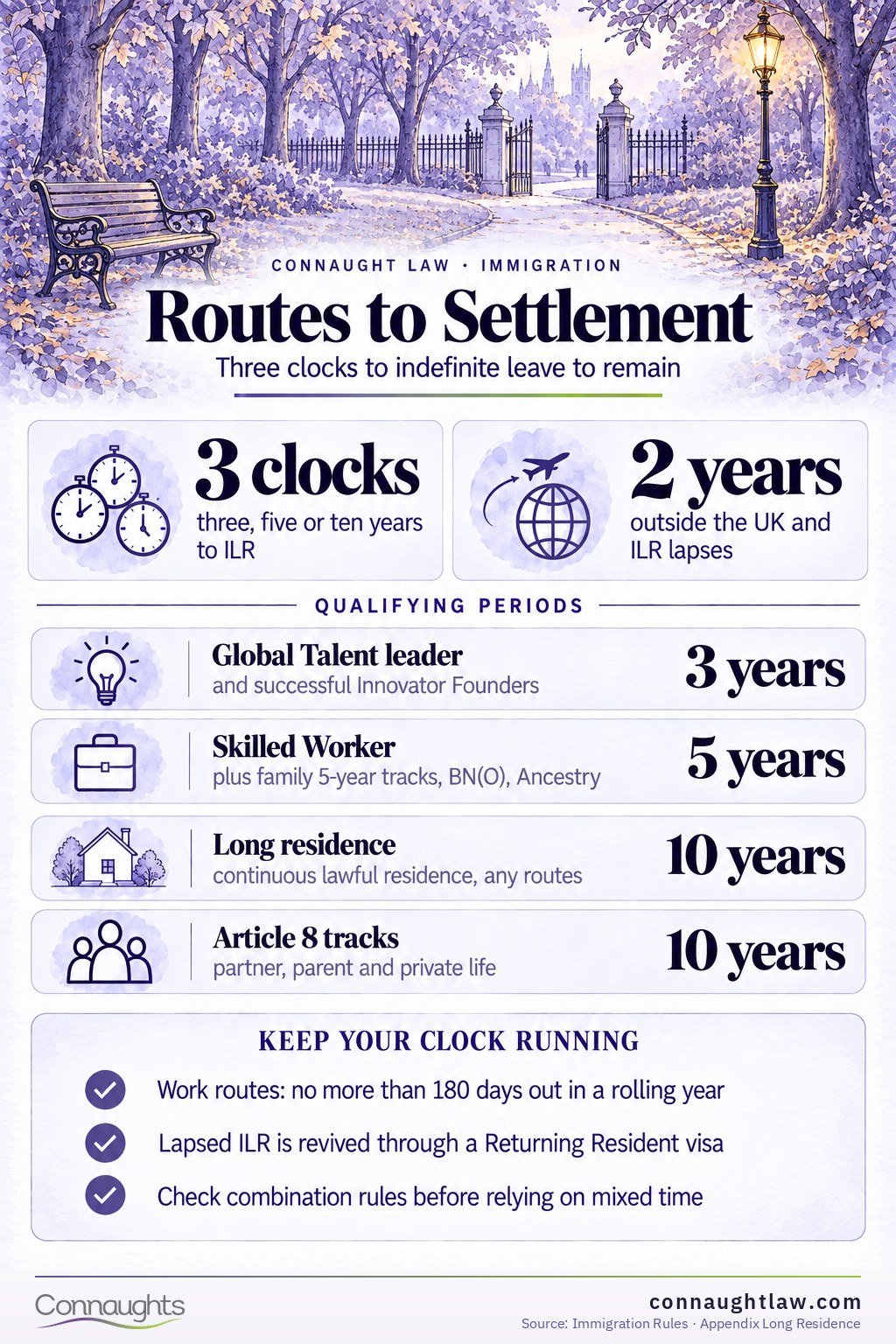
The current UK settlement routes landscape encompasses multiple pathways ranging from accelerated three-year routes for Global Talent and Innovator Founder visa holders through standard five-year pathways covering Skilled Worker, Family, Hong Kong BN(O), and Ancestry visa categories to extended ten-year routes for Long Residence and certain private life applications. Each route carries distinct eligibility requirements, fee structures, and continuous residence obligations.
The proposed shift from time-based five-year qualifying periods to a contribution-based "earned settlement" model with ten-year baseline periods represents the most significant overhaul of settlement rules in decades. Although originally targeted for April 2026 implementation, the government has confirmed changes will now come "later this year," providing a window for eligible applicants to consider their options under current rules.
What Are the Fastest UK Settlement Routes in 2026?
Global Talent Visa Settlement Requirements
Global Talent visa holders endorsed as "exceptionally talented" in science, engineering, humanities, medicine, digital technology, or arts can apply for ILR after three years, while those endorsed as "exceptionally promising" follow the standard five-year pathway. The three-year route applies specifically to migrants endorsed by the Royal Society, British Academy, Royal Academy of Engineering, UKRI, or those granted "exceptionally talented" endorsements from Arts Council England, and individuals whose visas were granted based on prestigious prize eligibility.
Settlement requirements include demonstrating continued activity in the endorsed field, meeting English language requirements at B1 level, passing the Life in the UK test, and maintaining continuous residence with no more than 180 days absence in any rolling 12-month period. Researchers and academics benefit from special provisions where absences linked to professional activities outside the UK are not counted against the 180-day limit under official Global Talent settlement guidance.
Innovator Founder Visa Settlement Pathway
The Innovator Founder visa offers entrepreneurs with innovative, viable, and scalable business ideas a direct three-year pathway to settlement. Settlement eligibility demands demonstrating business success through at least two of seven defined achievement criteria, which may include generating GBP50,000 investment actively spent on the business, creating at least two full-time jobs for settled workers, increasing revenue substantially, or securing intellectual property protection.
Additional requirements encompass maintaining active business management roles, attending mandatory contact point meetings with endorsing bodies at 12-month and 24-month intervals, and obtaining fresh endorsement confirming ongoing compliance and milestone achievement. Students completing UK courses can switch directly to the Innovator Founder route without leaving the country, expanding access to this accelerated settlement pathway for entrepreneurial graduates.
Which Five-Year Settlement Routes Lead to ILR?
UK Settlement Routes 2026 Comparison by Qualifying Period
| Settlement Route | Current Period | Key Requirements | Earned Settlement Status |
|---|---|---|---|
| Global Talent (Exceptional Talent) | 3 years | Active in endorsed field, English B1, Life in UK | Retained at 3 years |
| Innovator Founder | 3 years | Meet 2 of 7 business criteria, fresh endorsement | Retained at 3 years |
| Skilled Worker | 5 years | Continuous sponsorship, salary threshold, English B1 | Proposed 10 years (pending) |
| Health and Care Worker | 5 years | NHS/social care employment, continuous residence | Potential 5-year retention (public sector) |
| Partner/Spouse of British Citizen | 5 years | Genuine relationship, GBP29,000 income, English B1 | Retained at 5 years |
| Hong Kong BN(O) | 5 years | BN(O) status, continuous residence, Life in UK | Retained at 5 years |
| UK Ancestry | 5 years | UK-born grandparent, employment, Commonwealth citizen | Subject to consultation outcome |
| Refugee Status (pre-March 2026 claims) | 5 years | Maintained protection status, no criminality | Retained for existing grant holders |
| Refugee Status (post-March 2026 claims) | 20 years (8 renewals) | 2.5-year "core protection" with periodic review | New framework from March 2026 |
| Long Residence | 10 years | Continuous lawful residence, good character | Proposed abolition |
Skilled Worker Settlement Route
The Skilled Worker visa provides the primary work-based settlement pathway, requiring five years of continuous residence while maintaining valid sponsorship in qualifying employment meeting minimum salary thresholds. Current requirements demand salary meeting the going rate for the specific occupation code or the general threshold of GBP38,700, whichever is higher, though transitional protections apply for workers sponsored before April 2024 salary increases.
From 8 April 2026, sponsors must pay Skilled Workers the full required salary in every pay period rather than averaging over the year. This change gives the Home Office faster visibility of underpayment and could trigger licence compliance audits where payroll anomalies appear. Time spent on qualifying predecessor routes including Tier 2 (General), Health and Care Worker, and certain Tier 1 categories can count towards the five-year qualifying period provided the most recent permission is Skilled Worker at settlement application time.
Family Settlement Routes
Family visa settlement pathways enable partners, spouses, and certain family members of British citizens or persons with ILR to obtain permanent residence after five years. The standard five-year partner route requires maintaining a genuine and subsisting relationship, meeting the GBP29,000 minimum income requirement, demonstrating adequate accommodation, and passing English language requirements at B1 level before settlement. Partners must typically extend their initial 2.5-year visa once before becoming eligible for ILR at the five-year point.
The Immigration White Paper explicitly exempts partners of British citizens from proposed extensions to ten-year qualifying periods, maintaining the existing five-year pathway. However, these applicants would still need to meet new "minimum mandatory requirements" including demonstrating earnings of at least GBP12,570 for three to five years and English language proficiency at B2 level, higher than the current B1 requirement. The family settlement routes guide provides comprehensive coverage of all family-based ILR pathways.
Hong Kong BN(O) and UK Ancestry Routes
British National (Overseas) status holders from Hong Kong can apply for ILR after five continuous years, with approximately 181,609 BN(O) visas granted since the route launched in January 2021. The Labour government's Immigration White Paper explicitly maintained the five-year pathway despite broader proposals extending settlement periods for other routes, recognising Britain's historic obligations to Hong Kong people. BN(O) applicants would still face enhanced "minimum requirements" including the GBP12,570 earnings threshold under proposed changes.
Commonwealth citizens with at least one UK-born grandparent can obtain settlement after five continuous years on the Ancestry visa, one of the most flexible UK settlement routes offering unrestricted work and study rights without employer sponsorship. Unlike Skilled Worker applicants, Ancestry visa holders face no minimum salary thresholds. The earned settlement proposals do not explicitly exempt Ancestry visa holders, meaning this route may potentially face extended qualifying periods under the new contribution-based framework.
How Do Ten-Year Settlement Routes Work?
Long Residence Settlement Route
The Long Residence route enables ILR applications after ten continuous years of lawful residence regardless of specific visa categories held during that period, provided all permissions were obtained within the immigration rules. This route historically served migrants whose visa histories include combinations of study, work, and family permissions that do not individually lead to settlement, allowing aggregation of qualifying time across routes. Stricter absence limits apply with the cumulative 18-month absence limit over ten years requiring careful travel management.
Under the earned settlement proposals, the standalone Long Residence route would be abolished, with the ten-year pathway absorbed into the new baseline model. This represents a significant change for migrants relying on mixed-leave histories. Those currently building towards Long Residence settlement should assess their position and consider whether accelerating applications under current rules might prove advantageous before proposed changes take effect.
Private Life and Family Settlement Routes (10-Year)
Applicants granted leave under private life provisions, particularly those unable to meet financial requirements for the standard five-year family route, may be placed on ten-year settlement pathways requiring 2.5-year renewals before eventual ILR eligibility. These routes apply where removal from the UK would breach Article 8 of the European Convention on Human Rights protecting private and family life. Enhanced suitability requirements apply with stricter criminal conviction thresholds and continuous residence calculations using rolling 180-day absence limits throughout the extended period.
What Is the Current Status of Earned Settlement Proposals?
The Immigration White Paper "Restoring Control over the Immigration System" published 12 May 2025 introduced the proposed shift from time-based automatic settlement to a contribution-based "earned settlement" model. The November 2025 consultation document "A Fairer Pathway to Settlement" detailed the framework including extending baseline qualifying periods from five to ten years for most visa categories, introducing mandatory minimum requirements, and creating adjustment mechanisms based on individual circumstances.
As of April 2026, the government has not published its response to the consultation or laid the necessary immigration rule changes before Parliament. The House of Commons Library analysis confirms that the Home Secretary has indicated changes will happen "later this year" rather than the originally planned April 2026 date. This delay provides continued opportunity for eligible applicants to apply for ILR under existing five-year rules.
Proposed Earned Settlement Framework
Under the proposed framework, settlement eligibility would be assessed against four core pillars: character (no criminality or outstanding government debts), integration (English language at B2 level and Life in UK test), contribution (annual earnings above GBP12,570 for three to five years), and residence (continuous lawful presence). These mandatory requirements would apply regardless of specific visa route, introducing economic contribution requirements where none previously existed for family and private life applicants.
Critically, proposed changes would apply retrospectively to everyone currently in the UK who has not yet obtained ILR, meaning migrants on existing settlement pathways may face significantly extended timelines. Transitional protections are under consultation, but the government's starting position suggests limited grandfathering arrangements. Refugees who claimed asylum before 1 March 2026 retain their existing 5-year settlement pathway under transitional provisions. The official earned settlement consultation documents detail the full framework.
Additional April 2026 Changes Affecting Settlement Pathways
From March 2026, asylum seekers making new claims receive 2.5 years of "core protection" status rather than full refugee status. This leave must be renewed up to eight times over 20 years before settlement eligibility, with each renewal requiring reassessment of whether protection is still needed. Unaccompanied children and those who claimed asylum before 2 March 2026 are exempt from this change. From 26 March 2027, a higher B2 English language standard replaces the current B1 requirement for ILR on most work and family routes.
How Much Does ILR Cost in 2026?
| Fee Component | Cost from 8 April 2026 | Notes |
|---|---|---|
| ILR Application Fee | GBP3,226 per person | Same fee for main applicants, partners, and children |
| Priority Service | +GBP500 | Decision within 5 working days (where available) |
| Super Priority Service | +GBP1,000 | Decision by end of next working day (where available) |
| Life in the UK Test | GBP50 | Booked separately through approved test centres |
| Biometric Enrolment | Free (standard) | Optional premium UKVCAS services may cost extra |
| Immigration Health Surcharge | Not payable | IHS applies only to temporary visas, not settlement |
| Standard Processing Time | Up to 6 months | Complex cases may take longer |
Family applications incur substantial cumulative costs, with a family of four (two adults and two children) paying GBP12,904 in ILR application fees alone from April 2026. Total settlement journey costs including initial visa fees, extensions, and IHS payments over five years frequently exceed GBP25,000-GBP35,000 for families on standard routes. Fee waivers remain exceptionally rare for settlement applications, limited primarily to certain human rights routes where applicants demonstrate destitution.
What Are the Continuous Residence Requirements?
All UK settlement routes require applicants to demonstrate continuous residence throughout their qualifying period. Standard routes allow no more than 180 days outside the UK in any rolling 12-month period during the qualifying years, with absences calculated from UK departure to return dates. Exceeding absence limits causes breaks in lawful leave, potentially resetting qualifying period calculations and requiring additional time before settlement eligibility.
- Standard Absence Limit: Maximum 180 days outside UK in any rolling 12-month period for most five-year routes
- Academic/Research Exemption: Global Talent and Skilled Worker researchers may exclude professional absences from calculations
- Long Residence Limits: Maximum 540 days total over 10 years with no single absence exceeding 184 consecutive days
- Day Counting Method: Only full days outside UK count; travel days partially spent in UK do not count against the limit
- Application Travel Restrictions: Cannot travel outside Common Travel Area during ILR processing
Applicants should maintain detailed travel logs and supporting documentation throughout their qualifying period. Passport stamps, flight records, and employment records help demonstrate compliance. Those concerned about borderline absence calculations should seek professional advice before submitting applications, as refusals based on exceeded absence limits result in losing non-refundable application fees and may affect ongoing visa status.
- - ILR fees increased to GBP3,226 per person from 8 April 2026, with a family of four paying GBP12,904
- - Earned settlement proposals have NOT been implemented despite the original April 2026 target; changes expected "later this year"
- - Current five-year settlement rules remain in force for Skilled Worker, Family, BN(O), and Ancestry routes
- - Three-year pathways for Global Talent and Innovator Founder would be retained under proposed reforms
- - New asylum claimants from March 2026 face 2.5-year core protection status with 20-year path to settlement
- - B2 English requirement replaces B1 for ILR from 26 March 2027 on most routes
- - Skilled Worker sponsors must now meet salary requirements in every pay period from 8 April 2026
Frequently Asked Questions
What are the fastest UK settlement routes in 2026?
The fastest UK settlement routes offer ILR after three years: the Global Talent visa for those endorsed as "exceptionally talented" in science, engineering, humanities, medicine, digital technology, or arts, and the Innovator Founder visa for entrepreneurs meeting business success criteria. Both routes require continuous residence, English language proficiency, and Life in the UK test completion. Under proposed earned settlement changes, these three-year pathways would be retained.
How much does ILR cost in 2026?
The ILR application fee is GBP3,226 per person from 8 April 2026, applying equally to main applicants, partners, and dependent children. Additional costs include the GBP50 Life in the UK test fee and optional priority services (GBP500 for 5-working-day decision, GBP1,000 for next-working-day decision). Unlike temporary visa extensions, ILR applications do not require Immigration Health Surcharge payment. A family of four pays GBP12,904 in ILR application fees alone.
Will UK settlement routes change to 10 years?
The earned settlement consultation proposed extending baseline qualifying periods from 5 to 10 years for most visa categories, but as of April 2026, these changes have not been implemented. The original April 2026 target date has passed without new rules taking effect, and the Home Secretary has indicated changes will come "later this year." Several routes would retain shorter pathways: Global Talent and Innovator Founder (3 years), partners of British citizens and Hong Kong BN(O) holders (5 years), and high earners above GBP50,270 (5 years).
Can I apply for ILR before completing 5 years?
You can apply for ILR up to 28 days before completing your qualifying period. Applying earlier than 28 days before eligibility may result in refusal. You must not travel outside the Common Travel Area (UK, Ireland, Channel Islands, Isle of Man) after submitting your application, as this automatically withdraws the application requiring fresh submission with new fees upon return.
How long can I stay outside the UK with ILR?
Once granted ILR, you can stay outside the UK for up to 2 continuous years before your settled status lapses. If you stay abroad longer, you will need to apply for a Returning Resident visa before re-entering the UK. During the qualifying period before ILR, most routes require no more than 180 days outside the UK in any rolling 12-month period.
Do I need the Life in the UK test for settlement?
Yes, the Life in the UK test is mandatory for most ILR applications, costing GBP50 and requiring booking through approved test centres. Exemptions apply to applicants under 18 or over 65, those with physical or mental conditions making testing impossible, and nationals of majority English-speaking countries for the language component. Settlement applicants must also demonstrate B1 English proficiency, rising to B2 from March 2027, unless qualifying for English language test exemptions.
What happens if my ILR application is refused?
ILR application fees of GBP3,226 are non-refundable if refused after biometric enrolment. Depending on circumstances, you may receive limited leave to remain instead, face curtailment of existing visa, or need to submit fresh applications addressing refusal reasons. Administrative review may be available for certain refusal types. Refused applicants should seek professional legal advice promptly, as refusals can affect ongoing immigration status and future applications.
When can I apply for British citizenship after ILR?
You can apply for British citizenship through naturalisation 12 months after obtaining ILR, provided you meet residence requirements (not absent more than 450 days during the 5 years before application, nor more than 90 days in the final year), good character requirements, and pass the Life in the UK test. If married to a British citizen, you may apply immediately upon receiving ILR. Citizenship application costs GBP1,709 plus GBP130 ceremony fee from April 2026.
Expert UK Settlement Guidance
Settlement Route Assessment
Comprehensive evaluation of all available ILR pathways based on your visa history, qualifying period status, and eligibility requirements ensuring optimal route selection for your circumstances
Application Preparation
Complete documentation review, absence calculations, supporting evidence coordination, and application submission ensuring compliance with all Home Office requirements under updated April 2026 fees
Policy Change Guidance
Strategic advice on timing considerations, earned settlement implications, and transitional protection planning helping you navigate proposed Immigration White Paper changes before implementation
UK settlement routes face the most significant changes in decades with the proposed earned settlement framework potentially extending qualifying periods from five to ten years for most visa categories. While April 2026 has passed without implementation, changes are expected later this year, making strategic timing of applications essential.
With ILR fees now at GBP3,226 per person, a higher B2 English requirement arriving in March 2027, and new per-pay-period salary compliance obligations for Skilled Worker sponsors from April 2026, professional guidance ensures applications meet all current requirements while anticipating forthcoming policy shifts.
For expert guidance on UK settlement routes, contact Connaught Law's specialist settlement and citizenship team. Our immigration experts provide comprehensive support across all ILR pathways, from eligibility assessment and documentation preparation through application submission and policy change navigation.