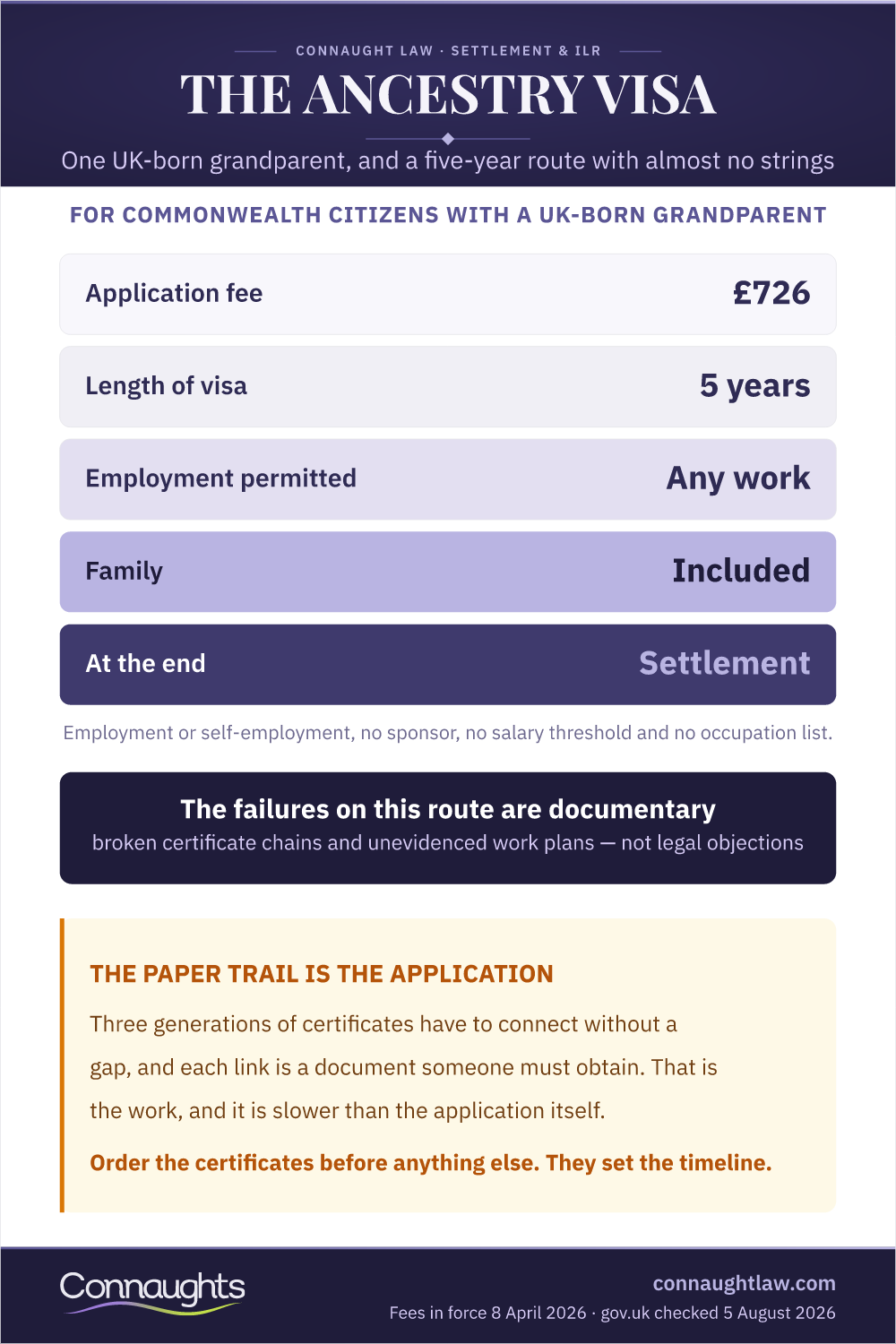
One UK-born grandparent gives Commonwealth citizens a five-year working visa with almost no strings: £726, any employment or self-employment, family included, and indefinite leave at the end. The route's failures are documentary — broken certificate chains and unevidenced work plans — not legal. This guide covers who qualifies, the grandparent rule, the evidence that carries applications, working rights, and the path through ILR to British citizenship.
On This Page

A Grandparent's Birthplace as a Visa
One grandparent born in the UK, the Channel Islands, the Isle of Man or pre-1922 Ireland opens a five-year working visa to Commonwealth citizens aged 17 or over. Nationality gates the route absolutely: the qualifying citizenships are listed, however strong the ancestry. Beyond that, the route fails on evidence rather than law — an unevidenced intention to work refuses more applications than anything else, and the ancestry needs an unbroken chain of certificates.
Eligibility
Nationality Requirements
Who Qualifies by Nationality
The Ancestry visa is for Commonwealth citizens aged 17 or over — Australians, Canadians, New Zealanders and South Africans dominate the caseload — with eligibility extending to British overseas citizens, British overseas territories citizens, British nationals (overseas) and Zimbabwean citizens. It is a nationality-gated route: US citizens with British grandparents do not qualify, however strong the ancestry, and their realistic alternatives run through the routes in our Americans moving to the UK guide.
The Grandparent Rule
One grandparent — by blood or legal adoption — must have been born in the UK, the Channel Islands or the Isle of Man, with births in what is now the Republic of Ireland counting where they predate 31 March 1922. Step-relationships do not qualify; parents' and grandparents' marriages need not have been formalised where the bloodline is proved. The claim runs through birth certificates, not family lore, which decides how these applications are actually built.
Documents and Evidence
- Full birth certificates for you, the linking parent and the UK-born grandparent.
- Marriage, adoption or name-change certificates wherever names shift across the chain.
- Work intention evidence: offers, applications, registrations or a business plan.
- Maintenance evidence: savings, budget and accommodation plans.
- Passport, TB certificate where required, and dependants' documents reconciled to yours.
The Certificate Chain
Three generations of full birth certificates — yours, the relevant parent's, the grandparent's showing the qualifying birthplace — plus marriage or name-change certificates wherever names shift between documents, and adoption orders where the link is adoptive. Order missing certificates from the UK's General Register Office early: registry lead times, not visa processing, set most applicants' real timetable.
Work Intention Evidence
You must intend and be able to work in the UK — the requirement that refuses more ancestry applications than any other. Evidence intention concretely: job offers or applications in progress, a CV matched to the UK market, professional registrations transferred, or a credible self-employment plan. Retirees cannot meet it; semi-retired applicants need genuine part-time work plans, honestly evidenced.
Maintenance Standards
No fixed figure applies — you must show you can support and house yourself (and dependants) without public funds until the work begins: savings, the first months' budget, and accommodation plans. The open standard rewards a coherent financial story over any particular balance.
Working Rights
Unrestricted Permission
What You May Do
Work for any employer, switch jobs freely, run a business, freelance, study alongside — the Ancestry visa carries the broadest permissions of any five-year work route, with no sponsor, no salary threshold and no occupation list. The only standing conditions are the usual pair: no public funds, and maintain the residence that settlement will later require.
Timeline and Extensions
After the Five Years
Entry clearance runs to the three-week standard from biometrics, and the visa is granted for the full five years. Most holders go straight to settlement at the five-year mark; those not yet ready — absences over the limits, or timing preferences — can extend on the same terms and settle later, since the route has no maximum stay.
Route to ILR
Settlement Requirements
ILR after five years requires continuing to meet the route's requirements — including the work requirement across the period — plus the 180-day absence discipline covered in our absence rule guide, English at B1 and the Life in the UK test. The application costs £3,226, decides within the six-month settlement standard, and keeping employment records across the five years is what makes it straightforward; the all-routes context sits in our settlement routes guide.
Citizenship
Naturalisation Requirements and Costs
The Route to Citizenship
Twelve months after ILR — or immediately on marriage to a British citizen — naturalisation follows at £1,839 including the ceremony, on the residence, good character and knowledge requirements. For ancestry holders the full arc runs six years from arrival to a British passport, restoring in one generation the citizenship the family line stepped away from; our settlement and citizenship team runs both stages.
Refusal Reasons
Work Intention Weaknesses
The classic refusal: an applicant who plainly qualifies by ancestry but files nothing showing they intend to work — no applications, no plan, a CV last updated years ago. The requirement is forward-looking and evidential; treat it as the application's centrepiece rather than a checkbox.
Documentary Chain Gaps
Missing generation-linking certificates, name changes unexplained between documents, and reliance on short-form certificates that omit parentage — each breaks the chain the caseworker must be able to follow. Full certificates, ordered early, close every gap that matters.
Financial Evidence Failures
Thin savings with no budget, or funds that appear untraceably before filing, invite refusal under the maintenance requirement even where ancestry and work plans are strong. Three months of ordinary statements and a settling-in budget answer it.
Dependants and Costs
Total Cost Analysis
Partners and children under 18 join at £726 each, with the health surcharge — £1,035 a year per adult, £776 per child — the dominant cost line: a family of four's five-year surcharge runs well into five figures, payable upfront. Dependants take the same broad work and study rights, settle on the same clock, and the family's applications should be reconciled line by line before any of them is submitted; our family visa team coordinates the multi-applicant filings.
Frequently askedQuestions about the Ancestry visa
Who qualifies for a UK Ancestry visa?
Commonwealth citizens (plus British overseas citizens, BOTCs, BN(O)s and Zimbabweans) aged 17 or over with a grandparent born in the UK, Channel Islands, Isle of Man — or pre-1922 Ireland — who intend and are able to work in the UK.
How much does the Ancestry visa cost in 2026?
£726 per applicant plus the health surcharge of £1,035 a year for adults (£776 for children) — £5,175 across the five years for each adult. Settlement later costs £3,226 and naturalisation £1,839.
Do step-grandparents count for the ancestry requirement?
No — the link must be by blood or legal adoption. Adoptive chains qualify with the adoption orders evidenced; step-relationships and informal arrangements do not, however long-standing.
Can I retire to the UK on an Ancestry visa?
No — the route requires a genuine intention and ability to work. Semi-retirement with real part-time work plans can qualify; a plan with no work in it fails the core requirement.
Does the Ancestry visa lead to ILR and citizenship?
Yes — ILR after five years (work requirement maintained, absences within 180 days per rolling year, English and Life in the UK passed), then naturalisation twelve months later. Arrival to British passport runs about six years.
Have the Ancestry visa rules changed recently?
The route's structure is stable; what moves are fees, the surcharge and settlement policy generally — including the earned settlement proposals, which remain consultation-stage. Check current figures at application and keep work records with settlement in mind.
Send us the family chain and your work plans. We'll confirm the qualifying line, order the missing certificates and build the intention evidence that carries these applications.
Get Expert Advice