
The 180-day rule decides more ILR applications than any other single provision: no more than 180 days outside the UK in any rolling 12-month period of your qualifying years. The calculation is stricter than most applicants assume, the rolling window catches trips a calendar-year count would miss, and dependants have their own version. This guide covers the counting method with worked examples, the excused-absence categories, evidence, and timing your application.
On This Page
The Rule That Counts Every Trip
Appendix Continuous Residence sets the modern test for work-route settlement: not more than 180 days' absence in any 12-month period across the qualifying years, assessed on a rolling basis rather than by calendar or visa year. The design catches patterns the old fixed-year counting forgave — a long absence straddling two calendar years now lands in a single rolling window — and the ILR framework applies it with little discretion. Mastering the count early is cheaper than discovering an overshoot in year four.
Counting the Days
Manual Calculation Rules
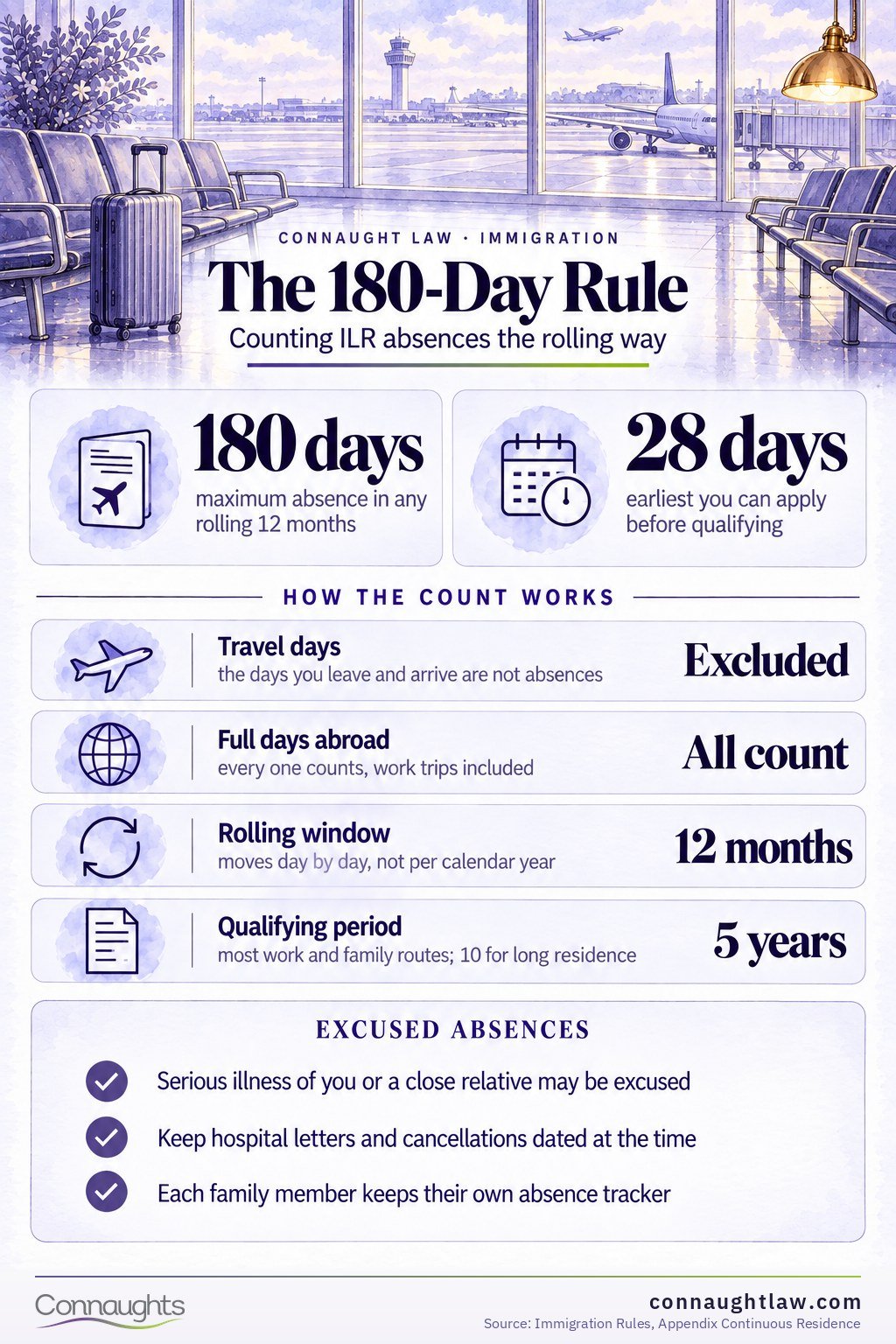
The mechanics favour the traveller in one respect only: the days you leave and arrive do not count as absences — a Friday-to-Monday trip costs two absent days, not four. Everything else is strict: every full day outside the UK counts whatever the reason, work trips included, and "absence" means absence from the UK, not from your job.
The Rolling 12-Month Window
Worked Examples
Take a worker with 100 days away in autumn 2025 and 100 more in summer 2026. Calendar years show 100 each — apparently safe. The rolling test draws a 12-month window from October 2025 to September 2026 capturing both trips: 200 days, and a failed requirement. The discipline that follows: before booking any long trip, count backwards 12 months from its planned end date and forwards 12 from its start, and keep both windows under 180.
Tracking Absences
A Personal Absence Tracker
Build the spreadsheet on day one of the qualifying period: departure date, return date, full days absent (excluding both travel days), reason, and evidence held. Add a rolling-window column that sums absences in the 365 days ending on each return. Passport stamps are disappearing as borders digitise, so the contemporaneous record — with boarding passes and tickets retained — increasingly is the evidence.
Dependant Rules
Family Members' Own Counts
Partners of work-route migrants face the same 180-day test on their own travel for leave granted since the rule extended to dependants — a trap for the partner who spends long periods in the home country while the main applicant works in the UK. Children are treated more flexibly, and partners on the family routes under Appendix FM are assessed differently again — through the relationship and residence requirements handled by our family visa team rather than a day-count. Every settling family member should keep their own tracker; the main applicant's compliance rescues nobody else's.
Qualifying Period Calculation
Current Rules Against the Proposals
Where the Law Stands
The rules in force remain: five years for most work and family routes, ten for long residence, with the 180-day rolling test governing work-route absences. The white paper's ten-year "earned settlement" standard stays a closed consultation with no rules made — plan on current law, and apply promptly once qualified.
Counting the Qualifying Years
Recent Route Changes
The qualifying clock runs from entry on the route (or the grant of permission where later) and can combine defined routes — Skilled Worker time with other sponsored work, per the rules for each combination. Long residence runs its own two-regime absence framework, covered in our 10-year long residence guide, and the Skilled Worker specifics — including the settlement requirements beyond absences — sit in our Skilled Worker settlement guide.
Application Timing
The 28-Day Window
ILR can be filed up to 28 days before the qualifying period completes; earlier filings are refused with the fee lost. The optimal sequence: fix the completion date precisely from your grant history, audit the absence tracker in the preceding quarter, book the English and Life in the UK tests early, and file at the window's open edge — with the £500 priority or £1,000 super priority services reserved for files with nothing to check twice.
Excused Absences
Evidence by Category
Absences beyond 180 days can be excused where serious and compelling: your own or a close relative's serious illness, natural disasters and travel restrictions, and postings the rules specifically protect. The evidential standard is contemporaneous documentation — hospital letters, airline cancellations, employer confirmations dated when it happened. Assembling it retrospectively is where excusable cases fail; where a refusal has already landed on absence grounds, our appeals team assesses the challenge, and our settlement team and business immigration team plan around the rule before it bites.
Frequently askedQuestions about the 180-day rule
How does the ILR 180 days rule work?
You must not exceed 180 days outside the UK in any rolling 12-month period of your qualifying years. The window moves day by day — it is not a per-year or per-visa allowance — and every full day abroad counts toward it.
Do travel days count as absences?
No — the day you leave and the day you return both count as days in the UK. A trip's absence count is the full days between them, which makes precise dates worth recording for every journey.
Does the 180-day rule apply to my dependants?
Partners on work routes face the same test on their own travel for the modern grants of leave; children are treated more flexibly, and Appendix FM family routes use a different residence assessment. Each settling family member needs their own count.
What happens if I exceeded 180 days in one window?
The absence can be excused where the reason was serious and compelling — illness, disasters, travel bans — and documented from the time. Otherwise the qualifying period restarts from re-entry, however painful the arithmetic.
How early can I apply for ILR?
Twenty-eight days before your qualifying period completes. Apply earlier and the application is refused; apply at the edge with the absence audit already done and the tests passed, and the six-month standard starts as soon as the rules allow.
Is the qualifying period changing to 10 years?
Proposed, not enacted — the earned settlement consultation has closed without rules being made. Current five-year routes stand, which argues for prompt applications from anyone already qualified rather than waiting into an uncertain regime.
Send us your travel history — even the rough version. We'll run the rolling calculation properly, flag any window at risk, and time the application to the safe side of it.
Get Expert Advice